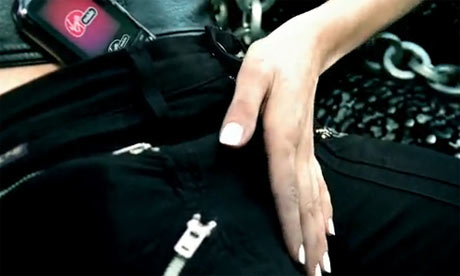
READ THIS: Anna Pickard’s review of Gaga’s latest production-laden video says it all. Pickard uses screenshots and the driest of commentary.

“Lady Gaga has out-sexied the entire world and for this crime she’s landed in a semi-nudist jail. Luckily she has a well-known brand of mobile, and her friend Beyoncé, on hand to help,” says Pickard.

“In minute four this happens, Gaga touching herself, wrapped in police tape in a medium to maximum security prison … and that’s intercut with pics of her planning her escape with the help of some really high-profile product placements.”

PRISON PHONES

Apart from the ridiculous fetishistic portrayal of jail, the violent skirmish greeted with laughs and the sell-out crotch-rub, the most offensive thing about the video is Gaga’s frustration at the phone line breaking-up.

Families across the United States have been fighting legal battles to break up the monopoly and racket that is prison telephone contracts. You can sign a petition here against MCI/Global Tel Link.

Unfortunately, many lawsuits have fallen away, but as the New York Times reported last November the public attention of lawsuits has brought about significant reform and lowered prices in a “terribly unfair system.”

I’m not saying that prison or jail inmates and families would necessarily be offended by a multimillion-dollar-pop-thing using a failing jail payphone as a prop for her next breast-thrusting million, I am saying that I am.

PRISONS IN MUSIC VIDEOS

This is not the first time I’ve been confused with popstars appropriating prisons for their music videos. Michael Jackson put on the full crotch-grabbing show in a prison chow-hall for his video They Don’t Really Care About Us.

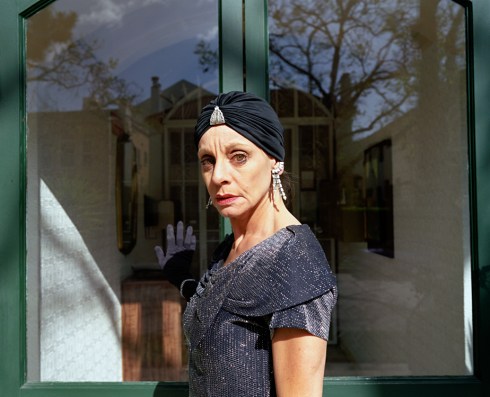
Sharon at the front door. Simone Lueck

CRITICAL MASS: 593 entrants, over 200 jurors, 181 shortlisted photographers, 50 finalists, 6 contenders, 2 eventual book deals.

For months, the Critical Mass jurors nudge and judge portfolio across the internet casting their opinions by way of prescribed digits – NO (0), YES (1), MEGA-YES (3), WOW (7). It’s numbers-gymnastics.

The 36,000 scores are then thrown into a big statistics cauldron and Shawn Records, one of CM’s organisers informed us back in November that the difference between the “lowest score on the list and the highest one that didn’t make the cut was just 0.01314411684.”

Down at the Photographic Center Northwest, Seattle the scores and calibration tables are forgotten as each of the Top50 winners is represented by a singe print chosen by juror Andy Adams of FlakPhoto.

RUNNERS AND RIDERS

The Top50 have been online for three months now. The names in the show are likely familiar, but the chosen prints possibly not. In some cases the anointed print on show didn’t satisfactorily deputize for the complete portfolio, and in other cases the strength of a single print was spur for a second glance at a portfolio.

Simone Lueck’s  Sharon at the front door was a stand-out print, as garish and perky as the subject’s make-up. Sharon holds your stare as the direct sunlight degrades her skin by the second. “Let me help you with that door” I urged, worried for the integrity of the l’Oreal face-goop.
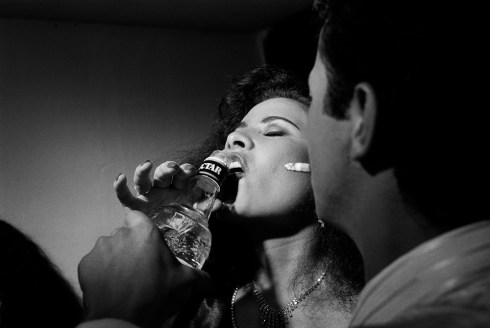
Aguardiente shots backstage at the beginning of the Miss Light pageant, Mesitas del Colegio, Colombia. Carl Bower

Women and the politics of appearance featured strongly throughout. Carl Bower’s project Chica Barbie examines the beauty pageant phenomenon of Colombia placing the contests within the context of the country’s pervasive violence; pageantry as escapism.

Bower’s work compresses pride, anxiety, routines, achievement and exploitation, but never casts aspersions upon this particular cultural more. Bower’s even-handedness presumably stems from his photojournalist background.

Bradley Peters’ print was banished to the stairwell, yet his work is strong enough to endure. Earlier on the night of opening, PCNW gallery director Ann Pallesen described juror Andy Adam’s FlakPhoto project as “off-kilter” – Peters is perhaps the best proponent of that look. Peters constructs scenes that so flauntingly blur art and documentary the viewer is hooked. I was befuddled last year when Peters came on the scene.

I liken Peters to Crewdson but without the six-figure budget; perhaps Crewdson on Valium. Peters also won the Conscientious Portfolio Competition, 2009.

© Bradley Peters

Ponce. Ellen Rennard

Also on the stairs, Ellen Rennard. Let me tell you, I generally don’t care for pictures of aninals but Rennard is the type of special talent to get my stubborn eyes seeing again. The runners and riders in the stables are partners, total equals. Respect runs through this series from photographer to subject, man to mammal. Rennard’s work is as compelling as any documentary portrait project I’ve seen in the past two years.

Dead dogs anyone? No, how about dead cats then? Mary Shannon Johnstone cares deeply enough about animal welfare and responsible stewardship that she went inside a North Carolina euthanasia clinic. Breeding Ignorance is a view we’ve not seen before and it may not be one you want to see again such is the visceral rendering of matted fur, stiff eyelids and garbage-headed biomass.

Cats Disposed. Mary Shannon Johnstone

Tree, Boston Public Garden, 2009. Pelle Cass

Talking about fur, Pelle Cass specializes in composite images of frantic activity, human and animal. The print from Selected People chosen for this show depicts a tree covered in scores of pudgy, russet squirrels surrounded by less fat humans and a flutter of birds in various stages of take off and perch. Cass’ work made me laugh, which is always a good sign.

Jane Fulton Alt’s portfolio Burn series is delicate but underwhelming if isolated. Fortunately, it is not isolated in that Fulton Alt has followed up on previous work with great intelligence. In 2005, Fulton Alt worked as a social worker in the aftermath of Hurricane Katrina. At dusk she’d document the ruined city. Burn series continues the same washed out grey of her Katrina series Look and Leave, only here it is smoke and not the “toxic, metallic air” of New Orleans. Fulton Alt observed upper respiratory problems among post-Katrina survivors and it as if this work is a lingering acknowledgement of legacy complications after the fact. Disasters are never just natural or man made but always a spiteful conflagration of the two … the air needs to clear … the dust needs to settle … the poisons sometimes burn slow.

Burn No. 81. Jane Fulton Alt
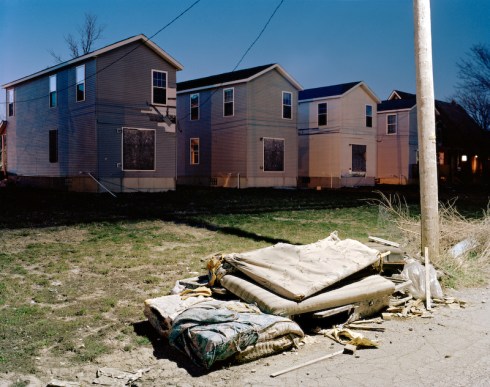
Alley Behind Ferris St. © Will Steacy

I really enjoy Will Steacy’s politic (his blog rants are a breath of fresh air) and he seems to be one of the hardest working photographers out there. The chosen print was luminous. However, I get the impression that Steacy only cares about these streets in as much as the debilitating effect they have on their inhabitants and itinerants. I’d have like to have seen one of his figure studies.

Manuel Capurso and Samar Jodha both pierced the darkness with portrait studies. Capurso’s chiaroscuro isolates his subjects and communicates the loneliness of life’s latter stages. Jodha literally spotlights the Phaneng people with whom he has lived for four years; they are a people on the verge of extinction and he has photographed every member of the 1,500 deep tribe. Both artists were effective.
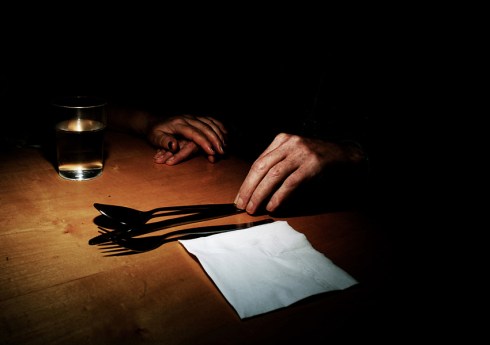
Untitled. © Manuel Capurso

Phaneng 1. Samar Jodha

Alejandro Cartagena was one of the two book award winners this year and I wouldn’t argue with the selection; he is doing immensely important work about mass-suburbanisation/social-housing projects in Mexico. However, I would argue for the case of half a dozen prints from his portfolio before the one chosen for this show.

David Taylor and Victor Cobo are also engaged in important inquiries both probing issues of immigration and policing, family and place. In each case though, the print did neither of their theses any favours. Cobo’s print was bright and with humour but, without context, it receded quickly from memory. Taylor’s print was large and empty but perhaps that was the point to suggest the illegal immigrants as helpless, lost and losing agency?

Definitely spend time with Cartagena, Taylor and Cobo’s online portfolios as I think they are three vital political thinkers in photography. Perhaps that was the problem, my hopes for the print were too high ?…

Mi Abuela, México, 2003 © Victor Cobo

Untitled © Ed Freeman

Up until last Friday, Joni Sternbach had single-handedly carried the genre of surf photography. She now has Ed Freeman to help her with the load. Generally, I dislike pictures of surf (bar the odd Friedkin print) as much as I dislike pictures of animals, but Ed Freeman’s print really stood out. His online portfolio is as balanced too. Definitely the surprise of the evening.

Finally, leaving the best to the last, Andrea Camuto’s print romped home with the win in the ‘gut-punching-and-my-world-is-better-informed-for-seeing-this’ category.
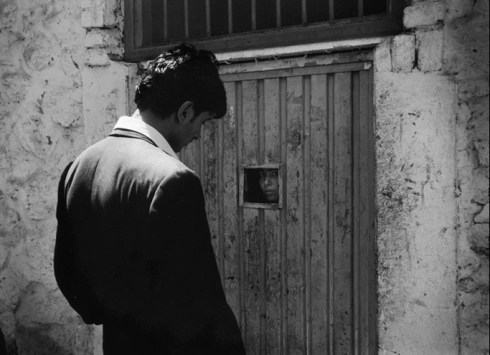
Visitation, Waleyat woman's prison, Afghanistan © Andrea Camuto

Camuto is interested in the needs of families to survive as they have migrated in and out of Afghanistan and in and out of the capitol Kabul in bids to find livings.

From Camuto’s statement, “Feeling great compassion for their struggles, I was compelled to return several times, most recently in 2009. As my ties with these families deepened, I followed them into such places as the women’s hospital and the women’s prison. Each trip furthered my understanding of the political and social complexities of Afghan culture. Entrenched attitudes, coupled with rampant illiteracy, create the oppressive conditions under which Afghan women are forced to live. In these photographs I call attention to these ordinary Afghans, who go unnoticed and unrecorded in the larger narrative of the conflict in Afghanistan today.”

While the chosen print is a literal depiction of enclosure, the house arrests and claustrophobic hardships of rural life as portrayed in Camuto’s work bring a heavier weight to bear on the viewer. Camuto’s is the latest in a slew of projects I’ve seen recently coming out of the AfPak region that don’t depict military engagement. These personal struggles, significantly, are dictated by larger political and infrastructural battles currently being fought in Afghanistan.

The helplessness served up in Camuto’s work is bitter blow and one that lasts.

– – – – –

EXPOSED: CRITICAL MASS will be on show at the Photographic Center Northwest, 900 12th Avenue, Seattle, WA 98122 until the 18th May.

Last week Joerg linked to Sometimes the Photographer’s Name Simply Doesn’t Matter with the words “Great post”.

Today, I return the sentiment. Why We Must See. Great post.

Great, partly, because it is straightforward, “I know quoting Susan Sontag is the thing to do when writing these kinds of articles, but I’ll try without. I don’t think I’m smarter than her (that’s very unlikely), but I want to see where I will be getting without using intellectual crutches.”

War wounds: Don McCullin on photography. The acclaimed frontline photojournalist speaks about the horrors of conflict, struggling with ‘this terrible name, war photographer’, and why shooting landscapes instead of battle zones has finally granted him a sense of peace.

WELL SAID MR McCULLIN

My post, Staring at Death, Photographing Haiti got a lot of attention. It was a simple format – an extensive collection of links to online photography coverage of Haiti. It was posted a week after the earthquake and very soon after was out of date.

It may have been apparent from my other posts on Haiti [1, 2, 3, 4, 5] that I appreciated words alongside images.

I was grateful for the interviews by the New York Times of Damon Winter, Maggie Steber and Daniel Morel.

Well, add Lynsey Addario to that list.

Even Orphanages Spawn Orphans in Haiti is the type of approach and reflexivity I admire in journalism. It is a great salve to the overly-anxious who worry that photojournalism has lost it’s soul.

Of course, I have a few buddies who’d insist that Haitian voices be heard also, so I don’t want to suggest that PJ audio interviews are the crowning point of crisis reporting – they obviously aren’t but they are a necessary component.

To hear the photojournalist’s voice and responses to their subject reminds us that photographers are not camera-wielding automatons operating in vacuums.

Screengrab

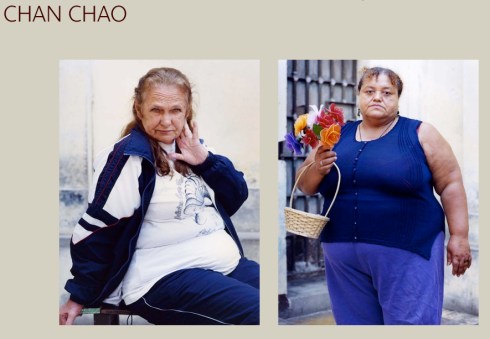
Chan Chao‘s portraiture is about the intimate moment he allows the viewer with his subject. For Chao portraiture is “communication through body language and facial expression.”

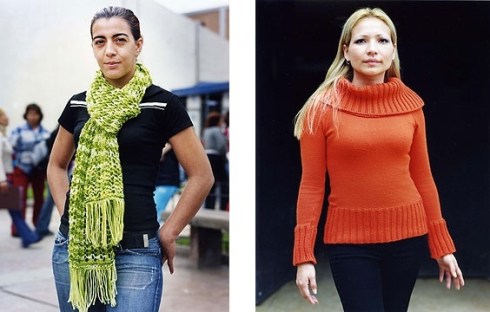
Santa Monica features the women of Santa Monica Prison, Lima, Peru. The prison is recognised as the site of detention for women caught and implicated in drug smuggling activities. There are dozens of foreigners from all over the globe. Santa Monica Prison contains an unusually diverse convergence of lives, stories and needs.

Not just in Santa Monica but in all his series, Chao intersperses his portraiture with environmental studies and in so doing expresses the inescapable strong-arm of military, government and judiciary.

In the portrait studies, Chao deliberately deemphasises the background; backdrops are evocative but not descriptive. The women of Santa Monica Prison are thus gifted something quite precious by Chao, their stage for a moment, and individual acknowledgment outside of a carceral context.

Two portraits from the 'Santa Monica Prison' series. © Chan Chao

Chao is well known for his nude studies for Echo, and his three-trip project to the border camps of Burma, his country of birth (See Chao describe his Burma project). Cyprus, again, reverently, deals with the portrait sitter.

All of Chao’s series should be viewed; together they create an winsome cloud of emotional sound. Wrap yourself up.

BIOGRAPHY

Chan Chao (born 1966 in Kalemyo, Burma) is an American photographer known for his color portraits. He and his family left Burma for the United States in 1978. Chao studied under John Gossage at the University of Maryland, College Park. When he turned 30, Chao decided to visit Burma for the first time since his family left but was denied a Visa. Instead, he travelled to the Thai-Burma and Indian-Burma borders where he photographed Burmese rebel and refugee camps. These images comprise his books Burma: Something Went Wrong and Letter from PLF, both published by Nazraeli Press. Nazraeli also published Chao’s book of female nudes entitled Echo. His Burma portraits were included in the 2002 Whitney Biennial. Chan Chao lives in the Washington, DC area. He teaches photography at George Washington University.

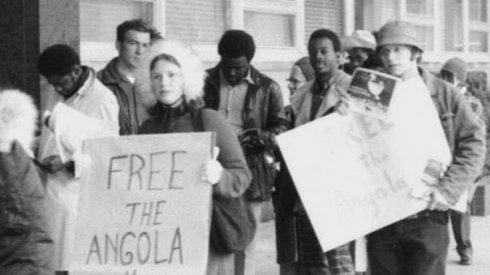
There is a place in the US where two men have been held in solitary confinement for 37 years. It is Angola Prison, Louisiana.

Robert H. King, one of the Angola 3 was released when his wrongful conviction was overturned in 2001. Herman Wallace and Albert Woodfox remain.

The length of their stays in solitary are due to the seriousness of the crime for which they were charged – the murder of a prison guard. They have always maintained they were framed for the jailhouse murder. Interestingly, in the In The Land Of The Free trailer the correctional officer’s widow doesn’t believe Wallace or Woodfox were the killers.

MENTAL HEALTH IN SOLITARY

For the most visceral and psychological description of solitary confinement upon the mental and physical health of a human read Atul Gawande‘s vital New Yorker article HELLHOLE (March 2009).

Every wondered what effect isolation has on the human psyche?

Craig Haney, a psychology professor at the University of California at Santa Cruz, received rare permission to study a hundred randomly selected inmates at California’s Pelican Bay supermax, and noted a number of phenomena. First, after months or years of complete isolation, many prisoners “begin to lose the ability to initiate behavior of any kind—to organize their own lives around activity and purpose,” he writes. “Chronic apathy, lethargy, depression, and despair often result. . . . In extreme cases, prisoners may literally stop behaving,” becoming essentially catatonic.

What a crazy world with inexplicable institutions.

‘IN THE LAND OF THE FREE’ STILLS

Solitary cell

Herman Wallace (left) and Albert Woodfox (right) with Angola prison in the 1970s (background)

Photos from the In The Land Of The Free facebook page.

Susan Wright. © Matthew Rainwaters

Matthew RainwatersOffender, an assignment for Esquire and Texas Monthly, depicts “two very different inmates inside the Texas Department of Corrections.”

The first is some bloke with a history of fraud and a penchant for escape.

I am more interested in juxtaposing Rainwaters’ portraits of a husband-killer and the prosecution attorney.

LADIES

Susan Wright was convicted of murder after stabbing her husband 193 times. She was recently granted an appeal and may be released after re-sentencing.

Prosecuting attorney Kelly Preistner doesn’t buy the battered woman’s syndrome defense. During closing arguments she reenacted stabbing her assistant 193 times for the jury.

Kelly Priestner. © Matthew Rainwaters

COMMERCIAL PHOTOGRAPHY

Generally, I don’t know what to make of commercial work and portraiture done inside prisons. I think I’ve only featured it once before on Prison Photography with a nod to Andrew Hetherington’s work for Wired on a story about cell phones and security breaches.

Evidently, Rainwaters’ is motivated to go beyond the requirements of assignment; he’s got the prison photography bug!

In an interview over at electronic beats he describes the fortune of the two stories coming at once, but that they catalysed a body of work upon which he wants to expand:

The [Offender] series came to life when a writer that I’ve worked with, Alex Hannaford, called me to shoot a story he was doing. It was on Steven Russell a former con man and escape artist. Later Texas Monthly was doing a feature on Susan Wright, so Skip Hollandsworth, the writer, and I went out to get the story. After shooting those two features I had a body of work that I really want to continue, that was the start of the portfolio.

Rainwaters goes onto explain he hopes to photograph at Guantanamo. This leap is remarkable. I would not expect a commercial or editorial photographer to make such a transition. For me it stands to reason that one discusses Guantanamo and illegal US prisons in the same context as homeland penitentiaries, but I don’t expect others to always hold the same opinion. That a photographer is pressing this line is intriguing.

I’ll be eager to show Rainwaters’ Guantanamo work when it surfaces.

– – –

You can also see the selection of Rainwaters’ work at Behance.

Thanks to Scott for the tip.

EMAIL

prisonphotography [at] gmail [dot] com

Prison Photography Archives

Post Categories