I have kept well away from the cyclical discussions about pay-walls, introductory charges, donation buttons, ad revenues etc.

I simply don’t have the experience of publishing industries necessary to predict the futures of words and images across all media.

It is challenging to say something succinct in a cacophony of well-informed professional and amateur content-providers.

Expect this to be my only comment, here on Prison Photography, about new media and payment for content.

THE BIZARRE HUMAN PSYCHOLOGY OF DOLLARS

Mark Tucker has an excellent post summarising the contradictions of our thinking as regard our willingness to pay for rented, mailed and theatre movies; newspapers and magazines; blogs, websites and email; and cable TV. He doesn’t mention cell phones …

Here’s what he says about blogs:

Blogs/Websites: What if old Rob Haggart or Joerg started charging fifty cents a month to read his excellent blog? Would I pay that? I don’t know — fifty cents is a lot of money! But I know, even a measly fifty cent charge, and my brain would resist it in some small way. Because the internet is free. Imagine how much time he puts into it; imagine how much time the NYTimes puts into their website. We’ll gladly pay a dollar for The Times at a coffeeshop, read two articles, and then throw it away, but no way in hell are those greedy bastards gonna charge me three dollars a month to read it nonstop, 24/7, at the comfort of my own desk. (Why does the brain work this way?)

IF, AND WHEN, IT IS GIVEN AWAY FOR FREE

I recently questioned Jonathan Worth for encouraging people to produce content for free, but only because I think many who were to do so would lose out. Jonathan and I could agree that providing content for free doesn’t always mean not getting paid as it leads to alternative opportunities and intangible benefits.

And yet, all I could worry about were those creators who were not diverse enough to plumb time and effort into an activity that didn’t return immediate funds. I suggested that it was possibly the older, less flexible creators (say those with mortgages) that will suffer most if they embrace the new culture of speculation in the creative market

Jonathan did make the clear distinction between blogging for free and creating (photographing) for free. At least for now the avenues of payment remain distinctly different.

HOW THIS RELATES …

Several friends have suggested I start making use of Google Ad-sense to at least get some money back on Prison Photography but my rapid answer that I never anticipated making money and truly don’t want to, garners only chortles and suspicion.

Maybe I am just a martyr. I feel while photographers should demand standards and rights to secure the best deal, I just don’t think bloggers have the gravitas to expect any monetary return on their efforts. The infrastructure doesn’t exist yet.

If you want to clutter your site with commercials, do it.
If you want to experiment with micro-donation, do it.
If you want to take the time to write about things you care about, do it.
If you want people to read and hear you, make it good.

Anything goes, still. The rules are unwritten.

But, don’t be so arrogant to presume that there is a magical solution to financial sustainability because your blogging activity is well-received.

Most often bloggers are relying on other income or other family members to sustain their activity. Recently, Tom White admitted his wife offers his career security. (You should read Joerg’s response and Tom’s counter response in which he also distinguishes between blogging and photography).

I have always been a firm believer that good quality abides. In the blogging industry (I called it an industry?) we are all newbies. We have come from nothing, we should probably be expected to go back to nothing. But, there is a chance that the good quality stuff will stick around. And, if the creators of the good stuff stick around also, then sustainable means may come to full order.

I’ll wait for any number of alternatives before I rely on the cents from Google Ad-sense.

Quite frankly, the web will be a better place when the mediocre disappears. Blogging is only one part of a digital revolution, or it might just be evolution, but I think the crap will be weeded out.

James Worrell‘s optimism is something I can agree with. Quoting Seth Godin, Worrell iterates that, “Every revolution destroys the average middle first and most savagely.”

What will be left, just might be worth paying for?
Schalk van Zuydam/Associated Press

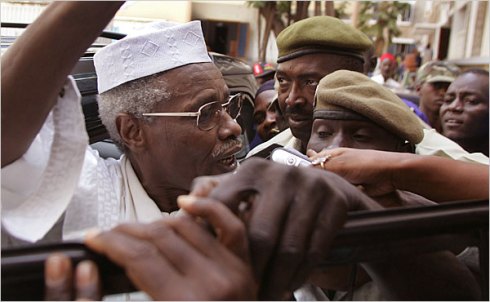
A new study by the Human Rights Data Analysis Group (HRDAG) discloses documents prepared by Hissene Habré’s own Documentation and Security Directorate (DDS) to prove he was personally aware of the deaths of political opponents. Habré has been accused of killing and systematically torturing thousands of political opponents during his rule in Chad, from 1982 to 1990.

This analysis shows that Habré received 1,265 direct communications from the agency about the status of 898 detainees. A total of 12,321 victims are mentioned in the documents, including 1,208 who died in detention.

“Our analysis of document flow encompasses more than 2,700 administrative records, which together illustrate a clear communication and command link between President Habré and his political police,” said Romesh Silva, senior demographer for HRDAG and lead author of the report. “Our findings also confirm earlier qualitative accounts of prisoner conditions and high mortality within the DDS. Perhaps most compelling is the fact that the information gathered by the DDS and Habré to document their own abuses can now be used to hold them responsible for their actions.”

It has been 10 years since his indictment, yet despite strong evidence, he will not be tried until Senegal (which agreed to host the trial in 2006) receives €27.4 million from the international community to fund the trial.

The Documentation and Security Directorate (DDS) pursued opponents and operated notorious prisons during the Habré regime. The files were discovered by chance by Human Rights Watch in 2001 at the abandoned Security Directorate’s headquarters in N’Djamena, the Chadian capital.

FURTHER RESOURCES

Copies of the HRDAG report in English and French are available at: http://www.hrdag.org/about/chad.shtml

For more information on the case against Hissène Habré, please visit:

http://www.hrw.org/en/habre-case

http://www.fidh.org/-Hissene-Habre-Case

There are SEVEN cameras in this image.

What an intriguing image. It’s got a foolish mixture of activity that confuses the viewer: slapping; parrying; a sizable unperturbed bunch of by-passers who display amusement, disappointment, indifference and camera-induced detachment.

One lady has a baby under one arm as she strikes with the other. The lady in defensive mode raises an elbow so as to not inconvenience the cameras she holds in each hand nor the pacifier on her middle finger.

The lady on the right has just been evicted by Israeli settlers. The situation is obviously tense, but who’d bet against me that without the cameras this confrontation would not have occurred?

Photograph by Ahmad Gharabli / Agence France Presse / Getty Images (Source)

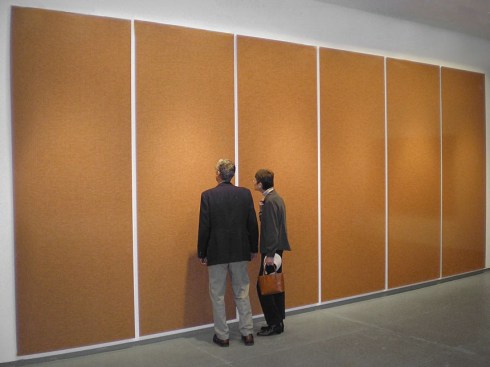
Chris Jordan. Prison Uniforms, 2007. Installed at the Von Lintel Gallery, NY, June 2007.

Chris Jordan‘s populist brand of socio-enviro-photography deserves our respect. The skills necessary to direct (what I presume) is a team to composite his images, is small fries compared to his ability to sell his brand. He brings to surface issues as varied as breast augmentation for teenagers, deaths by smoking, prescription drug overdoses and airline plastic cup wastage.

Jordan argues that all these issues are tied together by our collective denial and connected by our search for a global view obscured by the massive numbers (billions, trillions) which we cannot realistically fathom. Jordan reckons his illustrations help us feel, and thus have us consider and alter own behaviours.

Critics would say that Jordan plucks issues at will, and given their variance, he might just be a fraud. Aren’t we supposed to specialise in our advocacy? Don’t we pick one topic?

I’d be sympathetic to this view if I thought Jordan was picking the latest cause célèbre, but he isn’t. Jordan represented the 2.3million US prisoners with 2.3million prison uniforms (I discussed this before).

Prison reform has never been sexy. Prisoners rights are rarely considered and that is because many of us suspend our emotions toward those put behind bars. Heck, even rape is considered humorous when it is put in a prison setting.

Whatever your take on Jordan’s craft and motives, his research and discussion of issues is passionately informed. For me, most of the time Jordan trumps my cynical view that he’s just selling a cute visual idea.

The closing two minutes of this well-circulated TEDtalk is convincing enough. Yet, I’d forgive people who thought of him as a sellout.

Jordan’s assertion that US citizens are in denial about their prison system is dead on.

Thanks to Stephen Sidlo for the reminder of Jordan’s work.

© Daniel Morel / Corbis

Amidst the all the coverage of Haiti, I have found the interviews and words of photojournalists (eg. Damon Winter; Melissa Lyttle) FAR more interesting and informing than the images.

What an essential privilege to hear Haitian photographer Daniel Morel speak about not only his placement during the earthquake, but also the behaviour of the media, the complaints of Haitians toward said media and where he and Haiti go from here.

If I am going to put weight on any opinion it is Morel‘s.

An argumentative professor with a beautiful bias.

Howard Zinn will be sorely missed.


PART ONE OF A SERIES OF POSTS DISCUSSING PHOTOGRAPHERS’ ACTIONS AND RESPONSES TO THE KILLING OF FABIENNE CHERISMA IN PORT-AU-PRINCE, HAITI ON THE 19TH JANUARY 2010.

“The question is not whether Fabienne will be remembered as a victim of the earthquake but whether, outside her family, she will be remembered at all.”

Rory Carroll, The Guardian, January 26th, 2010

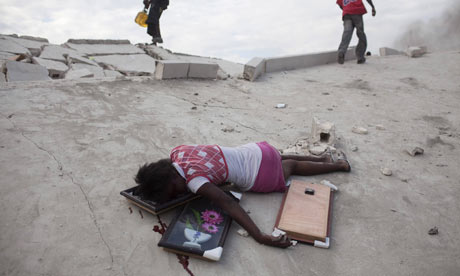
15-year-old Fabienne Cherisma lies dead after being shot in the head in Port-au-Prince. Photograph: Carlos Garcia Rawlins/Reuters.

Fifteen year-old Fabienne Cherisma was shot dead by police at approximately 4pm, January 19th, 2010.

On the 26th of January, the Guardian published an account of Fabienne’s life – her schooling, her sales acumen and her aspirations to be a nurse. The piece is not long, but it needn’t be. It is a modest effort – hopefully the first of a few – to remind us that Fabienne was a daughter, a sister, a source of love and pride for her family and, in the end, an innocent victim.

THE IMAGE THAT REMAINS, THE SYMBOL THAT EMERGES

There is a chance that Fabienne Cherisma could become a symbol of the Haitian earthquake and the problematic aftermath; that she become a tragic silhouette extending meaning far beyond the facts of her abrupt and unjust death.

This notion can be at once offensive and inevitable. If the visual rhetoric is going to play out as such, then if it is not Fabienne, it will be another victim.

What purpose could the emergence of a such a symbol serve?

Thus far Fabienne’s death is a story that has caught wide attention. It came without warning, it was unexpected. Her death – resulting not from nature’s violence but from human action – stands out from other deaths as a particular injustice; Fabienne’s killing is salt in the wounds. While tens of thousands lay obscured beneath rubble, she lay limp and exposed on a bare roof-top. The image itself is an affront.

If one believes that images fuel public awareness, thus securing donations and aid, and thus helping Haiti’s immediate future, then certain images and stories will carry that awareness and emotion.

All the accusations of media exploitation in Haiti do not discredit the positive effects a single image can – without any manipulation – have in the minds of millions. I wouldn’t call this the magic or the power of photography, I’d call it the mysterious perversion of photography. I don’t, and can’t, explain it. I merely observe it.

THE RESPONSIBLE USES OF PHOTOGRAPHY

Fears amongst those who care about media and its conduct hope that the focus can remain on Haiti and its long-term recovery. If the media deserts Haiti after a few short weeks then all accusations of disaster pornography will be upheld.

Photo-editors are now searching for the images that will maintain the humanitarian momentum on Hispanola. These images will be from committed photojournalists who stick around once press photographers have left.

It would be worthwhile to see and hear journalists’ reporting that follows up on the experiences of victims who may or may not have already appeared in coverage. I actually expect journos will follow up on the stories of the child born amid the rubble, the elderly woman rescued after 10 days and the man rescued after search and rescue was called off.

The Haitian recovery must be reported more than the initial chaos.

In the scenario of mass reproduction and circulation, the image of Fabienne’s dead body needn’t be one of mere exploitation. Nothing is so one-dimensional. Of course, this is very sensitive territory and above all the wishes of her family should prevail … in an ideal world.

That said, the history of photojournalism is replete with globally-recognised subjects whose visage was appropriated without their knowledge and/or consent. There’s no model release form in war and disaster.

Fabienne may become a symbol for the innocent victims of this disaster as Kim Phúc did for those in Vietnam. The politics of the two crises are a planet apart, but our modes of consumption are not.

Images are highly manipulable; Errol Morris asserts a caption will turn can turn the reading of a photograph 180 degrees.

The inconvenience of captions often results in the creation of symbol.

I don’t think it will be long before a symbol, a brand for Haitian plight, will rest upon a single image. Western thought demands a visual book-end to the visual dialogue.

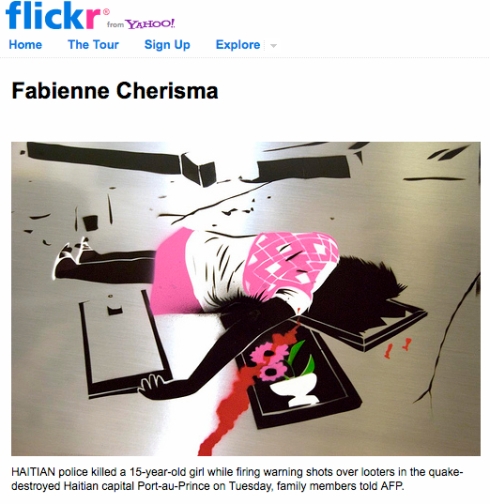
Pureevilbunny has already documented a graphic (in both senses of the word) stencil rendering of of Fabiennie’s corpse (artist not stated). The incongruous pink clothing, argyle sweater, flowers and blood are elements that shock.

THE PHOTOGRAPHIC EVIDENCES AVAILABLE

I do not want to prescribe a means of viewing images of Fabienne’s death. I am interested in informing the public about the photographers who witnessed and recorded the event.

The most widely circulated image is that atop this article by Carlos Garcia Rawlins and distributed by Reuters. It was used in the Daily Mail among others and in the Guardian’s original reporting of the killing:

Police armed with rifles shot over the heads of the people and kicked a man, part of a delayed effort to regain control of a capital which has been lawless – but largely calm – since the 12 January earthquake.

The crowd was carrying grime-­covered chairs while Fabienne, who was on a roof, clutched paintings, including one of two flowers in a vase.

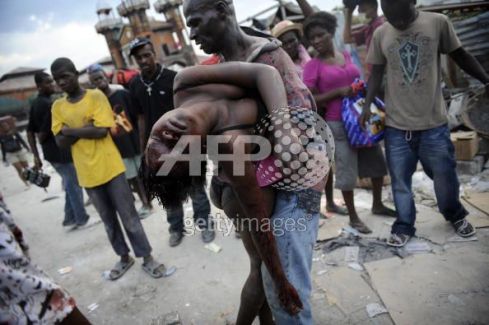
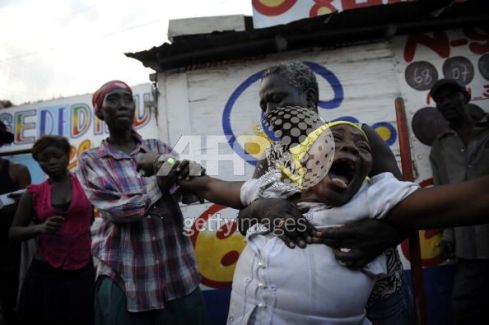
Photographs show her father Osam finding her body, then lifting it into a cart. Fabienne’s mother, Armante, is shown weeping and close to collapse. Osam told AFP news agency that police intentionally shot his daughter. Police were not available for comment.

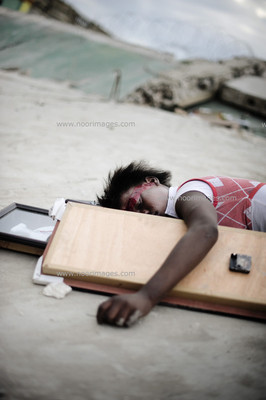
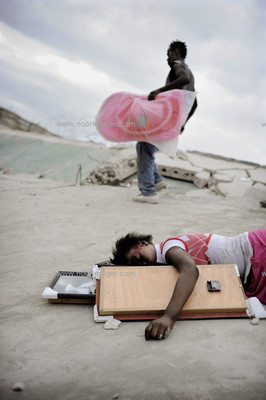
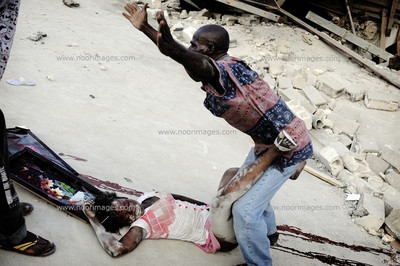
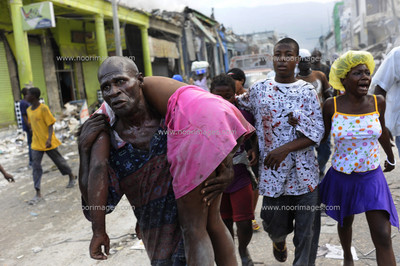
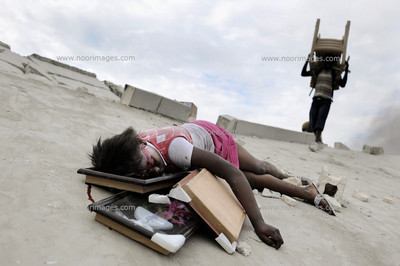
Jan Grarup of Noor images was also present. Grarup’s dispatch for the 19th and 20th January contains 136 images, nine of which include Fabienne.

© Jan Grarup / Noor Images

© Jan Grarup / Noor Images

© Jan Grarup / Noor Images

© Jan Grarup / Noor Images

Fabienne’s body is in a distinctly different position between the photographs of Garcia-Rawlins and Grarup:

© Carlos Garcia Rawlins/Reuters.

© Jan Grarup / Noor Images

Grarup was present at the scene before Garcia-Rawlins. Between their photographings, the framed pictures slid, Fabienne’s hips turned and her body rolled.

How much time was there between Fabienne’s slaying and the two photographers at the side of her body? How much time was there between the two of them photographing Fabienne? Were Grarup and Garcia-Rawlins on the roof at the same time? Did they see each other work?

Both photographers were obviously present before Osam, Fabienne’s father, carried her body away.

In the immediate aftermath, Grarup documented with a few frames a distraught Osam and family.

Olivier Laban Mattei continued documenting events. Laban Mattei’s dispatch of 28 images, is in fact only five images repeated.

Osam Cherisma carries the body of his daughter Fabienne killed by a policeman during lootings in the Marthely Seiee street January 19, 2010 in Port-au-Prince. © Olivier Laban Mattei/AFP/Getty Images.

Armante Cherisma cries in front of the body of her daughter, Fabienne, 15 years old, killed by a policeman during lootings in the Marthely Seiee street January 19, 2010 in Port-au-Prince. © Olivier Laban Mattei/AFP/Getty Images.

Despite the amateurish piecing together of evidences, presented here is a basic timeline to Fabienne’s death. These images placed in sequence describe more fully her tragic death and take Fabienne’s memory beyond that (Garcia-Rawlins’) single image.

Fabienne was an innocent. Whether misdirected warning shots or deliberate targeting, her shooting was needless.

If Fabienne’s death does come to symbolise something larger, I hope it does so to benefit the survivors in Haiti; that the injustice brought upon her will only distill our resolve to avoid injustices to others.

If the shocking form of her body, face down in the broken frame, becomes symbolic it cannot be for reductive consumption, disaster cliche or political gain.

AFTER THE PHOTOGRAPHS

‘With morgues overflowing, and earthquake fatalities being bulldozed into mass graves, the Cherismas took their ­daughter’s body out of the city. With a borrowed $70 they rented a private bus, and drove for four hours to relatives in Zorange. They buried her in a Catholic ceremony and placed a white cross over the grave.’ (Source)

– – –

ALSO IN THE ‘PHOTOGRAPHING FABIENNE’ SERIES

Part Two: More on Fabienne Cherisma (Carlos Garcia Rawlins)
Part Three: Furthermore on Fabienne Cherisma (Michael Mullady)
Part Four: Yet more on Fabienne Cherisma (Linsmier, Nathan Weber)
Part Five: Interview with Edward Linsmier
Part Six: Interview with Jan Grarup
Part Seven: Interview with Paul Hansen
Part Eight: Interview with Michael Winiarski
Part Nine: Interview with Nathan Weber
Part Ten: Interview with James Oatway
Part Eleven: Interview with Nick Kozak
Part Twelve: Two Months On (Winiarski/Hansen)
Reporter Rory Carroll Clarifies Some Details
Part Fourteen: Interview with Alon Skuy
Part Fifteen: Conclusions

EMAIL

prisonphotography [at] gmail [dot] com

Prison Photography Archives

Post Categories