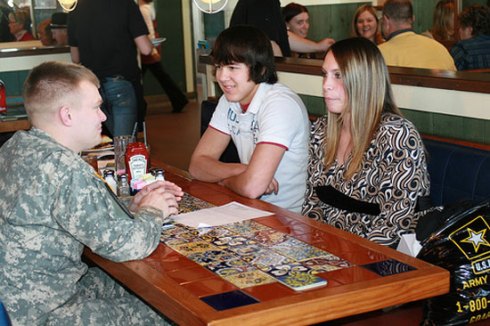
Alyse Emdur has begun a brilliant project Photograph a Recruiter that asks high school students to submit their own photos of military recruitment drives in schools.

In a modest way the project aims to offer  students an alternative national stage to the one the which involves guns and death.

It is, perhaps, a more playful means to combat predatory army and navy recruitment practices … certainly more so than the raucous and confrontational pickets in Berkeley, California last year.

(Found via iheartphotograph)

Andy Kershaw‘s view is a welcome counter to the presumptions of an unknown scenario I and others had considered:

“Most journalists were reporting breathlessly that Port-au-Prince’s main prison had collapsed. Good story. But not for the reasons we were told. The inexperience – and indeed arrogance – of every single reporter who drew our attention to the jail, missed the real significance of its destruction.

It was not that “violent criminals”, “murderers”, “gang bosses” “notorious killers” or “drug dealers” had “simply walked out the front gates”. (And just how did these escapees miraculously avoid being crushed to death in their cells?) Even if true, that was a minor detail to the people of Port-au-Prince, who had more urgent concerns.

The true significance of the prison’s implosion was that it represented for ordinary Haitians, like the wreckage of the presidential palace and the city’s former central army barracks, exquisite revenge upon the prime symbols of decades of state cruelty and oppression.

And many of the prison’s inmates were surely not the dangerous stereotypes of these lurid reports. Haiti’s jails were, notoriously, full of petty thieves and other unfortunates who shouldn’t have been in there anyway. I once had to go into that Penitentiaire Nationale, where I saw hundreds of men kept in cages, without room to lie down, shuffling around literally ankle deep in their own shit, to get out of there the son of a Haitian friend who’d been arrested so that the local police could extort money from his father for the release of his boy.”

via Colin

Currently, truth is also a large casualty in Haiti.

Kershaw’s version is as politically self-serving as most accounts coming out of Haiti, in the confusion following the earthquake citizens, aid-workers and journos are making fast assertions based on their own observations. We should expect that most of these assertions will need modifying in time.

Nevertheless, Kershaw’s is the only commentary that has countered the immediate furor and conjecture surrounding the vacated national prison.

Indeed, Kerhsaw makes it clear that the obfuscations of fact are the direct result of the typical blend of fear and uninformed judgement; judgement applied to prison populations of every nation.

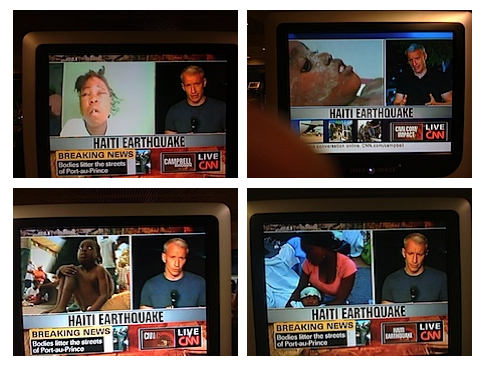
It one thing having foolish and clumsy media commentary of flash-in-the-pan (US) regional stories. It is another when CNN and Anderson Cooper use that same approach covering a humanitarian disaster.

As folk interested in media we should speak out when we see offensive framing and “reporting”.

Anderson Cooper’s bravado is only slightly more insulting than other major networks, but if we picket Cooper and his CNN editors maybe we’ll make a dent large enough that other major networks will also take note.

Michael Shaw just emailed this to concerned social media types. I am behind his sentiment:

I’m writing because I’ve just done a post at BAGnewsNotes that I think is extremely important.

It’s an appeal to readers to contact CNN, or tweet them (@andersoncooper @CNN – PLEASE STOP visually exploiting the Haitians! http://bit.ly/8R1DGc) about the way Anderson Cooper/CNN is visually exploiting the Haitians.

What Cooper has been doing is a complete affront, and it’s time we pushed back in a more systematic way.  Haiti is going through a completely sub-human experience as it is, and the humanitarian effort, and dignity for its people, should absolutely extend to the media sphere.

Thanks so much for putting your eyes on this, and being part of the response.

Here’s hoping.

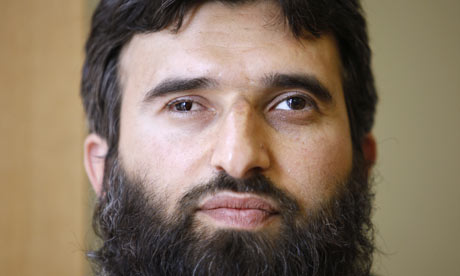
Omar Deghayes: 'I gave them a really hard time.' © Stefan Wermuth/Reuters

“I didn’t realise what was going on until the guy had pushed his fingers ­inside my eyes and I could feel the coldness of his fingers. Then I realised he was trying to gouge out my eyes,” Deghayes says. He wanted to scream in agony, but was determined not to give his torturers the satisfaction. Then the officer standing over him instructed the eye-stabber to push harder. “When he pulled his hands out, I remember I couldn’t see anything – I’d lost sight completely in both eyes.” Deghayes was dumped in a cell, fluid streaming from his eyes.

Excerpt: ‘How I fought to survive Guantanamo‘ (Guardian, UK)

I don’t want to give the impression I dislike Obama. I think he has toiled strenuously against many idiots this past twelve months. I think he’s carried a nation-sized curse of rhetoric and is subject to a Bush-beaten electorate hoping for more than neglect and dis-empowerment. However, I am disappointed he hasn’t yet been able to close Guantanamo, especially as it seemed like one of his easier-to-achieve promises.

Friend, Steve Silberman, pointed out Ezra Klein‘s WaPo article about where Obama has gone wrong this past year. Obama tried to get stuff done in a congenial manner but it was just not sexy enough for the American public. He never even tried to sell it;

Obama’s presidency has tried to show, not tell. He’s not given speeches about how government can work. He’s not tried to change minds about the theoretical possibility of government working. He’s tried to make government work. Winning achievements, not arguments, has been at the center of the administration’s agenda.

But that’s meant letting the government work. And that turns out to be an ugly thing, full of deals with pharmaceutical companies and concessions to Nebraska and delays and press releases and controversy and anger and process stories and confusion. Americans don’t like Washington, and they like it less when they see it more. Obama’s strategy has meant they see it constantly, and there’s no one really guiding them through its thickets.

Conclusion: No pleasing everyone. Politics is a b*st*rd of a career.

A crowd of people look at two men who were caught stealing and were bound and shot on Delmas Road in Port au Prince, Haiti 17 January 2010. The man in the yellow shirt was still alive after being shot through the head but neither the Haitian national Police nor the general public expressed any concern. EPA / Shawn Thew

Chay soti sout tet, tonbe sou zepol.

The load goes from the head to the shoulder.

(Problems go from bad to worse.)

Haitian Proverb.

DISCLAIMER: THERE ARE MANY LINKS HERE, BUT I HAVE CHOSEN THEM CAREFULLY AND ASSEMBLED SOME ORDER

First things first …

100Eyes

My early enthusiasm for Andy Levin’s proposed wider view of Haiti is now thoroughly tempered. In 100Eyes first statement, Andy made no mention of money. I presumed he was redirecting already committed attendees and resources, but he has extended the venture to new takers and at $1,500, the issue of money-flows (not to mention the obvious dangers and liabilities) makes it seem and sound like a bad idea … for reasons mentioned here and here.

And, I didn’t think Andy’s response was adequate.

GIVE MONEY!

Immediately, let’s us not confuse our value. We know it sits in our wallets and purses. GIVE.

Here is a list of organizations which have been highly rated by the American Institute of Philanthropy through which you can aid those in need in Haiti:

Source

UPDATE:

I also want to add that Paul Farmer’s Partner’s in Health has been doing increible work in Haiti for more than two decades. Money donated to his organization will be very well spent. http://www.standwithhaiti.org/haiti (Thanks Chris)

Possibly the most important and startling initiatives I have found all week …

The Young Haitian Documentary Photographers Group of the St.Marc region of Haiti in March of 2006. “This was the first time these young photographers had used cameras. Their work is ongoing. For more information about this unique group please visit the Haiti page.” (found via Manchester Photography)

Zanmi Lakay is an NGO that offers among its many educational opportunities, photography workshop for Haitian Street Children.

Zanmi Lakay is also Andy Levin/100Eye’s partner in Haiti, which complicates judgement on 100Eyes workshop, no? Maybe, maybe not.

© The Young Haitian Documentary Photographers Group

If you want to contribute while consuming art …

Haiti Benefit Sale was brought to my attention via the The 20×200 Blog.

William Greiner is auctioning an exhibition print & monograph book.

Aline brought to our attention a new Flickr Charity Print Auction. It isn’t exclusively for Haiti, but no doubt, Haiti will dominate current donations.

And, of course there is the Onè Respe Magazine at MagCloud with photos by Chet Gordon, Kari Hartmann, Mary Ellen Mark, Peter Pereira, Lindsay Stark.

@jeffantebi has made limited editions from Haiti available stolen space to benefit Oxfam and MSF.

Singular pieces of photography coming out of Haiti

American Red Cross Flickr Photostream.

Jonathon Torgovnik photos Anderson Cooper picking up a bloodied boy off the street.

Two photo essays from the Prospekt collective.

Flickr: Catherine Laine photographs for the Appropriate Infrastructure Development Group.

David Levene for the Guardian.

Jan Grarup and once again for Noor

Panos by Jeroen Oerlemans and Moises Saman.

Redux showcases Emiliano Larizza.

Alvaro Ybarra Zavala.

Not photography, possibly more important than photography, worth reading

“Stop treating these people like savages” by Andy Kershaw of The Independent, “An unbelievable 10,000 charities were already working in Haiti when the earthquake rocked the island, most of them tiny independent organisations. Humanitarian aid is, almost by definition, never where it is needed when natural disasters strike. But, in Haiti, what’s needed has been flown in with impressive speed. Yet the combined concern of all those organisations – many of them regarding fellow charities as professional rivals – has so far been unable to get that assistance a ride from the airport. Too much energy in the last week has been expended on bickering about procedure and the fetish about “security”.”

Interactive map of Haiti to report incidents.

From the BBCHaiti earthquake: Aid workers’ diaries.

Bizarre turn of events when an American cruise company chose to find a Haitian berth only 100 miles from Port-au-Prince but then to soften the blow offered to donate sun loungers to a Haiti makeshift hospital.

Poynter Online offers welcome perspective on photography in Haiti by focusing on Patrick Farrell’s Pulitzer winning work from last year.

Colin Pantall‘s Junot Diaz, Trujillo and The Dominican Republic looks obliquely at Haiti’s historical relationship with its neighbour.

Charlie Beckett of POLIS argues that when the major networks leave Haiti social networking and blogging must take over in sustaining the focus, testimony and support.

Philip Gourevitch makes a modest proposal; “Goldman Sachs and JPMorgan Chase should give a billion dollars apiece to Haiti relief and reconstruction efforts—and they should do it swiftly and without hesitation.”

Also, from the New Yorker, Earthquakes and Journalism Steve Coll offers some insight, “I learned something about journalism while covering my first earthquake, in northwest Iran, in June, 1990.”

Saturated in the Image

LENSblog (Maggie Steber, Damon Winter, James Estrin) have been leading the way with classy and sensitive coverage  diluting images with interviews .. and even dipping into the Archive: Haiti, Alive.

The Boston Globe started the trend for newspaper’s to post them large. It has had three monster galleries thus far: Earthquake in Haiti, 48 Hours Later and Haiti Six Days Later.

Plethora of disaster from the NJ Star-Ledger.

The Denver Post has two offerings: One Week Later Photos and Earthquake in Haiti Photos.

The Los Angeles Times goes Hi-Res with Carolyn Cole, Rick Loomis and Brian Vander Brug.

The Wall Street Journal has led the charge with mammoth galleries daily, ominously titled WSJ Photographers Document Chaos. Here’s the last three days, they go back further:

WSJ Photographers Document Chaos in Haiti: January 17, 2010.

WSJ Photographers Document Chaos in Haiti: January 18, 2010.

WSJ Photographers Document Chaos in Haiti: January 19, 2010.

The Sacramento Bee has also been offering the large scrolling wide web galleries. They used images by Logan Abassi and The Red Cross to take an aerial view. Here’s the SacBee’s latest, Haiti One Week Later.

Interview with Melissa Lyttle & gallery of Melissa’s images from St. Petersburg Times.

NPR Picture Show has been offering constant Haiti coverage from the ground.

Photographers in Haiti

Here’s the scoop from Lightstalkers: Is anyone on the ground in Haiti?

Zoriah‘s found his way in.

And finally, PDN ran this: Photographers in Haiti Face Shortages of Fuel, Water, Housing, and Food, which may be true but the headline is hardly tactful.

How many photographers does it take to photograph a humanitarian disaster?

Juan Barreto / AFP / Getty Images
Bruno Stevens / Cosmos
John W. Poole / NPR
David Gilkey / NPR
Ramon Espinosa / AP
Luis Acosta / AFP / Getty Images
Jae C. Hong / AP
Minustah / Logan Abassi / AP
Julie Jacobson / AP
Francois Mori / AP
Chris Hondros / Getty Images
Win McNamee / Getty Images
Ariana Cubillos / AP
Ricardo Arduengo / AP
Olivier Laban Mattei / AFP / Getty Images
Sophia Paris / Getty Images / UN / Minustah
Gerald Herbert / AP
Uriel Sinai / Getty Images
Patrick Farrell / AP / The Miami Herald
Peter Andrew Bosch / Miami Herald / MCT
Carl Juste / AP / The Miami Herald
Melissa Lyttle / St. Petersburg Times
Dominic Nahr / The Wall Street Journal
Julie Platner / The Wall Street Journal
Ron Haviv / New York Times / VII
Heather L Rohan / NJ Star & Ledger
Nicholas Kamm / Getty Images
Gregory Bull / AP
Michael S. Wirtz / Philadelphia Inquirer
Federico Gambarini / EPA
Orlando Barria / EPA
David Fernandez / EPA
Juan Barreto / AFP Getty Images
Shawn Thew / EPA
Thomas Coex / AFP / Getty
Thony Belizaire / AFP / Getty
Julie Remy / AP / MSF
Julien Tack / AFP / Getty
Michael Laughlin, Sun-Sentinel / AP
Francois Mori / AP
Julie Jacobson / AP
Jewel Samad / Getty Images
Paul J. Richards / Getty Images
Joe Raedle / Getty Images
Mario Tama / Getty Images
Martin Oeser / Getty Images
Jody Amiet / AFP / Getty
Logan Abassi / AFP / Getty
Marco Dormino / AP / United Nations
Frederic Dupoux / Getty Images
Eduardo Munoz / Reuters
Cris Bierrenbach / AP
Jorge Cruz / AP
Maggie Steber / The New York Times
Tequila Minsky / The New York Times
Damon Winter / New York Times
Michael Appleton / The New York Times
Erika Santelices / Getty Images
Jonathan Torgovnik
Boots Levinson
Alvaro Ybarra Zavala / Getty
Jan Grarup / Time
Jeroen Oerlemans / Panos
Moises Saman / Panos
Zoriah
Carolyn Cole / LA Times
Rick Loomis  / LA Times
Brian Vander Brug  / LA Times
Nick Kozak
Jason Henry / Wall Street Journal
David Levene / Guardian
Francesco Giusti / prospekt
Samuele Pellecchia / prospekt
Emiliano Larizza / Contrasto / Redux
Carol Guzy / Washington Post
Lisandro Suero / AFP / Getty
Clarens Renois / AFP / Getty Images
Kena Betancur / Reuters
Ivanoh Demers / AP / Montreal La Presse
Sam Yeh / AFP / Getty
Gus Ruelas / Reuters
Carlos Barria / Reuters
Jess Hurd
Axel Oberg
Jorge Silva / Reuters
Carlos Garcia-Rawlins
Andy Levin
Robert Larson

(List not exhaustive)

AND LAST BUT NOT LEAST

Special mention must go to Daniel Morel (AFP / Getty Images) who has photographed Haiti all his working life and holds the nation and its people close to his heart.

See a slideshow of his work here at The New York Times Lensblog


© Damon Winter / New York Times

In November, I interviewed Damon Winter for Too Much Chocolate. He is calm, modest and (quite frankly) not the best interviewee because he still feels he is too young in the career to make bold statements … you know the sound-bites from photojournalists we all crave … the ones about adventure or celebrity subjects.

His skills were proven when he raked in the Pulitzer for A Vision Of History his coverage of Obama (it was his first time covering a political campaign!)

Damon attested to the fact he has always learnt on the job. He did not train formally as photojournalist per se; he studied environmental science at college. He even admits that since his job is so time-consuming he feels somewhat detached from the talk and over-talk (my term) within the industry.

To cut a long intro short, I have a lot of respect for Damon.

Damon’s visit to Haiti has been his first coverage of a disaster area. His dispatches have been well received; most likely because he has put sensitive words (here and here) out there as well as his photographs.

I posted earlier this week about the unknowns surrounding the escape of the entire Haiti National Penitentiary population. Damon has since visited the prison for the New York Times and the NYT continues the reflections on these unknowns:

Who were the [prisoners]? Were they among the machete-wielding pillagers who made their way along the Boulevard Jean-Jacques Dessalines on Saturday afternoon? (The account in The Times, “Looting Flares Where Authority Breaks Down,” said no one could answer with certainty.) Did their numbers include political prisoners? In “Disaster Imperialism in Haiti” on MRZine, a Socialist Web site, Shirley Pate wrote: “Who knows how many of the dead or escaped prisoners there were those who were incarcerated without cause over the course of the two years that followed Aristide’s departure?”

Damon Winter’s photographs answer none of these questions. They don’t mean to. But they do begin to paint a picture of life inside a Haitian prison; a picture that few people have ever seen before.

(My bolding)

SEE DAMON’S DISPATCH

The Rev. Dr. Martin Luther King, Jr., jailed in Birmingham, Alabama for protesting injustice.

Because I just read this, I wince a little as I repost thoughts via the indubitable Jim, but time is of a premium today. Please excuse me.

Martin vs. Barack

Why is it some American’s “mythologize and sanitize” MLK – a man that called for a national guaranteed income – but as quickly abase and demonize Obama who, by the way, is a pithy moderate by comparison?

In other words, why is the socialist agenda of one leader ignored and – worse still – why is a socialist agenda fabricated and super-imposed on another?

Oh, and also, actual functioning democratic socialism (even in its sputtering form under New Labour) is a pretty good ticket.

Men rummage through the remains at the Haitian National Penitentiary that stands burnt and empty after a 7.0 magnitude quake rocked Port-au-Prince, in this United Nations handout photo taken and released on January 14. Photo Credit: United Nations, Reuters.

Source

The Port-au-Prince slum Cite Soleil was renowned for extreme violence and as stronghold for gang activity. Recently, activities there had calmed – as Reuters notes, “The pacification of Cite Soleil had been one of President Rene Preval’s few undisputed achievements since taking office in 2006, until the quake devastated Port-au-Prince.”

The National Penitentiary served to incapacitate the capital’s violent gang members and leaders. Between 3,000 and 4,000 former-inmates are now on the streets. The remains and records amid the rubble of the Ministry of Justice have been torched destroying the information needed to track down the former prison population. Law and order are fragile now, but still, violent incidents are few.

Undoubtedly, fear reigns. From the Guardian:

Now Cite Soleil is braced for a return of the gangs.

“They got out of prison and now they’re going around trying to rob people,” said Cite Soleil resident Elgin St Louis, 34, told Reuters. “Last night they spent the whole night shooting,” she added. “We dread their return,” said another.

So far, warnings that Port-au-Prince would descend into anarchy have not materialised. Lawlessness has been localised and confined largely to the night. But the few incidents have been brutal. In the Delmar neighbourhood, two suspected looters were tied together and beaten before being dragged through the streets.

Haiti’s National Penitentiary became an essential apparatus in Preval’s abatement of gang command in Port-au-Prince’s poorer neighbourhoods. In 2004, it is alleged prison administration put down a non-violent protest with lethal force. President Rene Preval’s office argued that they used acceptable force in the interest of self-defense.

But the problem’s in Haiti’s prisons existed long before Preval’s insertion into power in 2004 and even before Jean-Bertrand Aristide’s third stint as president (2001 – 2004).

In 1997, Donna DeCesare won the Alicia Patterson Fellowship and, in 2000, used the opportunity to examine the links between criminal activity, US deportees and gang structure in Haiti.

From looking at her essay I can only presume Preval’s strategic battle with the gangs compounded problems of overcrowding. DeCesare’s essay touches necessarily upon issues of poverty, services, police shortcomings and judicial corruption … all the while following the fortunes of Touchè Caman, U.S. deportee and organizer for Chans Altenativ, an organisation to help Haitian deportees.

Brilliant journalism, but of course ten years old.

More immediately are the concerns of safety and health for Haitians in Port-au-Prince and the surrounding areas.

At the Haitian National Penitentiary, Touchè Caman does outreach for Chans Altenativ.looking for deportees among the inmates. “I never thought I’d be going back into a prison after the last time,” he tells me laughing. “It’s a lot different on the other side of the bars. Maybe Chans Altenativ can help a few of them when they get out.” © Donna DeCesare

At Forte Nacional, where children, women and youths are incarcerated, more than 40 youths share the same cell. There are no school classes or trade workshops here. Most of these boys are 16 years old. A few are younger. Some claim membership in Base Big Up and other gangs. One thing is certain, without training or rehabilitative programs of any kind to offer alternatives to street life, many of these boys will find their way into criminal gangs when they are released, even if they weren’t already involved. © Donna DeCesare

EMAIL

prisonphotography [at] gmail [dot] com

Prison Photography Archives

Post Categories