The Geneva Convention on handling prisoners bans:
– Cruel treatment
– Physical and mental torture
– Humiliating and degrading treatment
– Outrages upon personal dignity
– Reprisals

The Image / Incarceration / Representation / Media / Social Justice / Responsible Photography
The Geneva Convention on handling prisoners bans:
– Cruel treatment
– Physical and mental torture
– Humiliating and degrading treatment
– Outrages upon personal dignity
– Reprisals
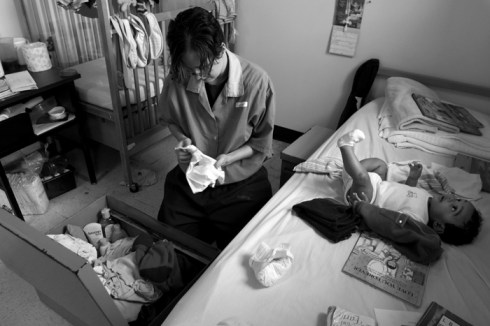
I while back I posted a nod to Angela Shoemaker and her work at the Prison Nursery at Ohio Reformatory for Women, Marysville, OH.
Since then, Angela has been busy with her multimedia work on families and the recession, updating her website theme & images and securing a Fulbright Grant to photograph Muslim youth in the Netherlands.
Check out Angela’s series about mothers and babies in prison. She has provided us with good background information to the program.
The stand out stat for me was that only 16 of the 138 women who have passed through this program have re-offended which is good for them and very good for us as a society.
Angela also teamed with Dustin Franz on the multimedia piece Hope is on the Horizon.
On Will Steacy’s blog this week:

Silverstein pulled a nearly foot-long knife from his conspirator’s waistband.“This is between me and Clutts,” Silverstein hollered as he rushed toward him. One of the other guards screamed, “He’s got a shank!” But Clutts was already cornered, without a weapon. He raised his hands while Silverstein stabbed him in the stomach. “He was just sticking Officer Clutts with that knife,” another guard later recalled. “He was just sticking and sticking and sticking.” By the time Silverstein relinquished the knife—“The man disrespected me,” he told the guards. “I had to get him”— Clutts had been stabbed forty times. He died shortly afterward.”
It may be helpful for my readership if I state that I am not a prison abolitionist.
It occurred to me that I may not have shared that with you. There is a legitimate need for prisons when incorrigible and dangerous men or women must be controlled for the safety of all.
Unfortunately, over the past three decades, prisons in America have been used to test the “incapacitation theory” – which as Ruth Gilmore posits in Golden Gulag is not much of a theory, in fact it is not really a theory because it doesn’t propose to do or enact much at all [I paraphrase].
Prisons are many things; the parts of an expensive social experiment, the dumping-grounds for citizens caught up in the war on drugs; the accidental and damaging substitutions for mental health institutions; and in very few (and just as real) circumstances the necessary lock-ups for extremely violent offenders.
One problem I have in communicating the need for real prison reform is created by the fact that violent offenders are those that seize the public’s attention. Violent criminals are a tiny fraction of America’s prison population yet they’re the ones that trigger fear instincts and sway public opinion. I understand why this is the case and why it takes a lot to get past that.
Men like Silverstein, who’s actions are described above, should be behind bars for a long, long time. But the vast majority of the 2.3 million prisoners of the US are not like Silverstein. This same vast majority would also want Silverstein behind bars … and they’d make good argument as to why they shouldn’t be there with him.
Fred Ritchin suggests using technology and photography as meta-evidence to validate, qualify and describe the act of photography and of photojournalism.
I am of the opinion … that a special frame placed around the photograph (perhaps a thicker one) indicating that a photograph is “non-fiction” — meaning that it is subjective, interpretive, but the image itself has NOT been manipulated beyond accepted darkroom techniques such as modest burning and dodging — would be helpful.
As well, those images that are staged, such as photo opportunities orchestrated by politicians or other celebrities, would have to be labeled as such in the caption. Whenever possible the staging itself should be revealed by using a second image made from another vantage point to show that what viewers are looking at is not spontaneous but a media event (this second image could be placed under the first, and revealed by rolling over the initial photograph with the computer’s cursor). Or a single photograph can be made from a perspective that reveals the staging (the mob of press, media handlers, special lighting, etc.), not one that conceals it.
Jonah Raskin: What do you have to say about the latest technology?
Eduardo Galeano: Machines are not to blame. We have become servants of our machines. We are the machines of our machines. Without a doubt, the new tools of communication can be very useful if they are in our service—not the opposite. Cars drive us. Computers program us. Supermarkets buy us.

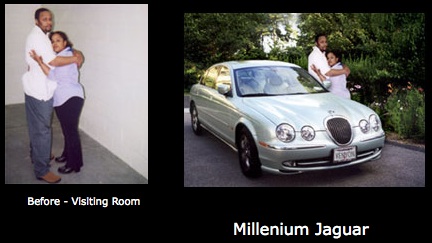
Aside the Coca-cola vending machines and Cheetos, portraits and photo-keepsakes are probably the most ubiquitous objects in prison visiting rooms.
I have speculated before about a massive, dispersed collection-without-walls made up of the millions of prison Polaroids; a sprawling, bittersweet and neglected vernacular photo-archive of true American experience.
Polaroid cameras are still the standard for prison visiting rooms as they provide instant results and they don’t have the “security issues” associated with he transferability of digital files. No matter the format, Friends Beyond the Walls will help construct your photo-idyll:
There is plenty of scope here to pour scorn upon the low-brow photo-manipulation, and there is (justifiable) reason to question the financial gains of the company involved in providing such a basic service, but I won’t go there.
People aren’t stupid. They won’t invest their emotions in “Composite Magic” if they don’t want to. But if someone does make use of this service then so be it – we all spend silly money on items foreign and bizarre to one another.


I will say this: prisoners and their families develop fast and hardened interactions with correctional authority. The procedures of the visit become as routine as picking up the paper or grabbing a morning coffee. It makes sense that some of that population would take the opportunity to leave that dictated reality behind and reclaim (visual) identifiers that don’t belong to departments of corrections and criminal justice.
Therefore, the only real way to discuss this niche photo-aesthetic and grow a legitimate appreciation would be to talk to the sitters, consumers and owners of this niche photo-aesthetic. That could be the territory for anthropologists and sociologists or, as easily, it could be the chatter of ordinary people who still take an interest in other ordinary people.


A Developing Story is a new joint venture by Johnny Bennett, Phil Maguire and Benjamin Chesterton of duckrabbit.
In an email a few months ago, Ben said to me his interest lies in “getting under the skin of NGOs” and have them realise that they can deliver their stories and campaigns in far more effective ways. A Developing Story wants the stories told in Government & NGO international development campaigns to outlast the short term objectives of said campaigns.
A Developing Story proposes that the media of these campaigns is deposited in a common silo, accessible by all (usually under a Creative Commons license) so stories – once created – can tell themselves infinitum.
Given the primacy of Creative Commons and open-source content, Matt and Scott at DVAfoto needed clarification on A Developing Story‘s impact on the photographer (which was provided). I have fewer worries as I feel this venture is aimed at transforming media sharing practices among government funded and NGO initiatives rather than another pressure on the distribution and remuneration of individuals’ works.
I would anticipate that the payments made to photographers and journalists by media campaign management will continue and that photographers will take on assignments in the knowledge that their work can be used repeatedly for non-profit purposes.
That said, A Developing Story is very open to individual contributions. This is the most relaxed approach to collaboration I’ve witnessed!
So, as Ben asked, “Can You Help?”
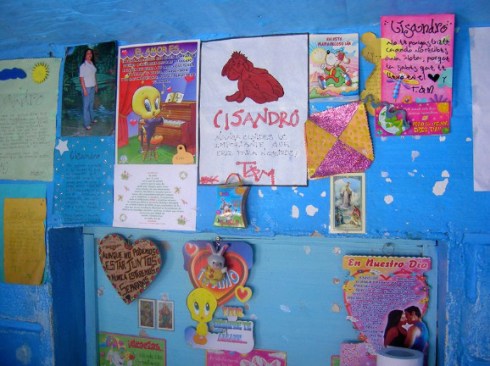
Often it seems photographs of South American prisons are presented in North American media only to emphasise the gulf that exists between the conditions of incarceration in the two regions.
I have posted before about prison beauty pageants in Bogota, Colombia; about the rise and fall of prison tourism at San Pedro in La Paz, Bolivia, and I have looked twice at Gary Knight‘s photography at Polinter prison in Rio de Janeiro – latterly featuring the conspicuous acts of a celebrity evangelical minister.
(Nearly) all photo essays I see coming out of prisons in South or Central America fall into one of two categories, or both:
1) A colourful contradiction to the dour, authoritarian environments depicted in US prison photojournalism.
2) A claustrophobic assault on our emotions as witnesses to desperate overcrowding and poor hygiene. The example par excellence of this is Marco Baroncini’s series from Guatemala.
What leads me to a narrow, ‘boxed’ categorisation of such documentary series is that I am convinced photographers know either the media or their editors well enough to know what flies with Western consumers and as such deliver an expected aesthetic.
I was therefore left without anchor when cyber-friend Nick Calcott sent over this latest offering by GOOD magazine on Medellin’s prison in Colombia. The images are by the inmates themselves:
On the invitation of the Centro Colombo Americano, an English language school for Colombians in Medellín, Vance Jacobs ventured to the Bellavista Prison with an inspired assignment: to teach documentary photography to eight inmates in one week.
“One of the things that gets the inmates’ attention is responsibility, that there is a stake in what they do. In this case, their ability to work together as a team, and to pull this together in a very short amount of time would determine whether other similar projects were done not only at this prison but at other prisons in Colombia,” says Jacobs. “Once they bought into the idea that there was a lot at stake, they really applied themselves.”
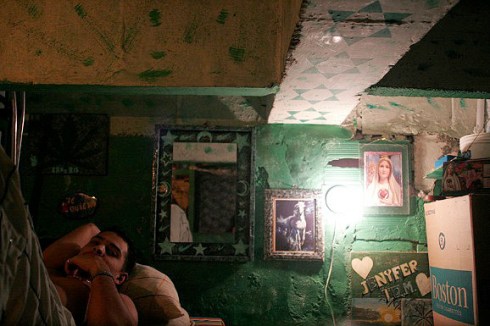
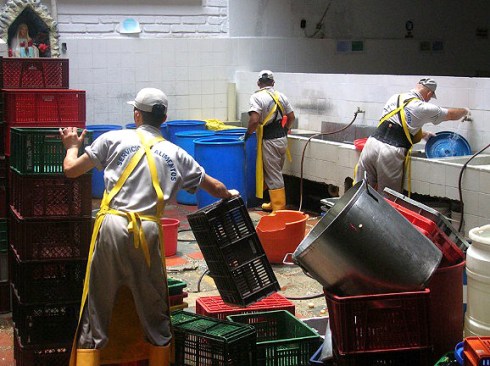
In the past, I have wondered how the camera can be used as a rehabilitative tool and it is a question that can be answered from different angles. In this case the responsibility given to the inmates is how we can derive worth. I have shown before that performance and team work in front of a camera can be good for exploring the self and ones own identity (and the results are of huge intrigue). The common denominator for any photography project is surely that it immediately relieves the boredom of incarceration.

 PETE BROOK ON MEDIUM PETE BROOK’S TUMBLR ‘PHOTOGRAPHY PRISON’
 Prison Photography