The American Psychological Association (APA) Council of Representatives, on Friday, voted today in Toronto to adopt a new policy barring psychologists from participating in national security interrogations. That means psychologists won’t be approving torture techniques or overseeing “enhanced interrogations.” That means psychologists can, and must, refuse to work in such capacities for the U.S. military and they will have full backing of their professional body in so doing.

Democracy Now! covered the decision, here and here.

My favourite comment came not from any of the APA members but from Peter Kinderman, the president-elect of the British Psychological Society who was representing the BPS at the APA meeting.

“I think it’s wonderful. I think it’s great. I think it’s well overdue. I was joking earlier that this represents American psychologists rejoining the 17th century and repudiating torture as a means of state power. […] The agreement is that American psychologists would respect agreed international definitions of the abuse of detainees and agreed international standards for judicial process. We shouldn’t be involved in abusing detainees, and we should remain within domestic and international law. That strikes me as commonsense, obvious. It’s what the public would expect. And about bloody time, too.”

whitaker

Joseph Harmon spent eight years in solitary at Pelican Bay State Prison in California. He is now a preacher, but still feels the need to withdraw. Credit Max Whittaker for The New York Times

I’ve spent a good amount of time over the past few weeks putting final touches to an essay for a forthcoming exhibition/project/programming by ERNEST Collective at c:3Initiative in Portland Oregon, in September.

The essay is about the sketches of a man who was held in solitary confinement for extended periods in the California prison system. Within it, I quote Dr. Craig Haney, a professor of psychology at the University of California Santa Cruz, a couple of times. His latest research was featured in the New York Times this week:

Most studies have focused on laboratory volunteers or prison inmates who have been isolated for relatively short periods. Dr. Haney’s interviews offer the first systematic look at inmates isolated from normal human contact for much of their adult lives and the profound losses that such confinement appears to produce.

The interviews, conducted over the last two years as part of a lawsuit over prolonged solitary confinement at Pelican Bay, have not yet been written up as a formal study or reviewed by other researchers. But Dr. Haney’s work provides a vivid portrait of men so severely isolated that, to use Dr. Haney’s term, they have undergone a “social death.”

[…]

Dr. Haney interviewed 56 prisoners who had spent 10 to 28 years in solitary confinement in Pelican Bay’s security housing unit, or S.H.U., including seven men he had interviewed in 1993, eight plaintiffs in the lawsuit and 41 randomly selected inmates. For comparison, he also interviewed 25 maximum-security inmates who were not in solitary.

It’s a very important read and a good primer for those who are not up to speed on the torture in our supermax prisons. Make no bones about it solitary IS torture.

The best part of the article, for me, was not the words, the well researched links, the historical context or even the portraits by Max Whitaker, it was the embedded 4min, 41sec video of prisoners speaking about their decades in solitary.

solitary

The final interviewee breaks down in tears and barely gets the words, “No human should live like this.” “Just give me a death sentence.”

Another prisoner, the article notes, said that the hour he had spent in Haney’s interview was “the most I’ve talked in years.”

Read: Solitary Confinement: Punished for Life

If you are in Portland, Ore. this autumn may I recommend you pay a visit to ERNEST’s show Demos: Wapato Correctional Facility, and particularly the opening on Friday September 18th.

1

A 1916 American Mug Shot

For anyone who thinks photography has only recently been abducted by state and corporate power for the purposes of control, think again. For anyone who thinks that high-tech-surveillance was the birth of photography being used to discipline and order humans, think again. Cyborgology recently had a great piece by Liam French lecturer in the Journalism and Media Department at the University of St. Mark & St. John, about the historical connects between image-making and criminal justice. French writes:

The relationship between visual technologies and the criminal justice system can be traced back to the emergence of photography and the invention of the camera as a tool for documenting ‘reality’ in the nineteenth century. The camera was widely believed, even more so than today, to be able to objectively and truthfully record social reality. A photograph was perceived to be like a window on the world – a mechanically produced, impartial and literal representation of the real world.

One such photographic taxonomy was produced by the Italian physician Cesare Lombroso who drew ink portraits depicting ‘criminal types’. Lombroso’s work is an exemplary case of the rise of positivist criminology in the nineteenth century. He argued that criminals possessed more ‘atavistic’ features and shared more characteristics with our evolutionary ancestors than more law-abiding citizens.

Most Wanted: Cameras, Criminal Justice and the Persistence of Vision argues that the breadth of surveilling techniques and technologies has extended to the Internet.

Still and moving ‘visual evidence’ is stored in state archives, used in courtrooms as evidence, and disseminated across almost every major media platform: from the printed press to the World Wide Web.

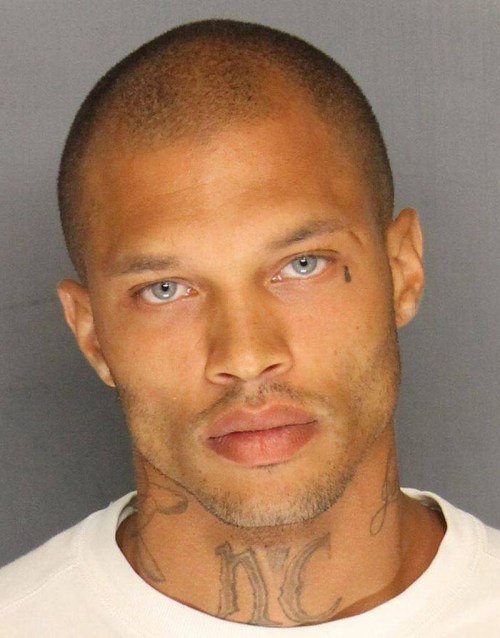
French references both a 2006 article about Mark Michaelson’s book and collection of mugshots and last years viral pic of Jeremy Meeks‘ mugshot to raise the idea that law enforcement photography (mugshots included) have transcended their forensic roots.

Take, for example, the posting of the police mug-shot of criminal Jeremy Meeks on Stockton Police Force Facebook page resulted in his image going viral and concluding with the offer of a quite lucrative modelling contract. What is interesting about the Jeremy Meeks mug-shot story is that once his photograph was displayed outside of the authoritative domain of the police archive and publicly circulated across different social media platforms and networks it accrued different sets of meanings (sexy, hot, good-looking) along the way despite the attempt to officially encode (or fix) the meaning (criminal, dangerous, wanted by the police) of the photograph.

Furthermore, French argues, that John Fiske’s theory that dominant power uses system to segregate and dominate apply here. Fiske says that authority will rely upon systems and “improve” them all the while facing resistance from the lesser power. Crucially, the lesser power uses the same systems to subvert and counter dominate. Sometimes the lesser power is successful and sometimes the larger power replaces old systems with new ones of greater efficiency or new tactics. In any case there is always a push and pull.

Jeremy Meeks

Booking photo of Jeremy Meeks, 30. (June 18, 2014). Credit: Stockton Police Department


So in the case of mugshots, there has always been inherent control attached to state-dominate manufacture and exchange of mugshots. Until social media found a way to interrupt that exchange.

Even Sheriff Joe Arpaio’s mugshot of the day website and the countless mugshot magazines like Busted were examples of larger authorities using the mugshot to their own ends. Arpaio’s use served not the general fraternity of law enforcement but his own ego. Busted wanted to bend the use of mugshots to its own profitable ends but interestingly did so without inconveniencing the state’s power; to the contrary dollar-mugshot magazines enhance the states criminalisation of individuals.

Fiske’s theory was formulated in the late 1980s and so pre-dates the emergence of web 2.0 and social media but his model of culture (and popular culture) does have a resonance with the ways in which social media tools and platforms further open up the terrain of culture for struggles over meaning, semiotic productivity and popular resistance. Imposing official (or dominant) meanings is now much more difficult because there are so many opportunities for contestation.

It would be naïve to cite the Jeremy Meeks example as some kind of paradigm changing moment or as the empowerment of the masses but it does offer an insight into the ways in which the potential for popular resistance is always possible and can surface in the most unlikely of places.

From dusty archives, to venerable vernacular objects, to art-world comedy-fetish, to online consumable, we need to consider deeply our relationship to mugshots. And to the criminal justice systems from which they emerge. Especially as one week we’re approaching them as shallow entertainment and the next we’re demanding a right to them in order to confirm or dispel controversy and conspiracy surrounding in-custody death.

Read French’s full piece Most Wanted: Cameras, Criminal Justice and the Persistence of Vision here

Schafer_Whores&Madonnas_01

Yesterday, I included an existing Medium story, by Peter Schafer, in the Vantage publication. Diary of a Sex Tourist is a very unusual account. Firstly, a man is speaking frankly about his use of sex workers in the Dominican Republic. Secondly, the man is a photographer who chose to pay for services in order that he could get closer and, by his appraisal, make better images. Thirdly, the work ends up focusing not so much on the sex industry as a whole but on private moments between Schafer and D_____ throughout their three year association.

It’s very unusual not because these things don’t happen but because these things are rarely admitted to or spoken of in public.

The images exist between amateur modeling, devotional portraits, candid shots, reportage, phone snaps and voyeurism. They are many things at once just as Schafer’s position on his work and the issue of sex-work is generally. The piece ends with advocacy. Yes, advocacy. Of sorts. Schafer calls supports the Global Network of Sex Work Projects‘ call to Amnesty International to support a move to decriminalise all sex work. They’ve launched a petition which (at the time of writing this) has 8,000+ signatures. It reaches far further than previous moves to decriminalise sex work.

Schafer believes the change will empower women. Many leading female celebrities who have figure-headed campaigns for women’s rights oppose the petition, but Schafer fairly notes that the recommendations to Amnesty International were made based upon feedback provided by sex-workers themselves. Molly Smith writing for the Guardian asks that Amnesty International not be bullied out of acting upon its own findings by Meryl Streep and others.

Asking women who work in the sex trade about the laws that are required to protect them most seems like good policy making.

Opponents to wider decriminalisation, that this petition proposes, worry that it will merely shield pimps and abusive men from the law and not improve women’s lives significantly. Streep, Steinem, Winslett et al. want to maintain the Nordic model of decriminalisation as the policy for worldwide progressive standards. “Legalisation keeps pimps, brothel keepers, and sex-slavers in freedom and riches. Criminalisation puts the prostituted in prison […] What works is the ‘third way’, the Nordic model, which offers services and alternatives to prostituted people, and fines buyers and educates them to the realities of the global sex trade,” says Steinem.

Smith and other supporters of widening decriminalisation, say the Nordic model–also known as the Swedish model–has serious problems. The Nordic model decriminalises the selling and keeps the buying as an offense, but it is applied inconsistently in some cases used by police against vulnerable migrant sex-workers.

The Nordic model also strips the sex-worker of agency. It assumes that all clients are enacting a type of male violence. So, the model is designed to slowly counter that, reduce demand and eradicate the sex trade. Schafer on the other hand believes that paid sex can be an equal exchange, a loving exchange and even part of friendship.

Ultimately, where you stand comes down to what type of interactions you think characterise the sex-industry most and which ones should be protected by, and combatted by, law enforcement. Currently we’re on the lefthand-side of this 4-bit chart. Most pliticans are reluctant to venture toward the righthand side.

Criminalisation / Decriminalisation / Wider decriminalisation / Full legalisation

If you feel that all, or nearly all, interactions between women and male clients and pimps are coercive and abusive, decriminalisation can still break and discourage those interactions. The criminalisation of sex-work (still very common) targets male clients and pimps the same, but has proven very unsafe for female sex workers.

I don’t know what the answers are. I do know that there are many women and men who make good and safe livings from sex work. Equally, there are many, many women who are coerced into sex-work and “trafficked” quickly becomes the best term to describe their circumstance. But even then those two simple binaries are not a reliable reflection of matters. In Schafer’s case, it doesn’t seem like there is a pimp involved in his exchanges with D____. She seems in control. That said, D____’s voice, except a couple of paraphrases by Schafer, is absent. In the pictures, D____’s bottom features in a disproportionate number of the pictures.

In places that have decriminalised sex-work, they’ve done so by putting in place legal qualifiers, paperwork and parameters of operation. These things have been found to obstruct safe practice of safe sex-work. Molly Smith writing for the New Republic notes that New Zealand is an example to follow and has been extensively praised by the U.N. for its removal of bureaucracy and an approach that forefronts women’s safety and access to services. “The director of the U.N. Development Programme’s HIV, Health and Development Practice observed, in accidentally amusing phrasing, “I would like to be a sex worker in New Zealand“,” recounts Smith.

Clearly, there is a debate to be had. I’d like to see that debate led by the sex-workers themselves, but given how marginalised they are it seems unlikely. I know I’ll be following the thoughts of Molly Smith from here on out.

One final thing, I cannot talk about sex-work, without mentioning Red Light Dark Room; Sex, Lives & Stereotypes, a stellar photography and book project by Gemma Rose Turnbull.

Turnbull, during a residency with non-profit organisation St Kilda Gatehouse, taught, photographed and interviewed street sex workers. Red Light Dark Room is a collaborative, frank look at sidelined and denied lives by those who live them. Importantly, the work doesn’t victimise, or claim to save, or preach; it describes and lays out the details for audiences to find connection.

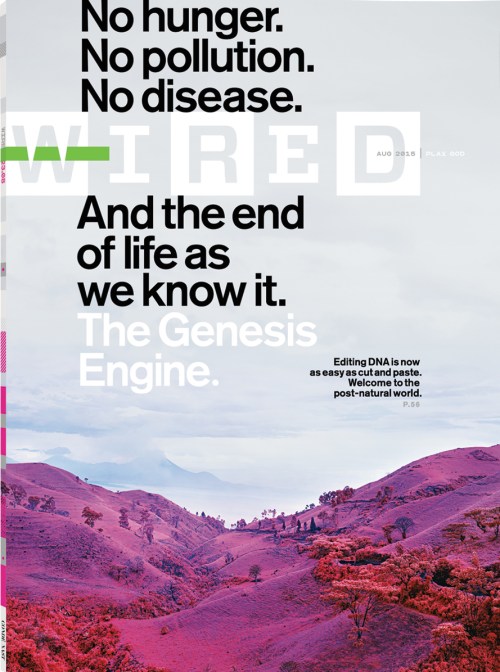
I just published What’s a War-Torn African Nation Got To Do with Editing DNA?, a piece on Vantage about Wired Magazine’s choice of a Richard Mosse photograph Myths Of The Near Future (2012) for the cover of its August issue.

The photograph was made as part of Mosse’s series Infra about the ongoing civil wars in the Democratic Republic of Congo, but the story is about the science behind– and the copyright battles over–Crispr-Cas9 a genetic engineering technique. The gulf between the original subject matter and the nature of the story raised some questions for me.

I must mention that, in light of 5.4 million deaths in DRC, the line “And the end of life as we know it” emblazoned in 48-font on the front cover, seems a little clumsy, but I’m too clueless about the magazine world for that to be my line of main inquiry. Someone else can muse over those loose words if they think there’s anything more in them than a disconnect between packaging and content typical of the marketplace.

[…]

Perhaps I am so discomfited because Mosse’s work makes so much more visual sense being bent ever-so-slightly for this futuristic narrative, than it does for its original intended political purpose?

Mosse pitched in on Twitter with the following three comments, they’re part of a longer back-and-forth with a couple of threads between Ed Brydon and I. Chase those threads if you can.

Read the full piece and see what you think.

chin

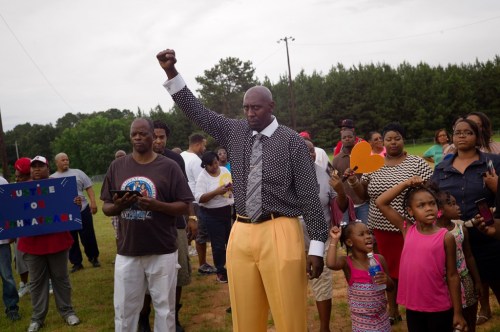
A rally in Stonewall, Mississippi calling for the indictment of Officer Kevin Herrington on charges of murder of Jonathan Saunders

The last thing I consumed on the internet yesterday was a story Another Reason To Question Whether Black Lives Matter In Mississippi by Alan Chin about the fatal shooting of a black man by a cop in rural Mississippi. His name was Jonathan Saunders.

The first thing I consumed on the internet this morning was a cop body cam video of said cop shooting an black man in the head. His name was Samuel DuBose.

Is it now a daily, normalised experience for myself, and for others, to consume death, filmed and online?

In between last night and this morning, I put the finishing touches to an essay for a fall publication about some haunting and frantic sketches made by a prisoner in solitary confinement. What is happening in the darkest, invisible, coldest cells of our criminal justice has everything to do with what is happening on our streets (after all, solitary confinement is disproportionately used against men of color and black men are 250% more likely to be thrown in the hole.) In my essay last night I wrote:

The Black Lives Matter movement has successfully tied over-zealous community policing, to stop-and-frisk, to restraint techniques, to custody conditions, to a bail system that abuses the poor, to extended and unconstitutional pretrial detention, to solitary confinement in a devastating critique of a structurally racist nexus of law enforcement. #SayHerName. Sandra Bland in Waller County, Texas; Jonathan Saunders in Mississippi; Tamir Rice in Cleveland; Charly Leundeu Keunang in Los Angeles; Sgt. James Brown in an El Paso jail; James M. Boyd in the hills of Albuquerque; John Crawford III in a WalMart in Ohio; Walter Scott in North Charleston; Eric Garner and Akai Gurley in New York; Michael Brown in Ferguson, Missouri; and thousands of more people over the past 12 months alone killed by law enforcement.

The Guardian is trying to keep track, and Josh Begley at the Intercept is trying to visualize killings by cop, but the statistics are frightening and as the cases come more and more often, they seem to get more and more egregious. Ray Tensing straight up murdered Samuel DuBose. No question. July is set to be the deadliest month of the year for people killed by police.

The tragedy heaped upon tragedies that Chin’s article hit home for me was that the news cycle can only deal with a handful of cases at any given time. But there’s scores of officer involved deaths every month. If the rate of killings continues, we’ll have seen over 1,100 deaths at the hands of law enforcement by the close of 2015.

I can’t imagine the trauma, anger and sense of injustice in Saunders’ family and community. I cannot fathom that 1,100 times over. I’m almost lost for words except for this thought. Pre civil rights, photography was used to boast of lynchings and hate crimes. During the civil rights struggle photography was ammunition in the fight for justice and the abolishment of racist laws. Since civil rights photography has broken from its usual documentary constraints to power the biggest growth of any society in the history of man, but despite massive wealth, we are still so poor in terms of understanding inequality and the combined effort by a society to fend it off. Now, images–moving and still–are taking center stage in public outrage and prosecution attempts toward law enforcement personnel who kill citizens. I just wonder what we will do with the footage of death — the jail surveillance tapes and the police body camera videos — if, in 10 or 20 years, we’ve not been able to change anything.

If nothing changes, the footage will become evidence against our own inaction in the face of massive racism and social inequality.

Change we must.

As I am lost for words, I’ll leave you (as Alan Chin did in his article) with the words of Frances Sanders, the mother of Jonathan Sanders.

“He is my son and I loved him and he didn’t deserve to die. There ain’t but one policeman who came to offer his condolences and he was black. So don’t tell me it wasn’t racism. We got a long way to go.”

See more of Alan Chin’s photos from the assignment at Facing Change.

TTP-poster-with-HBO-13

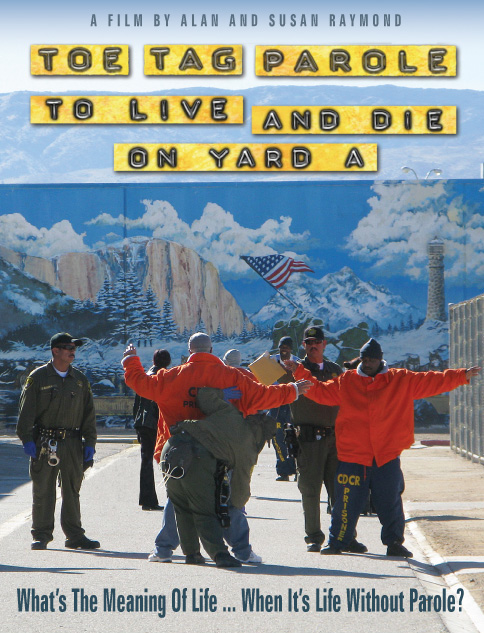
Toe Tag Parole premiers Monday, August 3rd at 9pm on HBO.

A: When it is a Life Without Parole (LWOP) sentence.

While criminal justice reformers, D.C. politicos, President Obama and the like are pressing for change they all too often focus on arguments for the release of non-violent (usually drug) offenders. Releasing that “category” of prisoner though doesn’t deal adequately with mass incarceration or prison overcrowding. We need, as a society, to look at how we treat those who are imprisoned for the longest sentences, how they got their and what we can do as a community to scale back on the vengeance and violence inherent to the prison system.

A literal life sentence is commonly referred to as Life Without Parole or LWOP. Activists tend to use the term Death By Incarceration.

In all other circumstances, parole is a complex and varied thing, but when the possibility of parole is removed it’s far simpler … and more brutal.

On HBO on Monday, there’s a documentary Toe Tag Parole: To Live and Die on the Yard, by Oscar-winning filmmakers 
Alan and Susan Raymond about LWOP.

To tell the story of LWOP, the Raymonds found an unusual facility in Los Angeles County, a maximum-security facility in the Mojave Desert. Yard A at California State Prison is the The Progressive Programming Facility — a space that committed LWOP prisoners and the California Department of Corrections forged together. With laws and sentences unlikely to change for those who are deemed the most dangerous, the “most dangerous” went about finding their own solutions.

Yard A — which inmates call The Honor Yard — is a prison yard is free of violence, racial tensions, gang activity and illegal drug and alcohol use. It’s the only type of its kind in the nation. 600 men living in The Progressive Programming Facility and seek self-improvement and spiritual growth through education, art and music therapy, religious services and participation in peer-group sessions.

The press release reads:

Ken Hartman, who beat a man to death at age 19 while drunk, and has been in prison for 36 years, says, “There’s a progression that these things go through. People used to be stoned to death and then they were shot and then they were hung, they were electrocuted. Each step along the way always the argument is made that this is a better kind of death penalty. I’m sentenced to Life Without the Possibility of Parole. It’s not better than the death sentence, because it is the death sentence.”

It promises to be a wonderful film. In an ideal world though, extraordinary efforts by men inside wouldn’t be needed because many of them would be offered the opportunity for improvement and release by the structures of the state.

pep

Social Justice and Environmental Justice Intersect

Any links between mass incarceration and environmental abuse might not be immediately obvious. But they exist and the Prison Legal News, the Human Rights Defense Center and Nation Inside are combining resources to talk to this unlikely but potent and dangerous intersection of issues.

The Prison Ecology Project is creating tools to dismantle toxic prisons.

Ask people in Appalachia who have watched prisons such as FCI McDowell built on exhausted mountain-top removal mining sites. Ask folks out west who’ve watched prisons plonked down upon fragile desert ecosystems. Ask those in the rust belt, who’ve seen prisons brought to town for the sake of jobs after heavy industry and mineral extraction have left town. When one would think regions couldn’t be stripped and abused anymore, the rape of communities follows that of the environment. In Pennsylvania, a prison built on a toxic coal ash dump is crippling those locked up inside.

Prisons, historically, have gone up where desperation for employment has meant little-to-no oversight, public discussion or even opposition. No one forecast problems because they didn’t want to imagine them; prisons provided an answer to your uncle Frank’s four years of unemployment.

“The prison industry has a long history of ecological violence. Rikers Island prison in New York City was literally built on a trash heap, and evidence suggests a high incidence of cancer among guards and prisoners,” writes the HRDC. “In California and Texas prisoners have little recourse but to drink arsenic-laced water. In Alabama, an overpopulated prison habitually dumps sewage into a river where people fish and swim. In Kentucky, construction of a new prison is poised to clear 700 acres of endangered species habitat. Stories like these are too common. The issues impact millions of people in and around prisons across the US but are largely ignored.”

GIVE ‘EM YOUR MONEY

The Prison Ecology Project is raising $15,000 on IndieGogo to boost its capacity to research and analyse data. They are uncovering abuses and amassing a clearinghouse of information on over 5,000 prisons nationwide which we can all use to fight poisonous prisons!

HRDC’s work in this chronically understudied area will “keep pressure on an industry notorious for its lack of transparency.”

DONATE

They’ve got the chops. HRDC is the publisher of Prison Legal News which has exposed environmental problems and covered stories of whistleblower litigation in prisons for over 20 years.

The first target of HRDC is a federal prison planned for Letcher County, Kentucky. Its construction would demolish 700 acres of endangered species habitat in Appalachia while imprisoning people hundreds of miles from their families.

WHY THE WORK?

“Incarcerated people are some of the most vulnerable and uniquely over-burdened demographics in our nation,” explains HRDC. “Almost all of the prison population is low-income, and people of color are disproportionately represented by wide margins in every state. Most people whose lives have been impacted by the criminal justice system have not engaged with the environmental movement up to the present time.”

The Prison Ecology Project changes that dynamic.

DONATE

Operating prisons stresses the environment. Recognising that provides yet another reason to fight the toxic philosophical underpinnings and racism of a broken and out of control system. Decarceration is good for your lungs!

It’s not so much as convincing players in one political action to adopt another, as it is exercising closer bonds between movements of the left that operate in opposition counter to the abuse and social exclusion of lower income groups. It’s about recognising new allies and being collectively stronger. I love this type of imagination.

IN THE PRESS

DONATE

EMAIL

prisonphotography [at] gmail [dot] com

Prison Photography Archives

Post Categories