Good news arrived today for Think Ten Media, producers of the innovative web series The wHole: funding has been secured to continue production. Producer Jennifer Fischer tweeted, “Big News! The wHOLE got the greenlight. Episode 2 is a go.”

$$$ ONWARD $$$

But the fundraising and the efforts are not over. If you’ve got any money to throw in the pot. I know Fischer and writer & director Ramon Hamilton would love to push toward the 100% funding. (At the time of writing, they are at 80%). You can view the pilot episode here, and if you like what you see, then donate.

If you need a little more convincing about why to support a web series about this issue then read this conversation about “The Truth Behind Solitary” — hosted by ACLU — between Amy Fettig, senior counsel at the National Prison Project at the ACLU; Jeff Deskovic, advocate and exoneree who was released after 16 years in prison; and Hamilton.

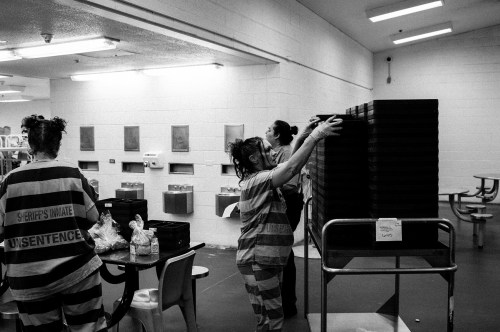
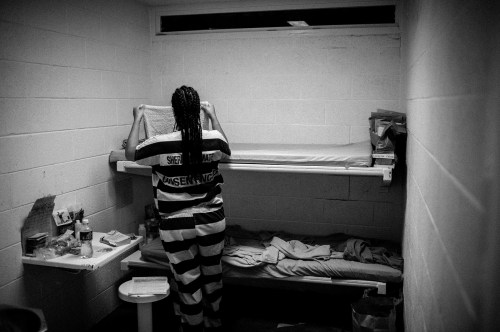
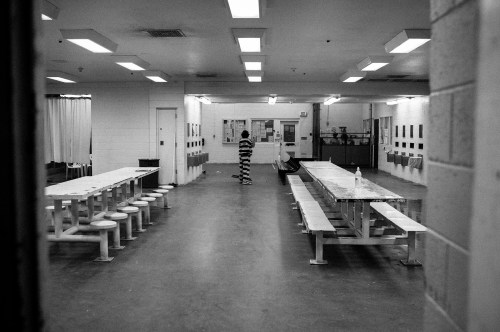
The wHole was filmed at the empty and never-used Wapato Jail in Portland, Oregon. When they were working on the pilot last year, I argued that it was the only good thing to come out of the vacant jail.

 SHAREHOLDERS? SLAVEHOLDERS!

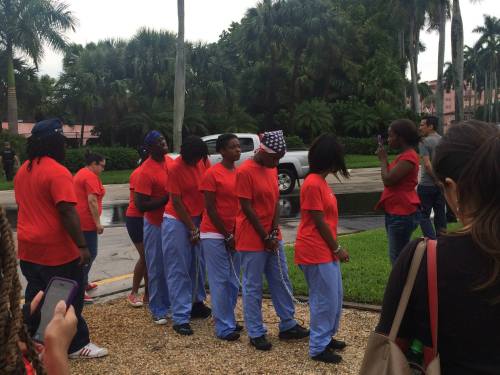
Last week, shareholders in the private prison firm GEO group attended the evil corporation’s AGM. The swarm of conniving, money-grabbing devil sperms were shocked to be joined by some protestors. Shareholders thought they’d encounter only other children of satan at the annual horn-sharpening ceremony.

Across the Boca Resort in Florida, the venue for the GEO AGM, the hell-obsessed portfolio-owners struggled repeatedly to engage with the protestors who appeared to have colorful irises and not the green dollar signs to which they were accustomed. Instead of a glassy stare, the protestors could hold lasting eye-contact and emote.
2

Some shareholders referred to the protestors as shape-shifters who employed behaviour that suggested confidence, faith, principle, civic duty, anger and nuanced reasoning — all emotions and motives that belonged to a long-lost group known as humanity, but alien to beelzebub’s GEO breed.

If the appearance of the protestors was confusing, it wasn’t a patch on the foreign language they used.

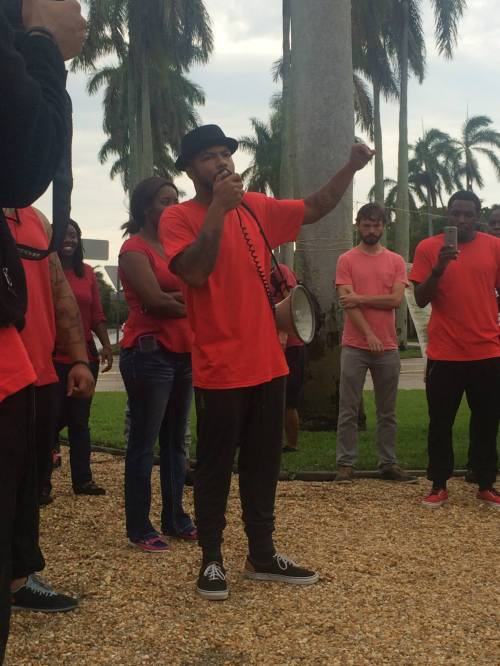
“Opportunities for Black and Brown communities have been intentionally thwarted through intergenerationally maintained oppression. What drives this? The same institution that has fueled this country since its birth—slavery,” says civil rights group Dream Defenders. “Through the proliferation of prisons for profit, the United States is a slaveholder, and private prisons are the cruel overseers who go through extreme means, including documented physical and sexual abuse, lobbying for increased mandatory minimums and fraudulent reporting, to maximize profit.”

Irene, a proud third generation GEO stock holder, mistook some of the protesters in red shirts as valets, at first.

“Then I realized they were trouble makers and just wanted to hurt others with signs. I couldn’t understand a word they were saying. Something about disadvantaged classes being heard and having a seat at a political forum not manipulated by big money. I dunno, I wasn’t paying attention,” said Irene as she rushed off to make a 4:15 tee-off time.

Okay, seriously now, it didn’t quite go down like that in Florida, last week. It was a 4:25 tee-off! No, no, really seriously. It wasn’t like that; above is just the story I wanted to write. Nothing like that. GEO shareholders are not the kin of lucifer. GEO shareholders are, each, lucifer incarnate. Let’s not dilute responsibility here.

Okay, okay, really, seriously, now.

We live in a society that allows the haves to make cash from the exploitation, hardships and warehousing of the haven-nots. What is wrong with us?
1

4

THE NEED FOR PROTEST

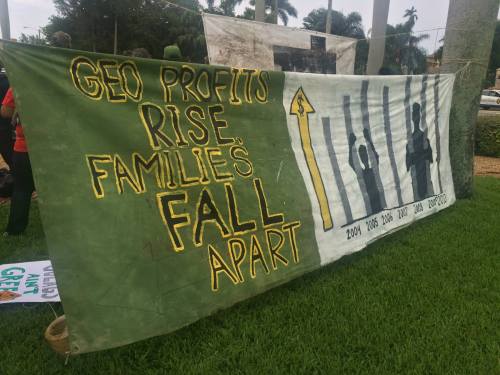
The protest organized by Dream Defenders, Prison Legal News, Grassroots Leadership, SEIU Florida and other groups adopted the slogan to “Expose the Slaveholders” for the protest.

GEO Group is the country’s second-largest for-profit prison operator, reports Nadia Prupis. GEO owns Karnes County Detention Center in Texas, which holds immigrant families and is the site of an ongoing hunger strike by detained mothers, as well as Reeves County Detention Center, currently the subject of a Department of Justice investigation.

Concerning Karnes, a Prison Legal News press release said:

Human Rights Defense Center associate director Alex Friedmann, an activist shareholder who owns a small number of shares of GEO Group stock, attended the meeting. When he asked about recent reports of hunger strikes by immigrant women held at the GEO Group-operated Karnes County Family Detention Center in Texas, he was informed by a GEO executive that there was no hunger strike; rather, it was a “boycott of dining facilities” at the detention facility.

5

As state budgets dried up, the private prison industry moved its attentions to Homeland Security $$$ and fought to win new build and operate ICE facilities. Which is weird because I don’t think it was a bevy of Latina mothers who flew those planes into the World Trade Center. GEO currently receives 42% of its revenue from contracts with federal agencies, including the Department of Homeland Security/Immigration and Customs Enforcement and the Bureau of Prisons. In 2013, 67% of all federal criminal convictions were for immigration-related crime.

What’s confusing to me is why the arguments for prison reform have been decoupled from those for fewer immigration prisons. Maybe it’s built into the DNA of the United States that the free folks can only fight for the rights of an oppressed group, if there’s another group in line to abused and brutalized? Why have we got bi-partisan support for criminal justice reform, but nothing close to such consensus about immigration reform? Why are politicians making efforts to reduce the number of people in the broken, expensive, abusive state and county prisons, but we don’t apply that same enlightenment to people who don’t carry a bit of U.S.A. paper?

Kudos to these protestors who are going after the private prison firms. Private prisons are where all the worst shit happens and the protestors know it. Private prisons are where the architecture and economic logic of cages is perfected. GEO and their equally sadist competitor CCA account for less than 10% of prisons in the U.S. but they are the growth sector.

“We know that GEO Group and other private prison companies thrive when they are able to obscure the truth about their business practices and what happens inside of their facilities,” said Kymberlie Quong Charles, Grassroots Leadership’s Director of Criminal Justice Programs.

Politicians have decoupled zealous policing and mass incarceration from ever more draconian treatment of migrants. The ICE archipelago of dentition facilities are the latest additions to the Prison Industrial Complex. Politicians hope we won’t notice. Politicians are congratulating themselves for having a civil discussion about criminal justice but they do so, now, because it is safe ground. Where were they for the past 35 years?

While state legislators tweak corrections budgets, the private prison industry will be throwing migrants into boxes at will.

Don’t think that politicians are going to lead on the private prison issue. They won’t. Look to the activists, with boots on the ground, who know what is happening. Hillary Clinton has hopped on the criminal justice reform bandwagon tapping the issue du jour for her presidential run. That other guy with designs on the White House, the Republican Senator Marco Rubio, loves GEO Group

“While Rubio was leading the House, GEO was awarded a state government contract for a $110 million prison soon after Rubio hired an economic consultant who had been a trustee for a GEO real estate trust,” writes Michael Cohen in The Washington Post. “Over his career, Rubio has received nearly $40,000 in campaign donations from GEO, making him the Senate’s top career recipient of contributions from the company.”

Short story: GEO and CCA are evil. Stakeholders have evil in their blood. Politicians are mostly clueless. Activists are without career or money ties to the issue and will speak truth to power.

3

All images: Courtesy of Grassroots Leadership.

4

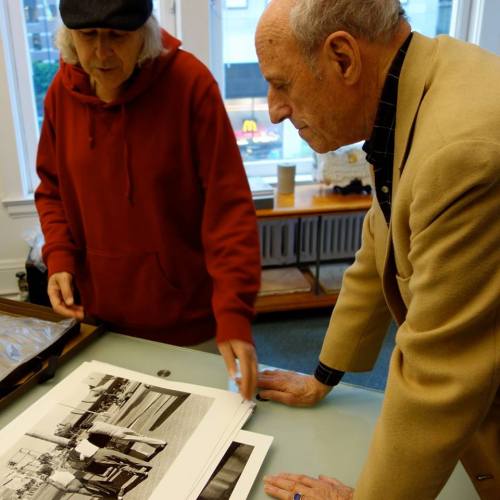
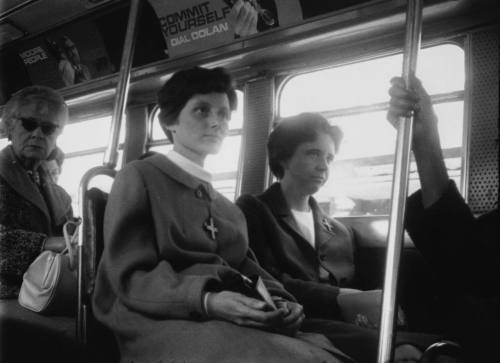
Mark Wolfe Contemporary Art in San Francisco, is to host an exhibition of never-before-seen images of San Francisco and San Franciscans, made between 1965 and 2015.

The two photographers responsible are Maury Edelstein and Ted Pushinsky — two local legends.

Of Maury’s work, 25 images have been selected from a pool of more than 6,000! God knows how many images Ted’s made in the past 5 decades. This show, I must conclude, is long overdue … and it’s gonna be gold.

All the info you need is right here.

1

3

2

MW FLYER (Ted)Spelledright

Prison-8

CAN WE ALL AGREE, NOW, THAT THE DISGRACED SHERIFF ARPAIO IS A DISGRACE?

In December 2011, Judge Snow ordered the Maricopa County Sheriff’s Office (MCSO) headed by Sheriff Joe Arpaio to cease its practices of racial profiling and “enforcement” of immigration law. The reason? Sheriff jurisdictions are not responsible for enforcing immigration law; federal authorities are.

If Arpaio had complied then he wouldn’t be where he is now and we wouldn’t have a story about his demise to enjoy. Arpaio is currently in court. He has admitted to not adhering to the court order to cease his deputies’ special brand of patrols. His weak-sauce defense is that “things fell through the cracks” and his subordinates made mistakes. The upshot? Deputies didn’t receive any retraining about how not to racially profile and harass Latino citizens.

Arpaio thought he and his office so untouchable that he ignored the court order and instructed his staff to do the same. Arpaio has been battered in court this week. First, a former senior deputy recounted how Arpaio urged him to hold presumed undocumented persons who’d committed no crime, even after ICE had told MCSO that they were not going to transfer them into custody. Second, Arpaio has been on the stand cutting a forlorn figure — unheard of from the man who has personified cocky bullishness his entire career. It’s been humiliating. Arpaio’s apologies seem less than sincere and more the actions of a man with no other options and no other distraction-techniques to call upon. Third, Arpaio admitted that his former attorney hired a private investigator to snoop into Judge Snow’s wife’s life and political affiliations.

If Arpaio’s lawyers aren’t walking out on him, they are coming under question themselves.

Prison-1

Prison-2

Prison-3

Prison-4

Prison-5

The case is ongoing and there might be more to come. Let’s just say it looks like Arpaio is going to get hit with civil-contempt charges for his non-compliance to the court order. It could’ve been any of dozens of abuses that Arpaio’s enacted, but it seems like it is this one that is to be his undoing. For a brief history of Arpaio’s sleaziest tricks, read this.

Why do I bring all of this up? Well, part of Arpaio’s power plays has been a constant play of the media. He invented pink underwear, adopted striped uniforms, instigated chain gangs. He had prisoners painting curbstones in down town Phoenix in order to put the image of the convict in front of his constituents. He dominated the visual tropes of criminality … and expanded them all. MCSO invited a constant stream of photographers through its facilities to perpetuate Arpaio’s media game and to propel the cult of personality. I’ve written a lot about different photographers’ work from ‘Tent City’ or Estrella Jail (women’s jail) or the chain gangs at large in the desert, but my position — after years of peering at it — is best described in this post Photos That Extend the Jailer’s Narrative.

Prison-7

Prison-9

Prison-10

An all-female chain gang. Maricopa County, Arizona.

Recently, photographer Anthony Karen contacted me with his photographs from the Maricopa County jails. I felt like I’d said everything about Arpaio that I wanted to say, but when “America’s Shittiest Sheriff” stepped into the courtroom this week, I was excited by the prospect of covering Big Joe and not having to complain. To the contrary, I can positively celebrate these developments. Hopefully, this is Arpaio’s final act in public office and this is the last I’ll ever have to type his name.

I’m thankful for Mr. Karen for sharing his images with Prison Photography and for letting me editorialise our Q&A with this lengthy intro.

Karen made these photographs in Oct 2012, which is to say right in the middle of the 18-month period in which Arpaio’s office was willfully ignoring court orders to cease racial profiling.

Scroll down for our Q&A.

Prison-6

Prison-12

Prison Photography (PP): You said you wanted to make non-sensational coverage. Did you achieve that?

Anthony Karen (AK): I believe so, although I consider this a work-in-process and would like to return at some point. I did take several images of Sheriff Arpaio’s poster-board ladened office, but it’s a necessary element in my opinion.

Asides from that, daily life in a jail is fairly straightforward for the most part. I say that with the exclusion of the pronounced environmental situation aka the temperatures at Tent City to which prisoners are exposed.

PP: How long were you there?

AK: I spent approximately 6 hours — in the jail and with the female chain-gang outside the facility — over a two-day period.

PP: Why did you go?

AK: I was working on a project with a journalist friend of mine from Norway. Our initial focus was a White Nationalist who conducts his own border patrols in the Vekol Valley in Arizona. The Norwegian publication we were working for thought it would add some dimension if we interviewed Sheriff Arpaio regarding his views on illegal immigration and his unique approach to incarceration.

Prison-13

Prison-14

Prison-15

PP: Did you have much interaction with Arpaio? 

AK: We spent approximately 45 minutes with him at his office.

PP: What was that like?

AK: Honestly, it was very relaxed. The Sheriff seemed to appreciate my sarcastic sense of humor.

During the interview, my friend asked the standard Tent City questions and Sheriff Arpaio responded accordingly. It was quite obvious he’s been down this interview road thousands of times before. He’s definitely his own man and proud of his accomplishments — he doesn’t seem to be phased by those who disagree with his methods.

Prison-16

Prison-19

Prison-21

PP: What did you make of the people in Maricopa and Estella jails?  

AK: The correction officers were polite and accommodating to me as a visitor and photojournalist.

Overall, no one seemed bothered by my presence. I was able to interact with the prisoners, but most of my time was spent observing and taking photos as moments presented themselves.

PP: Did they need to be there? 

AK: Unfortunately, there are people in our society who do very bad things. So as far as being incarcerated, yes we need jails and prisons. Might there be a better way to rehabilitate prisoners – yes, and that goes for other institutions as well.

PP: Were they learning, improving, drying out? What was their experience in the jail?

AK: To be fair, I didn’t spend enough time at the jail to answer that question with any authority. I did notice several prisoners occupied with activities such as drawing and reading. That said, I would like to return at some point to observe how prisoners engage in worship, the chain-gang burial detail at the White Tank Cemetery, the infirmary and processing.

Prison-23

Prison-22

Prison-24

PP: I’ve said many times before that Arpaio is media savvy and controls the message too much. Do you agree, or is there space for photographers to work and forge their own view?

AK: He is media savvy, but I’d imagine that’s to be expected from someone who’s constantly bombarded with interview requests.

I was able to roam freely within the jail, so as a photojournalist his words had little affect on my visual experience. I feel the issue is the journalist(s) that go into a story with only an hour to spare and are lured into the sensational aspects (and let’s not forget the editors role as well) which is all too common these days. Something as simple as non-scripted daily-life is far more interesting to me.

PP: Thanks Anthony.

AK: Thank you Pete.

Prison-25

9

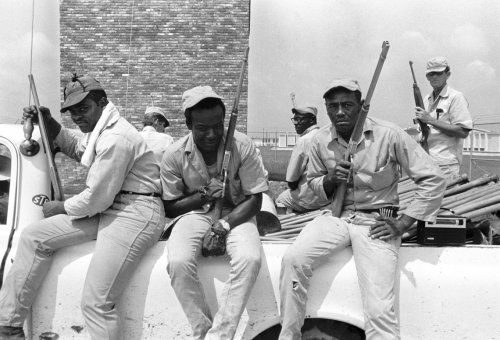
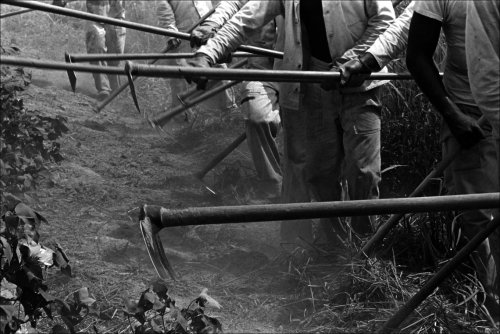
This week, The Marshall Project published an illuminating piece Prison Plantations about Bruce Jackson‘s work from inside Texas and Arkansas in the 60s and 70s. As far as I am aware, it is the best presentation of Jackson’s work on the web. 27 images.

Jackson a professor in history, writer and photographer, focused on the work songs of prisoners to trace the progression of arable land in the South from plantation to prison. For a century, between the outlaw of slavery and the era of mass incarceration (approx. 1865-1975), the Texas Department of Justice bought up old family plantations on which to house and work inmates.

Maurice Chammah writes for TMP:

For the black men who had once been slaves and now were convicts, arrested often for minor crimes, the experience was not drastically different. As Jackson writes in his introduction to the 2012 photo collection Inside the Wire:

“…Everyone in the Texas prisons in the years I worked there used a definite article when referring to the units: it was always “Down on the Ramsey,” not “Down on Ramsey,” and “Up on the Ellis,” not “Up on Ellis.” It made no sense to me until I realized that nearly all of those prison farms had been plantations at one time, so it was like an abbreviated way of saying “I’m going to the Smith family’s plantation,” or “I’m going to the Smiths’.”

This was the end of an era. Right after these photos were taken, in 1980, William Wayne Justice, a federal judge, issued a sweeping decision in the prisoner rights case Ruiz v. Estelle. Justice forced Texas prisons to modernize in all sorts of ways, from adding staff to improving working conditions to stopping the policy of allowing prisoners to guard one another with weapons. Jackson photographed prisoners with rifles, an image unthinkable today.

It’s a great little piece putting into stark perspective our very recent history. And Jackson’s pictures take us straight back there. Read Prison Plantations.

11

3

2

J_Krimes_ESP_Install

In the past, I have sung the praises of both Jesse Krimes’ huge 39 cloth-panel mural Apokaluptein:16389067 and the programming at Eastern State Penitentiary.

Last night, the two joined forces to insert Krimes’ otherwise massive flat mural into one of the cells at ESP.

The wrap around, judging from the photo (above) looks very effective. I’m guessing they’ve reproduced the mural on paper and pasted it up on those damp, crumbling ESP walls. If I wasn’t 3,000 miles away I’d pay a visit and immerse myself in this work.

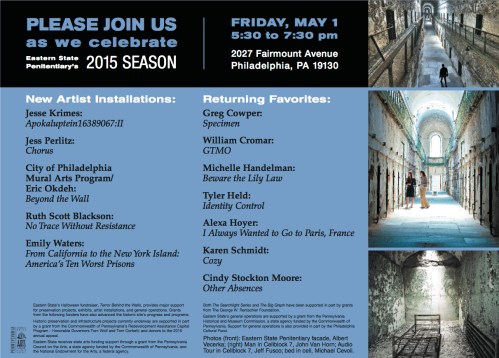
Krimes’ work is part of a new season of art installations at ESP (see the flyer below) in which Emily Waters’ fantastic “commemorative” plates of the 10 worst prisons in the United States is also featured. More on Waters’ project here.

ESP_ArtInvitePostcard

Fantastic project this — it marries snark, with traditional craft, with urgent PIC politics.

Emily Waters's avatarEmily Waters Design

Decorated by the shop of Louis Marie François Rihouët, French Hard-paste porcelain with enamel and gilt decoration Decorated by the shop of Louis Marie François Rihouët, French
Hard-paste porcelain with enamel and gilt decoration

My idea is to tie the history of solitary confinement at Eastern State Penitentiary with the present conditions of the American penal system. The inspiration for my installation came upon seeing a photo of the Dessert Plate, created at the Rihouet Factory in Paris, circa 1838, which was part of a larger collection of souvenir plates that presented contemporary images of Philadelphia tourist attractions.  The sight of a prison, a place of suffering and isolation, on a dish designed to serve the sweetest confections seemed wierdly incongruous and startling, even if the original intention was benign and idealistic.

I learned that solitary confinement at ESP, an early 19th century “progressive” experiment, was discontinued in the early 20th century.  Since the end of our last century, however, the practice nationwide has grown to unprecedented…

View original post 190 more words

Maj-Daylight-AlmondGarden-023-72

NO BARS, NO GUARDS, NO LOCKS

Tattered lace curtains, taped family photos, patterned carpets, plastic flowers and snappy fabrics. Gabriela Maj’s portraits from the series Almond Garden have all the chirpy, easy-to-patronize details of portraiture from a former Soviet controlled region. Lost you already? Think of Sergey Poteryaev’s portraits, Rafal Milach’s Winners in Belarus, Olya Ivanova’s portraits of young girls in rural Russia or anything by Sasha Rudensky. More directly consider the backdrops photographed by Lucia Ganieva.

(As much as I hate top-loading an article with links to a host of other photographers, I must because before we can understand how special and different Maj’s work is, we must appreciate the en vogue photo practices from which it emerges and above which it must rise.)

Almond Garden

For the moderately trained eye, Maj’s work is obviously anchored within a super-region that still carries the visual culture of its immediate past. No matter how hard former Soviet countries try, nor how quick they build, photographers still seem to be able to isolate the details that’ll whiplash people back in time. The problem I outline here is twice as tricky because we, in the west, think that all changes in the former USSR since the end of the Cold War must at least be headed in the right direction.

The framework I am trying to set up here, basically, is that in which Soviets — and all those formerly-ruled by them — are ‘Othered’ and misunderstood by most viewers looking at photographs made in the region. I offer a word of caution before you step into Maj’s portraits. The stories burdened by the women in Maj’s Almond Garden are devastating and the worst thing we can do with Maj’s work is to lump it in with all that work of the knackered Russian empire.

Almond Garden

Maj-Daylight-AlmondGarden-00872

Almond Garden

Maj-Daylight-AlmondGarden-010

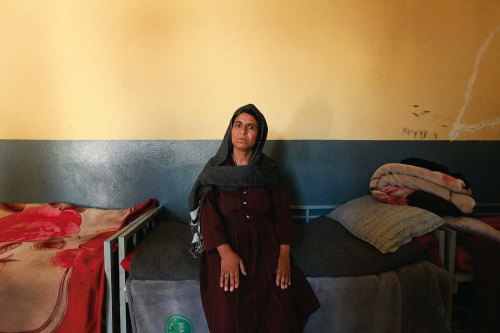
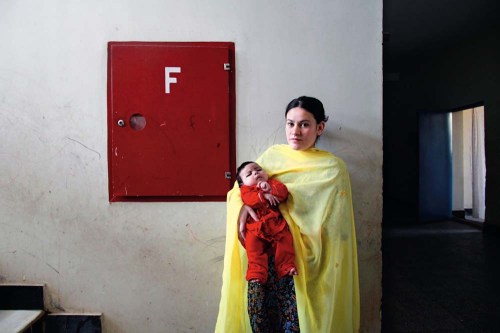
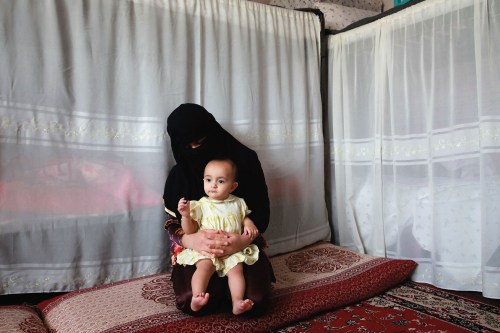
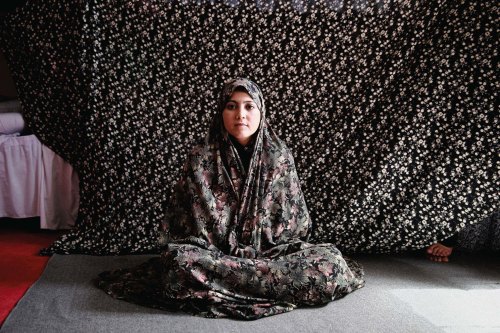
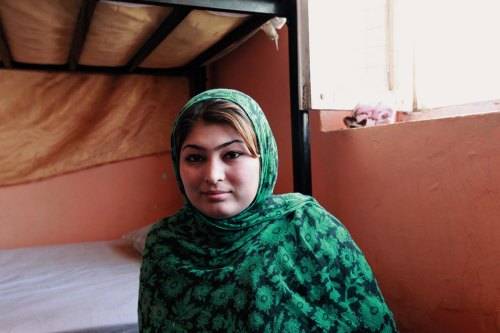
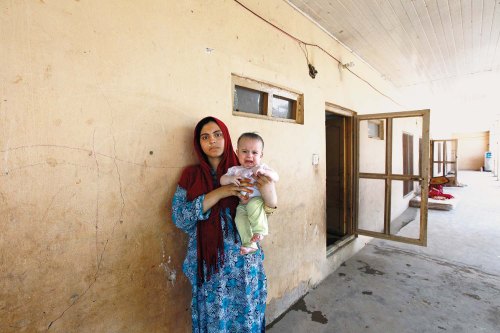
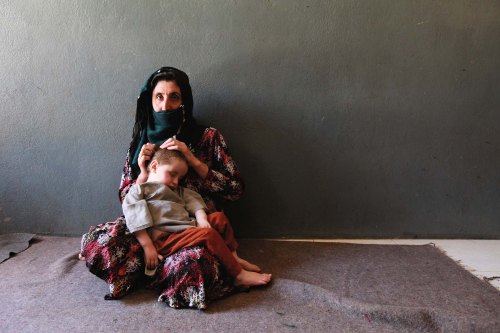
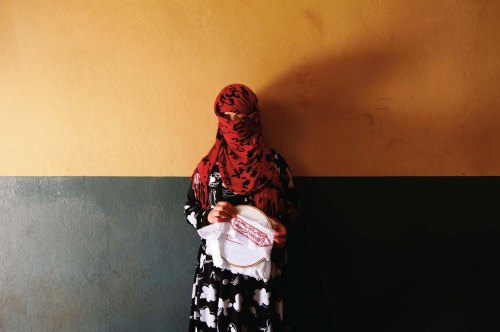
Over the course of four years (2010 – 2014), Polish Canadian photographer Gabriela Maj travelled throughout Afghanistan to collect portraits and stories from inside the country’s women’s prisons. She visited with many of her subjects on multiple occasions.

Maj actually believes that being of Polish origin helped her to gain relatively unhampered access. Poland and Afghanistan shared a history of Soviet oppression.

It also helped being a woman. In fact, her mode and ability of movement revealed the so very twisted logic of a prison system that brutalised women.

“As a solitary female photographer, accompanied only by an Afghan interpreter, I was frequently left alone in the prisons once our guard escort tired of monitoring me. My sense was that unaccompanied by any security, a woman, albeit a foreign one, was not considered a threat,” she writes in an essay featured in the book. “Being overlooked in this way became a strategy that ultimately exposed the context within which I was working, one where women’s narratives were considered irrelevant to the power dynamics that ran the country.”

Maj-Daylight-AlmondGarden-062-72

Maj went the extra mile and then some. The least we can do it get there with her. The majority of the prisoners Maj documented were incarcerated for what are known in Afghanistan as “moral crimes,” a term used to condemn those who’ve had sex outside of marriage, or run away from any number of abuses — forced marriages, being sold into prostitution, domestic slavery, physical violence generally conducted by their husbands, and rape and involuntary pregnancy.

Indeed, the portraits are powerful but it is the relentless injustice of the testimonies of the women that delivers the power and absolute necessity of Almond Garden. Maj has changed the names of the women to protect their privacy. She goes a step further and moves the stories to the back of the book.

“Separating the portraits from the stories has allowed for a record of the experiences of this group without any one woman being defined by the crime she was accused of,” explains the press release.

Each entry leads with the offense that the woman is accused with, her age and the length of her sentence.

I haven’t been so effected by a project pairing portraits of women with their transcribed words since, strange as it might be to offer, Malcolm Venville’s The Women of Casa X, which features portraits of aging sex-workers in Mexico. But, then again, perhaps not so strange? Both the women in Melville’s work and the prisoners in Maj’s work have been categorized, judged, ostracized and maligned by dominant patriarchal culture. In both cases, if the photographer hadn’t shown up, these stories would be buried (which is the culture’s intent, right?)

“Often times rejected by their families, these women’s situations can become grave after they are released,” says the Almond Garden‘s blurb. “Without the protection of their relatives that spurned them, they are often in very real danger of being killed or tortured unless they are able to seek refuge in a women’s shelter.”

Maj-Daylight-AlmondGarden-057-72

Maj-Daylight-AlmondGarden-033-2-72

Maj-Daylight-AlmondGarden-038-72

Almond Garden

It is bittersweet to think of these tortured moments in prison might be, for some women, where emotional and physical trauma exists least. That said, there is no psychological treatment or therapy available within the prisons Maj visited.

The title of the book Almond Garden is a play and is incongruous. It is the English translation of Badam Bagh, the name of Afghanistan’s most notorious penitentiary for women, located on the outskirts of Kabul.

Almond Garden publishers, Daylight Books, say that Maj’s project is the “largest record documenting the experiences of incarcerated women in Afghanistan produced to date.”

It’s stunning. It works in waves as all good photography should. I’ve been drawing important lessons from Almond Garden each time I’ve returned to it. Aesthetically, it’s as good as Michal Chelbin’s Swans and Sailboats, portraits from Ukraine and Russia. Ethically, I think it surpasses it as Chelbin is evasive about the details of her access.

BOOK TOUR, NOW!

Maj is currently on book tour.

Los Angeles tonight! If you’re in San Francisco, hit up one of her two events next week. On May 5th, at Modern Times Bookstore, or on May 6th at The Women’s Building.

BUY THE BOOK

Here, for $45.00.

DATES ON THE ALMOND GARDEN BOOK TOUR

May 1st, Exhibition and book signing with Daylight Books at the Leica Gallery in West Hollywood, CA.
May 5th, Presentation and book signing at Modern Times Bookstore in San Francisco, CA.
May 6th, Presentation and book signing at the Women’s Building,7:30-9:00, San Francisco, CA.
May 9th, Presentation and book signing at Apostrophe Books, 5:00-7:00pm, Long Beach, CA.
May 22nd, Presentation and book signing hosted by the Vermont Professional Photographers Association and the Peace and Justice Center, 6;00-8:00, Burlington, VT.
July 31st, Exhibition opening and book signing at Daylight Project Space , Hillsborough, NC.
August 8th, Book signing at Author’s Night 2015, East Hampton, NY.

Almond Garden

EMAIL

prisonphotography [at] gmail [dot] com

Prison Photography Archives

Post Categories