Nigel Boyle

‘TRIUMPH’

For the Winter Issue of Actually People Quarterly (APQ), I interviewed college professor Nigel Boyle who played the beautiful game in circumstances that most would consider unlikely. Nigel explains, however, that football is a way of life among the Ugandan prison population who welcomed he and other educators with untold warmth.

The theme for the Winter APQ Issue was ‘Triumph.’ Nigel had a good game.

It’s great to publish the APQ article, in full, here on the blog. Thanks to my friends over at San Francisco’s Carville Annex for ongoing collaborations.

FOOTIE

Nigel Boyle is a bit like me. He’s English, he’s quite white, he can’t control his bigger smiles, and he’s a mad football fan. Earlier this year, before I visited Nigel’s hometown of Claremont, California, I contacted him because he had been teaching in his local prison. I wanted to know more about that.

I did not know he had taught in a prison in Uganda this summer, too. Nigel invited me to a soiree at his house. It was a reunion of the faculty, students and administrators involved in the Uganda prison teaching program as well as directors of partner organizations. I was made to feel very welcome.

Nigel supports Aston Villa, who play in claret and blue. They’re based in Birmingham, have existed since 1874, and were one of the 12 founding teams of the English Football League. I support Liverpool who play in red and, down the years, have won more trophies than Villa. Neither team haven’t won many titles in recent decades.

Nigel is one of those lucky people that has managed to merge his passion for a particular sport with his professional pursuits. He has taught seminars on the history and political economy of football and once delivered a conference paper titled “What World Cup and Champions League Soccer Teaches Us about Contemporary Europe.” Before he moved to California to teach at Pitzer College, Nigel taught at Duke and Oxford universities.

During his party, Nigel entered the kitchen clasping a photograph. In it, he was pictured with teeth and fists clenched, in mid-sprint in front of a crowd of onlookers. It looked like he had just kicked a ball. He explained that the onlookers were prisoners in the Luzira Upper Prison, in Uganda. Naturally, I had questions.

Q & A

Prison Photography (PP): Why were you in a Ugandan prison?

Nigel Boyle (NB): I was there as a volunteer with the Prison Education Project (PEP), a California program founded by my colleague Professor Renford Reese. PEP had been invited by a Ugandan academic, Arthur Sserwanga, who has been doing third-level education in Ugandan prisons.

PP: So football in prison?

NB: There are 10 “clubs” at the prison and they are all named after renowned European teams — Man United, Liverpool, Aston Villa, Leeds, Chelsea, Arsenal, Newcastle, Everton, Barcelona and Juventus.

PP: Really?

NB: Really. A league structure is an organizing principle inside. They all have long histories and fan clubs. They adhere to league codes of ethics and conduct. They have transfer windows!

PP: Why were you playing?

NB: I watched several games at the prison – tournaments between a game between the Luzira Upper Prison Team and another prison team (Murcheson Bay Prison) and one between the Luzira Upper Prison Team and the prison staff team. I got antsy as a spectator and put together a team of U.S. students and students from Makerere University. Games are the primary entertainment at the prison, 3,000 spectators. I was not sure when the game was going to happen which is why I was wearing my “teaching kit” not my Villa kit. We were playing the Arsenal club team.

PP: How did the game go?

NB: Arsenal started off by scoring early and then went easy on us as we had some inexperienced players on the team. But then we started to play a bit, got an equalizer and the crowd really got into it. They were supporting us mostly (apart from the Arsenal fans, of course). The crowd was most delighted with the “the girl” on our team, a U.S. student called Ashley. That she could actually play well led to roars of approval. As the old Muzungu* on the field I also drew some cheers when I showed I knew how to kick a ball.

PP: Was it tense?

NB: It was the friendliest “friendly” game I have ever played in. In fact all games at Luzira are played in a very gentlemanly fashion – the prison soccer association constitution demands it and sets explicit standards for player and fan behavior, above anything FIFA* can manage.

PP: What are your strengths and weaknesses as a player?

NB: I’m your basic Brummie* parks player. Good in the air, poor control, good passer, slow. I played at the back most of the game, with 10 minutes to go it was 3-3 and I moved up front.

PP: That’s when your moment of glory came?

NB: I scored with a sidefooted shot from 15 yards out, with only 8 minutes of the game to go. The crowd which was about 3,000 roared.

PP: A crowd of 3,000!?!?

NB: My childhood fantasy came true. Then I scored again. I was through on keeper, chasing down a clearance. We won the game. Being “interviewed” about my performance in this game only adds to the sense of my childhood dream coming true at the age of 53! After the game there were speeches (there always are after Luzira UP games). I thanked the Upper Prison Football Association, and it’s president-prisoner Opio Moses, whom I’m proud to call a friend.

PP: Will you ever play in front of a crowd that big again?

NB: Only if I get back to Luzira again, and I would love to do that.

PP: Are you at all tempted to retire on a high?

NB: I know guys in their 60s still playing pick-up soccer and I intend continuing as long as my knees hold out. But this is the story I will be telling my grandchildren.

PP: What’s football got to do with education?

NB: I’ve taught a course on comparative political economy through football (or soccer/futbol/fussball) eight times, at three institutions: Pitzer College, the University of Landau in Germany, and at California Rehabilitation Center, which is a prison in Norco. Is there a better lens for understanding contemporary globalization out there? Certainly not one that engages students the way the beautiful game does.

PP: How do Uganda prisons differ from those in the U.S.?

NB: U.S. prisons use vast human and financial resources to dehumanize prisoners and deny them the ability to function as social beings. I’m only familiar with Level 2, medium-security prisons in the U.S., but these are militarized holding pens.

Luzira Upper Prison is the top maximum security prison in Uganda, but staff carry no weapons, look prisoners in the eye, and treat prisoners as potential co-managers of the prison, not as human refuse. Resource starved Ugandan prisons allow prisoners to organize themselves into a civil society behind walls, and it’s through the football clubs and the Prison Football Association that prisoners have organized and bargained with prison staff.

Upper Prison Luzira was a colonial prison designed to incarcerate and punish men who threatened British law and order. In the last 20 years, this colonial shell has been allowed to sprout prisoner-led education (literacy through degree levels), and sports and cultural organization that provide a training in how to be a productive citizen. U.S. prisons talk about “rehabilitation” but appear to be designed to induce PTSD.

PP: Thanks Nigel.

NB: Thank you, Pete.

A GLOSSARY OF TERMS

Brummie = a person born in Birmingham, England.
Muzungu = Swahili word for white man.
FIFA = The International Federation of Football Associations, known most recently for its bloated coffers, back room deals, golden handshakes and rampant corruption.
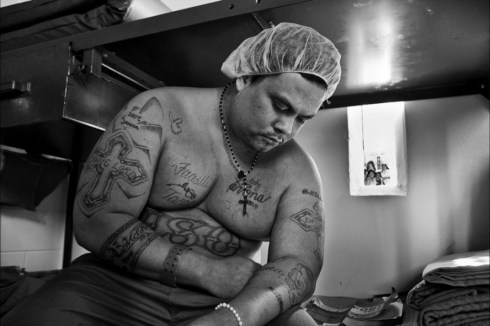
Gumpert

Photographer, friend and fellow San Franciscoer Robert Gumpert will be exhibiting at St. Mary’s College in Moraga, California from January 25th to March 15th.

On show will be photographs from two projects — Gumpert’s ongoing Take A Picture, Tell A Story, and images from “I Need Some Deodorant. My Skin Is Getting Restless” which were made between 1996 and 2002 at the Alameda County’s Psychiatric Emergency Services at John George, Oakland. In both bodies of work, Gumpert uses oral history (audio and text interviews) to add description, depth and context to the experiences of his subjects.

If you’re in the Bay Area, I strongly recommend a trip through the Caldecott Tunnel out to Moraga.I’ve long been an admirer of Gumpert’s work, specifically Take A Picture, Tell A Story which is part of my curated effort Prison Obscura.

Prior to the public reception on January 25th, will be an hour long panel discussion with Gumpert; architect/activist Raphael Sperry; and psychologist/authority on solitary confinement Terry Kupers.

Click on the flier below to see it larger and glean all the critical information.

Robert Gumpert

Tameika Smith-032 copy

Tameika Smith, San Francisco, CA. SF CJ2. 9 July 2012.
Take A Picture
Deborah Lee Worledge, San Francisco, CA. CJ1 Men’s jail. 4 April 2008.

Take A Picture

Michael Johnson, San Bruno, CA. CJ5.

FullSizeRender-8

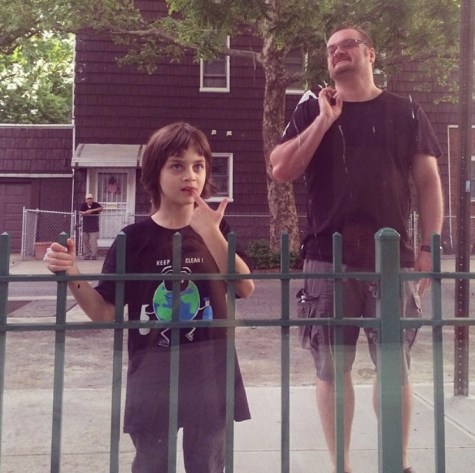
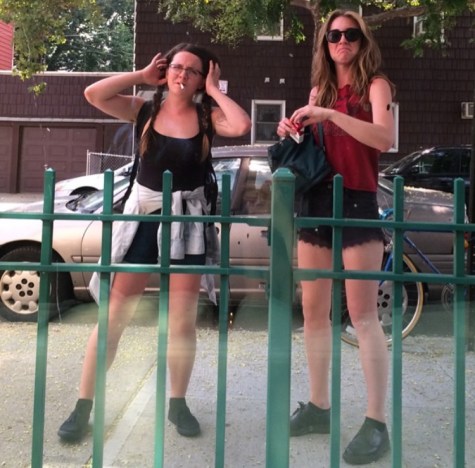
I wrote about the Greenpoint Glass Selfie Window for Vantage, on Medium — All Of Us, Looking at You, Looking at You.

“Molly’s living room window — Greenpoint’s own ‘Selfie Window’—is a local landmark. Over the past year, a small patch of Brooklyn pavement has become a haven for impromptu portraits, in-jokes among friends and street performances.”

Follow @greenpointglass on Instagram — they’re one of my favourites.

FullSizeRender-25

FullSizeRender-9

FullSizeRender-20

FullSizeRender-13

FullSizeRender-6

FullSizeRender-4

FullSizeRender-18

FullSizeRender

FullSizeRender-22

Group holding cages, C-Yard, Building 13, Administrative Segregation Unit, Mule Creek State Prison, August 1st, 2008

Photographer unknown. Group holding cages, C-Yard, Building 13, Administrative Segregation Unit, Mule Creek State Prison, August 1, 2008

The coalition activist groups Californians United for a Responsible Budget (CURB) are doing tremendous work at tracking was is said as compared to what is done by the Golden State’s politicians. Governor Jerry Brown has been particularly adept at appeasing the centrist and liberal leaning electorate without ever taking bold action to reduce California’s reliance on incarceration.
This morning, Gov. Brown announced an increase in spending on corrections at the state level. Not acceptable.

You may wonder why I focus on California so much. Well, aside of the fact it is my home state, California is often a bellwether for actions in other states. California was the first to enact Three-Strikes-And-You’re-Out Laws in the mid-nineties and it was the first to repeal them at the ballot in 2014.

California is a massive economy — bigger than most nations — and yet inequality in the Golden State has never been more stark. California tells itself it is a global leader. However, if that were true it would be spending less money on cages and more money on education, rehabilitation, and initiatives to build healthy communities.

Today’s announcement from the Governor’s office simply is not good enough. Here’s CURB’s response:

CURB PRESS RELEASE

California Governor Jerry Brown Backslides on Corrections Budget, No Substantial Reductions to the Prison Population Except Costly Expansion

Gov. Brown’s 2015-16 Budget, released this morning, defies comments earlier this week that the administration is committed to shrinking California’s over-sized prisons by increasing prison spending by 1.7%, bringing the total Corrections budget up to $12.676 billion.

“If the Governor believes that ‘we can’t pour more and more dollars down the rat hole of incarceration’ and has actively attributed the voice of the voters in this decision, then why is he increasing spending on corrections, planning for more prisoners rather than fewer and defying the demands of the Federal Court to further shrink the prison system?” asked Christina Tsao of Critical Resistance. The proposed increase of funding for corrections is partially due to 13 new reentry hubs.

California’s overwhelming passage of Prop. 47 was widely recognized as a mandate from voters to further reduce the prison population. County officials in Los Angeles have estimated an annual reduction of 2,500 in their jail population, however today’s budget predicts that in 2015-16 only 1,900 people will be released from state prison under the proposition. The budget highlights the release of people from prison as a result of the expansion of good-time credits (4,418) and elder parole (115). The budget does not outline any further plans to expand these efforts.
“Today’s budget shows the success of parole and sentencing reform measures in beginning to reduce crowding in California’s bloated prisons,” said Diana Zuñiga, Statewide Organizer for Californians United for a Responsible Budget. “Then why is Governor Brown still spending millions of dollars to open thousands of new prison beds, instead of implementing even more aggressive population reduction reforms?” asks Zuñiga. The budget anticipates that 2,376 new state prison beds will open in Feb. 2016 at 3 different locations.

“Today’s budget maintains California as #1 in poverty and #1 in prison spending. This is not an accident, “ said Vanessa Perez from Time for Change Foundation. “This morning Brown applauded the legislature on a balanced budget but we need to tear down the wall of poverty and invest more into vital programs and services that will lift the most vulnerable in our community out of poverty and stop wasting money on building new prisons walls. That is something that will be worthy of an applause”.

After years of cuts, today’s budget includes an increase in spending on K-12 and higher education. Education advocates, particularly in the UC system would like to see even further increases to prevent tuition hikes. “Higher educations in California has needed more funding for years. As we see tuition hikes happening for UC students across the state, here in San Diego they are building new prison beds at Donovan State Prison,” says Allyson Osorio a student working in External Affairs at UC San Diego. “We should support the students in California and stop wasting precious funding to increase incarceration.”

——

CURB Press Contact

Emily Harris, Statewide Coordinator, Californians United for a Responsible Budget

1322 Webster St. #210
Oakland, CA 94612

510-435-1176

emily@curbprisonspending.org

Twitter: @CURB_Prisons

facility4692

I was invited by WIRED to write about Josh Begley‘s work Prison Map. The article is Aerial Photos Expose the American Prison System’s Staggering Scale:

There are some 2.2 million people behind bars in the United States. That’s more people than there are in all of New Mexico. And there are more jails and prisons than colleges and universities in this country. Still, it can be difficult to grasp the scale of incarceration in America, in part because so many of these facilities are tucked away far from view in rural areas.

Prison Map provides a sense of the enormity of it all by giving us a fascinating vantage point from which to view the architecture of incarceration. Begley’s created a vast visual compendium of the nation’s jails and prisons, comprising more than 5,300 aerial images that offer a compelling metaphor for the rapid expansion of the American prison system.

Prison Map is about visualizing carceral space,” says Begley. “We have terms like the ‘prison industrial complex’ but what does that actually look like? If you were to stitch together all these spaces of exception, how might they appear from above?”

Read more at WIRED.

facility3131

facility 487

facility403

facility491

facility221

facility497

facility206

facility4644

facility1653


The Abolitionist Law Center is doing wonderful things to hold morally-bankrupt and cowardly Pennsylvanian politicians to account.

prisonpop

More prisons than colleges? Are we surprised? It seems that ever depressing metric one turns to, shows the prison industrial complex out of control, tumorous and beyond expensive. Just when you think you’ve seen all the maps and data points, another emerges to hammer home our sad reality with “corrections” in this country.

Charlie Ingraham at the Washington Post’s Wonk Blog points out that when we trot out the U.S.’s incredibly high incarceration rates, we tend to focus less on where we’re putting all those people. If we do that, we see that large swathes of California, Florida and Arizona have the biggest prison populations per capita. Southern states are not shy to lock people up. Rural counties’ demographics are skewed — up to 20 or 30% of their population being imprisoned individuals.

“To put these figures in context, we have slightly more jails and prisons in the U.S. — 5,000 plus — than we do degree-granting colleges and universities. In many parts of America, particularly the South, there are more people living in prisons than on college campuses. Cumberland County, Pa. — population 235,000 — is home to 41 correctional facilities and 7 colleges. Prisons outnumber colleges 15-to-1 in Lexington County, SC,” says Ingraham.

One conclusion of many? Prisons and jails have infected nearly every corner of the land of the free. “Nearly 85% of U.S. counties are home to some number of incarcerated individuals,” says Ingraham.

See the map and see your county.

HONORÉ FELICIANO DE SOUZA, the CHACHA VIII

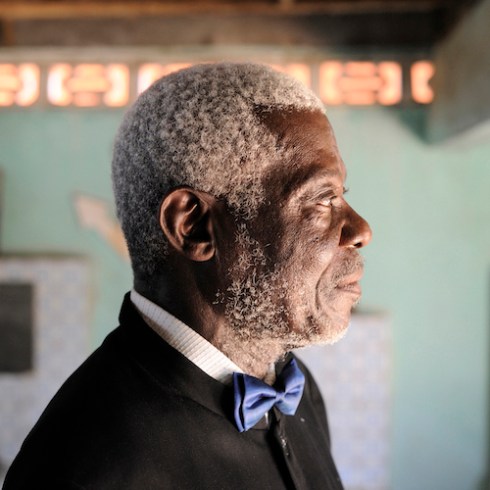
Honore Feliciano de Souza is the current head of the Agoudas community and the direct heir of Chacha I (1754–1848), who was one of the foremost middle-men in the slave trade between the Kingdom of Dahomey and the Europeans, early 19th century. To honor their ancestor, the family seemingly runs a sort of memorial in Singbomey, where Chacha I is buried in the family cemetery. According to Honore Feliciano’s unlikely opinion, “the Chacha was not involved in such a slave trade as this. At the time when the Kingdom of Dahomey was killing people, he preferred to take them to Brazil to make them work. He was in fact saving people and that is the reason why today there is some admiration for him,” he says. “Nowadays, no one would want to be a Chacha. Being Chacha is facing many hardships. I haven’t chosen to be one. On October 1995, everyone gathered here and I was appointed Chacha VIII, I cried that day. It’s a life-long mandate.” © Nicola Lo Calzo. From the series Tchamba.

LEGACIES AND TRACES OF COLONIALISM

Culture is a complex thing, especially when it is emergent from centuries of violence, oppression and bondage. The Atlantic slave trade moved millions of bodies and reordered the geographies of peoples and their customs. There are as many histories as there were individuals who lived and suffered, were bought and sold.

Photographer Nicola Lo Calzo has waded deep into this history for his ongoing, serialised project Cham. For five years, he has investigated slavery’s legacy in Africa, the Caribbean, the Americas and Europe.

“From the destruction and the uprooting imposed by the Europeans, to the conquered and deported peoples, the history of slavery is inseparable from the odyssey of Western colonialism,” says Lo Calzo. “But it is also the history of resistance to slavery.”

Elements of resistance are visible in the myriad of visual cultures and traditions upon which Lo Calzo has turned his lens. There no longer exists clear icons or customs that are squarely of a single experience or people. Over the centuries, and at different moments, descendants of slaves across the Atlantic region have won freedom, moved and settled, mixed, revived ancient traditions, and reclaimed symbols of the slavery era. Everything, visual culture included, is in constant flux.

“I’m interested in exploring through photography how and why these groups re-appropriate their slavery past, the ways and manners by which they are transferring this memory to the next generation, as well as its impact on modern societies,” says Lo Calzo.

Portrait of David GODONOU DOSSOU, Porto Novo

The founder of the David Akplogan Godonou Dossou family was a wealthy merchant of Gouns ethnicity, coming from Porto Novo. “Akplogan” referred to his function as cult minister under King Toffa. According to Mirabelle G. D., great great granddaughter of the founder, “at the peak of the French domination, he decided to change his name and give up voodoo”. Like most of the city’s rich merchants, he owned “mede”, literally “chosen people”, a dozen of domestic slaves, according to his descendant’s testimony. In this picture shot in the nineteen-twenties, at the height of his economic power, he is seen sitting in the main courtyard of his property. Porto Novo, Benin. © Nicola Lo Calzo. From the series Tchamba.

Gerardo DE SOUZA and the DEATH on Ouidah’s Beach ( closed to the «Gate of No Return» ) after the Buryan ceremony.

In Buryan, Death embodies also the spirit of the slaves’ master, who is the founder of their community, Don Francisco Felix de Souza, known as the Chacha I. This double figure of the “Death-Master” is the protector of the hierarchy within the community, while becoming the oppressor of those who would violate it. Buryan perpetuates its original signification in confirming and consolidating the hierarchy and casts among the members of the community: the De Souza of servile ascent on one hand, and the De Souza of direct lineage on the other. Oiudah Beach, Benin. © Nicola Lo Calzo. From the series Tchamba.

CONFORTE and GODONOU DOSSOU FAMILY, Porto Novo

Sitting in the center of the picture, Conforte, aged 30, now lives in this house built by her great-grandfather David Godonou Dossou, in the early 19th century. Like the majority of the merchant families, he owned Médé, literally meaning “chosen people,” a dozen of them according to her. These slaves were employed for domestic tasks; construction works in the family concession and in the palm oil plantations. This house is one of the highest examples of Afro-Brazilian architecture in West Africa. “Everyone wanted to abandon our ancestral property as we lacked resources and personnel,” says Mirabelle G. D., the great great granddaughter of the founder. “We’ve been brave enough not to let the house crumble down. The UNESCO has asked for the house to be maintained but we are still waiting for all the heirs’ approval.” Porto Novo, Benin. © Nicola Lo Calzo. From the series Tchamba.

CLEMENT OLIVIER DE MONTAGUERE, descendant of Olivier de Montaguere in the family cemetery, Ouidah.

Clement is a member of this family originally from Marseille, France. His ancestor, Olivier de Montaguere, was the nineteenth steward of the French Fort for Louis XVI. He arrived in Ouidah in 1776. He brought with him his wife and their three children, Joseph, Nicolas and Jean Baptiste and organized the slave trade with the French West Indies, He disappeared during one of his trips to the Caribbean and he is never returned to Ouidah said Clement Olivier of Montaguere. Their descendants still live today in the old compound of their ancestor. Unlike many other local families, they have no voodoo altars in their homes, and while claiming their European origins, they strictly observe the catholic religion. Today, in the family cemetery (where I got the pictures), the oldest tomb is to Nicolas Olivier de Montaguere’s. According to the tradition, Nicolas grew up with the king of Dahomey Agonglo (1789–1797). After his adolescence spent in Abomey with the king, he returned to Ouidah in his father’s family home when he continued to deal palm oil . Nicolas and Joseph’s descendants still live in the old compound of their ancestors. They have maintained a position of prestige in the society, and historically occupy important positions in the public administration. Ouidah, Benin. © Nicola Lo Calzo. From the series Tchamba.

Cham is made up of multiple chapters. Mas was made in French Antillas in collaboration with the Mas groups of Guadaloupe. Ayiti was shot in Haiti. The series Tchamba explores memory and experience in the African nations of Senegal, Ghana, Togo and Benin.

COMPLEXITY AND CONTRADICTION

During his work, Lo Calzo has encountered Creoles, descendants of revolutionaries, Voodoo practitioners and black resistance revivalists. Lineages and connections to past slavery are unique. Each generation that passes churns the mix. Lo Calzo, who resides in Paris, likes to use the French word ‘metissage’ when discussing the Cham. Metissage is a positive and politically-conscious term that celebrates diversity and the mix of race in culture.

“With all forms of creation and miscegenation, born as a result of the clash between the oppressed groups and the dominant system, the memory of slavery should be read and interpreted within this hybrid and metis universe,” says Lo Calzo. “It is characterized by ambiguity, mixture, juxtaposition and contradiction. I wish to make visible the connections — and also the contradictions — between these forgotten memories still living through the Atlantic world.”

To note the assimilation of colonial festivals, costume and figureheads is a potential political minefield. Yet, Lo Calzo is not celebrating the vestiges of Western colonizers. Rather, he is merely documenting them as fact. Sympathy toward, and faithfulness to, his subjects stories is Lo Calzo’s modus operandi. The African Yoruba and Nago communities in Benin and Togo have suffered especially, Lo Calzo has observed. So too, the Creole families of slave descendants in Guadaloupe.

Series "The Wandering memory", Headquarters of the movement “An Bout a-y” Pointe à Pitre

Every evening after 6 pm, the group members meet each other in front of the headquarters, the old Fritz family store and they discuss politics, business, religion, and the next actions of the militant group. Pointe à Pitre. © Nicola Lo Calzo. From the series Mas.

Series "The Wandering memory", Remy features a “Mas-a-Kon”, “Voukoum” group

The role of the rebel, the resistant, the “Slave maroon” is staged through a particular technical and musical choice. The masks are chosen very simply and made from natural materials. The aim of these technical choices is to result in a direct incarnation of history in the individual’s body, who can claim their multiple origins and reaffirm their putting down of roots in the Guadelupian ground. The body is then becoming a direct carrier for the Caribbean identity and history, which scalds and wounds are expressed in the flesh, through the corporeal moves, through the sounds of the chains and whips. Voukoum headquarters, Basse Terre. © Nicola Lo Calzo. From the series Mas.

Series "The Wandering memory", Mystical vigil, “An Bout A-y” group

Fritz Duncan is the group’s head as well as its religious leader. “After several years of thinking and of rejection by the other groups “a mas,” I created the group “An Bout a-y” (literally “at the end”), to pay tribute to the ancestors,” he says. The group claims to be part of the animist religion and it doesn’t participate in the Carnival. For this group, the Mas are a link between the world of the living and the dead enslaved ancestors. The group is part of the secessionist party LKP. Bas de Bourg, Basse Terre. © Nicola Lo Calzo. From the series Mas.

Series "The Wandering memory", Series "The Wandering memory",The members of the group reach the sea to bathe and liberate themselves from the mas.

In the group’s symbolism, the bathing in the sea or river concludes the “charge” on «Mardi Gras», the last day of the Carnival in the catholic calendar. It is an emblematic moment that allows the members firstly to purge themselves from the “mas” to reclaim their individual identity, and secondly, to be reconciled with the “treacherous” sea and to reaffirm their relationship to the island’s history: the place of the bathing is just beneath the Fort Delgrès, a hotbed of the resistance to slavery. Basse Terre. © Nicola Lo Calzo. From the series Mas.

Marcellus, alias Jean Jacques Dessalines with Adrien Jean Saint Vil, alias Charlotin Marcadieu, "Movement for the Success of the Image of the Heroes of the Independence" Croix-des-Bouquets

Marcellus, alias Jean Jacques Dessalines with Adrien Jean Saint Vil, alias Charlotin Marcadieu, “Movement for the Success of the Image of the Heroes of the Independence.” Croix-des-Bouquets. © Nicola Lo Calzo. From the series Mas.

ACKNOWLEDGING DIFFERENCE, HONOURING SAMENESS

Cham emerges from Lo Calzo’s interest in the concept of ‘Otherness,’ which is defined as that which is alien and divergent from prescribed social norm or identity. ‘Otherness’ is the identification, definition and social categorization often of a supposedly inferior group — and, usually, to oppressive ends — by a dominant group.

“Colonialism is connected with the ideological construction of racism and the invention of the ‘Other,’” says Lo Calzo, whose reflections upon physical ability, race, gender, sexuality and ‘Otherness’ have been consistent throughout all of Lo Calzo’s photography series such as Morgante, The Promising Baby, and The Other Family.

Whenever Lo Calzo travels he partners with local anthropologists, historians or associations. Recently, he worked with the Joan Mitchell Center in New Orleans and this month (August) he is photographing in French Guyana and Suriname with the help of La Tete dans les Images. Such allies are important as many of his subjects — especially those who live in societies with racial tensions — are reluctant or unable to speak about slavery. Still, Lo Calzo brings a respectful curiosity to the topic and presses the points.

“To think about ones own enslaved ancestry can pose identity, social and existential problems,” he says. “Who I am? Where do I come from? How can I integrate my family past in my present? What can I do to transmit this memory to the next generation? Why does society still looks at me through the outdated racial categories? What I can do to change it?”

The success of the Cham rests upon its breadth and the way Lo Calzo mirrors the complexity, and sometimes ambiguity, of history in his photographs. This complexity though does ask a lot of the audience. His greatest challenge is to tear down entrenched Eurocentric and Americentric attitudes which prohibit nuanced understanding of groups’ and nations’ uniqueness.

“We act and think through predefined categories of thought, without realizing these categories are daughters of colonialism and are no longer suitable for reading and interpreting the modern world,” explains Lo Calzo. “For example, in the western imagination, Haiti is a country of misery, a ‘neverland,’ a country without history. This dogma is obviously a falsehood created by the colonialist propaganda and integrated deeply into Western thought.”

Lo Calzo forecasts he’ll be making photographs for one more year to complete his complex statement. The entire project will be exhibited internationally in 2016, accompanied by book. The contribution is forever timely.

“The memory of slavery is a delicate subject,” says Lo Calzo. “The wounds of slavery are alive and present.”

——

Tuesday prayer on the ruins of the habitation "Duplaa", Place of Voodoo worship, City of Cap-Haitian

In the water basin, a spirit named Lovana appears in the guise of a fish. The faithful come to pray around the basin, on Tuesdays and Fridays. A big party takes place there on September 5, the eve of the pilgrimage in Bord-de-Mer de Lemonade, to honour the Voodoo deity St. Philomena, also called “Lasyrenn” (the Mermaid). Today in Haiti, most of the Voodoo sacred places are located in the countryside, especially on the ruins of ancient colonial estates, which are thus affected by these community identity practices. © Nicola Lo Calzo. From the series Ayiti.

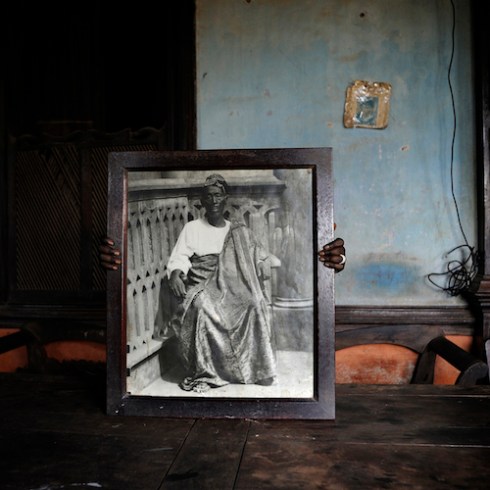
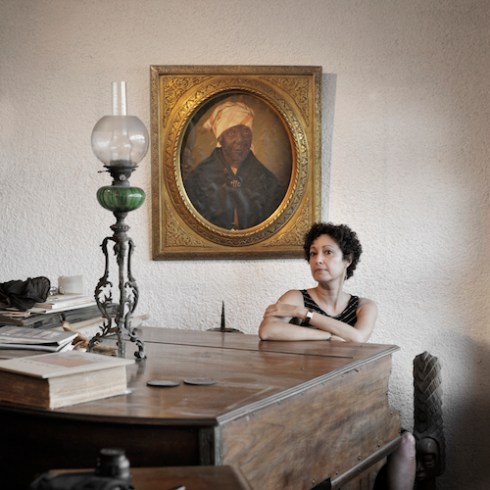
Lorraine Manuel Steed, with the portrait of her ancestor, Martha Adelaide Modeste, an African woman, City Pietonville

Modeste (in the framed picture) was deported as a slave from Ethiopia to Haiti, in 1781, to the land of Francis Testas, a sugar grower in the south of Santo Domingo. Testas last wishes read, ‘I order that all my negroes here with me, are free, are fed and maintained at my expense, until they have chosen if they want or not to return to the city of Jeremie […] July 13, 1795, seven and a half in the morning, Philadelphia.’ After five years of research between the United States, France and Haiti, and despite some opposition of her parents, Lorraine Manuel Steed was able to reconstruct the life of her ancestor Martha Adelaide Modeste, an African slave.” © Nicola Lo Calzo. From the series Ayiti.

Series "The Wandering memory", Preparation of the “Mas-a-kongo déportaisyon”, Voukoum group

Preparation of the Mas-a-kongo déportaisyon, Voukoum group The phenomenon of the reinterpretation of the past and the African origin is clearly present in the case of the Mas-a-Kongo. This mask consists of coating the body and the face with a mixture of sugarcane syrup and soot collected in the chimneys of the sugar factories. Once again here, the elements have lost a part of their original meaning (referring to the cult of the bear or the savage man in the Indo-European carnival), to assume a new symbolism derived from the local context. Indeed, the Congo Mask is presented as symbolizing the African origin of the Caribbean people, because of its exacerbated black color. On the other hand, this image reflects of very occidental and colonial vision of the African savage. Nevertheless, this “Congo mask”, with its ambiguous origins, is considered the strongest symbol of the Antillean people’s Negro origins. Petit-Paris district, Basse Terre. © Nicola Lo Calzo. From the series Ayiti.

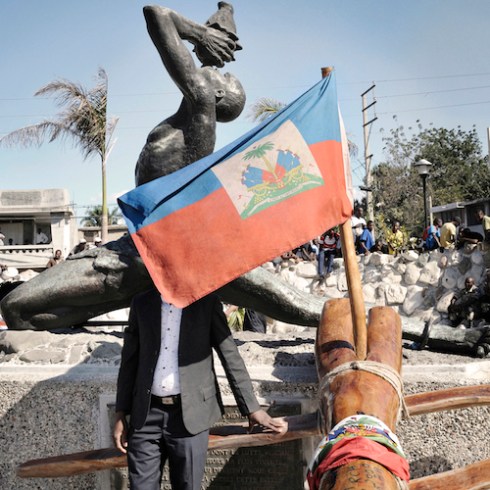
A pilgrim touches the Kita Nago, a tree trunk, which became a symbol of national unity, after a journey of two weeks across the country. Statue of the "Unknown Maroon" Champ de Mars, City of Port-au-Prince

The fugitive slave — or maroon — occupies a central place in the Haitian universe. He is the ancestor of the fathers of the nation. The maroon is the assurance of an uninterrupted genealogy, despite many ups and downs experienced by the young nation, since its birth in 1804. It is survival, resistance and refusal to abdicate. It is Haiti and vice versa, the incarnation of the Haitian Revolution. © Nicola Lo Calzo. From the series Ayiti.

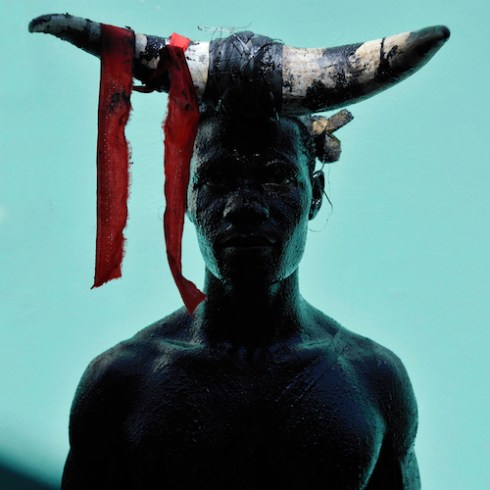
Céleur, "Rope launcher", Group Base Track, Carnival in Jacmel

Theodore Taondreau is the manager of this group. The role of the rebel-resistant, the “maroon” is staged through a technical choice and a specific music. In the case of the “whipper” or “rope launcher”, the mask consists in coating the body and face with a syrup pack (sugar cane syrup) mixture, normally collected in stacks at sugar factories. Again, these elements have lost some of their original meaning (in reference to the cult of the bear or the wild man in the Indo-European carnival) to endorse a new symbolic meaning linked to the local context. Indeed, the “whipper” symbolizes the African origin of the Haitian people because of his exacerbated black colour. © Nicola Lo Calzo. From the series Ayiti.

——-

Follow Nicola Lo Calzo on Twitter and Facebook.

——-

Cross-posted to Medium on January 6th, 2015.

EMAIL

prisonphotography [at] gmail [dot] com

Prison Photography Archives

Post Categories