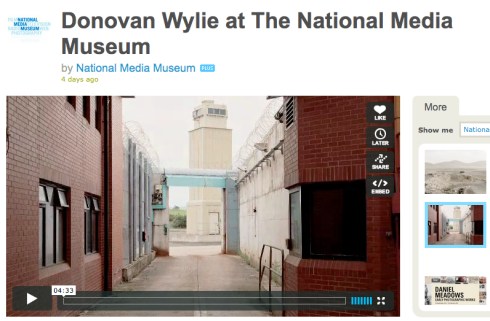
Donovan Wylie, whose work I’ve discussed before, talks about his approach photographing the retired Maze Prison (also known as Long Kesh).

Wylie, who describes his work generally as “conceptual-documentary” attempted at the Maze to pin-point the design decisions behind the politics behind the structures.

For any of you in Seattle this Thursday, September 8th, I’ll be speaking at the “Photo Slam” event in the PIONEER PASSAGES alley between 1st Avenue S & Occidental Ave S and Yesler Way & S Washington St.

I’ll be talking about a handful of prison photographers, my motives for focusing on U.S. prisons and asking the audience to think about the images they don’t see.

Others presenters are John Keatley, Mike Kane, Alan Berner, Danny Gawlowski, Jordan Stead, Genevieve Alvarez, Joshua Trujillo and Chantal Anderson.

The event runs from 6pm to 8pm.

The goodies just keep rolling in. Shame they aren’t shifting as quick as the smaller level funding incentives. So while this print is amazing and I want it myself, I must encourage any of you with big “photography collector friends” to pay the Prison Photography on the Road Kicksarter page. They might just get a bargain!

If you want to know more about Stephen’s work and motivations see The Feedback of Exile, an interview we did a couple of years ago.

 – – – – – – – – – –

Photographer: Stephen Tourlentes
Title: Comstock, NY State Prison
Year: 2009
Print: 11″x14″ B&W, Archival Pigment Print
Aritist’s Proof, Signed

Print PLUS, self-published book, postcard and mixtape = $500 – BUY NOW

A Meeting of the Harvard Corporation, which invests Harvard’s endowment, guarded by police. © Gregory Halpern

As a resident alien, much of the American revelry is lost on me. But Labour Day? That’s a national holiday dedicated to the social and economic achievements of American workers. That’s something I can celebrate.

Today then, I point you in the direction of Gregory Halpern‘s neatly edged project Harvard Works Because We Do (it has a beginning, a middle and an end) about the service workers employed by Harvard University. From portraits to playful presentation (above) to messy colour film shots of a student sit-in to a successful outcome securing over $10 million in pay and benefits for the more than 1,000 service workers on campus.

Harvard Works Because We Do is a project full of character and a clear voice. Halpern was one of the sitting students. From his portfolio:

“Between 1994 and 2001, the endowment of Harvard University tripled, making the school the wealthiest non-profit in the world, second only to the Vatican. In the same years, Harvard heavily outsourced many service jobs to lower-paying companies, thus resulting in average wage cuts of 30% for the schools’ custodians, food-workers and security guards. In response, I got involved with a student group called the Harvard Living Wage Campaign and I began this project. My goal was to publicize the situation, to share the stories of a number of service-workers I had come to know, and to raise questions about the prevailing class-structure at Harvard and on college campuses in general.”

UPDATE 09.05.11 (11:45 PST): Sarah Hoskins emailed, “The warden who was there at the time, and allowed me access, had a lot of good programs for the girls. She told me once how many of them would commit crimes to actually get back in as it was often the only place where they were safe. I don’t know if you saw the stats in my overview regarding the abuse [“90% have been physically and/or sexually abused. The average age of first abuse is 9.83 years”]. Those numbers have always stayed with me. Especially as the mother of a daughter.”

 – – – – – – – – – – – – – – – – –

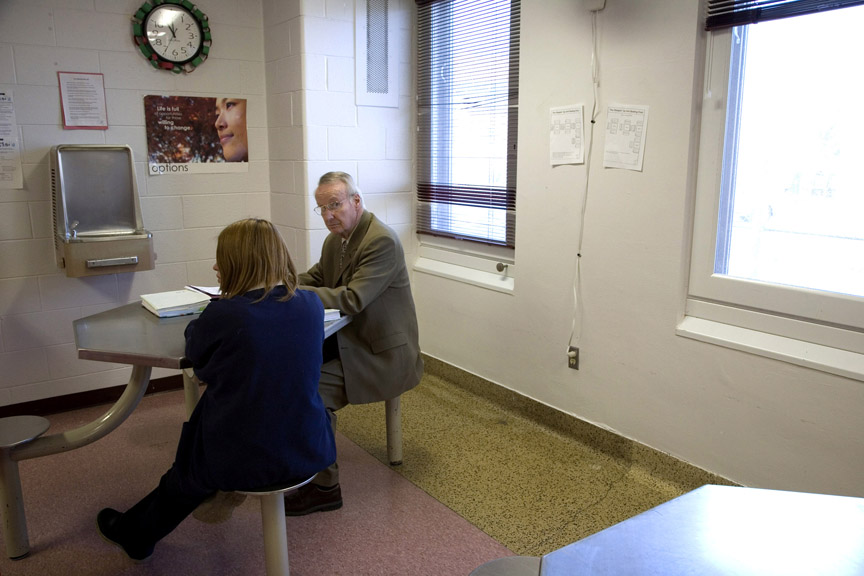
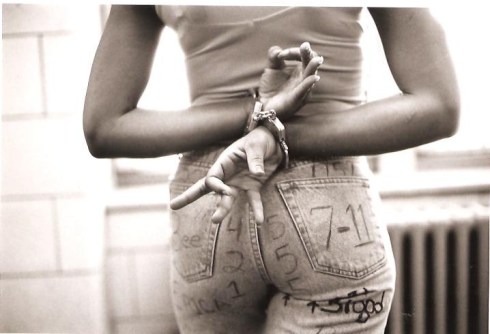
In June 2007, Sarah Hoskins photographed in the Southern Oaks Girls School (now closed), a detention centre for youth operated by the Wisconsin Department of Corrections.

Girls School struggles with the limitations imposed by privacy laws disallowing the identification of minors. As a result we get interior architectural details, objects substituted for their makers and the backs of heads. This is no criticism of Hoskins as I’ve seen it many times before in photography of prison or jails where faces are off-limits to media.

This is a shame in one regard, Hoskins is shooting in a facility that houses youth with troubled lives and important stories, but looking through Hoskins’ lens we are made to feel outsiders. Maybe that’s a point that shouldn’t be dismissed? Maybe we need to accept photography in this instance for what it is – an act (and a product) that fully adopts and extends the poise, boundaries, prescribed separation of the site?

As compared to projects like Leah Tepper Bryne’s work from a NY State youth detention centre (I don’t know how Tepper Byrne negotiated permissions to show faces) Hoskins’ photographs leave you wishing for some more connection.

Of the portfolio, Girls School, I was most taken with the picture above and it is precisely because it bears a connection through eye contact. It’s an ambiguous connection to say the least; one might even argue it is a suspicious or patrolling look, but it is a look nonetheless.

Ed Kashi has recently confronted this same issue head on with Eye Contact an exhibition at the VII Gallery in Brooklyn and an interview with the New York Times’ Lens Blog in which he says:

“I think it’s because we don’t want to exist in our pictures. After 30 years of being a photographer, I don’t know if it’s a conceit. I don’t know if it’s self-delusion. But there is this idea that if somebody is looking into the camera, then somehow it’s inauthentic or it’s not a genuine moment. We don’t want anyone to think we were there.”

I’ve always been clear, as a viewer and a critic – I like collaborative photography in which the photographer is not stalking but engaging and discussing the ground they share with their subject. Photographers can’t disappear and there’ll always be images made that show that … often with the sharpest glance.

 © Adam Shemper

Photographer: Adam Shemper
Title: ‘In the Wheat Fields, Louisiana State Penitentiary, Angola, Louisiana’
Year: 2000
Print: 9″x9″, B&W on archival paper.

Print PLUS, self-published book, postcard and mixtape – $325 – $BUY NOW

 – – – – – – – – – – – – – – – – –

Another incredibly beautiful and difficult image has been made available for purchase to funders of my Prison Photography on the Road proposed road-trip. This time by photographer and psychotherapist Adam Shemper.

I first discovered Shemper’s work in the Mother Jones feature, Portraits of Invisible Men: A photographer’s year at Angola Prison. Shemper describes how he responded to the frequent question for inmates, “What are you doing here?”

I answered that I’d come to make their largely invisible world visible to the outside. I said I wanted … to reconnect them in a way to a world they had lost. I talked of the prison-industrial complex and the deep-rooted inequalities of the Southern criminal justice system. (Almost 80 percent of the inmates at Angola are African-American and 85 percent of the approximately 5,100 prisoners are serving life sentences.) But as I spoke of injustice, it was obvious I wasn’t telling them anything they didn’t know from their daily lives.

Eventually I stopped trying to explain what I was doing. I simply kept taking pictures.

Chaperoned by a prison official at all times, I visited dormitories, cellblocks, and even the prison hospice. I photographed prisoners laboring in the mattress and broom factories, the license plate plant, the laundry, and in fields of turnips, collard greens and wheat.

BIOGRAPHY

Shemper was born in Hattiesburg, Mississippi. His images and words have appeared in Time, Mother Jones, Double Take Magazine, The Oxford American, Salon.com, and The San Francisco Chronicle, San Jose Mercury News, The Daily Yomiuri Shimbun (Japan) and The Bund (Shanghai). Selected images from his Sardis Lake series were included in the International Center of Photography’s exhibition, Only Skin Deep: Changing Visions of the American Self (2003). He lives in Sonoma County, California.

Undocumented Mexican Immigrants, Tent City © Jon Lowenstein

CLICK FOR LARGER VIEW

Photographer and NOOR Images co-founder Jon Lowenstein has offered a print at the $1,000 level for the one lucky person who donates to my Kickstarter campaign, Prison Photography on the Road.

It’s an image from Sheriff Joe Arpaio infamous “Tent City” in Maricopa County Arizona. I’ve commented on this facility before (here and here) and across the political spectrum this facility has been questioned or condemned as deplorable. Here’s my best round of information on immigration prisons.

As early as 1997, Amnesty International published a report on Arpaio’s jails which found that Tent City is “not an adequate or humane alternative to housing inmates in suitable . . . jail facilities.” And as recently as 2009, Tent City has been criticized by groups contending that there are violations of human and constitutional rights.

Photographer: Jon Lowenstein.
Title: Undocumented Mexican Immigrants – Tent City.
Year: 2009.
Print: 11″x 14″ coloor print, on Hannemuehle archival paper.
Signed.

Print, PLUS, self-published book, postcard and mixtape. – $1,000 – BUY NOW

 – – – – – – – – – – – – – – – – – –

VISUALS

Bag News Salon : Jon Lowenstein’s Haiti

Getty Images Grants for Editorial Photography Jon Lowenstein, September, 2007

BIOGRAPHY

Lowenstein specializes in long-term, in-depth, documentary photographic projects which question the status quo. He believes in documentary photojournalism’s ability to affect social change. He studied at the Universidad del Pais Vasco San Sebastian, Spain, and is a graduate of the University of Iowa and Columbia College. He was a staff photographer at newspapers including The Arizona Republic.

In December 1999, Lowenstein was chosen as one of eight staff photographers for the CITY 2000 (Chicago In The Year 2000) project. For more than three years, Lowenstein taught photography to middle-school students at Paul Revere Elementary School and helps publish Our Streets, a community newspaper documenting the nearby South Side Chicago community.

Lowenstein is a 2011 TED Global Fellow.

In 2011, he got awarded a John Simon Memorial Guggenheim Foundation Fellowship in the field of Photography. In 2008 he was named the Joseph P. Albright Fellow by the Alicia Patterson Foundation and also won a 2007 Getty Images Grants for Editorial Photography. He also won a 2007 World Press Award and was named as a USC Annenberg Institute for Justice and Journalism Racial Justice Fellowship.  He won the 2005 NPPA New America Award, a 2004 World Press photo prize, 2003 Nikon Sabbatical Grant, the 58th National Press Photographer’s Pictures of the Year Magazine Photographer of the Year Award and Fuji Community Awareness Award. He participated in the Open Society Institute’s Moving Walls Exhibitions from 2002 through 2005.

“If you want to be a successful street photographer I think you need to slow just a little bit, be a little more patient, be a little more humble, and slow it down a bit. I don’t believe in rushin’.” – Jamel Shabazz (Source)

Female Blood, 1995 @ Jamel Shabazz

Jamel Shabazz is best known for his street portraiture of New Yorkers in the eighties. Shabazz has consistently delivered images of life, active bodies, colour, fashion and individual confidence. His is a street life on show.

Shabazz was also a correctional officer for twenty years, and for a large portion of that time at Rikers Island. Female Blood (above) is an image from the criminal justice system. It is heavy and deserves discussion, but for that we must wait. Jamel has agreed to sit down for an interview with me in October. To that end he has put up a print for fundraising toward Prison Photography on the Road

Photographer: Jamel Shabazz
Title: ‘Female Blood’
Year: 1995
Size: 8″x10″
Paper: Resin coated black and white print.
Signed

Print, PLUS a postcard, mixtape (CD) and a self-published book – $600 – BUY NOW.

See also:

Interview with Format Magazine

New York Times Lens blog gallery, Through the Lens of Jamel Shabazz

Gallery of images at Dirty Pilot

EMAIL

prisonphotography [at] gmail [dot] com

Prison Photography Archives

Post Categories