Photographers attempt to capture a picture of Julian Assange, believed to be in this prison van, leaving Westminster Magistrates Court on December 7, 2010 in London, England. (Photo by Peter Macdiarmid/Getty Images)

Today I came across this image by Peter MacDiarmid. It converges a few threads I’ve noted before.

I don’t know how many times Assange went to court along the public streets of London but it’s worth looking at another of McDiarmid’s images, this time of Assange in the interior of a custody van.

SERCO, the company providing the custody van is as global as Wikileaks itself and specialises in lock-ups and government services.

The Wikileaks saga has gone relatively quiet recently. Bradley Manning’s circumstances are no longer top of the hour. The Bradley Manning Support Network describes his conditions of detention:

Although Bradley has not yet been tried, he has been held in solitary confinement since May 2010. He has been denied meaningful exercise, social interaction, sunlight, and has occasionally been kept completely naked. These conditions are unique to Bradley and are illegal even under US military law as they amount to extreme pre-trial punishment.

Contrary to this account are reports that Manning is no longer in total lockdown. In April, he was transferred to a medium security facility in Fort Leavenworth.

If we are to compare experiences, remember, Assange in the scenario above was also under pre-trial detention.

Solitary confinement or not, Bradley Manning – regularly the subject of bullying -is not in the best shape to cope with incarceration. In 2007, early in Manning’s army career, doctors reported he was “mentally unstable” and recommended he be “discharged immediately”. The recommendation was rejected and due to a shortage of computer intelligence analysts, Manning was recycled back into service and pushed through the system.

Currently, Manning is heavily medicated with anti-depressants.

The U.S. military has made no comment on Manning’s psychological condition other than to say it is being investigated. He faces court marshal in December 2011. Manning faces 52 years if he is found guilty. That’s a long time for someone who, according to this credible 18-minute presentation, is a shell already.

The theatre surrounding Assange’s charges, detention, court dates and bail are in stark contrast to the near invisibility of Manning’s transfers and detention. With Assange remaining bold, vocal and in the public eye, Manning’s invisibility is even more conspicuousness. By numerous definitions, it seems Bradley Manning is already fading away.

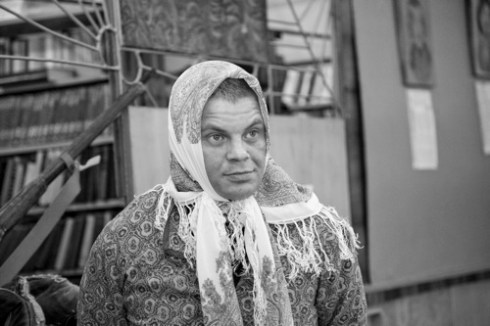
British photographer Sebastian Lister is having a joint exhibition with Russian photographer Sergey Ponomarev entitled Russian Prison Theatre – A Photographic Journal at Pushkin House, London’s Russian Cultural Centre.

Earlier this year, I put Sebastian’s work into perspective with two contrasting posts; the first about the stereotypes of Russian prison imagery and the second about meaningful theatre programs as documented by Sebastian.

About the exhibition:

In 2009, British theatre director Alex Dower worked with prisoners in Perm Prison Colony 29, as part of Territoria International Contemporary Theatre Festival, staging three short stories – Chekhov’s The Burbot, Isaac Babel’s My First Goose, and prisoner Albert Sadrutdinov’s Butterfly.

Alex was accompanied by two leading photographers. The result is a set of extraordinary photographs that together provide a deep insight into contemporary Russian prison life – the prisoners, their work and their guards – as well as a view of a remarkable theatre project that captured the imaginations of the group of prisoners and took them on a journey beyond the narrow confines of their lives.

This collection of award-winning images presages the continuation of the companies work, in a prison in Kazan in November 2011.

Exhibition runs from Friday 16 Sept – Friday 7 October 2011, 4pm to 7pm Monday to Friday (and Sat 17 Sept – Sun 18 Sept, 11am to 4pm), at Pushkin House, 5A Bloomsbury Square, London, WC1A 2TA. Entrance is free.

Sergei as Babushka © Sebastian Lister

Spanish photographer Fernando Moleres has embarked on a singlehanded and single-minded mission to improve the lives of juvenile prisons in Sierra Leone. His interview Visa Pour l’Image: Fernando Moleres’ struggle to help juvenile prisoners in Sierra Leone at the British Journal of Photography is a must read.

Moleres speaks of the incredible difficulty to raise money for his work – not his photography work, but his work to connect these children with their families (many of whom are unaware their children are incarcearated) and also his work to provide bail so as to “prevent the children seeing the walls of a jail in the first place.”

Moleres is clearly disillusioned by the lack of forthcoming support from groups he’d expect to be solid allies. Here’s some choose quotes that are a challenge to politicians and NGOs alike (my bolding):

“[In African prisons] you have more chances of dying in these prisons than anywhere else – you can die of diseases, malnutrition. Also, injustice is more flagrant than anywhere else. There are barely any lawyers, some detainees have spent years in prison without even going in front of a court. There is a deep injustice – deeper than in any other country such as Russia, India, Israel or the United States.”

“People don’t realise the extent of the injustice present in these prisons. They are forgotten by everyone. When I was asking for help to NGOs – the Red Cross, Médecins du Monde, etc. – no one, absolutely no one wanted to help me. Of course, I was there on my own initiative; so I didn’t have a project they could study, send to Europe for the green light, which would then be rescinded… There’s so much bureaucracy that in these cases it would just not be possible.”

“I’m the only one paying for all of this. I’m spending my own money. This exhibition, which is travelling around Spain at the moment, has received an award from the NGO Medecins du Monde. During the award ceremony, I asked them if they could help me finance this project. Their answer was no.

“I think it would be easy for an organisation to force Sierra Leone to do something. The United Nations, for example, would be the perfect organisation to do so. Talking about the United Nations, when I was in Sierra Leone, a representative from the organisation came to the prison to visit the detainees. I went with him. He talked with a few dealers, the guards, etc. But when other detainees came to see him to denounce the injustice of the entire system, his answer was: “I’m not here to solve your personal problems.” This man, whose name is Antonio Maria Costa [his official title is Executive Director of the United Nations Office on Drugs and Crime (UNODC) and Director-General of the United Nations Office in Vienna], has access to the country’s vice president and home affairs minister. He could have done something about it, but he chose not to.

Depressing stuff.

For my more general thoughts on Moleres’ work from Sierra Leone and other photographers who’ve documented juvenile detention in Africa see Fernando Moleres: ‘Merciless Justice’ from January, 2011.

Schedule, 50x50cm, Ed. 3+2P/A

The two airliners flown into the World Trade Center towers were props of a devastatingly selfish and lunatic ideology. Ten years ago, my Dad and I watched the telly in his front room and watched the first tower burn and the second plane hit. It was just before 2 in the afternoon.

The visual shock of fireball plumes at eighty storeys above ground, or the dispersal of debris and bodies, or the engulfing clouds of dust over Lower Manhattan, cannot compare to the emotional shock and trauma spread far and wide as a result of those two murderous impacts on that clear September morning.

As I watched footage of the 9/11 Memorial in New York my heart went out to the victims’ families and I cannot imagine difficulties faced for those in their many journeys of healing.

Just as the events of September 11th 2001 make no sense, so too has the American response. I want to say simply that while sympathies for the victims and victims families are essential, sympathies for the Bush administration’s decade of war are not.

A few weeks ago, I got an email from James Pomerantz asking, “Have you seen this craziness?” James was referring to Francisco Reina‘s Strauss’ Legacy.

Peacemaker 03, 50x35cm, Ed. 3+2P/A

Strauss’ Legacy may be incendiary, angry and even a bit cack-handed, but as I’ve already suggested there have been many reactions to 9/11 and, I for one, am not ready to dismiss a photographic project based purely on the fact that the imagery is coarse and confusing. U.S. foreign policy since 9/11 has been coarse and confusing.

From Reina’s statement:

Strauss’ Legacy focuses on the so-called neocons and the way in which their presence in the American presidential administration on September 11, 2001 shaped events. Particularly close attention is given to the role played by a number of multinational corporations in a conflict which began under the name “Operation Enduring Freedom” and turned into a perfect market niche for multi-million dollar earnings. […]

Ideas were espoused by Strauss’s disciples and followers, leading to the creation of the Project for the New American Century (PNAC) in 1997.

PNAC is a highly controversial organization. Many people claim that the project advances the notion of total military and economic world dominance based on the idea that the 20th century was the “American Century,” and that this supremacy must continue into the 21st century. The only way to achieve this domination is by scaring the public with the specter of a dark enemy whose mere existence posed a threat to the survival of the American nation, thereby making it possible to carry out their ambitious plans. This is one of the goals of the neocons, and they were prepared to do whatever it took to attain it. September 11, 2001 was the match that lit the fuse on the savagery that continues today.

9/11 was a catastrophic day. For the 3,000+ people that died then and the hundreds of thousands that have died since in the folly that was the War on Iraq and in the unwinnable war in Afghanistan. Profits and gains have been made but very few of them have been for American families.

Enduring Freedom, 67x85cm, Ed. 3+2P/A

It’s fair to say that building, finding and maintaining momentum for a Kickstarter project keeps you busy (the case for any crowdfunding effort I’d guess).

In promoting Prison Photography on the Road, I’ve been lucky this week to tap a couple of networks previously beyond me.

KICKSTARTER BLOG

Cassie Marketos and I did an email interview for the Kickstarter blog: Creator Q&A: Pete Brook and Prison Photography.

This seems to be the most popular quote: “We live in a visual world. Every image is political. Sometimes we should not be thinking about the images we see, but instead thinking about the images we do NOT see.”

THOUGHTS ON PHOTOGRAPHY

Paul Giguere and I did a phone interview for the Thoughts on Photography podcast (available on iTunes).

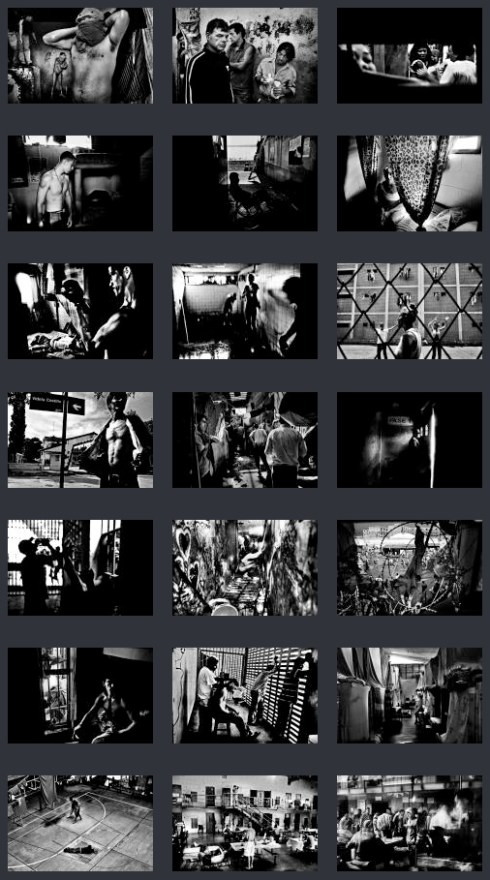
Valerio Buspuri‘s work from South American prisons is on view at Perpignan now. Buspuri says:

“A ten-year trip visiting 74 prisons for men and women in every South American country turned out to be a portrait of the continent, describing troubles, violence and massive overcrowding, as well as lifestyle, habits and the mood of the inmates. The story offers an in-depth view of the mind and soul of prisoners.”

Prisons as a portrait of a continent? That’s pretty bleak and too reductive for me.

The image of the prisoner using a “bathroom” probably sums up the vast differences in prisons between North and South American prisons; securing basic sanitary conditions is more of a concern than the other pressing issues of rehabilitation, and fair legal process.

The Attica Prison Uprising occurred at the Attica Correctional Facility in Attica, New York, United States in 1971. The riot was based in part upon prisoners’ demands for better living conditions, and was led in large part by a small band of political revolutionaries.

On September 9, 1971, responding to the death of prisoner George Jackson, a black radical activist prisoner shot dead on August 21 by correctional officers in California’s San Quentin Prison, about 1,000 of Attica prison’s approximately 2,200 prisoners rioted and seized control of the prison. They took 33 staff hostage and began negotiations with the state. Governor Rockefeller refused to visit the site and sanctioned the taking of Attica Prison by force.

At 9:46am on Monday, September 13, tear gas was dropped into the yard and New York State Police troopers opened fire non-stop for two minutes into the smoke.

In total there were 39 deaths during the Attica Rebellion; 29 of which were prisoners and ten were guards held hostage.

Poster created by the Students for a Democratic Society (SDS) advocating support of prison rebellions, and the abolishment of alleged racist prison terror. Source: Wisconsin Historical Society

The most famous prison rebellion in American history began in the early hours of September 9th, 1971.

I’ve written about the Attica Prison Uprising before, mainly in relation to Cornell Capa’s involvement in the general politics of prisons and his testimony during the inquiry that followed the riot.

I wanted to share an image of this poster and ask you if you can imagine this type of visual being used today. It wouldn’t happen. Universities are less and less incubators for radical action; prison issues are rarely incorporated into overarching critiques of capitalism; and, sad to say, solidarity and Socialist motifs are derided in today’s media culture of garish graphics, breasts, comments of misdirection and ridiculous 24-hr coverage.

Not wanting to end on a down note, these groups are working against our society of excessive, blaring infotainment. Check them out.

EMAIL

prisonphotography [at] gmail [dot] com

Prison Photography Archives

Post Categories