From Spinning Head:

Dayanita Singh is an Indian photographer. She used to be an internationally famous photojournalist until the day she realized that the India editors kept asking her to shoot was not what she herself was experiencing. There was a gap between the cliches being asked of her and the complexities, human and social, that she knew lay unexamined behind so many of the stories she was being asked to do. Whether the stories were about poverty, prostitution, child labor or any number of the conventional cliches we seem to love to produce from India, Dayanita Singh was unable to turn off her mind. She was amongst the first to produce a series of images of India’s emerging middle class. She had seen this phenomenon at a time when others would not take it seriously.”

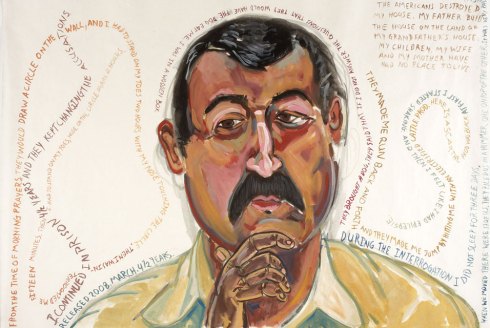
“The friend was killed at Abu Ghraib. His picture with Graner, on the floor with ice and beaten face. He was friend from work.”

– Jabar Abdel, former Abu Ghraib detainee, quoted in A Friend of Mine Was Arrested (below), by Daniel Heyman

Anyone that has made analysis of the photographs of Abu Ghraib should also be aware of Daniel Heyman‘s paintings Portraits of Iraqis.

Heyman made the watercolours and sketches while sitting in on interviews between former Abu Ghraib detainees and Susan Burke, a human rights lawyer with Burke O’Neil LLC, Philadelphia. Burke was looking to bring in artists and writers to tell the stories of her clients in different ways and to reach a wider audience. (Simultaneously, photographer Chris Bartlett was also working on portraits for his Detainee Project.)

Heyman had previously used facsimiles of the Abu Ghraib pictures in his mixed-media and woodblock artworks, but had become discouraged by the laziness of the appropriation:

“The potency of those images really diminished. All sorts of artists had started to use these images, and the more they were used, the more they indicated Abu Ghraib without providing any understanding of Abu Ghraib. They became a kind of code for anger about so many things to do with the war. You flash on the famous picture of the man on the box, and people become numb to that image. And you re-humiliate that man. You re-victimize that person.”

I recently saw three of Heyman’s works in a gallery; they are the perfect foil to those infamous images of Abu Ghraib. In December 2008, upon reflection of Standard Operating Procedure, Errol Morris’ film that gave the US soldiers a voice against the military brass, I suggested, “what the global community needs now is an equally comprehensive documentary project bringing together the testimonies of all those held and tortured at Abu Ghraib.”

There have been articles written, lawsuits brought, oral testimonies made – but Heyman’s work stands out as a particularly successful enterprise. Heyman makes the paintings and records the words in real time as the interview goes on. A slightly grueling process about a horrifically grueling topic. Heyman brings us very close to these victims of torture; they are no longer the abstractions we’ve known through the Abu Ghraib files, but individuals with the knowledge and details of fact that should shake our conscience.

In consideration of the broad range of artists’ responses (from good to bad) to the Abu Ghraib images of torture, for me, Daniel Heyman’s paintings carry an impact far beyond that within the capabilities of most photography.

Read Heyman’s interview with Foreign Policy in Focus.

View Heyman’s website.

SmithMag has an easy-to-navigate gallery.

Northwestern University in Evanston, IL is to host the conference ‘Blogging Images: Photojournalism and Public Commentary’ on Saturday, April 30th.

Robert Hariman explains why here:

“Because photojournalism is a public art, it exists in part to provoke and inform public discussion.  Likewise, good public discussion includes talking about images as a way of thinking about public affairs and other things held in common.  Although photojournalism has been accompanied by commentary from its inception, digital technologies have provided both new media for image circulation and new venues for critical commentary and audience interaction.  These changes provide an opportunity for scholars in the humanities to become more directly engaged with public audiences, but effective engagement is likely to require different skills and perhaps different attitudes than those that characterize academic discourse.”

Speakers include Brian Ulrich, (Document to Propaganda: The New Face of Photographic Truth), Jim Johnson (The Uses of Photography: Thinking About Public Space) and Michael Shaw of BagNewsNotes (Role and Process of Analyzing News Images). Looking forward to the conclusions.

I’ve been thinking about Portland recently and the potential importance of the Grid Project. I’ve been instructed to go to Christopher Rauschenberg to give my ideas the shakedown. This is because he’s largely responsible (although it is a collective effort), but also as one person mentioned over the weekend, “everything photography in Portland goes through Chris.” He is a founding member of Blue Sky Gallery, the regarded Portland photographer’s art collective.

Before I get to the Grid Project, I thought you’d get a kick out of Christopher’s answers lifted straight from this interview:

Do you feel you grew up in your dad’s shadow? He casts a big one.
Not at all. Both my parents were so full of joy and curiosity about life. They taught me how to look at the world. It was always, ‘Look at this piece of trash on the sidewalk. Isn’t it beautiful.’ I won the parent sweepstakes. The difference between me and George Bush is, we were both born on third base, but he thinks he hit a triple. I know I was born on third base, actually, a couple of feet from home plate.

You won the parent sweepstakes, but your dad was an alcoholic.
I’m not a big fan of alcohol. It’s more entertaining to be at full strength than be self-handicapped. Alcohol is a powerful dragon to slay. I’m sorry he couldn’t make that happen. People have flaws. He was a good deal as a dad.

The art world is quite hieratical, but he didn’t seem to be.
At museum openings, he was more interested in talking to museum guards than the director. He said he knew what the director was going to say but not the guards.

Were you impressed with his friends when you were growing up?
I wish I’d been more impressed. I remember one time I stopped by his place after school and he asked me to stay for dinner. Cartier-Bresson was coming. I said I couldn’t. I had homework.

RAUSCHENBERG, Robert. Brace (1962). Oil and silkscreen ink on canvas, 60 x 60 in. (152.4 x 152.4 cm) Collection of Robert and Jane Meyerhoff

This weekend I’m in Portland, Oregon for Photolucida. I pored through the catalogue of participants and found about twenty photographers whose work I am keen to learn more about. In that group is Jesse Louttit.

Louttit is right on the money when he says “the intimate details of our everyday lives can still be completely foreign to those who know us outside our work, even to our closest loved ones.”

Employees Only is a clever selection of quiet moments in the workplace with some psychological tension and eye-pleasing balance.

In 2000, Mark Hogancamp was beaten by five men outside a bar in Kingston, New York. The attack was so brutal that afterward his mother Edda did not recognize him. When Hogancamp emerged from a 9-day coma, brain damage left him without language, or the ability to walk or eat without assistance. Hogancamp received state-sponsored physical and occupational therapy for twelve months, but when the aid ran dry he was on his own.

Refusing to “let those men win”, Hogancamp set about creating his own therapy, a 1/6th scale WW2 era town called Marwencol. He populated it with alter egos and played out scenes in order to make sense of life and humanity.

I’m really proud to have been able to bring his story – and his photographs as documents of that story – to a wider audience. Please read Miniature Town Brings Its Creator a New Life.

Check out the Marwencol documentary film website.

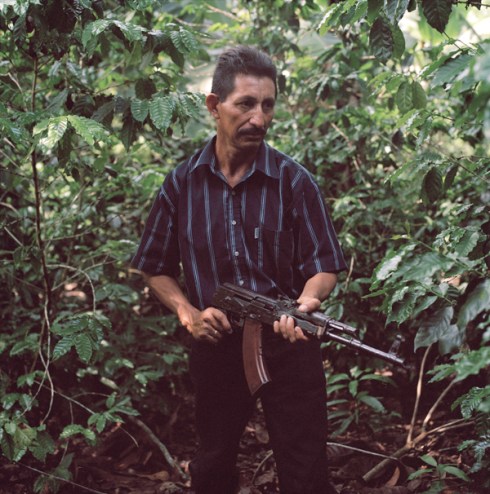
In 1979, after over a decade of struggle, the socialist Sandinista movement in Nicaragua overthrew the famously corrupt dictator, Anastasio Somoza. The Sandinistas quickly began the work of applying their social and ideological values in the hopes of creating a better Nicaragua. Amid the rhetoric of the cold war, the US had different ideas – it mobilised the Contras, a CIA financed, armed and trained clandestine rebel insurgency against the fledgling government.

Kevin Kunishi has just won the 2011 Blue Earth Alliance Award for his series Los Restos de la Revolución.

This series consists of portraits of Sandinistas and their opposing Contra veterans, as well as artifacts and landscapes significant to that volatile era. Although these two sides held polarized political philosophies, both in their foundation and practice, their survivors are united by the burden of a war-torn history,” says Kunishi.

Powerful stuff.

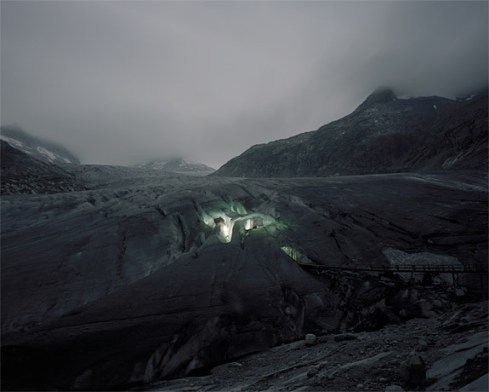
Corinne Vionnet has had a lot of coverage recently for Photo Opportunities, for which she stacked hundreds of culled internet images of tourist sites . I rather like her Du Glacier du Rhone au Lac Leman (From the Rhone Glacier to Lake Geneva) aswell

Du Glacier du Rhone au Lac Leman (From the Rhone Glacier to Lake Geneva) has a variety of strong but distinct images. The example above takes care of the cool landscape aesthetic (for a Sigur Ros generation) while the portrait below ticks the box for quirky stranger … it also plays nicely on this famous image.

EMAIL

prisonphotography [at] gmail [dot] com

Prison Photography Archives

Post Categories