
You are currently browsing the tag archive for the ‘Dawoud Bey’ tag.
Dawoud Bey suggested during his address to the Society for Photographic Education 2010 Conference audience, Saturday night that ‘diversity’ had become not an ideal but a political mantra of art institutions that papered cracks and contributed nothing to long-term involvement of people of colour.
Bey argued the word ‘diversity’ has been appropriated, misused and redefined. Bey does not foresee a reclamation of the word but calls for an abandonment of the institutional practices the word has come to stand for.
Bey wants ‘inclusivity’, a firm shared understanding of the term, and relevant action instead. Bey distinguishes:
Diversity to me implies that there is still some normative paradigm at the center that we are seeking to destabilize rather than doing away with it in favor of something quite different. It suggests that institutions have an inherently white and male identity that needs to be added to. To operate out of this paradigm is, of course, a kind of tokenism by yet another name and seeks to trade on the momentary (but always empty and short lived) self-congratulatory excitement of seeing a new color in still unexpected places. It would seem to me that by now we should be approaching a point where anyone should be expected to be anywhere.
I think it’s time to turn away from “diversity” as an operative objective and turn instead towards the more meaningful and substantial goal of making institutional spaces ever more inclusive and embrace the goal of inclusivity, in which everyone’s identity is central to the whole. One way to accomplish this is to consider how in fact the institution’s identity can be meaningfully transformed and expanded conceptually by this enhanced inclusiveness in a way to deeply transforms the very nature of that institution. Inclusivity implies a desire to actually change through institutional expansion, while diversity implies to me that those being brought in have to simply fit into the normative and dominant existing paradigms and simply add “color” to it.
[My bolding]

The full lecture which Bey transcribed to his blog is essential reading as it sums up with authority the history of localised art movements, the legacy of protest among minority communities against silenced or non-represented voices (even in shows dedicated to the work of African American artists for instance!)
Bey recounts the protests against the “Harlem On My Mind” exhibition at the Metropolitan Museum of Art in 1969. Bey reminds us that Roy DeCarava carried a sign outside reading, “The White Folks Show the Real Nitty Gritty.”
Bey traces many of his own successes not to umbrella changes in culture or industries but to committed artist actions doing the leg work for themselves. He is the inheritor of community spirit so to speak.
Bey drives the point home exquisitely by pointing to one of New York’s favourite and largest art love-ins:
And then along comes the Whitney Biennial 2010 to remind us just how little some things have changed … In an exhibition that ironically uses an image of Barack Obama on the catalogue cover, we find among other things absolutely no Latino artists and a total of three black artists among fifty-five artists in the exhibition. What is your response to that? What would the response have been in 1969? I can’t imagine that this kind of situation would have been tolerated at that moment.
[My bolding]
CONCLUSION
Again, cold hard figures don’t lie, and I think Bey has shown that history doesn’t lie. We’ve got a lot to do.
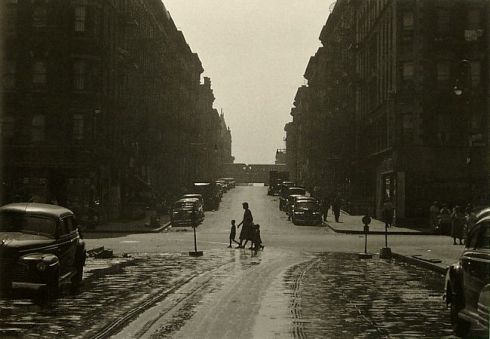
Roy DeCarava’s life and work has been noted by every source that should be seen to care following his recent passing.
There’s no doubt, DeCarava was a photographic great, a pioneer and a fine craftsman … but he had barely registered on my own personal radar. Until I found the story below courtesy of Dawoud Bey, I did not intend to comment upon DeCarava’s death. It would be inappropriate: I didn’t know about his work when he lived, why should I put on a show of knowing when he died?
Bey says:
Dawoud goes on:
I guess the lesson – for all things – is that one should only comment if the comment is vital, relevant and fair.
Thanks for sharing Dawoud.
___________________________________________________
Elsewhere, from a 1996 NPR interview, it was fascinating to hear DeCarava’s matter-of-fact memory and experience of serving in the US Army, “In those days there were two US Army’s. One Black, one White.”

 Prison Photography