
You are currently browsing the tag archive for the ‘Photography’ tag.
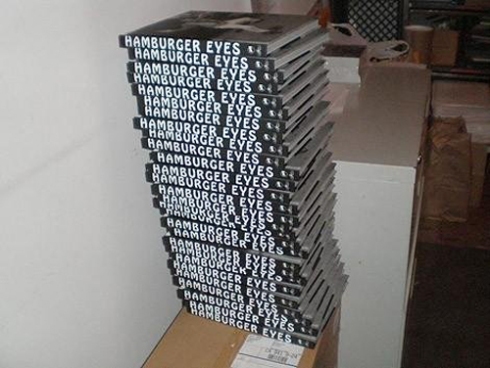
Of course, everyone in the photobooks debate had their own preface and a necessary confirmation bias to bolster. Andy and Miki unleashed a monster. Great stuff.
IT’S THE EYE OF THE BURGER, IT’S THE CREAM OF THE FIGHT …
Hamburger Eyes has my mostest respect so far. HE is rightly confident in the book as a medium; HE doesn’t uphold a naive belief in the internet or technologies to deliver ALL the goods; and they make a call for real life.
Photos and photographers should “get into some shit” away from the web.
Hamburger says:
I was asked to write my thoughts on this subject as part of a forum in the form a blog, meaning FLAK PHOTO and LIVEBOOKS are writing about the subject and inviting others to join in by writing something, linking it, then they re-link it up for an ultimate future post of all of it together in one blog? I don’t know I’m confused too. Blogs eat blogs, and they never be not hungry.
Blogging is a good segway into my thoughts about the future of photo books. I’m thinking the internet is turning into a library or more like jail for your photos. Yes, libraries are way awesome and yes we are all photo nerds forever learning, but how long can you stay in there. It’s like detention for your photos. Saturday school. Your photos need to get out, go on dates, and get into some shit.
What happens next is what’s already happening now. Photogs are deleting their flickr and their blogs and crewing up with only the hardest realist ninjas. It’s hyper attack mode. Photogs are scrambling because their agency just cut them and their editors got laid off. Not to mention, “Oh, you shot this or that, someone else caught it before you on their cell phone and New York Times already spent their budget on those.”
HERE’S WHAT I SAY
I wrote a huge treatise not only on the future of books, but on the future of the image and the future of our existence based upon our surrender to the image. We will soon all be docile slaves.
I shelved the piece. I’ll need to chew on it for a while until the next photoblog debate about the future of photography/contracts/journalism/print/distribution/consumption comes along. My main points will still apply:
– E-books is an oxymoron. Hopefully, all digital text will be referred to as E-words.
– Actual books will be fewer in quantity and higher in quality.
– Open source will dominate, because ownership of any digital matter will become useless.
– Micropayments are bogus. In the future if a creator unleashes it on the web, they will hold no claim to it
– Every household will have access to rapidly improving printing technology; any available online material will be printable to spec.
– Handhelds will have instance access to every non-proprietary file on the internet.
– People will have self-facilitated projections to the sides of buildings as a legitimate alternative to books when experiencing images.
– We will become detached from one another. Those who question the mediation of technology – even moderately – will be ostracised. In this regard, book ownership will become a slightly perverse political act.
Wendy Watriss, co-director of Fotofest, really digs Chinese photography. In 2008, Fotofest set up camp in China reaching out for the sakes of diversity, discovery and commerce.
Today, Fotofest announced its International Discoveries II. They include Alejandro Cartagena, Wei Bi, Minstrel Kuik Ching Chieh, Christine Laptuta, Rizwan Mirza, Takeshi Shikama, Kurt Tong, MiMi Youn, and Vee Speers (although Peter Marshall points out Speers isn’t that “new”).
The most comprehensive information available remains the Fotofest Press Release (PDF)
The most tantalising prospect for me personally is Wei Bi. Partly because of his project and partly because there’s nothing out on the web about him.
I skanked this screenshot of the Fotofest website. Sorry FF!

Wei Bi, Untitled, 2008
Here’s the blurb: “Issues of justice are embedded in Chinese artist Wei Bi’s re-staging of his 80–day experience in a Chinese prison — a sentence received for making a photograph. His large black and white photographs are minimal, showing a surreal relationship between near expressionless guards and disoriented prisoners. Despite the constructed nature of his work, Mr. Wei insists his “photography is not aimed to reveal, but to record, recording the existence of my life.” Wei Bi’s work was “discovered” at the Guangzhou 2009 Photo Biennial in Guangzhou, China.”
How can we not be drawn to this work? He was imprisoned for his photography! Potentially, it is a narrative against adversity in which creativity triumphs.
If anyone reading this makes it to the exhibition please get in touch and tell me what you think of Bi’s prison photographs.

Source
Why?
There have been two prevailing attitudes toward the proposed conference/symposium dealing with issues of race and diversity in photography:
a) That it is absolutely necessary & b) It is a terrifying prospect.
The first point speaks for itself, and the second point becomes clear when one considers the kerfuffles, misunderstanding and (dare I say it) vitriol that has accompanied much online discussion.
I have been in contact with some, but by no means all, people who could contribute to an extended dialogue. These include Amy Stein, Ben Chesterton, Colin Pantall, Daniel Cuthbert, Daryl Lang, Jean-Sebastien Boncy, Joerg Colberg, John Edwin Mason, Mark Page, Matt Lutton, Michael Shaw, M. Scott Brauer, Nathalie Belayche, Qiana Mestrich and Stan Banos. They have been very generous in response.
Originally, I suggested mixing things up by means of an in-person meet. This was intended to directly address the inadequacies of online discussion. However, when Qiana Mestrich of Dodge & Burn alerted us to SPE‘s conference in March, 2010: “Facing Diversity: Leveling the Playing Field in the Photographic Arts” it was clear that we may just end up replicating (on a smaller scale) SPE’s efforts.
The early feeling was that to piggyback on the back of an existing photography festival could leverage most involvement and impact. Boncy has had good feedback from Houston Fotofest and Lang believes that PDN would want to collaborate and lend a hand for an event at New York Photo Festival. These are very, very encouraging early signs.
In terms of organisation, these prospects are a far cry from the normal activities bloggers. Bearing in mind that this idea was conceived to challenge the tried and tired modes of photography blog discourse, it is difficult to conceive of good reasons to forsake our collective blogging strengths (wide-reaching audiences, maximum engagement, a breadth of coverage and investigation and first rate methods).
We haven’t abandoned a desire for a face-to-face meet and indeed we’ll continue to lobby established photography festivals and industry expos for the inclusion of extended discussions about race and diversity.
But, we are aware of our strengths. Simply put; a focused and concerted online effort will impact and forward dialogue more than a bunch of bloggers gathering in a single room could.
Early plans
This will be an Online Symposium. I would like see a concerted effort among photobloggers: I offer an open invitation to all those who wish to get involved.
The online symposium will look something like this:
– Occurring mid/late spring 2010
– A one week long, coordinated series of photo-features, interviews, op-eds, inquiries and articles.
– All written works will aim to compliment and build upon one another, not repeat or needlessly criticise.
– All written works will be subject to peer-review (a grand term for “read by another blogger”) prior to publication.
– It will incorporate the widest mix of experiences in the industry as possible. Discussion may vary from academic speculations on representations to the everyday experience of the working photographer.
Aims
– To communicate the wide experiences, attitudes, facts and myths in photography as they relate to race and diversity.
– To achieve respect and understanding among photographers, contributors and readers.
– To test the reach and strength of blog-networks as they relate to photography.
– To be progressive instead of reactive in our tone and objectives.
– To leave a legacy and record of this community action that will be of use and reference for continued learning.
What Should You D0?
– Please think seriously about your experience and knowledge and if you’d like to share that as part of this community project.
– Spread the word. If you don’t wish to get involved, perhaps you know someone who would have a valuable contribution?
– Share your ideas, initially through comments below, or directly with me [prisonphotography at gmail point com] and later on a devoted website.
Thanks! Please don’t hesitate to be in touch/throw ideas about. The projects’ outcomes depend on the quality and commitment of your input.
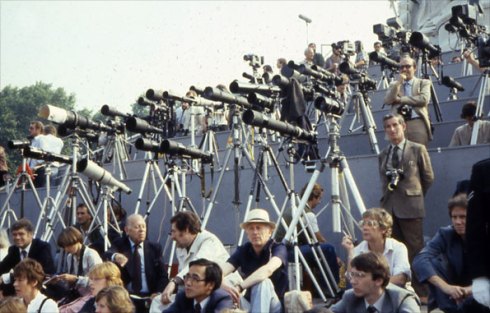
Source

- Arrest 1 (1965) by Bridget Riley
I’d like to propose an alternative method to discuss issues of race in visual culture and the photographic industry, but first some preliminaries.
HUGO AND THE CURRENT DEBATE
Necessary discussions about photography and its intersection with race are occurring once-more. Earlier this year, the criticisms were unambiguous – that the PDN failed to reflect the diversity of society on it’s jury panel. Now however, the discussions stem not from critique of the photographic industry, but off the back of Pieter Hugo’s work and all the readings viewers have heaped upon Nollywood and latterly The Hyena and Other Men.
The confusion between the two series doesn’t help as they have very different purposes; you won’t see Nigerian movie actors in zombie costumes on the street, but there is an outside chance you’ll see animal-handlers in Nigeria because they actually travel, actually perform and actually have large, wild animals as pets.
To borrow a term from M. Scott Brauer, the ‘blog echo-chamber’ has been rumbling – Jim Johnson (interestingly all the way back in July); Amy Stein; duckrabbit; Daniel Cuthbert; and Joshua Spees
I will be clear here. I like Hugo’s work. I don’t think he exploits his subjects. I disagree with Jim Johnson when he says that Hugo’s work is ‘unexceptional’. I didn’t know that Nigeria had a thriving movie industry nor that Hyenas could be ‘tamed’ and kept on chains. To deliver new information is the least we should expect of photography, and yet often not achieved.
Sebastian Boncy and Stan Banos are absolutely right in that Hugo’s work can be used by viewers to confirm their existing racism, but Daniel Cutbert is also right in that Hugo is making interesting photos of interesting people in Africa.
Any work can be misinterpreted and to criticise Hugo for the potential small-mindedness of his viewers is to cut of debate prematurely. If we took this logic to the extreme then we’d all stop making pictures. I am glad to see names as famous as Walker Evans mentioned in the cultural relativist argument – that being that we don’t all get up in arms when photographers aesthetisise the rural (white) poor of Appalachia or beyond.
John Edwin Mason emailed me. He focused on the photographic product as it is consumed, and drew parallels between Hugos’ fine art work and that of the idiots at French Vogue:
“If Hugo’s viewers are the sort of folks who hang out in downtown galleries and read Aperture, wouldn’t there be considerable overlap between them and Vogue readers? Aren’t Hugo’s photos high-end consumer goods – in the same league as a designer dress, a Rolex, or a Merc? And like them signs of wealth, taste, sophistication? Even if we only aspire to own these kinds of [luxury] items and consume them via the magazines we read, the aspiration alone moves us away from ordinary people.”
The territory of art as commodity is perhaps where the richest investigations of inequalities can occur.

World #13 (2006) by Ruud Van Empel, Cibachrome, 33 x 36.5 inches
PHOTOGRAPHY AND RACE CONFERENCE
I wonder if this hotly debated topic were fleshed out elsewhere our results would be different? Instead of PDN answering to the inequalities of an industry, instead of comments being lost in wordpress/tyepad archives, instead of calls to extend the discussion being missed/ignored and instead of suspicion and frantic typing prevailing … could we try something different?
I am sure most photographers have a lot of common ground to stake. But unfortunately, the web (or at least typing on the web) is no substitute for discussion. It takes too long, the moments pass, emotions deflate and you’re not even sure if you’re being heard/read.
So could we not back up our convictions with a commitment to meet in person. I am not talking about a coffee and a quick chat. Could we the photoblogosphere-peeps not arrange among ourselves a “conference”? It doesn’t need to be a massive production but the invite could be open. If photo-collectives, companies, magazines want to join then all the better. The agenda is ours to set.
Don’t panic. It’s just a proposal. We could hold it anywhere; New York, San Francisco, Santa Fe, New Orleans, Toronto, Chicago. We could do it next spring or summer … and plan.
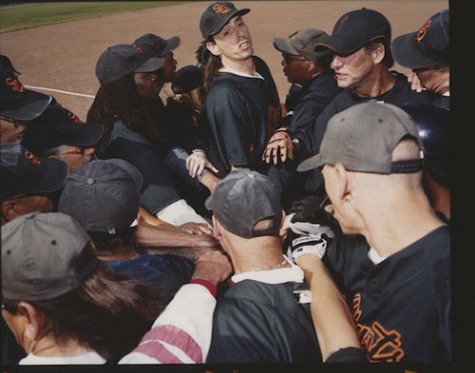
San Quentin Giants, by Emiliano Granado
Obviously, discussion of race is impossible to ignore within the Prison Photography project.
The American prison system cages a disproportionate number of Black men. Other minorities are subjugated. Accusations of misogyny and gender prejudice can only gather traction given recent sentencing pollicy.
Issues change as one moves between domestic and foriegn sites of incarceration, but are no less important.
I’ve got much to say. Will you join me?
Street Photography is a recognised genre.
Prison Photography is yet ill-defined. For the most part, it is a series of interventions by camera and operator into the procedures and relations within institutions of containment.
With these criteria in mind – the familiarity of the subject; the public visibility of the practitioner(s); the obstacles to access; and the assumption of existing/distinctive authority – it seems like the two approaches to subject are in opposition.
My presumption my be illustrated as thus:

The x axis is Time on the job.
The y axis is The original number of leads (to securing access to your subject) still open. Shown as a percentage.
Scott Langley has orbited the protests, prison protocols and politics of execution for over ten years. Judged by sheer coverage, his activism with the camera is without equal.
Capital punishment is one of the major failings of the US criminal justice system – it also remains one of the most divisive. Prison Photography was grateful to pick Scott’s brain about America’s current death industry, the legal landscape and his personal involvement.

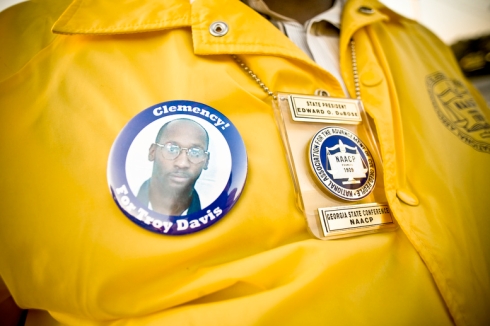
We agreed that it would be wise to focus on Scott’s coverage of Troy Davis’ stay of execution.
Troy Davis‘ case is currently the most high-profile death penalty case in America. It has become a focus for anti-death penalty activists not only because a man’s life is on the line, but also because so many doubts have been brought to bear on the original jury verdict. Through Davis’ case, society is realising that juries are fallible, eye-witness testimonies are unreliable, proceedings can be flawed and fatal errors have been made … continue to be made.
Prison Photography: What were you first, a photographer or an activist against the death penalty?
Scott Langley: I was first a photographer, working for my college newspaper and yearbook. I didn’t become active on the death penalty until a human rights class my senior year that challenged me to use photography as a tool to report on the death penalty.
PP: Your portfolio of images documenting executions, prisons, vigils, families and celebrities is the most comprehensive of any photographer currently working in the United States. Did you envisage your project would become so large, and important?
SL: I never thought it would get this far, cover so many facets, and continue for so long (over 10 years now). As I said, it started as a class project, but I quickly realized the importance of such historical documentation and the effect it could have on an important issue.
PP: This work is obviously borne of your political position, but you also work as a freelance photographer to earn a living. Are your conflicted or compromised by pressures of time and money?
SL: I am proud to say I am not compromised by pressures of time and money. I live a very non-traditional lifestyle, for the sole purpose of maintaining an emphasis on my political activism on a number of human rights issues. I do work for pay as a self employed photographer – picking up news assignments, weddings, and other photo jobs as they come up. But those take up minimal time. Of course working for pay “as it comes up” requires living a bit more simply than the average person. I run my car off of used vegetable oil. I grow much of my own food. I do all my shopping at thrift stores, yard sales, dumpsters. All these things greatly reduce the need for money, which in turn allows me to work on the death penalty photo project and my political action full time, and neither of those pays much, if anything.
PP: You are particularly well connected with the capital punishment abolitionist movements of Texas, Massachusetts and North Carolina. Describe those territories and the current legislative and cultural situations in those states.
SL: My work in North Carolina is the most in-depth and extensive. I was only there two years, but it was two years engrossed full-time in the death penalty debate. North Carolina obviously is a southern state. And it is the southern states that leads in executions and death sentencing. At the time I was there (2004-2006), North Carolina was the number two executing state, only behind Texas. And the death row was 6th largest in the United States.
But the momentum there has shifted. There hasn’t been an execution there in almost 3 years now. And more people have been found innocent on death row. And right now, as I sit here, NC is considering the Racial Justice Act, a bill that provides those on death row the ability to appeal their case due to race discrimination at the time of trial (which is a huge, huge problem in the south).
North Carolina has come close to legislatively putting a moratorium on executions. There is real hope of ending the death penalty in NC in the near future.
In Texas, where my work began, it is a whole other world. Texas executes by far the most people – more than most countries combined. There are some great organizations and activists in Texas, but there is little hopeful movement in the legislature to end or limit the death penalty. In fact, Governor Perry just oversaw his 200th execution. And to think, the media gave Bush a hard time about 152 executions back when he ran for president in 2000.
Massachusetts is in a whole different position. The Commonwealth ended the death penalty in the 1980s, and hasn’t had an execution since the 1940s. Capital punishment came close to reinstatement back in the late 1990s, but has since seen a decline in support in the Governor and legislative bodies. It will be a death penalty free state as far as I can see, although there is the real threat of federal capital prosecutions there.


PP: Explain precisely your opposition to the death penalty. Is it a religious, moral, political, ethical or philosophical stance?
SL: It started as ethical. I first learned about the death penalty through a human rights history class, where we also studied the holocaust, genocide, war… all those gruesome atrocities carried out by governments – even democratically elected governments. I learned right away the grave danger of giving the state the power to kill – to choose who lives and who dies. The class took me down many roads since then, and so my opposition covers all facets – religious, philosophical (arguments I love, but can never wrap my mind around on my own), moral, political… the whole gamut of reasons. It is now to the point where I just cannot fathom how anyone, for any reason, could justify the taking of a human life.
PP: Bill Richardson recently signed in a moratorium of the death penalty in New Mexico, joining 14 other states to ban the death penalty. How much of a victory is this?
SL: It is a huge victory. It made what happened in New Jersey the year before not just a random occurrence dependent on a liberal governor or a certain regional mentality, but part of a movement and a trend. It will cause waves of effect – and it has. Colorado, Montana, Maryland, Connecticut, North Carolina … they are all very close to drastically changing the way the death penalty will be used – or hopefully, not used.
PP: In banning the death penalty, Governor Richardson put aside his personal opinion (support) for the death penalty cited a lack of trust in the cogs of the criminal justice system to act as “the final arbiter when it comes to who lives and dies”. The death penalty is actually a procedure of criminal justice that affects a small minority of convicted criminals. What are your thoughts on the prison system as a whole.
SL: The whole prison system is a complete failure. We’ve got the majority of people locked up for harsh sentences for mere drug possession. We’ve got a system that has no policy or effort to rehabilitate. We’ve got a system that spits people back out into the exact same environments that put them in prison in the first place. And meanwhile, there is extreme racism, abuse and torture within the whole system and the walls of the prisons. Not to mention that the taxpayers are funding all of this. It is just maddening that we don’t have a better way of doing things. It is obvious that it is not working. We have a higher per capital imprisonment rate than any other country in the world, including China. Prison in the U.S., as it is, serves no positive function for the vast majority of those who go through it.
PP: Describe from personal experience the attitudes toward capital punishment in the US compared to other nations you’ve visited.
SL: During the summer of 2000, I spent six weeks backpacking through Western Europe, with camera gear in tow, to photograph sites connected with the death penalty issue in Europe’s history. This was the summer of the heated U.S. presidential race between Al Gore and George W. Bush. Because of the impending election and Bush’s history with state sanctioned killing, the Texas death penalty had become the forefront of much political conversation. When I met folks in Europe and mentioned that I was from Texas (born and raised), the first thing that always came out of their mouth was something about the death penalty. They just could not fathom how a nation, so “advanced” and “great” as the USA, could go about with a barbaric and failed practice of exterminating prisoners – at a rate of nearly 2 per week. It was a stigma that was held against me everywhere I went.
I acknowledge that not all Europeans are whole-heartedly anti-death penalty. There is ongoing talk about whether executions should resume, but it is a real minority view at this point.

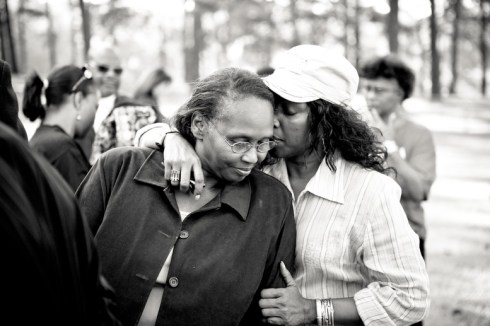

PP: Your project is over 800 pictures deep and touches upon many stories of those affected by the death penalty, but here we have focused on the case of Troy Davis. You were present to document his most recent stay of execution. Give us your thoughts on the case.
SL: Troy Davis‘ case is particularly disturbing. People who support the death penalty are starting to ask questions about this case. Even a former Georgia official publically stepped up to question why there hasn’t been a hearing of the new evidence to prove Troy’s innocence. When you have 7 out of 9 trial witnesses saying they lied, and were even coerced into lying by the police, you have to stop and say there is a problem here. It just baffles (and depresses me) that the courts just won’t hear the new evidence. The system is so caught up in judicial process that there is no humanity whatsoever. But remember, it is human life we are talking about. Real people with real family. The courts need to hear this case, desperately, because it stands for so much that is wrong with our broken system. If we, as a country, fail with the Troy Davis case, we have failed justice, failed humanity and failed all good that could possibly come out of a system designed to right wrongs and keep society safe.
PP: It seems this activism will be with you for life. Is that a fair assumption?
SL: I hope that my activism remains with me for life. There is a great need for people to always be on call to step up and do the right thing. Sometimes that might be little things like challenging the status quo by collecting used grease to run one’s car, and sometimes it might mean crossing a line to risk arrest to stop a greater harm from being done.
PP: What are your hopes for, and activities in, the future?
SL: I hope for an end to the death penalty soon. I hope to always have opportunities to educate people – through photos, through words, and through actions – about these issues of injustice. I have projects in the works to expand the death penalty documentary project and am planning for a cross-country trip in the winter 2010 to make photos in a wider variety of states.
I will continue to follow the Troy Davis case, using my camera as a tool when the opportunity arises.

View all of Scott Langley’s work here. Scott has also spoken out against sites of incarceration used in America’s global war on enemies. He has presented at the University of North Carolina, partnered with the Innocence Project, worked with Amnesty International, North Dakota Human Rights Coalition, Unitarian Universalists Against the Death Penalty and many, many more. He has also recently started working with video.

Joseph Rodriguez‘s work is essential. If I and others can promote his photography humanity then we’ve done some good.
Last week PDN ran a post about the value of the “Digital Curator“. It was a well threaded argument about things we already know: that if an online presence (blogger) does his/her thing for long enough and with a consistent (their own) voice they’ll begin to garner readers, respect and influence.
[WARNING: link blitz, but all justified]
Thankfully, we have (I believe) a healthy photography blogosphere in which plenty of photographers present their own STUFF; megaliths go vernacular; academics question and answer; fine art specialists point us in the direction of good practice & theory; insiders offer editorial, publishing, gallery, collector, buyer or industry viewpoints; universities promote; non-profits take new angles; curmudgeons grumble; old media gets hip; young guns splash out with collective and interview projects & some hover untouchably above.
In September, duckrabbit joined the fray. You may know already, but I am a fan of duck’s blog (by Ben Chesterton). I am not a fan because I agree with everything Ben has to say, but because he says it without frills and then will spend the time necessary to engage the consequent discussions. Such commitment is a priceless commodity.
duckrabbit deals primarily with photojournalism and multimedia and so Ben’s coverage doesn’t always dovetail with the preoccupations of other photographic genres – which is fine, we all have our favourite corners.
To get to the point. I am nodding furiously toward the coverage of Joseph Rodriguez on duckrabbit for three reasons:
1) Because Rodriguez (along with Leon Borensztein) made me realise how vital the relationship between photographer and subject is in creating images. Rodriguez is worth more time than duck or I could ever commit.
2) Because this is the latest in principled stances duckrabbit has taken, AND it happens to highlight the stories of formerly incarcerated.
3) Because I am committed to writing more about Rodriguez in the next month … and need to let you know.
duckrabbit’s first feature of his new series ‘Where It’s At’ (stuff that kicks a duck’s arse) is Rodriguez’s work on Re-entry after prison. Rodriguez worked with Walden House (I remember fondly the stained glass of the San Francisco WH, Buena Vista Park). As duckrabbit puts it, “Rodriguez records lives lived and he never measures the lives of those he shoots against a photographic award, magazine spread or advertising contract. His eye is never on the future, it is always in conversation with the now.”
Go to duck’s post and watch Rodriguez’s 7 minute multimedia piece on re-entry. California is where I cut my teeth in the prison policy and prisoners’ rights fields, so for me, it is especially resonant … and vital.
Also worth noting is Benjamin Jarosch, Rodriguez’s current assistant.
While we are on the topic of different realities in urban America, keep an eye out for this film at your local cinemaplex indie-theatre.
In the next few weeks I’ll be making comment and whirring the brain cogs over Rodriguez’s photographic endeavour Juvenile Justice . Stay tuned.
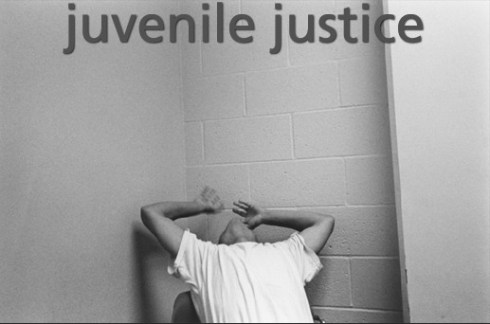
Rodriguez has won acclaim from all the important people that need to take notice, including Fifty Crows, which incidentally started up a blog recently. Everyone reading this should follow Fifty Crows because they support photographers who get in knee deep … and then some.
Peace.

San Pedro Prison in Bolivia has ceased tours for foreign visitors.
I regret my one missed opportunity. I’d been mildly obsessed with the La Paz prison for a couple of years before I arrived outside its gate and got turned away. That was July, 2008. I had read in Lonely Planet it was a piece of cake to get in and get a tour. Apparently not in my case. I surmise, that I had experienced the beginning of the end for La Paz’s most bizarre tourist attraction.
It’s definitely over now. This from yesterday’s Guardian;
Tours have never been officially recognised and the vagaries of securing visiting privileges for foreigners stems from the fact that prison guards have different rules/corruptions and relationships to outside ‘tour-guides’. Basically, foreigners had to be lucky or connected to get inside.
Flickr searches prove that “wide-eyed travellers” have visited in all the months since my failed attempt.

The reason for the end of this bizarre tourist ritual? Seemingly, tourists got too cocky and too brazen. The new prison warden ended the debacle. This was a peculiar decision (on first glance) given years of international coverage and tolerance by the authorities, but basically, everyone involved had become too comfortable – objectionably so – with the institution-turned-circus.
The group most guilty for giddy spectacle was of course the tourists. In February the self-titled “Wild Rover Group” posted this video.
And it was the tipping point. The video doesn’t show anything that wasn’t commonly known, but it spells it all out with clarity and (critically) to an unrestricted worldwide audience.
This thorough dissection of the events by a Bolivian source, explains;
It is surprising that a single video should be the tipping point, especially after a decade of widely circulated photographs. Nevertheless, the circus could no longer be ignored, nor controlled.
Interest online was mirrored by interest on the ground. Tourists filled the square outside wishing to visit; such numbers could no longer be surreptitiously ghosted in the side-door.
Vicky Baker explains,
Here’s the local media shining a big spotlight on activities with long-overdue questioning and coverage of the tours. Foreigners reacting to the attentions, flipping off the camera and scampering away under jackets were only ever going to look bad!
Unrest
Governor, Jose Cabrera, is emphatic, “The prisoners have to understand that this is a penitentiary.”
The tourism, while exploitative, was a reliable source of revenue for the prisoners and their families. By shutting down the tours, incomes for over a 1,000 men, women and children was dragged out from under them.
San Pedro was/is indelibly tied to society outside. Family members come and go daily to bring goods and services to the self-made micro-economy. The decision to close the tours down was exacerbated by new restrictions on visiting privileges. Discord grew.
As the Bolivian news crews were present to film the hoards of foreign tourists in the square, they captured the three hours of unrest from start to finish. Families, including children, of the prisoners were caught in the tear gas clouds. Unfortunate scenes.

The riot was a predictable end point to the new warden’s crude (but probably) necessary shut-down of this dubious spectacle. Many Bolivians didn’t like the fact the nation’s biggest prison was a site of titillation for foreign visitors; many were understandably ashamed and angered.
Paradoxically, one of the factors that allowed mass visitation was the accommodation of family members to spend unlimited amounts of time with incarcerated husbands & fathers during daylight hours. The institution had a generous (and unAmerican) protocol for the relaxed coming and goings of non-inmates.

What Next?
Money and the necessities it brings are key to solving the tensions. According to a prisoner interviewed by La Rázon, “70% of the [250 peso] fee goes to the police and the people who organize the foreigners for the tours,” the rest being split up among prisoners. This monetary ecosystem may not have been fair but it was consistent.
The new warden has since negotiated and agreed new rules for San Pedro, presumably taking into account the stymied income for all inside. Time will tell. As an indication of how fragile authority is at the prison, the new warden has adopted a fast rotation of guards to prevent foreigners … the suggestion being, a guard needs only to get comfortable at his gate post before he can start manipulating bribes to get tourists in again.
I’ll leave you arguments for permanent closure of San Pedro to foreigners with the thoughts of two Bolivians;
and
True.

The Remains
The photographic legacy is wide and varied. Amateur snaps prevail here, here, here and here. Enthusiasts occasionally turn their skills, and professionals such as Hector Mediavilla have focused on cocaine manufacture and drug addiction in San Pedro Prison.


 Prison Photography