
You are currently browsing the tag archive for the ‘Prison’ tag.

A TB patient at Tomsk Regional Clinical Tuberculosis Hospital, Building #3. Photograph and caption © James Nachtwey/VII.
“Tuberculosis is a disease of poverty and stress“.
Merrill Goozner, The Center for Science in the Public Interest.
“Sixty percent of all new cases of tuberculosis have resulted from the rapid growth of the post-Communist prison archipelago”.
Proceedings of the National Academy of Sciences. Aug. 26th, 2008
Tuberculosis (TB) was under relative control in the former USSR. Soviets had lifestyles, nourishment and conditions of living that kept disease at bay. When communism fell, so did a civil order in many areas. The phalanx of activity that filled the vacuum involved new systems, new relationships, new businesses and new criminal opportunities.
The prisons filled in a society that needed to organize itself before it could organize it’s transgressors. The prison population swelled to 1.1 million (it is now down to little over 700,000). Post-communist prisons held malnourished, crowded populations with weak immune systems; they have been described as ‘Tuberculosis incubators‘.

Correctional Treatment Unit #1, a TB prison colony in Tomsk, Siberia. TB patient/prisoner gets a chest x-ray. Treatment is supervised by Partners in Health in partnership with the government TB program. James Nachtwey/VII
TB is best treated with various labour intensive methods known under the umbrella-term Directly Observed Therapys (DOTs). Due to TB’s many different strains – each with different drug resistancies – case by case treatments differ according to patient reactions to drugs. At the least, a patient must be observed and his/her drug regime modified over a 6 month period. For Multi-Drug-Resistant Tuberculosis (MDR-TB) the treatment can take as long as two years. And, MDR-TB & XDR-TB are increasingly common among prison and civilian populations of Tomsk and other Siberian urban centers. Unfortunately, closely monitored drug regimes are improbable in over-stretched and poorly funded state systems.
It wasn’t always so dire. The former Soviet provided a regular supply of drugs to abate disease amongst its prison population, but those supplies were interrupted in the fall of Communism – sporadic and incomplete treatments gave rise to multiple resistant strains of tuberculosis. To compound this the side effects of drugs were enough to discourage patients, and rarely, if ever, did courses of treatment go with a prisoner into his community following release.

TB patients smoke cigarettes in the smoking room of Tomsk Regional Clinical Tuberculosis Hospital, Building #1. James Nachtwey/VII
James Nachtwey‘s mega-promoted TED prize crusade addresses the spread of Extremely Drug Resistant Tuberculosis (XDR-TB), its mutant forms and human tolls. This excellent Guardian article notes Nachtwey has photographed the epidemic worldwide, from Siberian prisons to Cambodian clinics.
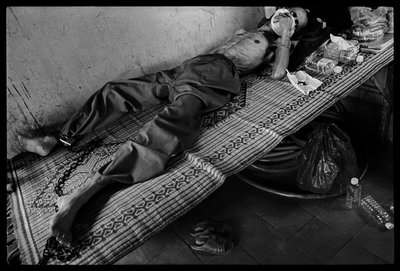
A prisoner who was convicted of murder was moved from prison to the TB ward of Battambang Provincial Hospital, Battambang, Cambodia when he was diagnosed with TB. He is coinfected with AIDS. James Nachtwey
Nachtwey stands with Sebastião Salgado in the “super-photographer” stakes. They both make the ugly beautiful.
Both Nachtwey and Salgado have inspired others to action and both believe firmly in the power of photography to change existences … even in a time when such sentiment is derided as old-fashioned, false idealism.
But, despite the odds, Nachtwey has succeeded in forcing his work into the conscience of millions. For some his work is an inspiration for social justice; but for others his work is a sub-conscious default to guilt, despondency and powerlessness to help others less fortunate.
James Nachtwey puts human faces to global suffering. And we are outraged. Or we feel we should be outraged.
I think Nachtwey wants us to believe in ourselves as agents of change. Nachtwey deliberately chose Tuberculosis – because while the situation is critical, it is not terminal and TB is theoretically entirely curable. Beating TB on a global scale is dependent on the behaviours of individuals and their communities.

Correctional Treatment Unit #1, a TB prison colony in Tomsk, Siberia. A prisoner proves to a nurse that he has swallowed his daily oral TB medication. The prisoners receive treatment through metal bars in order to give security to the nurses. Treatment is supervised by Partners in Health in partnership with the government TB program. © James Nachtwey/VII.
Nachtwey’s work extended beyond the prison walls in Tomsk and went into the public clinics (some images included here show those facilities); TB is no respecter of human walls or demarcations. Regional, economic poverty will spike rates of TB.
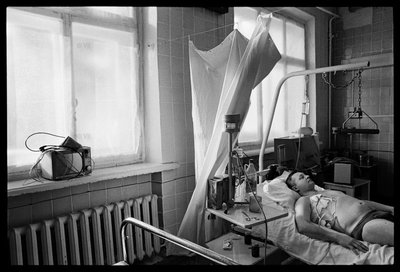
A TB patient has excess fluid drained from his chest a Tomsk Regional Clinical Tuberculosis Hospital, Building #1. James Nachtwey/VII
The worst thing we could do here would be to think that TB is a disease of other nations and other peoples. In Pathologies of Power (2004), Paul Farmer wrote about the New York prison system’s huge Tuberculosis epidemic of the mid-nineties, “By some estimate, it cost $1 billion to bring under control”. The strains that arose in the NYDoC have been directly related to the resistant strains of the former Soviet Union. Tuberculosis is latent within one third of the world’s population. Tuberculosis needs only the conditions for its growth.
Paul Farmer, of Mountains Beyond Mountains fame has taken the lead on combating TB, as well as other infectious diseases, amongst the world’s poorest populations. He worked with Partners in Health partly funded by a Soros Grant to “develop demonstration tuberculosis control projects which could become a model for replication throughout Russia.”
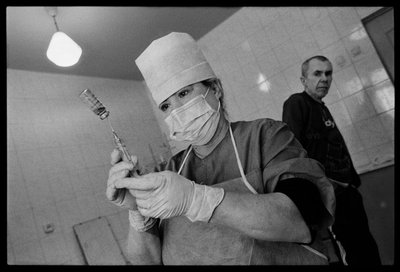
A nurse prepares a daily injection for TB patients at Tomsk Regional Clinical Tuberculosis Hospital, Building #3. James Nachtwey/VII
Prison Photography blog has focused twice previously on photographers’ responses to the USSR and its aftermath – the Gulag and the new prisons that arose. While Anna Shteynshleyger and Yana Payusova are working with very different issues, regions and populations they – along with Nachtwey’s work – remind us of the severe problems facing parts of modern Russian society. Unfortunately, and certainly in the case of Tuberculosis, these problems exist in other nations also. Nachtwey focused on TB because it was not – despite being a global problem – on the radar of most people. That sounds like something I’d say about prisons and prisoners’ rights.

Correctional Treatment Unit #1, a TB prison colony in Tomsk, Siberia. A patient/prisoner receives a daily medical injection. The prisoners receive treatment through metal bars in order to give security to the nurses. Treatment is supervised by Partners in Health in partnership with the government TB program. James Nachtwey/VII
For more information on XDR-TB read the Action – Advocacy to Stop TB Internationally website, and the Center for Disease Control & Prevention website. For the most accessible and recent article, read Merrill Goozner’s 2008 Scientific American article about Russian Tuberculosis strains which also includes a audio segment with a clear explanation of the situation.
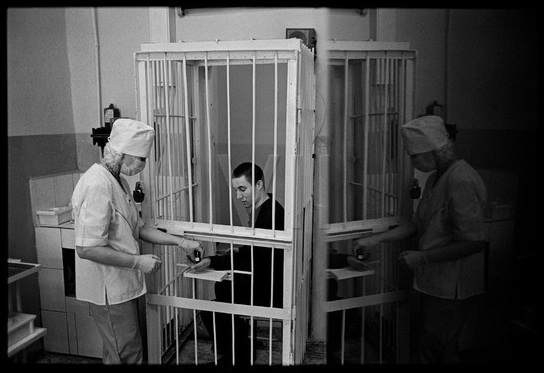
A TB patient/prisoner receives his daily oral medication at Correctional Treatment Unit #1, a TB prison colony in Tomsk, Siberia. © James Nachtwey/VII.
James Nachtwey built his reputation as a combat photographer.
He was always reluctant to be the focus of media attention but after 5 Capa Gold Medals for War Photography he couldn’t escape the curiosity of Christian Frei who made the extraordinary film War Photographer. Nachtwey comes across as an articulate, self-isolated journalist-force devoted to his craft and courteously distant to others; here is a clip.
Nachtwey has done interviews here, here and here. Read an interview about his 9/11 pictures, and associated videos on Digital Journalist. The images were published in TIME.
He worked in Rwanda for his book Inferno.
View his TED Prize acceptance speech and the consequent October 2008 launch of his XDR-TB project and Flickr pool.
If you search “Prison Photography” on Twitter you’ll get nowt back. That’s because I use an inverted version of my pseudo-faux-baptismal avatar, brookpete.

In truth, you’d all be better spending time with Brian Solis’ latest tussle divining Twitter’s worth than following my twits, twats and tweets.
Two months ago I interviewed Emiliano Granado about his experience photographing the San Quentin Giants.
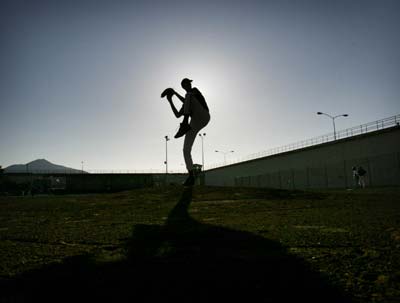
Pitcher for San Quentin Giants. Credit: David Bauman/PE.com
In my research I came upon a lot of media coverage, but I recently unearthed this gem of a slideshow by David Bauman. Enjoy.
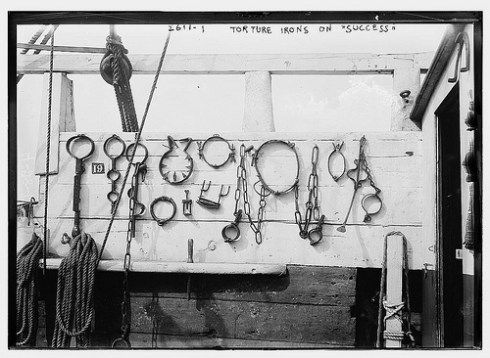
A couple of months ago, I wrote about the prison convict ship Success and its repurposing as a museum ship in the early 19th century. At that time, I featured a couple of images of the ship docked in Seattle and Tacoma. To continue from that visual anchor (pun intended), I’d like to share these few close up images of this unique and long-gone “Museum Ship of Colonial Horrors” (as I like to refer to it).
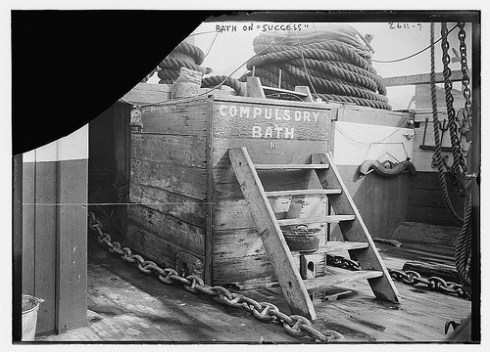
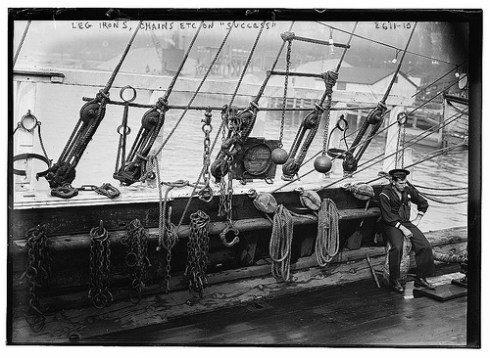 The accoutrements of abuse on display are chilling. The international seafaring exhibit was an old British and latterly Australian ship used for deportation of ‘criminals’ during Victorian times and for non-human commodities thereafter.
I wonder what sort of museological interpretation of Success was given to American audiences? Would this have been kept in a separate narrative to the slavery ships of the Atlantic or would all histories be foisted into one macabre reductive appreciation of the ‘Other’?
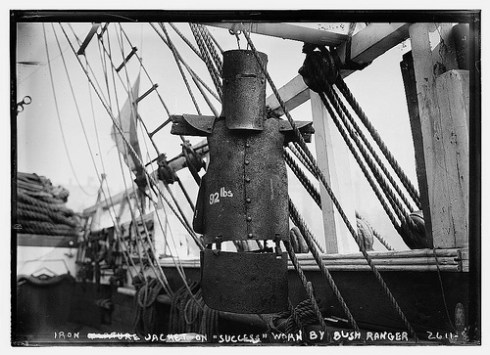
 When I saw the iron jacket I was terrified, but then I read Wystan‘s description of the Wooden Maiden:
If you were very naughty, you might be asked to remove your clothing and climb inside this vertical coffin, where of course it was pitch dark, there was no water, and fresh air was scarce. Then the box (which was clad in sheet iron) would stand in the hot sun until you got nice and warm. But you wouldn’t want to slump or faint, because then your bare flesh might get snagged on the ends of the long nails that had been pounded into it from random directions . . .
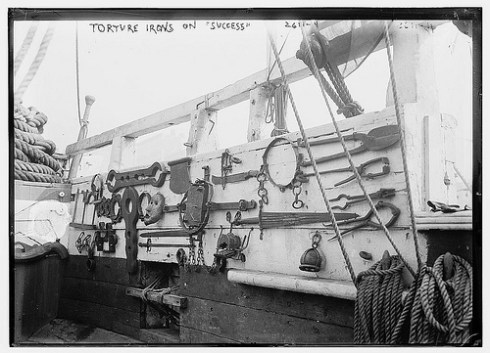
All images from the Library of Congress on Flickr,
and searched out through Flickr Commons.
On Thursday, 28th May, photographs of prison conditions and detainee custody from six facilities other than Abu Ghraib will be released to the public.
Reports over the weekend suggested a figure of 44, but the Guardian has stated over 2,000 photographs are to be made public. Images of Bagram Air base in Afghanistan are included in the cache. Critics will surely scan for similarities in detention/torture methods used in Afghanistan as in Iraq to argue against the ‘few bad apples’ logic that railroaded earlier attempts to bring military and government commanding authorities to full-accountability.

ACLU’s advocacy deserves international acclaim. Not only have they forced the release of photographic evidence they won a ruling to prevent the destruction of audio tapes that record torture scenarios.
This is an interesting counterpoint. I presume we all assume we’ll see the images in the printed press. Would we expect the tapes to play on our televisions and radios? That scenario makes me uncomfortable.
Continuing with issues of format, it will be interesting to see how the media presents the-soon-to-be-released photographic documents in contrast to the recent torture memo’s. WoWoWoW set the bar low with the tabloid inquiry “How Bad Will They Be?” and the Los Angeles Times allays fears with a dead-pan assessment, “examined by Air Force and Army criminal investigators, are apparently not as shocking as those taken at Abu Ghraib.
No doubt these images will be contested and a ‘Meaning-War’ over the images will ensue, but I think people for and against the Bush administration’s interrogation policies are not going to change their position now – whatever the evidence.”
But, I guess it depends who’s looking.

Lefties want more weaponry in the push for prosecution of Bush and his cronies for war crimes. The right is debilitated and otherwise occupied by the economy, stocking guns before the “Obama-ban” and the latest Meghan McCain slur.
Politicians from both parties seem to want this to go away, snarking on about how the release of yet more Un-American activities will only fuel the burning hate toward the US. This position is an insult.
Did Bush care what Iraqi’s would think when he bombed them out of house and home? Did Bush care to think how American’s would react in the face of diminished civil liberties? Yet here, politicians of both parties are scrambling to avoid the negative reactions of entrenched, fundamental opponents INSTEAD of anticipating the beneficial good-will and return to mutual trust provided by honest disclosures of a transparent and constitutional government. Why cover-up a cover-up?
Maybe, the Democrats are shy to see these documents because they may implicate their top brass?

One concern I will air, is that all this could move toward some bizarre show-trial scenario, where lawyers bargain, Bush is spared, the American public settle for a conviction of Cheney, and careers and reputations lie in waste on both sides of the aisle!?!
I certainly didn’t expect the incriminating documents to flood as they have in recent weeks. I have no idea how all this is going to shake down. Obama doesn’t seem to have control of this. That doesn’t bother me. No-one can hold back the truth.
So, as wise at it’d be to remember the date, 28th May, you should bear in mind the photographs of abuse could well leak earlier…
________________________________________________
First Image lifted from Gerry May. http://www.gerrymay.com/?p=1426
Cartoon courtesy of the Nation. http://www.thenation.com/doc/20050307/duzyj
Final Image by Takomabibelot. http://www.flickr.com/photos/takomabibelot/2090273618/

In 2007, Jürgen Chill‘s Zellen series won him the European Architectural Photography Prize in the “Favorite Places” category. Awarded every two years since 1995, the international prize is now organized by the nonprofit architekturbild.eV (since 2005). The 2007 jury – chaired by Hans Eberhard Hess, chief editor of Photo International magazine – was impressed by Chill’s strict central overhead perspective and chose four images.
Today, the 2009 prize winners are announced, so it seems like a good time to recall Chill’s intriguing images.
Jürgen Chill’s Zellen photographs are a unique perspective upon prison space. Of all the positions in the cell, this floating light-fixture-eye-view should be the least claustrophobic, and yet, the central (physically impossible) high vantage point is dizzying. How does the camera (let alone cameraman) take up such a position? From here, what is there left to do but fall?
Has Chill has pioneered a new photographic typology? I was fascinated by the order of each work; the order of each cell. I must presume this order is the inmates doing and not the photographers. Chill’s work is labour intensive. The reason he nor the camera falls is because each image is a stitch of over one hundred photographs, captured by a digital SLR mounted on a boom, pressed – facing downward – against the ceiling surface.
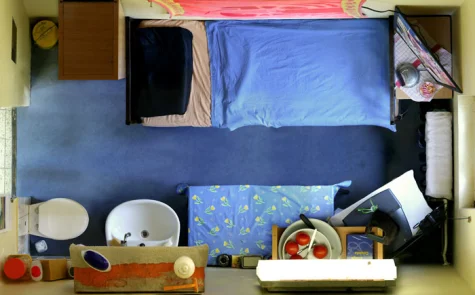
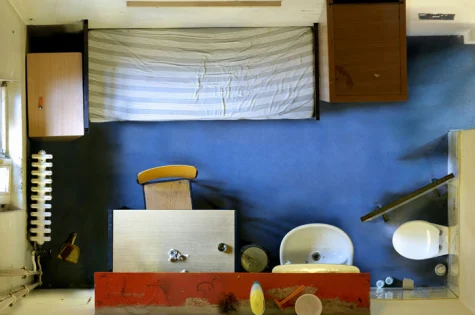

Chill is aware that entering his work in the category ‘Favourite Places’ may seem careless or even cynical, especially as the inmates are not pictured. On the other hand, as he notes on his website, “the barren rooms of the inmates are highly individualized and at least temporary qualify as de facto ‘Favorite Places’.” In 2006 he stated:
A person’s favourite place is a place which can be chosen at will. The person’s freedom is presupposed. Freedom, however, is not granted to all. Those that do not have it must adjust to whatever opportunities exist and strive to create their own place. A cell is perhaps the smallest possible space for habitation that a person can have. Personal and functional items are all accommodated in the tightest space. The spaces are represented as they are found. The Spaces are represented as they are found. The proportions of the photographs mach those of the rooms. All details in the rooms are shown orthogonally from above, nothing has been altered.
________________________________________________________________
I contacted Jürgen via email to ask about the practicalities of making Zellen, and to secure his comments on the series concept.
Jürgen, please introduce your work.
My photographs are most like a map of the prison cells; like a Google Earth view of a landscape. I try to communicate information about the individuals that have to live in perhaps the smallest possible space for habitation that a person can have – without showing this person himself. Personal and functional items are all accommodated in the tightest space.
I’m interested in how a person arranges personal and functional items in their small cell. And what kind of person can it be [based upon the visible evidence]? Is it possible to get a “picture” of a person by having a view of his private space? It’s a view and perspective that you normally would never get of these cells. So it is not really “real”, more a scenery set or something similar.


Where are the cells?
The are all in Germany in big cities in the area of Nordrhein Westfalen.
Are the photographs made in the same institution?
I made 16 photographs in 6 different prisons in the cities of Bochum, Hagen, Duisburg, Gelsenkirchen, Essen and Geldern
Where were the prisoners when you took the photographs?
I had a short conversation with the prisoners in their cells; explained my project, my concept and my motivation. Some of them were really interested in my work and my kind of photography. The prisoners allowed me to spend about 45 minutes alone in their cells, while they are waited outside, in the alleyway, guarded by one or two persons from the prison.
After my work, for their permission to photograph and publish their private things and space, I gave them a small gift; a packet of coffee or cigarettes. Later I sent them all the photograph of their rooms. Some of them asked for it to have as a kind of souvenir for when they are released from prison.
How long did set up take and what equipment did you use?
Just to photograph takes about 30 minutes. With the test shoots and everything it takes about 75 minutes in one cell. The main work, the montage to one photo takes about one week. So it took a long time to make the photo series. You can see how the images were made in the youtube clip of this German television show from October, 2007.
Does the collection and order of all worldly possessions in a single space fascinate you?
It’s the combination of personal and functional items in a small space. First, the cell must contain all the functions of a house in one room: bedroom, toilet, living-room, store-room and sometimes a kitchen. Then the prisoner combines it with his personal possessions and create his private space in about 8 square metres. How does a person arrange such a small space with personal items so that it [also] keeps its basic functions ? And that arrangement exists for years. So my photographs try to draw a picture of an individual person.

Americans, in particular, are starting to realise that they must use/waste less petrol, possessions, energy, space and give up personal largess for the benefit of community. Does the modesty of the prison cell appeal to you? Do future modes of living relate to the cell?
For me, as the artist and maker of these photographs, my intention is not to call out [to people] to give up personal largess for the benefit of community or for other kinds of social and political attitudes or activities. I just want to show the state of things in the visual of photography and try to show these things in an unusual perspective or context. Just to ask questions about it and not to give answers. That’s the viewers job.
Would you put your images into a history of visual culture that represents humans under duress and finding humanity in the smallest places/between the cracks? Or, is the Zellen series a totally modern piece, completely divided from historical context?
About historical context: I think every art work (the good ones) can not be divided from cultural and historical contexts. The Zellen series, and the new photographic series of whorehouse rooms, which I’m now working on, tells us about situations and the state of things now.
But the contemporary associations of now ( the “Zeitgeist” ) result from the past. The series Zellen was shown in a large exposition about prisons, CUSTODY/SPACES OF SURVEILLANCE in the Summer of 2008 in Frankfurt, Germany. The photographs were shown there in the historical context of humanity under surveillance; within imprisonment and [in the context of] prison architectures.

________________________________________________
Thanks to Jürgen for his kind help and time in piecing this article together.
All Images © Jürgen Chill.
The blogo-photo-sphere has been spinning the past couple of days with the 2009 Pulitzer Prize announcements. Damon Winter took one gong for “his memorable array of pictures deftly capturing multiple facets of Barack Obama’s presidential campaign.” (Featured Photography). Patrick Farrell secured the other with his “provocative, impeccably composed images of despair after Hurricane Ike and other lethal storms caused a humanitarian disaster in Haiti.” (Breaking News Story)
Winter’s images are eye-catching, but to be honest I am suffering from ‘Obama-fatigue’. So saturated were we with so many high-quality images of the new 44th President, I now look for different material. A quick shufties through Winters website revealed all. His portraits of sports stars show a precocious willing to improvise with technique and composition. Winter has a seriously sentimental side also epitomised by his portraits of American Olympians from the 1984 Los Angeles games.
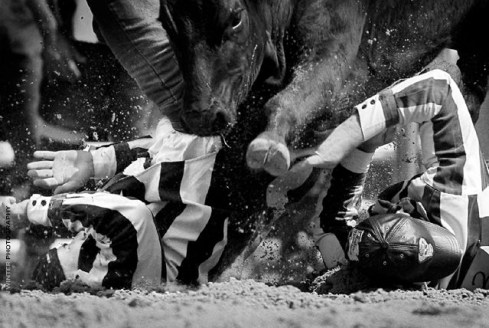
I guess, my hope is that he doesn’t become known as ‘that guy that did Obama’ … which is why I am more interested in his Angola Prison Rodeo photojournalism.
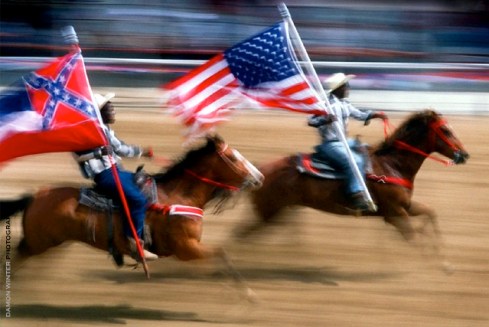
The rodeo featuring the prisoners of Louisiana State Penitentiary, commonly known as Angola, is an old – even traditional – event in the Louisiana calendar. Damon Winter is one of many photographers that have covered the community event. It is a raucous spectacle that brings together populations in and outside of the prison.
I still cannot reconcile this event my existing ethics which this event. There’s a charge that the rodeo is exploitative entertainment for which prisoners can suffer serious injury. Yet, I have not witnessed the rodeo-weekend first hand and I have read in the past that this is an event that provides long-term focus and short-term adulation for the prisoner-competitors. All I want to do is bring Winter’s photographs to your attention and hope they’ll compete with Obama for your attentions!

Winter’s pictures capture the strong forces and consequent risks of rodeo competition. I deliberately picked his colour images. The black & white stripes of inmates harry within Winter’s ‘red, white and blue’ palette. The star-spangled palette imbues the series with patriotism, pomp and faux-purpose. I almost feel we are subliminally less inclined to question Angola’s unique display of pseudo-gladiatorial entertainment when the games are suffused with hues of the American flag.

_________________________________________________________
View Damon Winter’s Obama campaign coverage for the New York Times, and listen to an audio interview with Winter about his experiences. Winter and PDN did an interview in 2008.

 Prison Photography
Jacob Holdt’s America: Hitch-hiking, Poverty, Racism, Prisons, Death and Love
May 19, 2009 in Activist Art, Documentary, Historical | Tags: America, Anti-Racism, Comment, Death, Drugs Addiction, Inequality, Jacob Holdt, Love, Murder, Philosophy, Poverty, Prison, Prisons, Problems, Social, Violence | by petebrook | Leave a comment
Jacob Holdt presenting at the New York Photo Festival, 2009. Screen shot from WTJ? Video.
In 2008 it was Ballen. In 2009 it was Jacob Holdt; The highlight of the New York Photo Festival.
I have been a fan of Holdt’s work for a couple of years now. Longer than some and not a fraction as long as others. Holdt has lived across the globe as an activist against racism and a harbinger of love for nearly four decades.
In 2008, Jacob Holdt was nominated for the Deutsche Borse Prize eventually losing out to Esko Männikkö. It was a shrewd shortlisting by a notoriously urbane committee at Deutsche. Holdt’s life and productive trajectory is his own, and much like Ballen does not conform to any norms of expected photographic career paths.
Any nomination – any praise – is purely a recognition of Holdt’s philosophy, his “vagabond days”, his trust in fellow humans and his rejection of stereotypes, fear and pride. Holdt does not revere photography as others may, “Photography never interested me. Photography was for me only a tool for social change.”
© Jacob Holdt
I watched Holdt’s presentation without expectation. I was, in truth, very surprised by the number of times he referred to his subjects – his friends – spending time in prison. It seemed only death trumped incarceration in terms of frequency amongst his circle of friends.
Prison Meal on Toilet © Jacob Holdt. Through a “mysterious mistake” I got locked up in this California prison with my camera and had plenty of time to follow the daily life of my co-inmates. Food was served in their cells where the only table was their toilet.
Slide after slide: “I can’t remember the number of times I have helped him get out of prison” and, “He’s in prison, now” or “He’s doing well now. He was in prison, but now he is out, has a family, and is doing well.”
Holdt described his method of finding community. Upon arrival in a new place, he would visit the police station and ask where the highest homicide rate was. He’d go to the answer.
Violence was tied up with poverty, was tied up with drugs, was tied up with deprivation, was tied up with hurt, was tied up with punishment and was tied up with prison – usually long sentencing.
Holdt’s series straddles the massive prison expansion experiment of America that began in the 1980s. Also enveloped are the crack epidemics, the racial fragmentation of urban populations and the relocation of middle classes to the suburbs. Holdt’s photographs are the mirror to racial economic inequalities.
Dad in Prison © Jacob Holdt. Alphonso has often entertained my college students about how he and the other criminals in Baltimore planned to mug me when they first saw me in their ghetto. However, we became good friends, but some time later he got a 6 year prison term. Here are the daughters Alfrida and Joann seen when they told me about it at my return. Today Alphonso has found God with the help of these two daughters who are now both ministers.
Holdt doesn’t play the blame game. Just as institutions and corporations walked all over many African Americans in Philadelphia, Baltimore, New York, and states across the South, so too did people step on each other, “This is a photo of a man the night after he shot his own brother in the head.” The next night, he was out stealing again and soon after was convicted for another crime and served 16 years in prison.
Holdt only makes excuses for the failings of his friends insomuch as their mistakes are more likely – almost inevitable – set in the context of their life experience. He doesn’t jump in, drive-by, photo some ghetto-shots nor cadge some poverty-porn. Holdt involves himself directly and tries to open other avenues.
He and his team has lectured across the globe running anti-racism workshops. Holdt had ex-cons sell his anti-racism book on the streets when they were released from prisons without opportunity. He offered pushers the chance to sell his books instead of dope. Sometimes he saw the money and sometimes not, “But, it was never about the money” Holdt adds.
Prisoner cleaning up on Palm Beach. © Jacob Holdt
One of the most sobering facts of the talk was a double mention of Lowell Correctional Institution in Florida. It was the only facility referred to by name and twice Holdt named friends who’d spent time inside. Lowell is a women’s facility. The female prison population of America has quadrupled in the past 25 years. It is still expanding at a far faster rate than the male prison population. Women’s super-prisons are singularly an American phenomenon. Holdt dropped as an aside, “I have three friends with grandmothers in prisons.”
If he could help, he would. Holdt described a struggling young lady who he desperately wanted to get on staff of American Pictures, but in 1986 she was too strung out on crack. In 1994 he visited her in prison. In 2004 she was released. In 2007 she was still out and Holdt photographed her with her son.
He photographed mothers, lovers, father and sons behind bars. In one case, when the father was convicted the son turned to crime to keep enough money coming in to support the family. He soon joined his dad in prison.
Prison Kiss © Jacob Holdt. I was visiting the friend of this inmate when his wife suddenly came on a visit.
But when it would be expected that Holdt may be too deep inside the experience of the poor Black experience, he took the chance to live amid the poor White experience.
Poor whites at a Klan gathering in Alabama. © Jacob Holdt
In 2002, Holdt had the opportunity to live with the Ku Klux Klan. He became pals with the Grand Dragon and his family.
“I have spent my life photographing hurt people.” The KKK members were no different. The leader had been abused as a child, subject to incest and beatings. Holdt presumed this but it was confirmed around the time the leader was sent to prison for 130 years for murder.
Holdt moved in with Pamela, the leaders wife, to support her in her husbands absence. Also in his absence he brought the unlikeliest of people together.
Pamela with white friend (Jacob Holdt). © Jacob Holdt
Pamela with black friend. © Jacob Holdt
During this time and only through informal discussion did Holdt learn that the man was innocent – he had voluntarily gone to prison to spare his son, the real culprit, from conviction for a hate crime.
Holdt petitioned and won his release. The former Grand Dragon was unemployed upon release and went on to sell Holdt’s anti-racism book on the streets … just as the dope-dealers of Philly had 15 years earlier.
Holdt’s presentation confirmed to me that the prison is inextricably linked with the social history of America. But this should not be surprising in a society so violent. Holdt paints a portrait of America from the 70s through to today in which the poorest people (both Black and White) held the monopoly on violence, disease, depression, addiction and struggle.
When Holdt was in Africa he showed people there his images of African-Americans suffering. Africans thought the Black communities of America would fare better in Africa, “Why don’t they come back here?”
Two unemployed Vietnam veterans at wall on 3rd St. © Jacob Holdt
Given the situations he walked into, some may think Holdt is fortunate to still be alive but having armed himself with love he made his own luck … and friends.
Check out more on Jacob Holdt here and here. Here is an article in support of his hitch-hiking activity.
Holdt’s incredible 20,000 image archive American Pictures.
WTJ? 70 minute video of his NYPF presentation.