
You are currently browsing the tag archive for the ‘Solitary confinement’ tag.
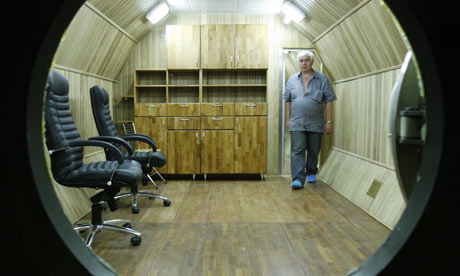
European Space Agency simulation module used to study the effects of long term confinement. Photo: Pavel Zelensky/AFP/Getty Images
In June 2010, as part of the Mars 500 research project, the European Space Agency (ESA) put six trainee astronauts into a space flight simulation. In a giant ” tin can” in a Moscow hangar with no sun, no fresh water and no alcohol for 520 days, the psychological tenacity of these six ground-bound astronauts will be under constant scrutiny. Mars 500 is the most ambitious space-simulator research to date. The ESA put away its trainees in similar conditions for 105 days in 2009.
As a spokesman for Mars 500, Dr. Christer Fuglesang, a Swedish astronaut with the human spaceflight directorate of the European Space Agency (ESA) emphasised the usefulness of the study:
“This isn’t a joke. It will give a lot of useful information, not just about Mars but also for Earth […] People are isolated in many places in the world. We have scientists in the south pole for a long time, or in submarines. Then there are all those in jail.”
Fuglesang is right. Solitary confinement is never a joke.
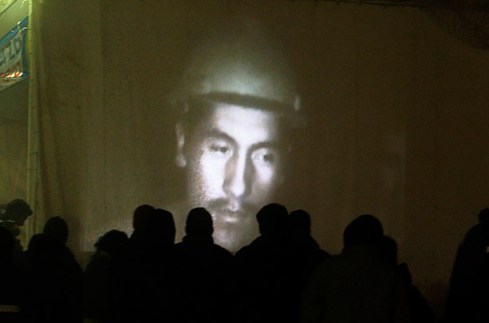
Well-wishers, family and friends watch a video of the miners projected onto a screen erected near the collapsed gold and copper mine near Copiapó, Chile. Photo: Ivan Alvarado / Reuters.
When the Chilean miners were trapped for 69 days experts from NASA were called in as experts on the psychological strains of long term confinement. A call to the management of any one of America’s hundreds Intense Management Units (IMUs) could have been as useful (except for the fact that prisoners are hardly cared for or monitored in the way necessary to improve their psychological state.) On any given day in the United States, 20,000 men, women and children are held in solitary confinement.
I have used this quote before, but it bears repeating:
First, after months or years of complete isolation, many prisoners “begin to lose the ability to initiate behavior of any kind—to organize their own lives around activity and purpose. Chronic apathy, lethargy, depression, and despair often result. . . . In extreme cases, prisoners may literally stop behaving” (Haney). [They] become essentially catatonic.
Source: Hellhole, The New Yorker, March 30, 2009, by Atul Gawande.
UNFATHOMABLE SCALE
Everyday in American prisons wallow the equivalent of 600 Chilean mining disasters … except prisoners can remain penned in for longer than 69 days.
“The [psychological and cognitive effects of long term isolation] is not something that’s easy to study,” says Craig Haney, psychology professor at the University of California at Santa Cruz, “and not something that prison systems are eager to have people look at.” Haney leads academic research on solitary confinement and notes that US prisons didn’t always resort to its current widespread use:
We have an overwhelmingly crowded prison system in which the mandate to rehabilitate and provide activities for prisoners was suspended at the same time as the prison system became overcrowded. Not surprisingly, prison systems faced with this influx of prisoners, and lacking the rewards they once had to manage and control prisoner behavior, turned to the use of punishment. And one big punishment is the threat of long-term solitary confinement. They’ve used it without a lot of forethought to its consequences. That policy needs to be rethought. (Source)
FIRST HAND TESTIMONY
Academics, studies and statistics may hook, inspire and lead some to direct action, but for others the voices of those who’ve suffered in solitary confinement may inform more effectively.
In a prison system that has lost its moral compass, in a system that uses solitary confinement cells as the new asylums, in a country which had made torture its own, it is the voices of the confined to which we should pay most attention.
I would like to recommend an excellent writer, who also happens to be a prisoner. Arthur Longworth was awarded First Place in memoir in the PEN American Center 2010 Prison Writing Contest. Longworth writes about the violence of the Walla Walla Intense Management Unit (IMU) in Washington State. Longworth’s second memoir piece is entitled The Hole.
You can buy The Prison Diary of Arthur Longworth #299180 ($7) by following the directions posted at Changing Lives, Changing Minds.
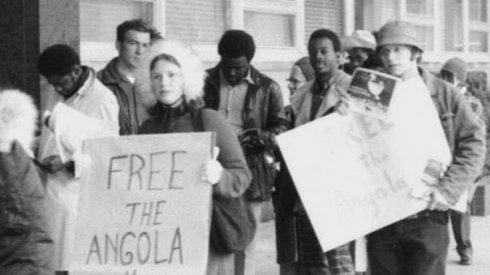
There is a place in the US where two men have been held in solitary confinement for 37 years. It is Angola Prison, Louisiana.
Robert H. King, one of the Angola 3 was released when his wrongful conviction was overturned in 2001. Herman Wallace and Albert Woodfox remain.
The length of their stays in solitary are due to the seriousness of the crime for which they were charged – the murder of a prison guard. They have always maintained they were framed for the jailhouse murder. Interestingly, in the In The Land Of The Free trailer the correctional officer’s widow doesn’t believe Wallace or Woodfox were the killers.
MENTAL HEALTH IN SOLITARY
For the most visceral and psychological description of solitary confinement upon the mental and physical health of a human read Atul Gawande‘s vital New Yorker article HELLHOLE (March 2009).
Every wondered what effect isolation has on the human psyche?
What a crazy world with inexplicable institutions.
‘IN THE LAND OF THE FREE’ STILLS

Solitary cell

Herman Wallace (left) and Albert Woodfox (right) with Angola prison in the 1970s (background)
Photos from the In The Land Of The Free facebook page.
If I ever have kids I’ll read them Naomi Klein’s Shock Doctrine at bedtime. I’ll use Klein’s words as proxy for my own in imparting the necessary cautions of governments and guns in our f*#ked up world.
(Hold up, there’s reason enough why not to have kids.)
Chapters two and three deal with the growth of Chicago School economics and its pernicious experiments and infiltration into the ‘Southern Cone’.
Throughout the 60s and 70s, the US & the CIA facilitated right-wing opposition movements, juntas, military coups and consequent torture programs in Chile, Brazil, Uruguay and Argentina.
During this time between 100,000 and 150,000 people were killed or ‘disappeared’. Estimates are wide and varied because the murders were out of control, accountability suspended and the terror doled out faster than it could be monitored.
During the Dirty War in Argentina, the terror of each night repeated the previous; a seven-year state-sanctioned massacre that bled into every neighbourhood under the cover of darkness.
The inhumanity is incomprehensible, but Klein attempts to describe the various methods used at times by different forces in each of the countries. Uruguay had a particular penchant for isolation;
Prisoners in Uruguay’s Libertad Prison were sent to la isla, the island: tiny windowless cells in which one bare light bulb was illuminated at all times. High value prisoners were kept in absolute isolation for more than a decade.
“We were beginning to think we were dead, that our cells weren’t cells but rather graves, that the outside world didn’t exist, that the sun was a myth,” one of these prisoners, Mauricio Rosencof, recalled. He saw the sun for a total of eight hours over eleven and a half years. So deprived were his senses during this time that he “forgot colors – there were no colors.”
(Page 93)
In a foot-note Klein remarks:
‘The prison administration at Libertad worked closely with behavioral psychologists to design torture techniques tailored to each individual’s psychological profile – a method now used at Guantanamo Bay.’

 Prison Photography