
You are currently browsing the monthly archive for February 2010.
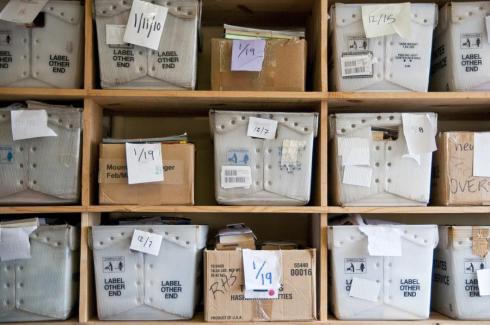
Photo by Sang Cho.
I volunteer with the Seattle organisation Books to Prisoners. It’s a pretty awesome initiative; in 2009 it mailed 12,000 packages to prisoners across the US.
Seattle is helped by satellite groups in Bellingham and Olympia in Washington, and Portland in Oregon.
Books to Prisoners has just been presented with a generous 2:1 matching grant by a local family foundation. That means if you donate $20 it is actually a $60 donation.
If there was ever a time to donate it is now!
Books to Prisoners engages volunteers from all walks of life and has lasting relationships with student volunteers from Mercer Island High School, Seattle University, Shoreline Community College and the University of Washington.
The UW Daily just published this article – quoting my buddies Andy and Kerensa – which explains a little more about the BTP community.
The tasks are simple, the impact huge.
Books to Prisoners is a very slim and simple operation; all donations go directly to operating costs (postage, wrapping paper, tape, and occasionally purchasing dictionaries). It is an all-volunteer staff, so no money goes to salaries, staffing or admin.
There are 2.3 million prisoners in the US, a quarter of the world’s prison population. Ignoring them doesn’t make a society safer, engaging their minds does. 95% of prisoners in the US will be released at some point. It is in all our interests to treat them with dignity and provide simple tools for them to aide their own rehabilitation.
Thank you

© 1989 A.G. Reinhold, 14 Fresh Pond Place, Cambridge, MA 02138. K2PNK "May be freely distributed with attribution."
Recently, I’ve been floored by the quality of writing and fresh analysis springing forth from the biospheroblog:
PRISONS
Sara Mayeux, a relative newbie over at the Prison Law Blog has been busy her first two months. Lots of serious stuff but it was Sara’s reminder that Lil Wayne goes to Rikers in two weeks that held my attention.
“Lil Wayne was supposed to head to Rikers earlier this month, but got his sentencing postponed to accommodate an oral surgery appointment; his new court date is March 2. I’m always curious about what, if any, effect celebrity prison stints such as this will have upon the national dialogue about mass incarceration.”
I think the circus surrounding Lil Wayne’s stint will further obscure the facts of a broken system. If it gets millions of Americans talking, I suspect it’ll be the wrong talk.
Everybody should have Grits For Breakfast in their RSS reader.
Radley Balko on the significance of a milestone exoneration for the Innocence Project:
“These 250 DNA exonerations aren’t proof that the system is working. They’re a wake-up call that it isn’t. Instead of falling back on groups like the Innocence Project to serve as unofficial checks against wrongful convictions, lawmakers, judges, and law enforcement officials should be looking at why there’s so much work for these organizations in the first place.”
PHOTOGRAPHY
The Spinning Head, pulls no punches, especially when talking about photography in Haiti. Rafiqui’s long-form posts are worth their weight in word-count.
I don’t know where Peter Marshall gets the energy to photograph seemingly every protest in the Greater London area, post the images and then offer an editorial for each event! Over at >Re:PHOTO
I found Simon Sticker‘s writing first via A Developing Story swiftly followed by his photography and Ugandan workshops WITH OUR OWN EYES via his site Flow Media
The Visual Student, courtesy of the NPPA, doesn’t waste anyone’s time. The site has filled a much-needed niche offering students advice and most importantly encouragement from other students/recent grads. None of it is patronising and the interviews and showcases are quality. For proof see: Scott Brauer, Dominic Nahr, Kathryn Cook and Alex Welsh. They also announce important stuff like the recent NPPF $16,500 worth of scholarships.
Of course, we are all intrigued by the Hulin’s new aggregation-toy The Photography Post.
JOURNALISM
Charlie Beckett has been coaxing us back to the hard questions about the nature of photojournalism and media coverage. Necessarily, he’s looking at Haiti (Part one & part two).

Rendition. Photographer Unknown
Last week, Eliza Gregory at PhotoPhilanthropy got knee-deep in speculations about prison photography.

Eliza was spurred by NPR’s On the Media which “did a story about a series of images that the International Committee of the Red Cross made of the prisoners at Guantánamo Bay. The ICRC made pictures of the prisoners to send to their families, and allowed each prisoner to choose which particular image would be sent. Naturally, the images the prisoners collaborated in making are very different from the images we’ve seen of them in the news.”

Eliza contacted me and asked me to leave some comments.
I rounded off my comments with a question I think is very important: Could an American photographer complete a project with the access, familiarity and story-telling-verve as Mikhael Subotzky did in South Africa for his project Die Vier Hoeke?
Not wanting to funnel my diatribe down just one web avenue, I copy my comments here …
Eliza,
I’d like to talk about two issues that you point to in your post. First, the general absence of prison imagery in contemporary media and secondly the urge to judge the subjects of the imagery that does crop up.
I doubt highly that Guantanamo would’ve been closed if more photographs had come out of there. While there is no question visuals out of Gitmo were controlled stringently, the MoD had proven itself impermeable to even the most reasonable requests by human rights advocates and legal watchdogs.
The point you make about smiling detainees instantly changing ones perception could be applied to all prison populations. Phillippe Bazin, Luigi Gariglio and Dread Scott have each used straight portraiture to cause audiences think about the individual character of prisoners.
I recommend books by Douglas Hall Kent, Morrie Camhi, Bruce Jackson, Jane Evelyn Atwood and Ken Light. I recommend work by Carl de Keyzer, Joseph Rodriguez, Steve Liss and Andrew Lichtenstein for imagery of prisons beyond the press shots of tiered-cells and orange jump-suits.
More than any of these though I recommend photography of self-representation. I have speculated on it before, and it has been done by Deborah Luster in Louisiana, and by the inmates of Medellin prison, Bogota, Colombia.
All of these photographic interventions are inspiring but barely make it into the mindshare of media consumers. I believe the unforgiven monster who deserves no thought is the predominant version of “the prisoner” in the minds of most Americans and many others in the Western world.
Of course, the invisibility of prisons is a collective tactic. We are molly-coddled by zealous enforcement agencies to whom we’ve outsourced management of transgressors. We have no interest in dealing with the difficult issues surrounding mistakes, mental health, inequalities and human frailty … this is where the “lock ’em up” mentality comes from.
Prisons and prisoners are not scary places because they are threatening and violent, they are scary places because they are wasteful, boring, soul-sapping warehouses. This is the document we never see. America’s prisons are a human-rights abuse.
Photography will play its part, but it’ll take a monumental cultural and media shift to change sentencing and prison policies in the West.
In the meantime, It’d be interesting to see if a long-term project similar to Mikhael Subotzky’s could ever be completed in an American prison?

© Mikhael Subotzky, from the 'Die Vier Hoeke' series.
Louisiana has the highest rates of incarceration of minors of any state in the country. Louisiana has the highest incarceration rate per capita of any state in the country.
It has now become the first state to sue its own death row inmates:
via Solitary Watch.
The absurdity of this gesture is fitting for a policy that only ensures time and resources are wasted on arguing the merits for and against killing people for symbolic purposes.
Get beyond the obvious – that is that the state shouldn’t be involved in de-existing people – it seems the main conclusion to be drawn is that hundreds if not thousands of jobs rely on the self-indulged death-industry toying with the fate of death-rowers for decades.
It seems to me that victims, victims’ families and those sentenced become a secondary concern; an infrastructure of legal jousting imposes itself, acquires its own logic and fights it out because that what the cogs demand. The results are laughably tragic deadlocks and bizarre gestures such as that of suing convicted individuals who are virtually powerless anyway.
My solution would not be to limit the legal avenues of appeal following conviction, it would be to abolish the death penalty as a sentencing option.
Just as the state should not be involved in killing people, it should not be involved in the retaliatory-posturing concerning the killing of people.
_________________________________________________
Previously on Prison Photography: There is a lot of inequalities within Louisiana’s criminal [in]justice system, that I have touched upon here, here and here. There’s also chinks of light in an unforgiving system such as radio and football programs at Angola.
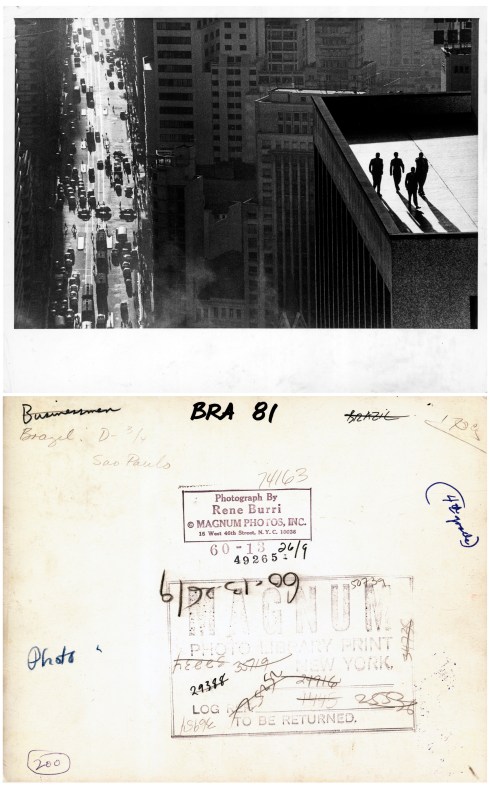
© Rene Burri/Magnum Photos. Brazil. Sao Paulo. 1960 / Back of print.
I spent last week on the phone to Mark Lubell, managing director of Magnum Photos; David Coleman, curator of photography at the Harry Ransom Center; and Eli Reed, photographer, Magnum member and UT professor.
The upshot was The Story Behind the Legendary Magnum Archive Sale, an article over on Wired’s Raw File blog.
There’s a couple of great quotes, my favourite is this from Coleman, “The boxes are marked with three-initial codes. I haven’t quite broken the codes that correspond to all the photographers. Robert Capa is CAR but then also BOB, which is funny. Bob.”
It was a story I really wanted to report on because I do think this is an astounding “incentivized” outcome for all involved. Read the article for details.
I do still wonder what will happen in 2015, though?

For a long time, in the early days of the war on Iraq, Abu Ghraib was a primary target for insurgents. Even before the photographs of torture were leaked, Abu Ghraib was mortared almost daily. Abu Ghraib held thousands of falsely accused men, the majority of whom were later released without charge, ceremony or apology.
Monica Haller‘s new book Riley and His Story is a collection of thoughts, diary entries and digital photographs from his tour of Iraq. For a period, Riley was a nurse in Abu Ghraib and the images from the medical tent are novel, uncensored, bloody.
Riley’s photographs from the hospital sits between snapshots from military vehicles, marines sat in paddling pools, goofy group shots, Al Franken (?) and decaying out-of-use planes.
This is the aesthetic we all know exists and we occasionally glimpse when there is interest, lawsuit or cultural re-use of military personnel snapshots in the media.
There must be millions of digital photos by American marines. Haller’s book is simultaneously a cleverly assembled piece of the wider dissemination of such imagery and an affirmation to the unexpected familiarity of such imagery.
A 21st century war is not a war without vernacular conflict photography.
Just as soldiers of WWI sent home words thus defining modern war poetry, so the soldiers of today bring home pixels and jpegs and define modern war imagery.
The singular prose, simile and letter-writings that painted a mind’s picture have been replaced by the multiple functionaries and fingers of digital observation.
As were the Abu Ghraib torture photographs, why shouldn’t we expect the next most iconic images of this century to be amateur snapshots? And why shouldn’t we be prepared for an equivalent violence in said iconic imagery?
It is curious that discussions about the lamentable loss of unembedded journalism have not always been balanced by discussion on the tumorous growth of ‘soldier-journalism’ (a term unsuitable, but an understandable extrapolation from the term ‘citizen-journalism’).
Whether you like it or not, the Canon PowerShot and its hand-held competitors own the future of war coverage.
Wilfred Owen and Siegfried Sassoon buffered the cruelty of war, but there are few artists now. (We are grateful to Haller for being such a thoughtful manager of Riley’s output.) Nothing is softened or made poetic/metaphorical. Laid bare. Perhaps, both the best and worst of scenarios we should expect is military censorship?
Monica Haller’s book is important not because it is Abu Ghraib and not because the images are snapshots made by American military personnel, but because it is a portent of an aesthetic already upon us. And we are in denial.
From here on in photography is ugly.


I found this project through Alec Soth on the Little Brown Mushrooms blog, via LensCulture.
A video interview with Haller is permanently available at LBM vimeo.
A sizeable preview pdf (over 100 pages) of Riley and His Story is available here.
Riley and His Story has a website. You can find out more about Monica Haller here, here and here.
PART FOUR IN A SERIES OF POSTS DISCUSSING PHOTOGRAPHERS’ ACTIONS AND RESPONSES TO THE KILLING OF FABIENNE CHERISMA IN PORT-AU-PRINCE, HAITI ON THE 19TH JANUARY 2010.
On the 3rd February, Adjustment Layer posted an account by photographer Edward Linsmier. It is the fullest eye-witness account by a photographer of events surrounding Fabienne’s death that I have read.
The account doesn’t name the girl as Fabienne. Her name has been available from different sources for some time.
Also worth noting, Linsmier talks of Nathan Weber, another photographer present. I was not aware Weber was at the scene.

Fabienne Cherisma lies dead after being shot in the head by police. January 19th, 2010. © Edward Linsmier
LINSMIER’S ACCOUNT
Read the full account on Adjustment Layer.
Linsmier opens with the excess necessary to hook the reader, “We heard gunshots and knew we needed to be closer. We processed the thought for a split second and we took off running with our fixer not far behind.” and, “Emboldened by the electricity of the chaos, we advanced further and saw people laying on the ground with police yelling and waving guns in the air and shouting commands.”
Linsmier goes on, “We retreated several steps and waited behind a truck for several seconds until the police were distracted. I saw another photographer up the road and decided that we needed to make a move closer to him so we could make some pictures.”
(One presumes this other photographer is Weber?)
“We followed … onto a downed roof top that led to the exposed insides of several shops filled with the scavenging and excited crowd. We were making pictures.”
“The fixer motioned for me to come because the police had caught a man and had him down on the ground. I, in turn, motioned for my friend and fellow photographer, Nathan Weber, who was still on the slanting concrete rooftop to follow me to the commotion down the road. I yelled his name and he looked at me with a blank stare. Nathan is someone who is on point in a situation such as this. He communicates quickly, clearly and with authority when needed. He is no stranger to photographing in similar situations but something of this magnitude was new to both of us. I knew he heard me and figured he would be right behind me as I headed down to the commotion.”
Linsmier returns to see Fabienne’s body, “[I] climbed back up on the roof to see Nathan in almost the exact same spot where I last saw him, except he was looking at a girl who was lying face down on the slanting concrete roof. As best as I can recall, Nathan spoke in short sentences, “I saw her fall. I thought she tripped and knocked herself out. She’s dead. Fuck. She got shot. I was right here.”
“The decision to continue making photographs was instinctual. More photographers showed up and we were all making pictures, composing the dead girl in the foreground as the looters continued to walk past her, almost over her, carrying whatever they could. Several men stopped to turn her over, seemingly to identify the body. They gently took her arms and almost had to twist her just a little to face her upward. They looked at her with little emotion and left.”
This record of events is interesting because it doesn’t report the bypassers going through Fabienne’s pockets as the Guardian did here.
“She had been shot in the head. From what I could tell, the bullet entered her cheek and exited from the back of her head. The blood had been pooling in some picture frames she was carrying when she fell. After the men moved her, the blood began to run down the slanting concrete roof towards us. We all were still making pictures. To anybody else, it must have looked sick, a crowd of photographers vying for the best position to tell the story of the death of a girl.”
“Just about the time that I figured the pictures were over and we should leave, a frantic man and several others emerged from the crowd. It was the family of the girl. The father hoisted her onto his shoulders and began the journey of bringing his daughter home. The photographers followed. Ordinarily, this would be a scene that hardly anyone could bare to photograph. They were experiencing probably some of the most painful moments of their lives but they knew why we were there. Not once did anyone give a mean look; not once did I hear anyone question why all the photographers were following this family’s grief so intently and so closely. It was part of the story.”
THOUGHTS
The underlining above is mine. It highlights the photographers’ conscious activities. I make no judgments here. Linsmier is aware of the sensitivity of the situation. Like, Mullady, yesterday, Linsmier’s candour should be appreciated.
Photographs are deceiving. I should know that by now. When I began my inquiry into Fabienne’s death, I assumed there was a scarcity of images. I presumed only Grarup and Garcia Rawlins had witnessed and recorded the incident.
It is clear, now, that there was more photography and activity. On the scene, at various points, were six photographers – Jan Grarup, Olivier Laban-Mattei, Edward Linsmier, Michael Mullady, Carlos Garcia Rawlins and Nathan Weber.
I’d like to state that I have no agenda here, I am simply interested in constructing the scene in a wider context. Photographers don’t work in a vacuum and we must demand to turn their images inside out to understand the context in which the images were created.
Mining the conditions of production is a position I have held consistently throughout my writing on Prison Photography. I am a great admirer of Errol Morris’ writings that demystify photography; it is in that spirit I am pursuing this inquiry.
Thanks to Melissa Lyttle for the note on Edward’s interview.
– – –
ALSO IN THE ‘PHOTOGRAPHING FABIENNE’ SERIES
Part One: Fabienne Cherisma (Initial inquiries, Jan Grarup, Olivier Laban Mattei)
Part Two: More on Fabienne Cherisma (Carlos Garcia Rawlins)
Part Three: Furthermore on Fabienne Cherisma (Michael Mullady)
Part Five: Interview with Edward Linsmier
Part Six: Interview with Jan Grarup
Part Seven: Interview with Paul Hansen
Part Eight: Interview with Michael Winiarski
Part Nine: Interview with Nathan Weber
Part Ten: Interview with James Oatway
Part Eleven: Interview with Nick Kozak
Part Twelve: Two Months On (Winiarski/Hansen)
Reporter Rory Carroll Clarifies Some Details
Part Fourteen: Interview with Alon Skuy
Part Fifteen: Conclusions

 Prison Photography