
You are currently browsing the monthly archive for February 2010.
In November, I penned a piece for Change.org about the Texas Department of Criminal Justice’s ban on two books that advocated for prison reform.

This week, friend Matt Kelley brought to my attention that Texas is now banning John Grisham novels. Kelley describes the sophisticated approach of the TDCJ:
The system is fairly arbitrary – prison mailroom staff look for offensive images and make the decision on the spot. Prisoners can appeal to state officials, but it’s tough to argue on behalf of a book you can’t see.
C’mon! Really? Add your name to over 500 petitioners.
Last month, spurred by Michael David Murphy‘s summary opinion piece I started writing about photographers rights.
I have talked before (and here and here) about the diminished freedoms for photographers in the UK. While the National Union of Journalists (NUJ) led many of the actions, it is the support of the whole photographic community that has driven the issue.
The half-penned piece was rendered redundant by last weekend’s “I’m A Photographer, Not a Terrorist” demonstration in Trafalgar Square, London last weekend. The event looked like a hoot (see here, here, here and here)! Nevertheless, I want to throw down a few thoughts and some links.
ONGOING CONFUSIONS
In November 2009, the UK police issued a memorandum retracting some of the misguidance it had issued; bobbies on the beat were reminded that it wasn’t illegal to take photos. Seemingly, this was more a PR exercise or simply the rank and file didn’t get the memo. Harassment continued.
This situation has totally degraded. The level of trust between the photographic community and police authorities is at an all time low (more here and here). Granted, the Guardian is my sole source here, but it covers the issue so well.
Outside of Britain, incidents have occurred in Los Angeles and elsewhere in the US. Some might say there is a certain amount of baiting employed by some journalists’ tactics (Paul Lewis outside the Gherkin in London springs to mind), but they are merely testing the communication and enforceability of new directives immediately after they’ve been announced by police authorities (in Lewis’ case, directives from New Scotland Yard).
In 2010, I hope to see less harassment of photographers. But, if hassle does continue I hope (and expect) to see its continued reporting to keep the pressure on police chiefs and politicians … particularly in the UK.
And with that I have a site recommendation. Photography is Not a Crime is a good one-stop shop for the unfortunate new genre of photog/authority face-off stories.

The watchdog is compiled by Carlos Miller a Miami multimedia journalist arrested by Miami police after photographing them against their wishes. He goes into his case at length and I still don’t think it is resolved.

Regardless of his motives, Miller’s coverage is comprehensive. As a silo for moments of confrontation and antagonism, the Photography is Not a Crime blog can be a repeated depressing look at abuses of authority.
More than the individual stories – which warrant extended consideration in themselves – it is the cumulative weight and significance of collected incidents that makes Miller’s site a cultural mirror.
Photography is Not a Crime is a must-read for photographers and other media journalists.
Schalk van Zuydam/Associated Press
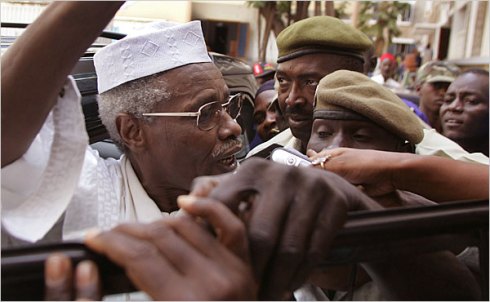
A new study by the Human Rights Data Analysis Group (HRDAG) discloses documents prepared by Hissene Habré’s own Documentation and Security Directorate (DDS) to prove he was personally aware of the deaths of political opponents. Habré has been accused of killing and systematically torturing thousands of political opponents during his rule in Chad, from 1982 to 1990.
It has been 10 years since his indictment, yet despite strong evidence, he will not be tried until Senegal (which agreed to host the trial in 2006) receives €27.4 million from the international community to fund the trial.
The Documentation and Security Directorate (DDS) pursued opponents and operated notorious prisons during the Habré regime. The files were discovered by chance by Human Rights Watch in 2001 at the abandoned Security Directorate’s headquarters in N’Djamena, the Chadian capital.
FURTHER RESOURCES
Copies of the HRDAG report in English and French are available at: http://www.hrdag.org/about/chad.shtml
For more information on the case against Hissène Habré, please visit:

There are SEVEN cameras in this image.
What an intriguing image. It’s got a foolish mixture of activity that confuses the viewer: slapping; parrying; a sizable unperturbed bunch of by-passers who display amusement, disappointment, indifference and camera-induced detachment.
One lady has a baby under one arm as she strikes with the other. The lady in defensive mode raises an elbow so as to not inconvenience the cameras she holds in each hand nor the pacifier on her middle finger.
The lady on the right has just been evicted by Israeli settlers. The situation is obviously tense, but who’d bet against me that without the cameras this confrontation would not have occurred?
Photograph by Ahmad Gharabli / Agence France Presse / Getty Images (Source)
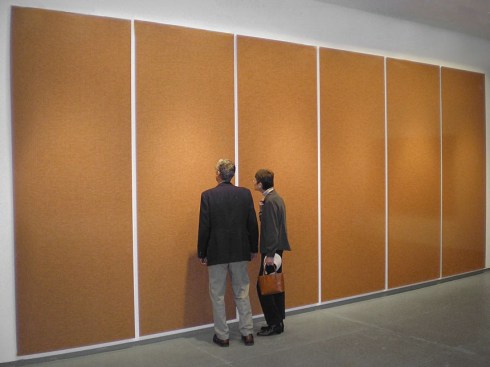
Chris Jordan. Prison Uniforms, 2007. Installed at the Von Lintel Gallery, NY, June 2007.
Chris Jordan‘s populist brand of socio-enviro-photography deserves our respect. The skills necessary to direct (what I presume) is a team to composite his images, is small fries compared to his ability to sell his brand. He brings to surface issues as varied as breast augmentation for teenagers, deaths by smoking, prescription drug overdoses and airline plastic cup wastage.
Jordan argues that all these issues are tied together by our collective denial and connected by our search for a global view obscured by the massive numbers (billions, trillions) which we cannot realistically fathom. Jordan reckons his illustrations help us feel, and thus have us consider and alter own behaviours.
Critics would say that Jordan plucks issues at will, and given their variance, he might just be a fraud. Aren’t we supposed to specialise in our advocacy? Don’t we pick one topic?
I’d be sympathetic to this view if I thought Jordan was picking the latest cause célèbre, but he isn’t. Jordan represented the 2.3million US prisoners with 2.3million prison uniforms (I discussed this before).
Prison reform has never been sexy. Prisoners rights are rarely considered and that is because many of us suspend our emotions toward those put behind bars. Heck, even rape is considered humorous when it is put in a prison setting.
Whatever your take on Jordan’s craft and motives, his research and discussion of issues is passionately informed. For me, most of the time Jordan trumps my cynical view that he’s just selling a cute visual idea.

The closing two minutes of this well-circulated TEDtalk is convincing enough. Yet, I’d forgive people who thought of him as a sellout.
Jordan’s assertion that US citizens are in denial about their prison system is dead on.
Thanks to Stephen Sidlo for the reminder of Jordan’s work.

 Prison Photography