
You are currently browsing the monthly archive for July 2010.

Large hangars and fuel storage, Tonopah Test Range, Nevada, distance 18 miles, 10:44 am. © Trevor Paglen
I’ve tried talking about Trevor Paglen’s expansive oeuvre before, with particular reference to his documenting of Black Sites (US extrajudicial prisons). I don’t think I did a great job, which is why I am happy to see Joerg and Asim both grapple with Paglen’s contributions.
Conscientious interviews Paglen
‘What I want out of art is “things that help us see who we are now” – and I mean this quite literally. I think of my visual work an exploration of political epistemology (i.e. the politics of how we know what we think we know?) filled with all the contradictions, dead ends, moments of revelation, and confusion that characterize our collective ability to comprehend the world around us in general.’
Asim Rafiqui delves deep: ‘Photographing The Unseen Or What Conventional Photojournalism Is Not Telling Us About Ourselves.‘
‘[Paglen’s photographs] remind us how most photojournalists prefer to pander in the simple, the obvious and the conventional, while never engaging in the complex and crucual. Our newspapers and photographers have, either out of convenience, laziness or sheer careerism, chosen to veil the GWAT behind beautifully rendered and largely distracting projects produced from the confines of embedded positions on the front line.’
Of course, war photography is only one aspect area of photojournalism, but the argument can be made that criticism of war photography has stopped short, cowered or just missed the point. If one accepts that as the case, then Jim Johnson‘s three posts about the changing conventions in war photography (here, here and here) are a good lesson in how to think and see war photography, which let’s admit it, is a genre America still dresses in wonder and heroic myth.
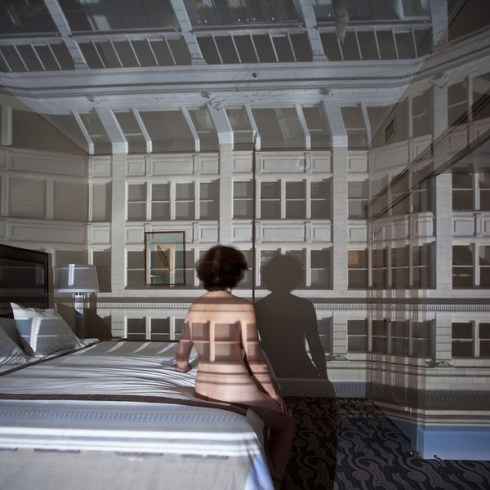
© Darius Kuzmickas
Darius Kuzmickas‘ work, found on Hey Hot Shot recalled Abelardo Morell‘s Camera Obscura works.
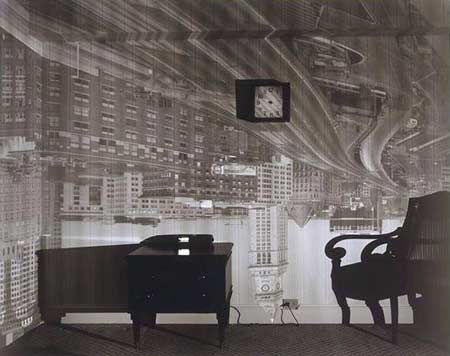
© Abelardo Morell
To paraphrase Morell, the best way to describe the camera to somebody is to put them in it.
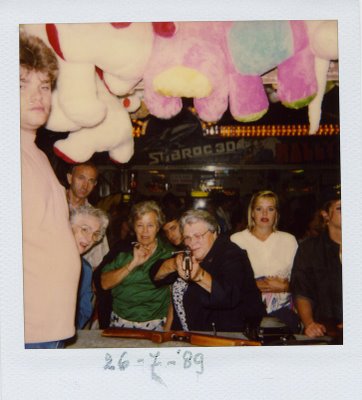
There’s been a few parallels drawn between cameras and guns recently.
Gizmodo reflected upon new laws that would suggest that to wield a camera is to act as a dissident and warrant attention from the police. Carlos Miller continues to collate “interactions” between photographers and law or security enforcement.
Fred Ritchin picked up on this drawing parallel between the Wikileaks video of the Iraq helicopter assault and the photographing of on duty police officers, “the former is certainly prohibited by law, and the latter is now also prohibited by law in some states. Both issues relate to the conduct of military/police forces and the inability of people to publish imagery that may point to excesses.”
Susan Sontag usually crops up when one discusses the violence of photography. Whether or not Sontag was the first to coin this notion I don’t know. I do know her writing about quite complex things can be beautiful, clear and accessible so perhaps she deserves recognition for simplifying and readying the idea that photography can be/is aggressive.
On the other hand, David Goldblatt – as Fred Ritchin argues – was a dispassionate practitioner who shied away from such comparisons.
Goldblatt, “I said that the camera was not a machine-gun and that photographers shouldn’t confuse their response to the politics of the country with their role as photographers.”
Goldblatt was not a dispassionate man, but a photographer who maintained a distance, developed his own language and avoided many of the frightful images that, for example, the Bang Bang Club produced for the world’s media.
Shoot! Rencontres d’Arles
In light of these recent commentaries, this exhibition review in The Guardian (originally in Le Monde) caught my attention:
In Shoot! Clément Chéroux, a curator at the Pompidou Centre in Paris, returns to a once popular fairground attraction. When it first appeared in the 1920s, target-shooting enthusiasts could take home as a prize a photo of themselves in action. When the bullet hit the bull’s-eye, a portrait was taken automatically. By the 1970s the attraction had disappeared, but there is no nostalgia here. “I’m not paying tribute to a vanished process,” says Chéroux. “What interests me is its metaphorical side. […] Of the 60 or so exhibitions at this year’s Rencontres d’Arles the most successful and original is certainly the one on the photographic shooting gallery.“
With work from Patrick Zachmann, Christian Marclay, Martin Becka, Rudolf Steiner and Erik Kessels the exhibition is a varied interpretation of camera and gun, or in the majority of these cases, camera and rifle. Looks like a unique and winsome show. More here and here.

Melanie McWhorter has really taken on the ongoing photobook discussion, archives, exposure, and championing and made it her own.
So far, she’s published three discussions about photography on newsprint. Wonderful stuff!
Newsprint and the Contemporary Photobook, Part 1: Alec Soth and Andrew Roth
Newsprint and the Contemporary Photobook, Part 2: Nicholas Gottlund and Grant Willing
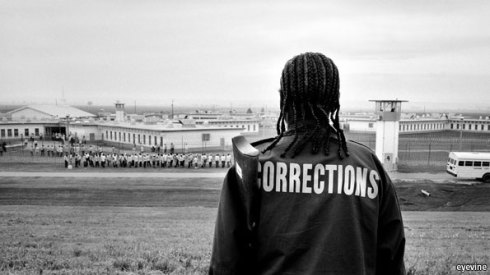
© Eyevine / Lori Waselchuk
Last weeks article, Rough Justice in America, by The Economist repeats many truths of America’s broken prison system we know already, here summarised:
“The system has three big flaws, say criminologists. First, it puts too many people away for too long. Second, it criminalises acts that need not be criminalised. Third, it is unpredictable. Many laws, especially federal ones, are so vaguely written that people cannot easily tell whether they have broken them.”
As expected the arguments made against mass incarceration here are on based on financial sustainability and fortunately such thinking is melding with the notion of social sustainability. The stories of George Norris and Michelle Collette form the anchor to the piece which posits that “Never in the civilised world have so many been locked up for so little.”
LORI WASELCHUK
I recognise the photographs as those of Lori Waselchuk whose work Grace Before Dying from the Angola Prison Hospice should not be missed. For it, Waselchuk won a Soros Documentary Photography Grant (2007), a Photolucida Critical Mass Top50 (2008). Here’s a great interview with her by Nicole Pasulka of the Morning News.
– – – –
Thanks to Joerg for the link

Caption: Mahmod Berghote stands with one of Marah Zoo’s world famous painted donkeys. The zoo’s two white donkeys caused an international media frenzy after Mahmod and his brother spent three days painting stripes onto them using black hair dye. Unable to find an animal trader to bring a real zebra through the tunnels from Egypt, the Berghote family decided to make a fake pair using white donkeys. The story was reported all over the world as a feel good news piece and often used as an example of the Palestinian people’s resourcefulness during the siege of Gaza.
Anastasia Taylor-Lind for VII Photo published a remarkable photo essay about the zoos of Gaza.
The idea that imprisoned people can make a business out of smuggling, locking up, and exhibiting animals is deeply ironic. There are about a dozen zoos in Gaza and their story is intertwined with world politics in a way that would be unimaginable anywhere else.
In 2005, Dr. Saud Shawa, a veterinarian, decided to establish Palestine’s National Zoo. For Shawa, this was about education and showing people how to care for animals. Supported by international donors, he built a spacious compound with big cages, a theatre, a library and research centre – Gaza Zoo, the first one ever in the strip.
Gaza zoo opened in January 2006, the same month Hamas, the radical Islamist movement, won elections in Gaza. The border was closed and the initiative was halted before it could get started.
As of today, not a single zoo has been profitable. In fact, there is only one person in the Gaza strip who benefits from the business: Abu Nadal Khalid, an animal trader. He has animals drugged and smuggled through the infamous system of tunnels leading from Egypt into the strip.

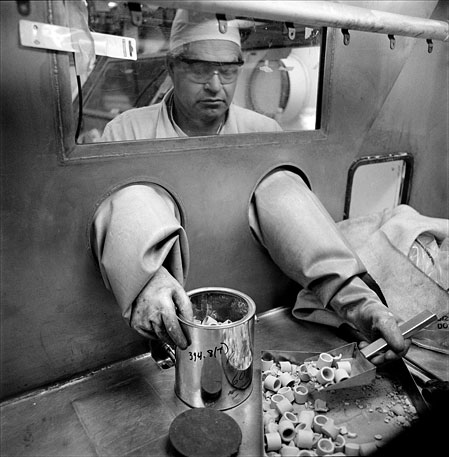
Nuclear Residues Repacking Glovebox, Building 440, Rocky Flats Nuclear Weapons Plant, 2002. © A.W. Thompson
A.W. Thompson‘s largest single project, “Incendiary Iconography” addresses Cold War-era nuclear sites in the United States that are in the process of public reclamation and/or transformation under the Defense Environmental Restoration Program.
The Rocky Flats Nuclear Weapons Plant sat at the foot of the Front Range of the Rocky Mountains overlooking the high plains of eastern Colorado. Boulder is ten miles to the north, Denver’s two million residents just 16 miles downwind and downstream to the east. The plant operated from 1952 to 1992, and since then the suburbs of Denver have extended to the border of what was a 25 square mile top-secret facility.
Thompson says, “The plant produced plutonium “pits,” for the nation’s nuclear weapons stockpile. A pit, or primary, is a plutonium fission bomb like the one dropped on Nagasaki, and is used to start the fusion reaction in a hydrogen bomb which has over 1000 times the power of a fission bomb. Plutonium is a man-made element which is highly toxic in addition to being radioactive.”
On June 6th, 1989, as part of an investigation into allegations of environmental crimes the Federal Bureau of Investigation, Environmental Protection Agency, and the Department of Energy’s Office of Inspector General raided The Rocky Flats Nuclear Weapons Plant. The raid led to the eventual decision to tear down Rocky Flats.
Again, Thompson, “In 1995 the U.S. Department of Energy labeled Rocky Flats the most dangerous weapons plant in the nation because of the health and safety risks it posed to the plant workers and the surrounding area. Although the search warrant documents were released in 1989, the full text of the grand jury investigation and findings remains sealed, despite efforts by members of the gagged grand jury to make them public. The former Rocky Flats Nuclear Weapons Plant site was officially designated a National Wildlife Refuge with the completion of decontamination and deconstruction activities in October 2005. The wildlife designation was chosen because it afforded the lowest level of cleanup standards. Debate continues among former workers and local citizens about the adequacy of the cleanup.”
“Rocky Flats was the only nuclear pit facility in the U.S. The Department of Energy announced plans to develop a new hydrogen bomb on March 2, 2007. Site location for a new multi-billion dollar pit facility is currently underway without significant public debate about the need, or the long-term financial, environmental, and security costs of a revived nuclear weapons production program, which many believe, will start a new nuclear arms race.”
Characterizing Legacy Residues in Plutonium Building 771, Rocky Flats Nuclear Weapons Plant, 2001. © A.W.Thompson
BIOGRAPHY
Thompson (born in Colorado) is the Director of the School of Communications and an Associate Professor of Photography and Visual/Media studies at Grand Valley State University, Michigan. He earned his B.S. in Physics from the University of Dallas and his M.F.A. in Photography from Washington University in Saint Louis.
Thompson has lived and worked in Rome, Italy and across the Midwest as a freelance and commercial advertising photographer. His work is about “the meanings attributed to, or derived from, experiences of place and/or technology, and the relationship of art and science as ways of knowing.”

I have not and will not ever go through 90,000 pages of wikileaked documents covering US military operations (January 2004-December2009). But, if the Guardian tells me its legitimate and important, I’ll begin with that understanding.
What then, when Mother Jones – more precisely Adam Weinstein – comes along and tells me not to believe Assange’s hype?
Adam Weinstein at Mother Jones dismisses the import of the Afghan War Logs on wikileaks:
“In truth, there’s not much there. I know, because I’ve seen many of these reports before – at least, thousands of similar ones from Iraq, when I was a contractor there last year. I haven’t been through everything yet, but most of what you see on WikiLeaks are military SIGACTS (significant activity reports). These are theoretically accessible by anyone in Iraq, Afghanistan, or the Tampa, Florida-based US Central Command—soldiers and contractors—who have access to the military’s most basic intranet for sensitive data, the Secret Internet Protocol Router Network (SIPRNet). Literally thousands of people in hundreds of locations could read them, and any one of them could be the source for WikiLeaks’ data.”
My question: Just because it is easy for service personnel or contractors to view the material doesn’t change the significance this leak has for the general public in its capacity to form a view of the war based on new material, does it? Weinstein counters again, “By and large, like most of the stunts pulled by Assange, this one’s long on light and short on heat, nothing we didn’t already know if you were paying attention to our wars.”
Weinstein does make the valid point that the lives of Afghan collaborators are now at risk, as their names are not redacted from the material.
Ultimately though, I fear the coverage of the leak may develop into a character dissection of Assange and “discussion” of the relative merits of new-journalism; the former will dominate and the latter could be fruitful but will probably miss the point.
I am in support of wikileaks, but mainly because I am opposed to the war. I don’t feel our media does a good enough job at getting to the realities of war for the American news consumer. We saw just last week that the mainstream media ceased using the word torture for water-boarding almost overnight. That linguistic culture shift suggests to me that the mainstream media are as subject to political pressures as any individual … so, why shouldn’t we have wikileaks mix it up? And why shouldn’t we think about the flows of information: or the definition of free media: or tactics are served when information is kept classified, hidden?

 Prison Photography