
You are currently browsing the monthly archive for December 2011.












As many of you will know, a little piece of Prison Photography has been wrapped up in my monotone voice, roadtrip b-roll a bit of car-singing.
Tim Matsui (who helped film the PPOTR Kickstarter video) thought my PPOTR trip was unusual enough that he was willing to put his time and money behind a week-long commitment to follow me over the mid-point of the PPOTR trip. Read Tim’s summary of the experience.
Most importantly the voices of prisoners from Sing Sing Prison in New York State are represented in this film. The prison only allowed us to video two prisoners talking to the camera; their insightful and reasoned positions are representative of all 13 students in that workshop back in November.
I also captured audio and written response to specific photographs from all the men in the workshop. That content will be simmered into something beautiful in the new year. (On production management, I’m astonished at how quick Tim turns projects around.)
Watch the Prison Photography on the Road documentary short
Tim wanted to help clarify my mission and explain it to a wider audience. Uncomfortable being in front of the camera, I was a septic skeptic and an unwilling subject at times. But Tim knows what he’s up to and I should have just trusted him 100% instead of being so precious.
The feedback already has been very positive and encouraging; many emails and Facebook loving. My buddies at DVAFOTO, LPV Magazine, PHONAR and DEVELOP Tube have also helped spread the word.
I’m now nearly at the end of the trip. I’m in San Francisco after 12,500 miles. Four days and two interviews remain.
I’ve made 63 audio interviews so far and published ten. I have to let go of the fact that I can’t share all this material instantly and instead embrace the size of the task to edit the audio, share the images and distill the essentials to do justice to each all of the amazing work and advocacy my interviewees have done and continue to do.
So, PPOTR will bleed into 2012.
For Prison Photography, next year is going to look different and involve a handful of projects that continue still to extend the project beyond the boundaries of the typed word. Stay tuned and thanks for your continued interest.
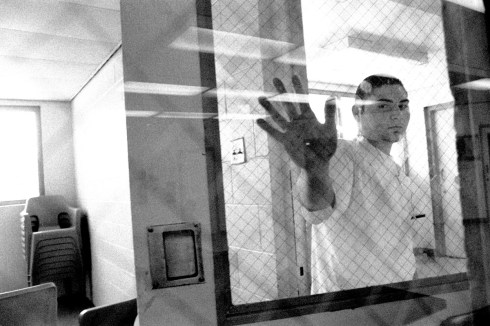
When Ara Oshagan was invited to shoot b-roll for a documentary film in the Los Angeles Central Juvenile Hall, he didn’t hesitate.
“I had lunch with Leslie [Neale, the filmmaker] on Monday, and on Tuesday I was inside with my camera,” says Oshagan. The film was Juvies.
As an Armenian emigre living in Los Angeles, Oshagan was aware of California’s bloated prison and jail systems, but had not thought about how he’d operate as a photographer within them. Previously, his approach was to spend years on his documentary projects often wandering and discovering. In Los Angeles Central Juvenile Hall, time was not a luxury … and neither was space. “I had to keep the film crew out the frame.”
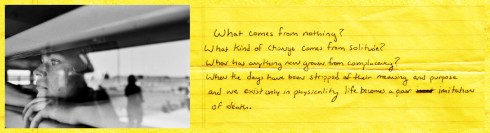
Over the 3 years of the project, Oshagan identified shortcomings in the ability of his photographs alone to describe the experience of the children. His solution? To pair images with poetry and prose of the six children he followed.
When the kids got bumped up into the adult system he followed them there too. “I wanted this work to be about this passage. The adult system is a complete change in culture,” says Oshagan. “The whole culture will take advantage of the younger kids coming in.”
Oshagan witnessed teenagers he knew as small boys, bulk-up in their first six months in the adult system. They told him how the first thing they learnt was how to make weapons to protect themselves.
What surprised both he and his subjects was the length of sentences children are routinely given. And, after they move up through the system, their chances of a secure, violent-free life diminish.
The real kicker? Oshagan concludes his own kids are not too dissimilar to those he photographed in lock up. It’s not too difficult to imagine one poor decision and a life taken over by years of incarceration.
Why does this matter? Well, not only are sentence-lengths for juveniles growing, in recent years many states (40 in total) have introduced laws to allow the trial of juveniles as adults.
How is our society poised for the conversation on the culpability of under-18s and our shared capacity to manage and then forgive?
To help the conversation, Oshagan is to shortly publish the photobook A Poor Imitation of Death. The title comes from one of the kids’ description of imprisonment.
LISTEN TO OUR CONVERSATION AT THE PRISON PHOTOGRAPHY PODBEAN PAGE
All images © Ara Oshagan




 Prison Photography