
You are currently browsing the yearly archive for 2011.
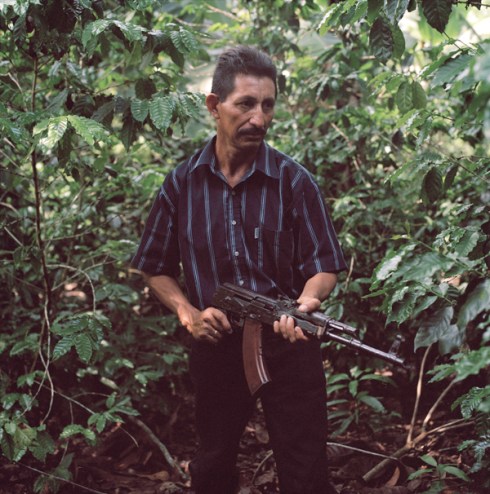
In 1979, after over a decade of struggle, the socialist Sandinista movement in Nicaragua overthrew the famously corrupt dictator, Anastasio Somoza. The Sandinistas quickly began the work of applying their social and ideological values in the hopes of creating a better Nicaragua. Amid the rhetoric of the cold war, the US had different ideas – it mobilised the Contras, a CIA financed, armed and trained clandestine rebel insurgency against the fledgling government.
Kevin Kunishi has just won the 2011 Blue Earth Alliance Award for his series Los Restos de la Revolución.
“This series consists of portraits of Sandinistas and their opposing Contra veterans, as well as artifacts and landscapes significant to that volatile era. Although these two sides held polarized political philosophies, both in their foundation and practice, their survivors are united by the burden of a war-torn history,” says Kunishi.
Powerful stuff.

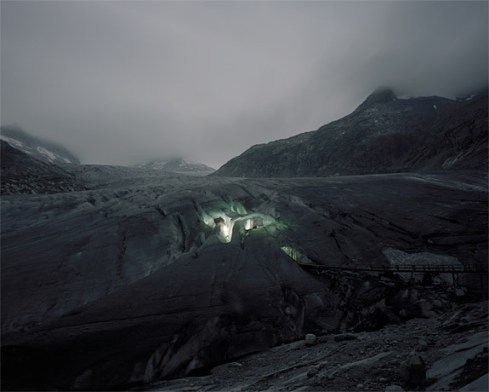
Corinne Vionnet has had a lot of coverage recently for Photo Opportunities, for which she stacked hundreds of culled internet images of tourist sites . I rather like her Du Glacier du Rhone au Lac Leman (From the Rhone Glacier to Lake Geneva) aswell
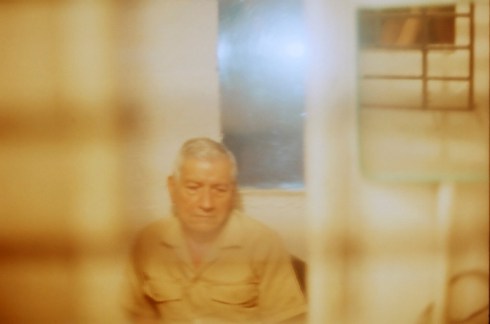
Du Glacier du Rhone au Lac Leman (From the Rhone Glacier to Lake Geneva) has a variety of strong but distinct images. The example above takes care of the cool landscape aesthetic (for a Sigur Ros generation) while the portrait below ticks the box for quirky stranger … it also plays nicely on this famous image.


Comstock, NY State Prison. © Stephen Tourlentes
Tom Griggs, the man at the helm at Fototazo has just published an interview with Stephen Tourlentes.
Aware of two earlier interviews with Tourlentes by Jess T. Dugan and myself, Griggs proposed he stitch information from those together with new questions and answers to fill the gaps and bring the reader up to date. The result is a very comprehensive, crowdsourced Q&A about Tourlentes’ photography and politics.
“[We must] find better ways to deal with poverty, education and human rights. The prison system in the US has grown at the expense of funding education, public health and investing long term in sustainable community initiatives that combat crime.”
“In my view we have an extremely complicated history in the US. Contradictions abound. Along with brilliant success and economic power we have built a prison system that holds 24% of the world prison population even though the US represents only 5% of the worlds population. In a country that holds it’s constitutional freedoms so dear we are the best in the world at locking people up.”
FOTOTAZO
Fototazo is a new philanthropic venture on the block. It raises funds to purchase equipment for young, emerging photographers from economically disadvantaged backgrounds from around the globe.
Fototazo will snag your interest with in-depth interviews and portfolios of new work by selected contemporary photographers. Hopefully, you’ll reciprocate with some spare change for the grants, the monies of which go to those building careers in photography and whose development is limited by an inability to purchase necessary equipment.
© Natalia Lopera

WTO Protests, Seattle, November 1999. © Dean Wong. Wong is featured in Susan Noyes Platt’s Art and Politics Now
Susan Noyes Platt is perhaps not the best person to quote on issues of online (media) activism, as her primary interest is politically engaged artforms, direct action and the perfected combination of both. However, I feel her reservations about blogging may be fairly representative of many people.
I just attended the opening of Noyes Platt’s curated show, Cultural Activism in a Time of Crisis at Seattle Central Community College. The art was electrifying and, based on the first chapter, so is her book Art and Politics Now.*
Already Art and Politics Now has touched upon Alfredo Jaar, Trevor Paglen, Walid Ra’ad and the WTO protests in Seattle. Details enlivening to read and ideas that are bliss to connect with.
Noyes Platt:
“Cyberspace is not a joyous collection of people who come together in the street.”
A truism if I ever heard one, but she goes on:
“That physical event, collective street action, is an aesthetic act, the embodying of the act of resistance. The body of a political march is a creative body. It is a seething, joyful, and celebratory act of collective communal resistance. Cyberspace is an individual experience limited to a demographic and economic elite that creates invaluable networks, even as it atomizes them. Blogging for example, provides collective information, but it also can simply keep people at home, well informed, but hovering over a screen, alone.”
I quote this because for all the importance, thought [1, 2, and 3] and energy I put into blogging, it ain’t worth zip if I’m not connecting and being with people who are acting in the physical world to stake their political claim.
There are good arguments against the hegemony of the biggest social networks and yet some studies have shown internet users are more socially engaged. What to think? Firstly, Facebook’s degree of evil is yet to be determined. Secondly, correlation is not causation and perhaps it’s just that active people are bouncing through both cyber and real spaces? Ultimately, responsibility for use of blogs and other social media rests upon individuals’ personal (life) balance: screentime vs. playtime.
My basic message remains … HIT THE STREETS!
* It took a blog post by Jim Johnson for the tip off on Susan’s amazing academic activism right here in my own city of Seattle.

© David Shrigley
__________________________________________________________
AUTHOR’S NOTE: THIS POST FOLLOWS A COUPLE OF OTHERS ON (PHOTO)BLOGGING, HERE AND HERE.
__________________________________________________________
The 2011 Orwell Prize, the British awards for political writing, has just announced its longlists. The awards are into their 18th year, yet blogging was only recognised as a form of political writing in 2009. Here’s the blog longlist.
Upon the news, Charlie Beckett at POLIS chose to reflect on the health of blogging.
On one hand Beckett says that some good bloggers have bowed out (presumably not replaced instantly by new bloggers, quality-wise) but on the other acknowledges the slew of very good, very relevant and very free blogged opinion and commentary. He also applauds former mainstream media (MSM) journalists using the blog format as one tool in their kit. Overall, he thinks blogging is still in transition and “much of it below par.”
While I agree with most of Beckett’s points, I don’t agree with his conclusion. I think he is bored by the increased specialisation of blogs:
Everyone’s at it. The market’s gone way down the long tail with very specialist blogs … where people are addressing a very niche audience (though I wouldn’t be surprised if some of those narrow subject niches are rather capacious in terms of readers).
When Beckett refers to the market, I take it he is talking of activity and development of ideas, not solely about money exchange.
If Beckett is right about blog proliferation (I think he is) then we can conclude two things. Firstly, that readerships are getting cosier with their blogs of choice and selecting from an overall wider choice. Secondly, bloggers are splintering into niche next to niche to good effect; one’s subject matter does not dilute the others, but complements it.
The upshot? Bloggers and blog-readers have increased in relevance to one another.
Beckett sees this preponderance from the other side too. The mind-share (of readers) has been, and continues to be, a premium commodity for writers. For eyes-on-screens, bloggers are not only competing against MSM but against each other too.
Original content will secure those eyes.
TOO MUCH OPINION?
Beckett weighs the reporting of new facts against the “surplus supply” of opinion.
There is a so much professional and personal comment around on MSM (Comment Is Free) as well as independent forums like Mumsnet or Facebook that opinion is now so cheap (free) that it’s has lost its value in the market place of public debate. New ideas and new facts suddenly have more currency than views.
Readers don’t mind if content – containing new ideas and new facts – is written by a journalist or blogger, professional or amateur, as long as it is proven reliable and informed.
So now it seems the expectation of a blog is to be not only specialised (niche) but also to carry exclusive material (unique). That is a tall order, yet the long and engorged tail may suggest it is already being done.
Certainly, blogs need to do more than merely point.
Finally, Beckett says that here in America, we might still be hung up on a difference between bloggers and journalists. I wasn’t aware.
In the States I am amazed that there is a still a debate about bloggers v journalists. In the UK we appear to have moved on from that rather sterile argument, although our blogosphere does not have the power of the American versions.
Beckett calls the argument sterile because it is clear that if blog content is bogus, people won’t read. Conversely, if content is good and the copy is lyrical then readership follows, no matter who you are. (This logic may apply more to the act of reading more than, say, watching cable news where nonsense seems to dominate.)
“UNICHE”
You heard it here first folks. Uniche, meaning the required combination of niche subject matter and unique content, might be the tricky combination required by bloggers to survive remain relevant in the future. It’s not merely good enough to have your own area, you have to deal with its issues with fresh information and shower it over readers in timely, tasty morsels.
Whadd’ya reckon? Uniche? Does the wordplay work?
Uniche. Also the feminine plural of unico:
Adjective: unico m. (f. unica, m plural unici, f plural uniche)
1. only, sole, one, single
2. unique, unparalleled, unequalled
ONE MORE THING: BEN’S PRISON BLOG
Incidentally, one of the longlisted blogs for the 2011 Orwell Blog Prize is Ben’s Prison Blog. “The only blog by a serving British prisoner,” as claimed by author Ben Gunn, looks “stupidity and ignorance in the eye whilst attempting to inject some neurons into the criminological debate.”
I wrote about Gunn’s position as a pioneer incarcerated blogger a couple of years ago when one of his letters containing content deemed by the prison governor as “interesting enough to be published on the internet” was intercepted and not delivered. (More here)
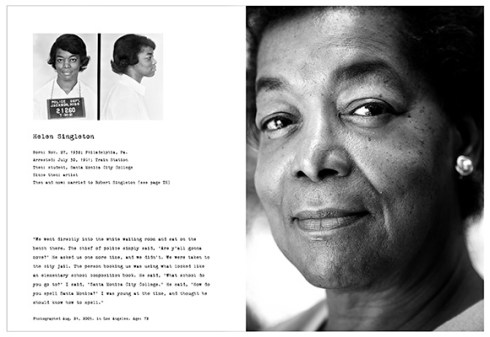
Born: November 27, 1932; Philadelphia; Arrested July 30, 1961; Train station, Jackson; Then: Student, Santa Monica City College; Since then: Arts administrator, now retired; Then and Now: Marrried to Robert Singleton; Photographed: August 24, 2005; Los Angeles. © Eric Etheridge
I’ve been meaning to write about Eric Etheridge’s project Breach of Peace for too long. This year marks the 50th anniversary of the Freedom Riders and their key 1961 victory for civil rights.
Today, the anniversary of Dr. Martin Luther Kings 1968 assassination, is an appropriate moment.
Firstly, a brief history of the Freedom Riders, as told by Etheridge:
In the spring and summer of 1961, several hundred Americans — blacks and whites, men and women — entered Southern bus and train stations to challenge the segregated waiting rooms, lunch counters and bathrooms. The Supreme Court had ruled that such segregation was illegal, and the Riders were trying to force the federal government to enforce that decision.
Though there were Freedom Rides across the South, Jackson soon became the campaign’s primary focus. More than 300 Riders were arrested there and quickly convicted of breach of peace — a law many Southern states and cities had put on the books for just such an occasion. The Riders then compounded their protest by refusing bail. “Flll the jails!” was their cry, and they soon did. Mississippi responded by transferring them to Parchman, the state’s infamous Delta prison farm, for the remainder of their time behind bars, usually about six weeks.
A few days after the last group of Riders were arrested in Jackson, on September 13, the Interstate Commerce Commission issued new regulations, mandating an end to segregation in all bus and train stations.
Etheridge’s book Breach of Peace: Portraits of the 1961 Mississippi Freedom Riders features his new portraits of 80 Riders and the mug shots of all 328 Riders arrested in Jackson that year, along with excerpts of interviews with the featured Riders. (See the Breach of Peace archives here)
The Mississippi Museum of Art is showing the mugshots of all 329 Riders arrested in Jackson as a giant, 54′ long mural, along with 20 of Etheridge’s portraits (March 19 – June 12). Free to the public.

Breach of Peace: Portraits of the 1961 Freedom Riders installation, Mississippi Museum of Art, March 2011
Etheridge’s work is a continuing multi-year effort. Through interviews and his camera, Etheridge gives his subject the opportunity to return to their political heroics. For those alive in the sixties, Etheridge’s work is an antidote to historical amnesia and for those who weren’t it’s an education.
KING’S GIFT TO HISTORY; A POLITICAL PHILOSOSPHY NOT TO BE FORGOTTEN, ALWAYS TO BE ACTED UPON
And so to King, whose politics are as relevant today as they were 43 years ago. As Jim Johnson reminds us, at the time of his assassination, King was in Memphis in solidarity with sanitation workers, who were striking the city not just for decent pay and working conditions but for recognition of their right to form a union. In light of the concerted, ongoing campaign by Republicans to subvert unions, it surely is plausible to wonder how far we remain from the promised land.
History is very important. Despite their self-label, progressives look back in time as readily as conservatives to pinpoint historical moments to justify their politics. Progressives look to the golden era of people power and the Peace Movement, conservatives hark back to the space-race and Reaganomics.
When history is at our backs, we must choose to leave it behind or let it propel us forward. In the case of the Civil Rights movement, its lessons should be forever in America’s conscience. The work toward social and economic equality is not yet complete, not by a long distance.
We have choices to make and a society to shape.
Which brings me to this potent image of the back of James Earl Ray, who was Dr. Martin Luther King’s assassin.
While hundreds of thousands were marching on the streets and millions across America swelled the turning political tides, James Earl Ray choose a different worldview.
Regardless of colour or creed, Martin Luther King’s promised land was for all … and for a better America. No doubt James Earl Ray was a troubled man but his rejection of America’s sea-change thrust him only in the direction of a dead-end.
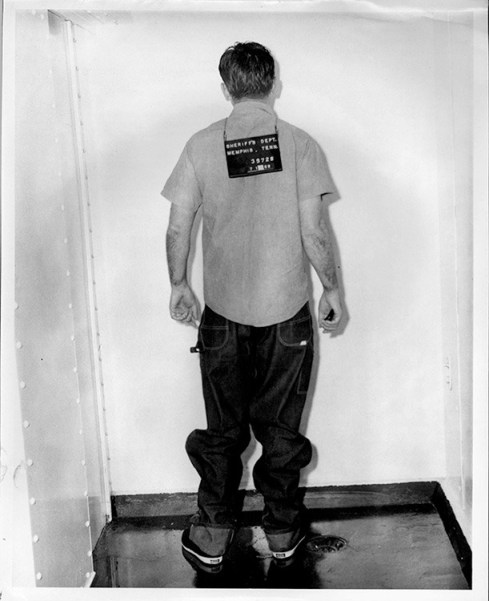
James Earl Ray facing the wall at Shelby County Jail. Photo by Gil Michael/Shelby County Sheriff’s Office
As Etheridge explains this is not an act of defiance. Shoved into a Shelby County Jail cell, Ray faces the reality upon him; the physical finality of confinement with nowhere to go. As he abandoned history, so history moved on without him.
TO END ON A GOOD NOTE
REMEMBER.
INSPIRATION, LOVE AND GOOD HEARTS ARE NOT FORGOTTEN BY HISTORY

Bob Gumpert‘s Locked and Found portraits are on show at HOST Gallery for the next month (April 7th – May 7th).
On the 13th April, there’s a panel discussion on three different projects made in, around and about jails and prisons, with Bob, Edmund Clark and Guardian writer Erwin James.
HOST’s blurb:
Robert Gumpert has been documenting the criminal justice system in San Francisco since 1994. We are delighted to bring his matchless archive of convicts, cops and courthouses to HOST gallery, where it will be exhibited for the first time in the UK.
Gumpert’s project began with an idea to photograph a homicide detective, but quickly expanded to cover numerous other aspects of the criminal justice system. After he exhibited the work in San Francisco in 2000, he thought that was the end of it, until he received a call from the sheriff’s office. California’s oldest jail was about to close, and for Gumpert, whose photographic roots were planted in the social activism of the 70s, this was a piece of history he felt compelled to document.
“‘Old Bruno’ was built in 1934 as an example of progressive incarceration, but it had become a toxic dump of a place where deputies and prisoners where expelled. Over the years the courts had ordered its closure and finally in August of 2006 everyone moved to the adjacent new Bruno. I documented the old jail, its closing and the opening of the new one,” says Gumpert, who then sought and received permission to continue his photographic quest across six county jails.
As his work progressed, so too did his attitude towards his subjects, the majority of whom were incarcerated men (he also photographed police officers and prison guards). From an ‘us and them’ relationship, his modus operandi evolved to one of participation, as Gumpert conducted audio interviews with everyone he photographed, in a kind of reciprocal exchange: a picture for a story.
Robert Gumpert has been working as a photographer since 1974, when he documented the coal miners’ strike in Harlan County, Kentucky. Since then he has worked on a series of long-term projects, including studies of the US criminal justice system and emergency health care in the United States.
For more information contact Anna Pfab on anna [at] foto8.com or 020 7253 2770.
HOST Gallery, 1-5 Honduras Street, EC1Y 0TH, London,UK

 Prison Photography