
You are currently browsing the monthly archive for June 2013.

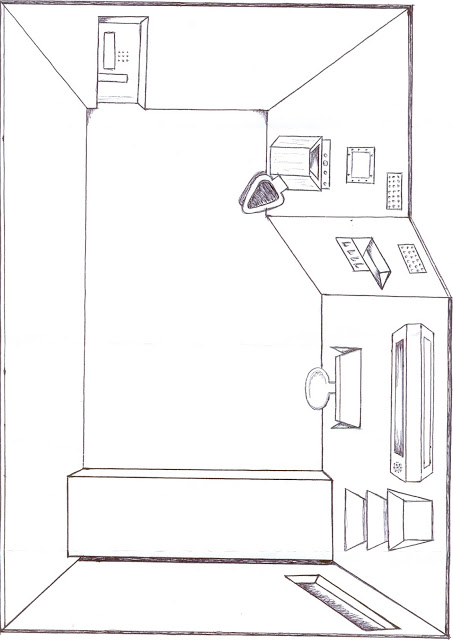
The image above was drawn by Katherine Fontaine, a San Francisco based architect, prison-questioner, friend to all, and book-art-space-collective co-runner.
“There are very few pictures of SHUs. The last drawing that was found at the Freedom Archives in San Francisco was from when Reagan was the Governor of California,” says Fontaine.
With solitary confinement, such a hot news topic, Fontaine was compelled to sketch when she realised there were very few images of solitary cells in circulation.
“I was given the few photos that exist from other similar prisons and a diagram that was used in a previous court case drawn by a prisoner while in an SHU at Pelican Bay. The drawing is what I came up with from the materials I was given,” explains Fontaine who hopes her drawing of a Pelican Bay State Prison Secure Housing Unit (SHU) will be used — in media materials and campaigns — by any organizations protesting solitary confinement.
Fontaine’s commitment to make reliable sketches of prison spaces and apparatus was spurred by a chance encounter with some fellow professionals in an unlikely place. She was among a crowd outside the Central California Women’s Facility protesting overcrowding inside the prison.
Fontaine noticed a person within the crowd with a sign that read ‘Architects Against Overcrowding In Prisons.’ On the back of the sign was www.ADPSR.org. The acronym stands for Architects, Designers and Planners for Social Responsibility. Despite her day job as an architect, ADPSR was not a group with whom she was familiar. Upon reading the statement for the Prison Alternatives Initiative, one of ADPSR’s projects, Fontaine was all-in.
ADPSR state:
“Our prison system is both a devastating moral blight on our society and an overwhelming economic burden on our tax dollars, taking away much needed resources from schools, health care and affordable housing. The prison system is corrupting our society and making us more threatened, rather than protecting us as its proponents claim. It is a system built on fear, racism, and the exploitation of poverty. Our current prison system has no place in a society that aspires to liberty, justice, and equality for all. As architects, we are responsible for one of the most expensive parts of the prison system, the construction of new prison buildings. Almost all of us would rather be using our professional skills to design positive social institutions such as universities or playgrounds, but these institutions lack funding because of spending on prisons. If we would rather design schools and community centers, we must stop building prisons.”
Fontaine’s sketches will regularly appear in Actually People Quarterly, partly to inform as partly as a means to focus her thoughts.
“People need to see them,” she says. “Also it was such a powerful thing for me to draw that SHU cell. I wonder if anyone else can have a similar feeling just by looking at it or if I just feel so changed by it because I drew it. Maybe it is because I’ve spent years of my life drawing, studying, measuring and designing spaces that in actually creating that image I imagined that actual space so much more clearly than I had before? To imagine being an architect and *designing* that space is incomprehensible to me.”
Incidentally, ADPSR was recently featured on the excellent podcast 99% Invisible in an episode called An Architect’s Code, following mainly the activities of Raphael Sperry, ADPSR’s founder.
Below is Fontaine’s sketch of cage used routinely within the California prison system. The cages are sometimes to hold prisoners during transfer between units but, increasingly, used for group *therapy* — an oxymoron if there ever was one.

I’d also like to take this opportunity to share the work of some other determined prison sketchers, some of whom are prisoners.
From the website, Solitary Watch:
One of the most prolific and talented artists in solitary is 60-year-old Thomas Silverstein, who has been in extreme isolation in the federal prison system under a “no human contact” order for going on 30 years. (He describes the experience here.) His artwork appears on this site. It includes meticulously detailed drawings of some of the cells he has occupied, including one pictured below, which is designed (with built-in shower and remote-controlled door to an exercise yard) so that he never has to leave it or encounter anyone at all.

Next is this cell in Ohio, drawn by prisoner Greg Curry.
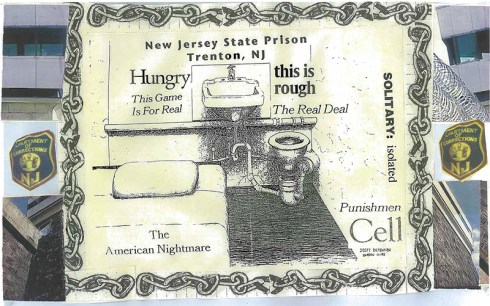
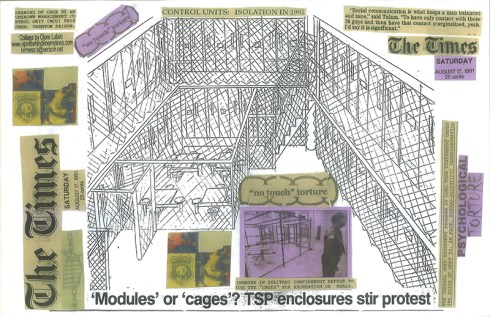
And finally, Ojore Lutalo has made some of the most politically charged prison art I’ve ever seen. Below, an isolation cell, and very below, Control Units, 1992.
When depicting prisons and their abuses there is no hierarchy of medium; sketches, photos, videos and oral testimony conspire to deliver a fuller picture. I will say though that these narrative rich drawings are more powerful than many photographs I come across.

I particularly liked this newsletter by Roger White, Campaign Director, of activist group Critical Resistance. I’ve reproduced parts below.
I especially appreciate White’s reinsertion of slave’s acts of resistance into the historical narrative.
Two and a half years after the Emancipation Proclamation was issued ordering states in the confederacy to release their slaves, Black people in Texas achieved their liberation from chattel bondage. On June 19,1865, General Order Number 3 was read from the Ashton Villa balcony in Galveston, Texas, that demanded that slaveholders free their slaves. That day has become an annual occasion for celebration, reflection, and education about the meaning of freedom and the on-going, universal struggle for liberation from domination.
These questions about the real meaning of freedom are more relevant to the work of abolitionists and those working against the prison industrial complex (PIC) than ever.
Today we struggle with how to stem and reverse the growth of imprisonment, surveillance, and policing. […] In our current work fighting against the construction and expansion of jails and prisons in California and New Orleans, we consistently find that the most durable victories against the PIC take place when the people are active participants in their own liberation. The same resolve that fueled the abolitionists in the state 150 years ago still lives today.
While the history of slave revolt in Texas is less well known, it is why we celebrate Juneteenth today. According to historian James M. Smallwood, “gangs of runaway slaves participated with Indians and Mexicans in a guerrilla-like warfare” against the planter class throughout the 1830’s. Resistance to slavery in Texas included everything from thousands of slave escapees fleeing into Mexico to freedom, to work slowdowns and refusals to submit to the enslavers. This record of resistance counters the popular narrative of a passive Black slave population in Texas that was freed by 2,000 heroic and benevolent Union soldiers on June 19, 1865.
To invoke the language of slavery abolition in calls to end the prison industrial complex may be confusing to some, even perverse to others. ‘What has the struggle to end slavery got to do with 21st century criminals?’ some may ask. For Critical Resistance, however, the inequality between the powerful and the powerless, between the wealthy and the poor are as marked now as ever. Racial bias is in sentencing, in the death penalty, in the drug war; it permeates our criminal justice system.
Critical Resistance is a member-led and member-run grassroots movement to end the Prison Industrial Complex (PIC) by challenging the belief that caging and controlling people makes us safe. Critical Resistance refers to their form of activism as abolitionism very deliberately:
“We call our vision abolition, drawing, in part from the legacy of the abolition of slavery in the 1800′s. As PIC abolitionists we understand that the prison industrial complex is not a broken system to be fixed. The system, rather, works precisely as it is designed to — to contain, control, and kill those people representing the greatest threats to state power.”
Read more on the logic behind CR’s language here. This brief history of CR’s trajectory will also help in positioning them on the political spectrum, which, is to say the far left.
I’ve been thinking about the absolute necessity of peoples’ power recently — about how it emerged briefly during Occupy and wondering where and how it bubbles since. I’m inspired by protests outside of prisons in solidarity with prisoners and when I hear about groups such as DecarceratePA marching from Philadelphia to the capitol in Harrisburg, I’m inspired and wish I could be with them. Walking (or standing) are distinctly undervalued forms of civil disobedience.
Measuring the successes of Occupy is a tricky proposition. Most people will admit that it shifted the politics of a national debate on economic justice back toward the centre, toward the interests of everyday people. Grassroots activism is achieving that constantly at a local level. I just wanted to celebrate that on this, the anniversary of one of the more progressive steps toward equity in American history. Love our neighbours and fight for them.

Refuge by Joanne Mullin “explores the nature of domestic conflict by examining shelters across Northern Ireland. It is a contemplative observation of a temporary place that allows for women and children to have a period of transition.”

If you’re strolling around the centre of Charlottesville these next few days and peep a red newspaper box, reach inside and grab yourself a copy of the free paper within.
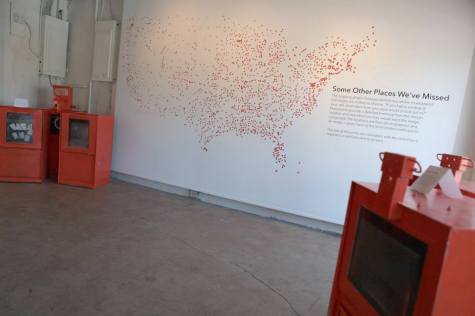
Accompanying his exhibition of Some Other Places We’ve Missed at The Bridge: Progressive Arts Initiative in Charlottesville, artist Mark Strandquist has created eight pages of photos, activist resources and a call to engage.
I have a vested interest in promoting this newspaper. For it, I wrote an editorial about the history of — and imperative of — photographers and artists working in American prisons. It is reproduced in full below.
Even if I wasn’t personally involved, I’d still be singing the praises of Mark’s work – I’ve posted about Some Other Places We’ve Missed before and I am including the work in a prison photography show next year. When Mark and I chatted about the exhibition of Some Other Places We’ve Missed, we got all giddy about the fact that his show is outside of the official LOOK3 program, and yet he is able to grab some mindshare among the throng of photobodies in Charlottesville this week.

© Mark Strandquist. A photograph made of a scene described by an incarcerated male.
ART AND SOCIAL ENGAGEMENT
For the longest time, photojournalism and documentary work has pursued common good, reliable information, hidden stories and social change. At least, that’s the ideal. With guests such as Susan Meiselas and Martha Rosler, and with Koudelka’s exhibit, the LOOK3 schedule looks serious and seriously good.
Mark and I are huge fans of this year’s LOOK3 line up, but LOOK3 remains a big festival where the cucumber martinis flow like wine and big name photographers will hold court in Charlottesville town center. Festivals are about learning, meeting and sometimes brown-nosing … and, for that, we love them. Everyone leaves photography festivals feeling connected and re-energised and that’s how it should be. But, there’s more.
Some Other Places We’ve Missed asks us to think about image-making in slightly different ways. Not everyone can produce a 20 foot tall Nat Geo vinyl banner, but everyone can have the type of intimate conversations on which Some Other Places We’ve Missed is based. Of course, I am biased because Mark is having conversations with American prisoners and I think there’s rehabilitative value in that.
I’ll stop prattling on now and just say if your interest is piqued then you should attend the panel talk More than A Witness – Photography as Social Engagement on June 15, 2pm – 3:30pm. Speakers are David Levi Strauss, Chair of Critical Studies at the School of Visual Arts, Edgar Endress of Floating Lab Collective, Yukiko Yamagata of the Open Society Foundation, and Matthew Slaats, Executive Director of the Bridge. They’ll discuss how art facilitates dialogue and can be used to reach out to new subjects and engage broader audiences. Find out more on Facebook here.
Mark has programmed a busy schedule of events at The Bridge including a poetry reading and discussion between gallery-goers and prisoners via a direct feed from a local jail. Full details on The Bridge website.
[Scroll down for my newspaper editorial.]

Installation shot of Some Other Places We’ve Missed, opening night at The Bridge, Charlottesville, VA.
EDITORIAL: DRAWING ON MEMORY, WORKSHOP GETS PRISONERS AND PUBLICS THINKING ABOUT PHOTOGRAPHY, STORY AND HIDDEN SPACE
In the 1970s, a purple barge floated up and down the Hudson River in New York state. Once moored, photographers emerged to teach workshops to communities traditionally outside of art circles; hospital patients, rural high-schoolers and — perhaps most remarkably — prisoners. The buoyant vessel with living and gallery spaces was operated by the Floating Foundation of Photography (FFP).
Not all New York State prisons are on the Hudson and so after initial offerings at Sing Sing, FFP ventured inland, eventually delivering photographic arts education in eight prisons. The majority of workshops were facilitated by founder Maggie Sherwood, her son Steve Schoen and a handful of close associates. But, the FFP enjoyed close ties with the New York arts scene and as such invited leading photographers in recent memory to deliver day-long workshops in the prisons – W. Eugene Smith, Arthur Tress, Mary Ellen Mark, Les Krims, Judy Dater, Lisette Model and Lee Witkin to name a few. The FFP mounted exhibitions of “outsider photography” on the anchored barge in Manhattan and in Central Park.
As one browses the images and stories within Some Other Places We’ve Missed, perhaps it is worth bearing in mind the history of arts education — and specifically the role of photography — in the rehabilitation of those locked up within our prisons and jails. The Floating Foundation represents a particular high point in this history; the access into prisons that it negotiated, the pedagogy it employed, and the optimism it eschewed stand out as extraordinary. These days, opportunities for arts education (with strong photographic components) in the prison industrial complex are rare. As such, projects such as Mark Strandquist’s deserve attention.
In the 1980s, mass incarceration began. In the past 35 years, the number of Americans locked up has more than quadrupled. The war on drugs, indeterminate and longer sentencing, broader definitions of criminal behaviour, the decimation of many safety-nets for society’s most vulnerable, and the politics of rhetoric and fear all contributed to the tumorous growth of America’s prisons. Even in states that entered a prison building boom, facilities were soon overcrowded. As costs soared, pressures mounted and efficiencies took priority, both the ability to provide — and belief in — the efficacy of education and arts to help in the rehabilitation of prisoners waned.
States previously provided high school and college education to prisoners as item lines on their budgets. These were scratched from budgets early, and when the Clinton administration revoked prisoners’ right to federally funded Pell Grants in 1994, the message was clear: prisons exist to incapacitate, not to rehabilitate. The majority of college level education provided in state prisons these days is administered by either earnest non-profits, University departments with social justice mandates, and sometimes the two in partnership. Prisons remain legally obliged to enroll prisoners without high-school diplomas into GED programs, but the success of students already alienated by public schooling often hampers success. To speak generally, it is the limited scope of — and limited opportunities for — education in prison that scupper advancement. To wright this ship, a huge shift in political will, informational (media) exchange and tax-payer attitude is required.
Prisoners are lining up to be part of this collective shift of consciousness. “Lucky” prisoners may live in state facilities close to a big city which can draw on volunteers to run programs previously provided by the state. Others find opportunities designed for successful reentry toward the end of their terms. But still, the majority of American prisoners have little to no voice and are for all intents and purposes invisible. Existing creative outlets include law libraries (although not in private prisons), pen-pal programs, and vocational work (prison factories remain because of the immediate profits they create), but these are programs that should exist for all and form merely first rung of the ladders to self-improvement and broadening of the mind.
Some Other Places We’ve Missed brings to us the voices, regrets, dreams and imagination of just a small number of men incarcerated in Richmond County Jail. Mark Strandquist provides us a bridge into their worlds. One needn’t share the political position of an artist to recognize the imperatives of a work or an action; intellectual curiosity and community engagement can saturate the entire political spectrum. Strandquist’s work is sadly exceptional, but it needn’t be. Perhaps, his tenacity is exceptional, but I believe it is within reach of us all. Whenever possible we should be thinking of ways that we can engage with our nation’s prison population. It is a population that has been strategically manipulated to the point of invisibility.
Cameras are a security tool for prison administrations, but in the hands of others are a security hazard. The ability to see, frame and witness life behind bars inherently involves power. In mugshots, in surveillance and in tightly-controlled visiting room digital portraits, prison authorities have a near monopoly on such power. Only rare and serendipitous moments (usually a sympathetic superintendent) give rise to an artist being permitted to use a camera in prison space — Robert Gumpert, Kristen Wilkins, Jenn Ackerman and Jeff Barnet-Winsby are a few examples.
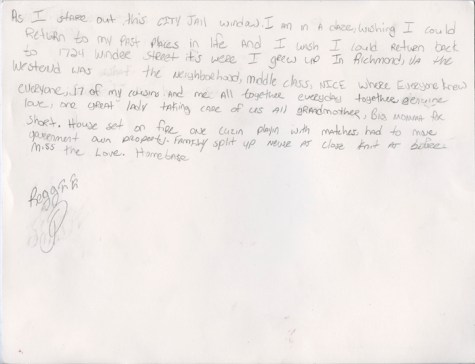
Strandquist navigated this potential barrier by conducting a photography workshop without any introduction of cameras into the classroom. His simple question, “If you had a window in your cell, what place from your past would it look out to?” acted as proxy to any release of the shutter. He asked students to think photographically. While the images are made by Strandquist beyond the prison walls, the essential discussions about memory, self-reflection, the power of photography and the comfort of the image all inform the project.
Through Strandquist’s photographs, we the public, are given an opportunity to connect with the incarcerated; their imagined windows become, momentarily, our window into their lives. But the 1/125th of a second needed to make a photograph is a perverse fraction of the months and years many spend imprisoned. Are the photographs enough? On their own, probably not. But the collaborative and educational core to the project is considerable. As audience, we should employ the same amount of imagination as Strandquist’s students and consider similar ways we can engage with incarcerated persons. There is every reason to think Strandquist’s methodology can be replicated in prisons and jails across the nation. With 2.3 million men, women and children behind bars Some Other Places We’ve Missed should also be a prompt for us to meditate on the millions of sights and experiences in American prisons that we never witness.

“The neighborhood was middle class, nice, where everyone knew everyone. One great lady taking care of us all – grandmother; Big Momma for short. The house set on fire when one cousin playing with matches. Had to move into government owned property. Family split up. Never as close as before. Miss the love. Home base.”
BIOGRAPHY
Mark Strandquist is a multi-media artist and curator based in Richmond, VA, who creates work that incorporates viewers as direct participants, features histories that are typically distorted or ignored, and blurs the boundary between artistic practice and social engagement. His work has been featured in various film festivals and independent galleries as well as a current exhibit at the Art Museum of Americas in Washington, DC. He is currently working on a BFA at Virginia Commonwealth University. He has a Tumblr.
The Eye On PDX series continues with Melanie Flood, who talks about psychtrance, pandas, chance, creative process and Portland friends. Read the full interview on Blake’s blog.
Flood: “I generally dislike separating photography from a larger art scene, but I feel that distinction in Portland much more than in New York. There are a lot of Portland based photographers and few spaces to exhibit their work alongside other mediums, and even fewer spaces that have a collector base. It creates a line between artists and that of hobbyists, amateurs and straight photographers.”
—————————————————————–
Eye On PDX is an ongoing series of profiles of photographers based in Portland, Oregon. See past Eye On PDX profiles here and here.

 Prison Photography