
You are currently browsing petebrook’s articles.

Photo: Mimi Plumb. Anonymous man. Do you know this man?
–
During the summer of 1975, Mimi Plumb spent months in the Salinas Valley, watching farmworkers make history.
“I traveled up and down the valleys of California photographing the young men living in farm labor camps, in chicken coops and under the sky, the children and adults working together in the fields, and the United Farm Workers Union (UFW) organizers and volunteers listening and talking with farmworkers about how elections in the fields might change their lives,” says Plumb.
Plumb shot dozens of rolls of film, which she developed at the time and made prints. But she didn’t show them much except for in the UFW field office and in an SFAI (San Francisco Art Institute) exhibition. A few images appeared in newspapers at the time.
Almost 40 years later, after her retirement from teaching, Plumb pulled the negatives and old prints from their boxes and started to put together the pieces. (An edit Pictures From The Valley is on her website).
It is an exhilarating re-emergence.

Camp Roberts. The weather had turned warm, and by noon the temperature topped 100 degrees. The marchers stopped for a rest at Camp Roberts, a former Army training center just off Highway 101. Chavez was always using his time to organize – whether he was in motion or sitting still. He posed for photos with groups of workers from each of the ranches — the hand sewn banners forming a good backdrop. Photo: Mimi Plumb. Caption: Miriam Pawel.
The photos are rich and pregnant; they deserve so much attention. And they get it. The California Humanities, a non-profit partner of the National Endowment for the Humanities, with help from the Center for Community Advocacy and the National Steinbeck Center, produced and funded efforts to identify the people in Plumb’s photographs and to seek out their stories.
The result is Democracy In The Fields, a visual record paired with oral histories. It’s the history of popular movements mixed with anthropology mixed with the history of labor. I love the way photographs have been leveraged here to shape a collective story that would otherwise have been dissipated and drowned out.

Among the subjects are Rosa Saucedo, Jose Renteria, Mario Bustamante, Alberto Magallon, Sabino Lopez, Celestino Rivas, Ricardo Villalpando, Cesar Chavez and the Amezcua Family.
Many of the people in Plumb’s photographs were identified by journalist Miriam Pawel who has written extensively about Chavez and the history of the United Farm Workers union. Together, Plumb and Pawel met with groups of former farmworkers who had been in Salinas in 1975.
“Children saw pictures of their parents as young adults for the first time. Grown men who had no photos of their fathers found them in Plumb’s images,” says the Democracy In The Fields website.
The faces in the images are luminous. Time and time again, there’s huge joy among the workers. Did they know they were marching to victory? Despite the grave consequences at stake, the workers and protesters seem unencumbered by the repsonsibility. The marchers particularly look as if they’re relishing ever purpose-defined moment.

The Teatro Campesino performed skits at the Potter Road Labor Camp. Photo: Mimi Plumb.

UFW Field Office. Photo: Mimi Plumb.
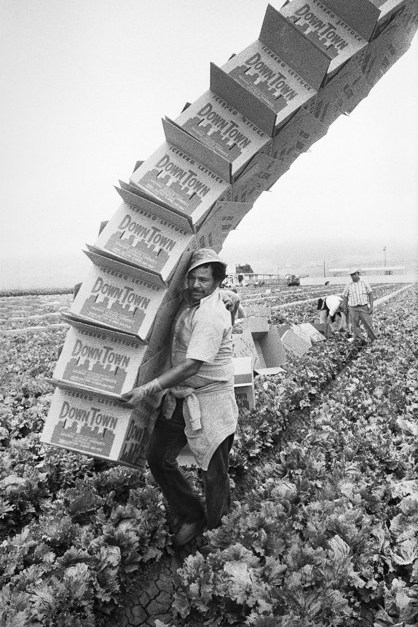
Photo: Mimi Plumb.

In the summer of 1975, with only months to prepare for the first elections in the fields, dozens of farmworkers who had demonstrated leadership were tapped by the UFW to leave their jobs in the fields and work for the union for ten weeks. Rosa Saucedo, a 21-year-old in the lettuce fields, was one of 40 hired in Salinas. Each was assigned specific companies. Rosa’s job was to win over workers at D’Arrigo, a large vegetable grower where the UFW was fighting the Teamsters. She was interviewed in Spanish by journalist Bob Barber in the midst of the campaign. Photo: Mimi Plumb. Caption: Miriam Pawel.

Photo: Mimi Plumb.

Jose Renteria mans one of the election booths. When the votes were counted, the UFW won a big victory – 188 votes to 84 for the Teamsters and 4 for No Union. Photo: Mimi Plumb. Caption: Miriam Pawel.
Journalist Bob Barber was conducting interviews in 1975 in the fields. Tapes from his archives provide audio on the website. Plumb and Pawel also conducted their own interviews in recent years. Wendy Vissar finessed the workers’ stories into a digital form.
“Celestino, Ricardo, Rosa and Chuy often included me in their daily rounds, from the fields and camps to Maria’s kitchen table,” writes Plumb. “The UFW field offices were a hub of activity, of nightly meetings, and frequent visits from the union president, Cesar Chavez.”

Farmworkers listen to Ricardo Villalpando, who worked tirelessly to persuade others that supporting the UFW was the path to a better life. He went wherever he had to in order to talk to workers in small groups—buses, the fields, labor camps, apartments. Photo: Mimi Plumb. Caption: Miriam Pawel.

‘With the Virgen of Guadalupe Leading the Way’. Every day, Chavez walked between ten and twenty miles. On July 28, the marchers reached San Lucas, where Chavez held the first evening rally in the Salinas Valley, in a small wooded grove on a makeshift stage. The next morning, the marchers set off again, heading for King City. Photo: Mimi Plumb. Caption: Miriam Pawel.
“On June 5th, 1975, the California Agricultural Labor Relations Act (CALRA) became law,” explains Plumb. “In July and August of 1975, Chavez led a 1,000 mile march, to help bring attention to the landmark statute recognizing the right of farmworkers to vote for union representation. The first farmworker election was held on September 5th, 1975 with a vote of 15-0 for the UFW.”
What an incredible project.
It takes a while to meander through the history and the people involved in the movement, but it’s a rewarding wander.

Photo: Mimi Plumb.
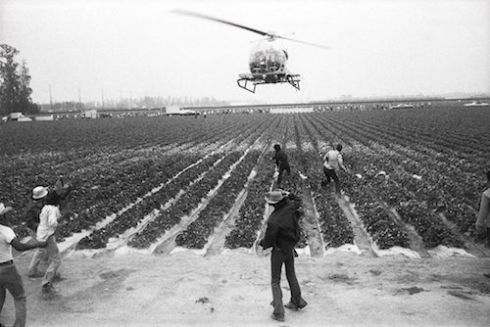
Photo: Mimi Plumb.
–
For more images and info visit Mimi Plumb‘s website and the Democracy In The Fields website.
The project is ongoing. You can help identify people in Plumb’s pictures!
Connect on Facebook too.

–
I can’t go to this but everyone in the Bay Area should.
–
Fighting Mass Incarceration: Strategies for Transformation
277 Cory Hall (off Hearst Ave) UC Berkeley
April 12, 2016
3:30pm-5:00pm
Discussion led by James Kilgore
THE BLURB
With the sudden trendiness of opposing mass incarceration, Dr. James Kilgore will critically examine the idea that bipartisan unity and legislative change hold the key to transforming the criminal justice system. Dr. Kilgore will outline how his book, Understanding Mass Incarceration: A People’s Guide to the Key Civil Rights Struggle of our Time, and what it aims to achieve as well as discuss the potentials/pitfalls of the present moment in the struggle to end mass incarceration.
Kilgore argues that the key to this issue is to build a large social movement led by those who have been critically impacted by mass incarceration. It is a movement that makes alliances with those fighting other key struggles of our time (climate justice, gender justice, economic justice, etc.) and creates a collective alternative.
Topics will range from building out from the New Jim Crow analysis in relation to race, class and gender, examining political processes like reparations and Truth and Reconciliation Commissions as processes for transforming the criminal legal system and how we collectively imagine alternatives while fighting for important reforms.
KILGORE
Dr. James Kilgore is an activist, educator, and writer based at the University of Illinois. His most recent book is Understanding Mass Incarceration: A People’s Guide to the Key Civil Rights Struggle of Our Time. He is also the author of three novels, all which he drafted during his six and a half years in federal and state prisons in California.
DETAILS
277 Cory Hall (off Hearst Ave) UC Berkeley
Tuesday, April 12, 2016. 3:30pm-5:00pm

Photo: Marina Paulenka, from the series The Other Home
–
Photo criticism/journalism is a curious thing. I read Jacob Brookman’s BJP piece The Anatomy of Absence: Inside Croatia’s Only Prison for Women about Marina Paulenka‘s photographs at Požega Penitentiary. I was left agog. The language is another level of all sorts:
The Other Home is a patchwork of subtle symbolism: a synecdoche of nothingness. There is no home, only absence from a home. A non-existence preserved in the lies that prisoners tell to hide their state-issued confinement. An experience denied – time that can only be understood through the inverted kaleidoscope of its floccinaucinihilipilification.
Floccinaucinihilipilification.
And:
The convicts themselves are missing from the photos. We are therefore invited to examine the inmates’ status in absentia, raising questions of guilt, freedom, motherhood, femininity and the topography of the prison itself.
“Questions of guilt, freedom, motherhood, femininity and the topography of the prison.” What questions? I’m not saying that questions aren’t there, but help me, the reader, get to them. What’s at stake here? Inexact language takes us away from understanding the mechanisms and powers at play at Požega.
Despite the byzantine descriptions, I was eager to click through to learn more about Paulenka’s work. I’m glad I did. The wide edit of 58 images on Paulenka’s website is a thrilling, still and moody view of Požega Penitentiary. BJP was right to feature the work. It’s no surprise that Brookman was engaged by the images.
(Side-note: I’m surprised by the limited BJP image edit for the piece. The small edit, for me, seems to limit the audience’s capacity to understand Paulenka’s work.)
I’m grateful to Brookman for explaining that Paulenka made the images over 18-months and that the reason the photographs do not feature women is because the prison administration would not allow Paulenka to make portraits, even anonymizing portraits.
The piece closes with:
The rooms, devoid of living beings, are inhabited by their lives; simple, methodical, punitive. The Other Home is a quiet paean to suppressed femininity existing in a distant valley. It is an expression of vacancy: an anatomy of absence.
A fancy way of saying photos of stuff that’s not there.
I guess here’s the key: Paulenka’s photographs summon the atmosphere of the prison in a way Brookman’s words do not. I don’t like to throw snark at fellow writers because I’ve written plenty of flowery stuff in the past (It’s all online, forever) and this isn’t about Brookman or this review specifically. This is just an opportunity to say this:
Make words count. If words aren’t needed, don’t conjure them.
Sometimes, when dealing with photos, it’s best just to get the words out of the way.
See Marina Paulenka’s work here.
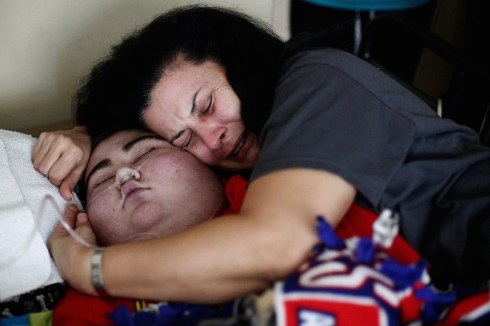
Maria Maldonado cries hugging Ethan Arbelo, 12, as he transitions into death on July, 3, 2014, in Lehigh Acres, Fla. “In those last minutes when you know your son is taking those last breaths, all you’re doing is praying for death for you too because you can’t imagine life without your baby,” Maria said.
IMAGES MADE IN THE SPIRIT OF THE SUBJECT
I was recently asked by EyeEm to select a neat piece of storytelling I’d seen in the past year or so. I thought back to Dania Maxwell‘s piece Little Man.
Here’s what I wrote.
One story from the last year that really caught my eye was Dania Maxwell’s Little Man, the story of Ethan Arbelo, who was ten when doctors diagnosed him with terminal brain cancer. This is the story of Ethan’s journey from boy to young man and his pursuit of happiness along the way.
Stories, particularly extended news stories or human interests profiles of individuals with terminal diagnoses are relatively common, but here Maxwell found in Arbelo a subject that really took the message, the impact and the emotion of the work to a new level.
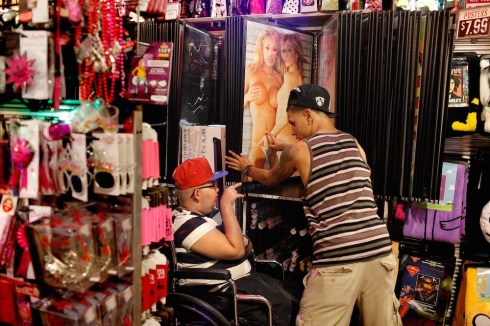
Reggie Iacono, right, helps Ethan Arbelo, 12, choose a poster for his bedroom while out for a boys’ day on February 21, 2014 in Fort Myers, Fla. Reggie, the son of one of Maria’s friends, moved in with Maria and Ethan in January to act as Ethan’s caregiver for a few months while Maria was back at work.
Arbelo was between childhood and adulthood and so his bucket list was a hotchpotch of things — some very predictable and others very surprising. For example, the photo of the woman kissing him as an 11-year-old is seriously dicey, but then you must remember that the things we see in the photos are things Ethan had discussed with his mother beforehand. Some dying wishes could be attained and others not.

Ethan Arbelo, 11, kisses Ashley Schroeder at a mud park named, The Redneck Yacht Club on May 25, 2013, in Punta Gorda, Fla. Ethan’s mom took him to the mud park as a compromise after Ethan had asked for a stripper for his 12th birthday. It was the first time Ethan had kissed a girl. “It felt like ice cream melting on my tongue,” he said.
Furthermore, over the course of the images we see the changes in Ethan’s body; we witness his death in pictures. But in each frame his personality bursts through. The story in each frame trumps the desperate circumstances Ethan is in. In that sense, Maxwell has achieved what all good photography should attempt to do — to really capture the subject’s spirit. Maxwell does this without trivializing, or patronizing, or sugarcoating.
The images are made in the spirit that Ethan wanted to live out his life; they’re optimistic and try to hone in on the common optimism we all surely have.
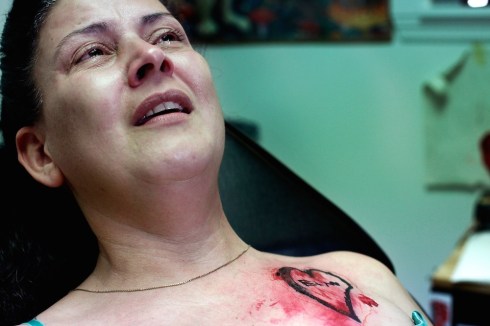
Two days after Ethan Arbelo died, Maria Maldonado receives a tattoo of a drawing Ethan made with their initials just before losing movement in his hands, at Ink Cafe on July 5, 2014, in Cape Coral, Fla. “This way he is always with me,” Maria said.
WHAT DOES “STORYTELLING” MEAN?
I think our future will be better if we start to agree as a community what storytelling is. It seems now that the term storytelling is a descriptor for everything. The term has been diluted. Are casual Instagrammers storytellers? Maybe, but I don’t think so. Is Humans Of New York storytelling? Yes, but the captions do the telling and the photos are not needed. Are selfies storytelling? What about still portraits? Storytelling has become a synonym of too many things to the point I don’t know if we’re all on the same page. For me, this is to storytellers’ and audiences’ detriment.
I’d like to see more long term projects and deep reporting and less throw away image making. I’d prefer one year long well-researched story than 3 or 4 in a year. I want to see huge silences on photographers’ social media, because then I know (I hope?!) they’re away reporting. Let’s make images to make stories visible, not just to feed the channels and try to stay visible ourselves.
ALSO, THE GIF
I think the GIF, and to a degree the looped video have huge untapped potential for telling stories in a clever way. Brandon Tauszik’s Tapered Throne is the best example I’ve seen of GIFs being used for documentary purposes but there’s all sorts of applications. Get over cat GIFs and memes and there’s a lot to be made, told and discovered.
FURTHER READS
Taylor Glascock’s feature of Little Man on Vantage: Dying Couldn’t Stop Ethan From Living.
Read the selections of four other photo editors much more expert than I: 5 Leading Photo Editors on the Most Powerful Storytelling Today
–
I mean really, at this point, what should we expect? I’m getting sick and tired of centrist, rightwing (and older) Americans ignoring the wonderful examples repeatedly set by youngsters about humane ways to treat one another.
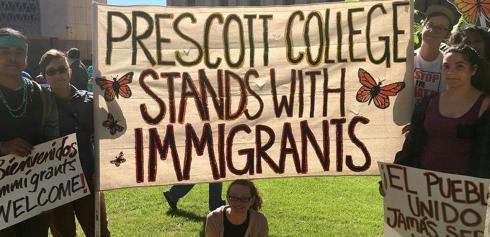
Latest example? In Arizona, the students of Prescott College, a small liberal arts school focused on environmental education, recently voted by a huge majority to initiate a $30 added charge to their annual tuition fees. The $15,000 that will be raised is to pay for a scholarship for one undocumented person to attend the college.
It’s laudable. It’s community minded. It’s called the Freedom Education Fund.
A few things to note first.
- This was a student led initiative.
- No faculty or administrative body foisted this upon the kids.
- This is a relatively small gesture: This fund will assist one teenager from an estimated 65,000 undocumented high-school graduates each year. (Only 10,000 of those graduates enroll in college each year.)
- This is a massive gesture in Arizona, a state in which voters approved Prop 300, a 2006 ballot measure, that prohibits students from paying in-state tuition and receiving federal and state financial aid if they cannot prove they are in the U.S. legally. Prescott College, a private institution, is exempt from the law which polices only public colleges and universities. Here then, relatively privileged kids are acknowledging and acting upon their privilege. This is Millennials being global citizens. Meanwhile the powerful in our world are hoarding and secreting cash left, right and centre!
Really, what is wrong with rightwing media like Fox and Breitbart who cast this empowered and beautiful move by students as a “levy” and a sneaky, “mandatory” subversive maneuver? What are right-wingers so fearful of? What whinging, narrow-focus on the world do you grip when youth solidarity bothers you but bloody-minded racism you let pass? What small world does one inhabit, if youngsters’ kindness to one another is cause for contempt?
Hurrah, kudos and all the very best to the students at Prescott College. Don’t listen to the haters and don’t let them distract you from the love you bear, the values you hold and the structural tweaks you make in the cause of social justice.
–
More at Mic and Phoenix Times.

–
There’s a massive prison labor protest in the offing.
If plans go according to plan, a coordinated and rolling series of shut downs will begin September in prisons across the United States.
Prisoners are staging the walk out to protest “wages” as low as 20cents/hour. Even well paid prison jobs rarely pay more than a dollar an hour, before deductions. (The top earners in the Federal Prison Industries and UNICOR earn $1.15/hour, before deductions).
Supporters of the strike are arguing that prison labor is modern day slavery. I can’t argue with that. The 13th Amendment to the U.S. Constitution, which abolished slavery, also maintains a legal exception for continued slavery in prisons. It states “neither slavery nor involuntary servitude, except as a punishment for crime whereof the party shall have been duly convicted, shall exist within the United States.”
I don’t know how many hundreds of thousands of prisoners work in prison factories and the like. 21,000 alone work in the Federal system.
Prison labor is not an issue entirely ignored by artists. In the past, Sheila Pinkel shone a light on the issue. Currently, Cameron Rowland is doing the same.
WHY DON’T WE SEE PRISON LABOR?
There are many grievances prisoners have with their detention. If outside society humors any of them, it usually humors calls for safe and sanitary conditions. Rarely, do you find outsiders calling for fair and equitable pay for the 40 hour weeks (or more) that prisoners work for pennies on the dollar. We make calls for secure and clean conditions because we’d not want to suffer squalor. Why then can we not make calls for the abolishment of legal slavery in the form of prison labor? Perhaps because we can imagine the smell of a putrid cell tier, but we cannot picture what prison work looks like?
Well, prisoners do everything from stuff mattresses to refurbish wheelchairs; make school dinners to shape Wendy’s and McDonald’s beef patties; stitch Victoria’s Secret panties to manufacture US military uniforms. Prisoners work as outsourced and subcontracted labor for corporations such as Boeing, Whole Foods, Walmart, Starbucks and Verizon. Prisoners man call centers for any number of private companies.
–

Prisoners work as operators at a call center in Snake River Correctional Institution. Perry Johnson Inc., a south Michigan based consulting firm has employed SRCI prisoners for over a decade. Little has been published online about the SRCI call center in recent years. Here’s a 2004 article about it.
–
Prisoners organizing the strike are not making demands or requests in the usual sense. They are calling each other to action in the hope that coordinated refusal to work will cause the prison industrial complex to creak so significantly that the nation will notice.
If critical mass is achieved, creaks and cracks will occur. A significant portion of America’s prison systems are built upon the cost savings, management philosophies and bottom line economics permitted by prison labor.
The planned action is essentially a good old strike, but of course, the repercussions for prisoners could be much more severe than the average worker: lockdown, solitary confinement and/or infraction charges that might jeopardize future parole.
WHY SEPTEMBER 9TH?
On Sept. 9th, 1971, prisoners shut down and took over Attica, New York’s most notorious prison. A total of 43 people were killed in the Attica prison riots—one of the darkest chapters in American penal history.
RECENT PRISON PROTESTS
Prisoners and their supporters can take heart and inspiration from prison strikes in recent years. The most well known would be the Prisoners Hunger Strike in California (2011-2013). The Free Alabama Movement in 2014 work stoppage garnered much attention. As did the 2010 Georgia Prison Strike. Hunger strikes at Ohio State Penitentiary, Menard Correctional in Illinois and at Red Onion Prison in Virginia flew under the radar of mainstream press. In December, women prisoners at Yuba County Jail in California joined a hunger strike in solidarity with women held in immigrant detention centers in California, Colorado and Texas.
Some actions have already kicked off in Texas.
There are many threads to the argument against prison labor, but none is better than outsiders making the leap to demand an end to exploitation that they would not tolerate for themselves or their loved ones. Remember, work programs and industries often operate in replacement of legitimate education and rehabilitation services.
Learn more at the Incarcerated Workers Organizing Committee.
Download the 2016 National Prison Strike pamphlet here.

–
UPDATE: You can get stickers these ways
–
SUBTLE, VIOLENT OMISSIONS
The ability to ignore the human rights abuse that is mass incarceration is built upon millions of small omissions, denials, and blind eyes turned. A group of students and faculty from Parsons The New School are pointing out to fellow New Yorkers one such omission.
Rikers Island, New York city’s main lock-up, is an institution beset by problems–including but not limited to environmental hazards, beatings by guards, juvenile solitary, predation, inadequate healthcare, suicide, abominable pre-trial conditions and more. On any given day it holds. Consensus is building that it is a jail that cannot be reformed and must be closed.
Ignominiously, Rikers Island jail is iconic. In a strange and depressing way, it represents NYC. Other icons for the Big Apple invariably include other structures: Empire State Building, The New York Public Library, Rockefeller Building, Statue of Liberty, The Metropolitan Museum.
The system and graphics that connect NYC’s important sites and buildings is the MTA subway map. Again, no less iconic. The subway map is ubiquitous; it is a powerful dictate of information. The subway map shapes knowledge.
Estefanía Acosta de la Peña, Laura Sánchez, and Misha Volf, graduate students at The New School, and creators of #SeeRikers, write:
The MTA and Rikers Island have a complicated relationship. Over the years the massive jailing complex has fallen on and off the subway map. An erratic absence, today Rikers Island is labeled on station maps but not inside trains, on digital versions but not in digital kiosks. #SeeRikers stickers are a simple way to acknowledge this erasure.
Whether an accidental oversight or an intentional omission – we believe it’s important to recognize a place that confines nearly 10,000 people each day and effects the lives of many more New Yorkers. So as you make your way across the city – on your morning commute or evening transfer – please help us put Rikers back on the map.
STICK RIKERS BACK ON THE MAP
You, me, anyone can be part of a rapid, insurgent and widespread correction. Acosta de la Peña, Sánchez and Volf have developed a sticker that riffs on the MTA “You Are Here” arrow. The sticker de-centers the map.
“Whereas the MTA’s label serves as an individual way-finding tool, ours signals a collective void,” say Acosta de la Peña, Sánchez and Volf.

–
FEEL THE BERN
Stickers will be passed out during the Bernie Sanders Rally at Washington Square Park on Wednesday, April 13th
Stickers will be handed out at the #CLOSErikers rally at City Hall.
THREE WAYS TO GET STICKERS
1. If you are a New York organization working on criminal justice reform email info[at]itsamademademademadeworld[dot]com and stickers can be delivered.
2. If you are an individual, visit the States of Incarceration Exhibition at the Sheila C. Johnson Design Center (66 Fifth Avenue at 13th Street, New York, NY) now through April 24th.
3. DIY. Use the #SeeRikers Print Files and print on clear sticker paper.
–
Follow #SeeRikers on Twitter.

 Prison Photography