
You are currently browsing petebrook’s articles.

Newark, New Jersey, December 2009: A Buthanese refugee is changing his shirt siting on the floor of his room. CREDIT: Gabriele Stabile/CesuraLab
Four years ago, Gabriele Stabile of CesuraLab went out to photograph in the airport hotels of New York, Newark, Chicago, Miami and Los Angeles – the five official US ports of entry for approved asylum seekers. The result The Refugee Hotel (originally The Refugee Motel) has been steadily added to since.
‘The “Refugee Hotels” are today’s Ellis Islands. Places of temporary lodging on refugees’ journeys from where ever “there” was to wherever in America they end up. My intention was to document the moments between two kinds of uncertainty. Refugees come fleeing hunger, they come from forced exile, they come escaping certain death. Some spend years in camps waiting for their ballot to be cast. I spoke to one person who’d waited seven years to talk to me in an anonymous hotel room in Newark, New Jersey. The resettlement process, even with all its difficulties and challenges, must be light years away from the harsh realities of life in a refugee camp. Still, I don´t know what to make of the establishing shot we start their American stories with: standardized hotel chains.’
The Refugee Hotel recently achieved it’s next phase by securing a pre-print agreement with McSweeney’s and raising $6,000 on Kickstarter to publish a book.
This is a fascinating project about immigration because while the lives of the subjects are swept up in global politics, there’s no possibility of them being caught up in the rhetoric of illegal immigration. Quite contrary, these are formerly persecuted people for whom the United States of America hold a real shot at stability.
Perhaps, Stabile’s photographs are of nascent American dreams, or maybe they’re simply the first images of American lives?
Stabile interviews with FADER and Miss Rosen.
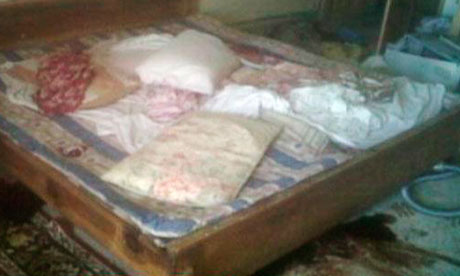
Screen-grab from ABC newsreel footage, as featured in the Guardian‘s front-page slide show.
Osama bin Laden wasn’t in mountain caves. He was in a mansion in Abbottabad, a major Pakistan city two hours north of the country’s capitol, Islamabad. Bin Laden had been there for more than six months.
Part evil-lair, part self-imposed prison, part luxury – the mansion is a major part of the story and questions about “who protected Osama bin Laden over the past decade” will no doubt follow.
There’s a few things going on here, so let’s start with the most simple. “You made you bed, now you must lie in it die in it.” Anyone? No? (To be clear, I don’t know if this was OBL’s bed, or even if he was killed in this room).
Nonetheless, the blood on the floor tells us this bedroom is a site of ambush; the bed is an object of a stormed house. Yet, this image is not distinguishable in any meaningful way from all the other images of house raids in America’s 21st century wars.
THE VISUAL CULTURE OF BEDS
Contemporary concerns have been about sex (the discarded condoms of Tracey Emin’s My Bed proved her as honest as she is crass) and violence (or maybe Rauschenberg was just about disorder?)
Historically, the image of the bed has been co-opted for highly political purposes. And interestingly, the bed played a central role in the dissemination of images of Arabic regions round Europe in the 17th and 18th centuries.
Artists under patronage painted aristocracies, noble beasts, mythologies, and Christian narratives. The boudoir was rarely mentioned; acts of the bedroom hidden. For titillation, commissioned artists were sent abroad. Orientalist Art has little to do with the distant lands it “depicts” but most to do with the obsessions of artists and patrons with harems and the sexual behaviours of people of colour.*
Without wanting to over-simplify, Orientalist Art is – at both conscious and subconscious levels – the projection of suppressed sexual desire upon an “Other” group. The subject has little or no means to correct the misrepresentations. Furthermore, any corrections by the subject would disrupt the self-serving narratives of the distant audience.
Centuries of visual manipulations and stubborn visual usury between the West and the rest, with the bed as the visual anchor to the lazy indifference, are wrapped up in the unorthodox war photograph above. If the image does indeed depict the bed of Osama bin Laden (the personification of cultural antagonism, violent opposition, the most distant of “Others”) then, I at least, identify some irony therein.
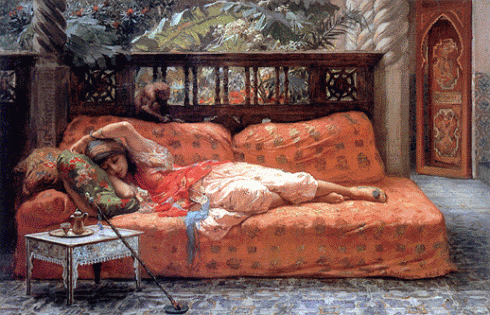
“The Siesta,” by Frederick Arthur Bridgman (1847-1928), oil on canvas, 11 ¼ by 17 inches, 1878, private collection, courtesy of the Spanierman Gallery, New York
One final thing. A bed is a place of rest, a grave is a final resting place. Western allies worried any grave would become an extremists’ pilgrimage site, so Osama bin Laden’s body was buried at sea. But have they avoided the problem? Might this Abbottabad mansion and this bedroom not become places of pilgrimage?
*Orientalist Art tends to refer to North Africa, but includes South Spain and the Middle East. The fetishisation of women of colour was also foisted upon Native people in North America and across the British colonies of the Southern Hemisphere.

I’ve spoken about artist Jeff Barnett-Winsby and his various photography projects in a Lansing prison, here and here. The main tangible object from JBW’s prison photography is the book Mark West and Molly Rose.
JBW is beginning a big push promoting Mark West and Molly Rose, starting with a book-signing at the International Center of Photography, 1133, Ave of the Americas #1A, NYC, on 6th May (6:00pm – 7:30pm).
From J&L Books:
Barnett-Winsby’s attraction to persons exiled to the fringes of society led him to photograph in Lansing Prison, in Lansing, Kansas. A year into his project, he found out that in February 2006, a convicted killer named John Manard had escaped from the prison, concealed inside a dog crate, with the help of a volunteer who worked at the facility named Toby Young. Manard and Young, operating under the aliases Mark West and Molly Rose, were captured two weeks later, after a high-speed chase, in Tennessee. Illustrated in color and black and white, this book is a collection of Barnett-Winsby’s photographs of and correspondence with the two lovers, both before and after the escape, and a unique record of an extraordinary tale of escape. “I have always been fascinated with loneliness and the outsider in society,” Barnett-Winsby writes, of his attraction to West and Rose’s extraordinary story. “Growing up, I felt pretty out of it (who doesn’t?) and was always in trouble for something.” His reconstructed narrative of their tale constitutes a highly original portrait.
ELSEWHERES
Week 38: Jeff Barnett-Winsby, Too Much Chocolate
Q & A : Jeff Barnett-Winsby, Providence, Feature Shoot

… you should check out a fine exhibition of prison art.
As some of you may know, I teach an art studio class once a week at a nearby prison. Last year, I asked a local gallery if they’d be interested in partnering for a show. The time has come. Here’s the skinny:
NON-SUFFICIENT FUNDS
Fundraiser for University Beyond Bars
Opening Reception: Thursday, April 28, 5-9pm.
Vermillion Gallery, 1508, 11th Ave (between Pine & Pike), Seattle
Featuring Artists from Monroe Prison with Special works by Buddy Bunting and Paul Rucker. (show runs through May 14.) Special Video Presentation of When You Learn, You Don’t Return, by Gilda Sheppard at 7:30pm.
Non-Sufficient Funds brings together the work of twelve prison-artists from the University Beyond Bars program at Washington State Reformatory, Monroe, WA, with works by established artists Buddy Bunting and Paul Rucker.
This exhibition of more than 50 acrylic paintings, graphite drawings and one video installation address abstract, figurative, allegorical and spiritual concerns. Non-Sufficient Funds is the culmination of over a year’s worth of weekly studio sessions within the prison and the brainchild of Pete Brook, a dedicated volunteer and board member of the University Beyond Bars.
In addition to the artwork by the inmates at Monroe, Paul Rucker will be showing his video, ‘Proliferation’, which documents the growth of the US Prison system over the past 200 years in an animated mapping of the US Prison system set to original music. Also, Buddy Bunting is presenting a 13 foot color painting of the stark facade of a prison at ground level.
The title of the show, Non-Sufficient Funds, has a few meanings: First, it refers to the stretched resources of volunteer-based rehabilitation programs within prisons across America, which is what this particular exhibit is advocating for. Research indicates that inmates who maintain contact with the outside world and who engage in educational and vocational programs experience a much lower rate of recidivism.
Second, it is a commentary on the financial burden the Prison-industrial Complex places on US society. Due to harsher sentencing laws and the war on drugs, the prison population has quadrupled since 1980. Now, in times of economic crisis, serious questions are being asked about the amount of tax dollars spent on prisons.
Finally, it refers to the scenario when a prisoner receives a letter or package has insufficient postage, and no funds available in their prison account fund to cover the difference. “Non-sufficient funds” is stamped upon the return correspondence. Many of us are unaware firsthand of the rigid structure the penal system requires. Mail sent to inmates in violation of policies can lead to punishment. Prison libraries and other media are also highly censored for various reasons. Non-sufficient funds hopes to shed some light on the way art and education in institutions benefits society as a whole and we hope it encourages a dialogue and additional advocacy.
In the local press
Keegan Hamilton of Seattle Weekly penned Insider Art and also ran a photo gallery with the article.
From Spinning Head:
“Dayanita Singh is an Indian photographer. She used to be an internationally famous photojournalist until the day she realized that the India editors kept asking her to shoot was not what she herself was experiencing. There was a gap between the cliches being asked of her and the complexities, human and social, that she knew lay unexamined behind so many of the stories she was being asked to do. Whether the stories were about poverty, prostitution, child labor or any number of the conventional cliches we seem to love to produce from India, Dayanita Singh was unable to turn off her mind. She was amongst the first to produce a series of images of India’s emerging middle class. She had seen this phenomenon at a time when others would not take it seriously.”
“The friend was killed at Abu Ghraib. His picture with Graner, on the floor with ice and beaten face. He was friend from work.”
– Jabar Abdel, former Abu Ghraib detainee, quoted in A Friend of Mine Was Arrested (below), by Daniel Heyman

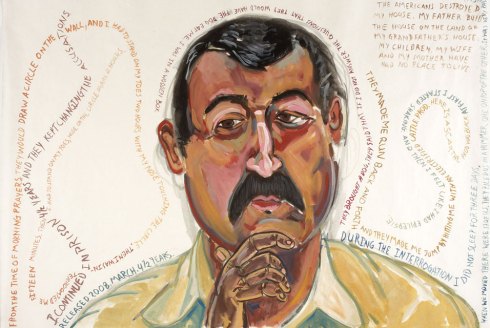
Anyone that has made analysis of the photographs of Abu Ghraib should also be aware of Daniel Heyman‘s paintings Portraits of Iraqis.
Heyman made the watercolours and sketches while sitting in on interviews between former Abu Ghraib detainees and Susan Burke, a human rights lawyer with Burke O’Neil LLC, Philadelphia. Burke was looking to bring in artists and writers to tell the stories of her clients in different ways and to reach a wider audience. (Simultaneously, photographer Chris Bartlett was also working on portraits for his Detainee Project.)
Heyman had previously used facsimiles of the Abu Ghraib pictures in his mixed-media and woodblock artworks, but had become discouraged by the laziness of the appropriation:
“The potency of those images really diminished. All sorts of artists had started to use these images, and the more they were used, the more they indicated Abu Ghraib without providing any understanding of Abu Ghraib. They became a kind of code for anger about so many things to do with the war. You flash on the famous picture of the man on the box, and people become numb to that image. And you re-humiliate that man. You re-victimize that person.”
I recently saw three of Heyman’s works in a gallery; they are the perfect foil to those infamous images of Abu Ghraib. In December 2008, upon reflection of Standard Operating Procedure, Errol Morris’ film that gave the US soldiers a voice against the military brass, I suggested, “what the global community needs now is an equally comprehensive documentary project bringing together the testimonies of all those held and tortured at Abu Ghraib.”
There have been articles written, lawsuits brought, oral testimonies made – but Heyman’s work stands out as a particularly successful enterprise. Heyman makes the paintings and records the words in real time as the interview goes on. A slightly grueling process about a horrifically grueling topic. Heyman brings us very close to these victims of torture; they are no longer the abstractions we’ve known through the Abu Ghraib files, but individuals with the knowledge and details of fact that should shake our conscience.
In consideration of the broad range of artists’ responses (from good to bad) to the Abu Ghraib images of torture, for me, Daniel Heyman’s paintings carry an impact far beyond that within the capabilities of most photography.
Read Heyman’s interview with Foreign Policy in Focus.
View Heyman’s website.
SmithMag has an easy-to-navigate gallery.



 Prison Photography
Blogging Images: Photojournalism and Public Commentary
April 20, 2011 in Non-Prison | Tags: 'Blogging Images: Photojournalism and Public Commentary', Brian Ulrich, Jim Johnson, Michael Shaw, Northwestern University, Robert Hariman | by petebrook | Leave a comment
Northwestern University in Evanston, IL is to host the conference ‘Blogging Images: Photojournalism and Public Commentary’ on Saturday, April 30th.
Robert Hariman explains why here:
“Because photojournalism is a public art, it exists in part to provoke and inform public discussion. Likewise, good public discussion includes talking about images as a way of thinking about public affairs and other things held in common. Although photojournalism has been accompanied by commentary from its inception, digital technologies have provided both new media for image circulation and new venues for critical commentary and audience interaction. These changes provide an opportunity for scholars in the humanities to become more directly engaged with public audiences, but effective engagement is likely to require different skills and perhaps different attitudes than those that characterize academic discourse.”
Speakers include Brian Ulrich, (Document to Propaganda: The New Face of Photographic Truth), Jim Johnson (The Uses of Photography: Thinking About Public Space) and Michael Shaw of BagNewsNotes (Role and Process of Analyzing News Images). Looking forward to the conclusions.