
You are currently browsing petebrook’s articles.
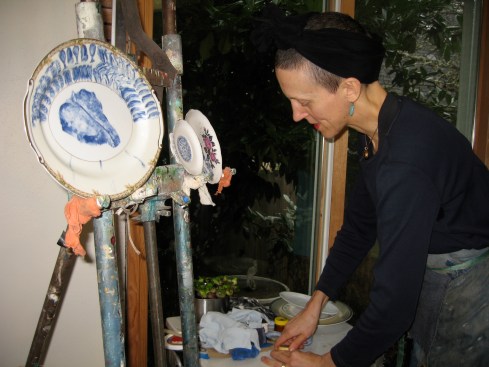
Julie Green in her studio. Photo Credit: Pete Brook
I recently visited Julie Green at her studio in Corvalis, Oregon. For the past twelve years, between her responsibilities as Professor of Art at Oregon State University, Green has been painting plates. Each plate quietly marks the life of a man or woman executed in the US and each depicts their final meal request.
Green’s The Last Supper has steadily grown down the years. There are now approximately 450 plates in the series and, when exhibited, they come together in a ghostly feast of absent eaters. I imagine a toast to the fury and retribution of US society.
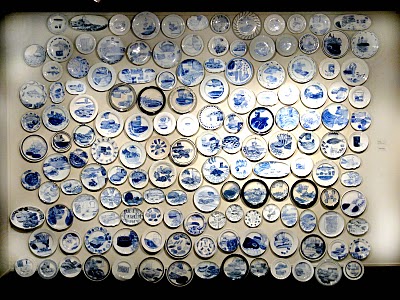
The Last Supper exhibited at Oregon State University (OSU). Photo credit: Doug Russell
Green acquires all her plates from thrift stores and bargain barns. Her preference is plain white plates, but she’ll tolerate flashes of navy or gold. The plates showing the last meals of female prisoners are occasionally a little more elaborate and may include floral decorations.
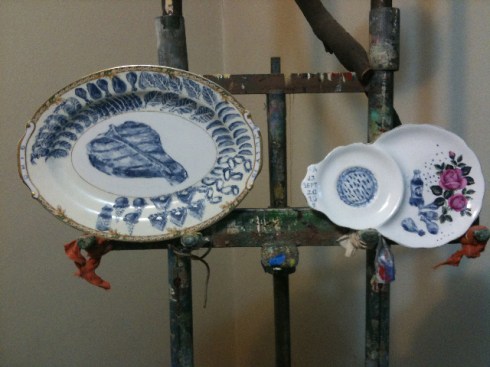
Two plates partially complete, for The Last Supper series, Julie Green’s studio, Corvalis, Oregon. Photo Credit: Julie Green
In some instances, last meals were refused and a statement was offered instead. Although, Green withholds the identity of the inmates, cursory internet sleuthing can pair meals with murdered prisoners. Writes Kelly Klaasmeyer for Houston Press:
Odell Barnes, Jr. [was] a Texas death row inmate. Barnes’s case caught international attention and caused Pope John Paul II to urge then governor, and presidential candidate, George W. Bush to show “compassion.” Barnes was executed, and Green has painted his last request on a gold-rimmed oval plate: “Justice, equality, peace.”

The Last Supper exhibited with Odell Barnes Jr.’s ‘Justice Equality Peace’ plate in the foreground. Photo credit: Aswin Subanthore

Mineral paint and Julie’s hand. Photo credit: Pete Brook
Green uses mineral paint, sometimes called porcelain paint. “I often add cobalt blue pigment to the mineral paint. Sometimes Nassau blue,” says Green. The paint slides across the reused plates and the effect is one of translucent foodstuffs. To fix the paint, Technical advisor Toni Acock kiln-fires each plate at 1,400 degrees Fahrenheit.

Kiln firing plates, January 2011. Photo credit: Deborah Gangwer
Finding out the last meal requests from across the States is not complicated work. As a matter of process, the last meal is usually included in media coverage. Until 2003, the Texas Department of Criminal Justice published its own online record of last meal requests. Green will also write to state authorities; the information is public record and always forthcoming. The fact that the details of last meals secured as part of procedure, and as part of the service of information to the wider public, is both significant and perplexing to Green. Why our fascination?
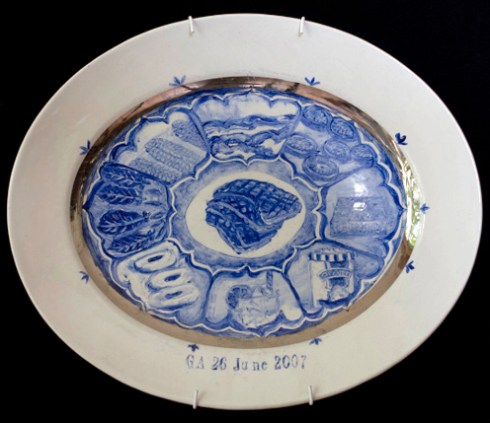
The Last Supper: Georgia 26th June 2007. Four fried pork chops, collard greens with boiled okra and “boiling meat”, fried corn, fried fatback, fried green tomatoes, cornbread, lemonade, one pint of strawberry ice cream and three glazed donuts. Mineral paint fired on to porcelain, 9″ x 15″
In keeping with her other projects, The Last Supper is an act of meditation. (Green was diligently painting shells on sheets with fabric paint before, during and after the Gulf oil spill of 2010.) Through the act of painting, Green takes on a critical awareness that – unfortunately – many of us choose to ignore. The Last Supper is both a remarkable dedication to mindful art practice and, for Green, an unsettling focus on violence.
“I think about food, choice, and whether inmates are able to eat the food they order,” says Green. “Specific food requests, often-local specialties, provide clues on region, race, and economic level.”
I don’t think Julie would mind me calling her a foodie (she made some hearty organic soup and bread for us to share), and so to her it is logical that the connection between the body, health and living intertwine with circumstance of education, socialisation and (potential) institutionalisation.
Aware of “the heinous crimes committed, the victims, the individuals executed, the large number of minorities on death row, and the margin for error in judicial process” Green is undoubtedly invested in the politics of prisons and anti-death penalty. And yet her response as an artist is apt, personal and all the more powerful for it. If she is angry, it is quiet anger.
Many photographers have chosen last meals as their subject. Possibly the best known is Celia Shapiro. Critic Fred Ritchin has referred frequently to Shapiro’s work saying that its power lies in the food choices of men and women clearly of lower economic status, but Green corrected this view; often a choice is not ‘choice’. Prisoners in most states have a budget of $20. “Inmates in some states are limited to food available in the prison kitchen,” says Green “There is a great deal of red meat but few lobsters, no sushi, and no Godiva chocolate.” The chocolate is usually Hershey’s.

Julie Green’s self-made reference book of food images. Photo credit: Julie Green

Plate from The Last Supper series waiting to be fired. Firing seals and dries the mineral paint. Photo credit: Pete Brook
The Last Supper plates were first displayed at University of Liverpool Art Museum, UK in 2000.
Later they have been on show at the University of California at Santa Cruz; Copia American Center of Food, Wine and the Arts, Napa, CA; Oregon State University, Corvalis; The Wing Luke Asian Museum, Seattle; The Hunter Museum of American Art, Tennessee; Living Arts, Oklahoma; Fort Collins MOCA, Colorado; The Spencer Museum of Art, University of Kansas; The Mulvane University Museum of Art, Kansas; Reed College, Portland, OR; and DiverseWorks, Texas.
Awaiting their next outing, the plates are numbered, ordered and locked in Green’s basement. I found some irony in that.
And when is The Last Supper project complete? “I’ll stop painting plates when the US ceases with the death penalty,” says Green.
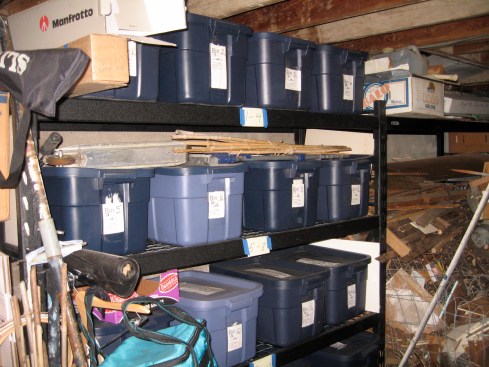
Between exhibitions, Green stores the plates in her basement. These sixteen tubs contain approximately half of the collection. Photo credit: Pete Brook
In 2003, Green was interviewed about The Last Supper on the NPR program The Splendid Table.
In 2008, The Last Supper was shown as part of the San Francisco State University show Criminal along with artists such as William Pope. L and Deborah Luster. Green’s work was included in the follow up book PRISON/CULTURE, (Ed. Bliss, Sharon E., Kevin B. Chen, Steve Dickison, Mark Dean Johnson & Rebeka Rodriguez) and published by City Lights. In 2010, I reviewed PRISON/CULTURE as “simultaneously a consolidation of achievement, a fortification of resources and celebration of resistance. PRISON/CULTURE may be a book with a Californian focus, but it has national and international relevance. Succinct, well researched, egalitarian and lively. For me, PRISON/CULTURE is the best collection of works by any US prison reform art community up until this point in history.”
FURTHER READING: FOOD AND DEATH
Cabinet Magazine: Debt, Guilt, and Hungry Ghosts: A Foucauldian Perspective on Bigert’s and Bergström’s Last Supper
Famous Last Meals blog
Dead Man Eating blog
Food in the Arts: The da Vinci Mode: Last Suppers, Old & New
THE DEATH PENALTY ON PRISON PHOTOGRAPHY
Media and the Aftermath of an Execution: Poring Over the Apparatus of Death
Louisiana Sues Its Own Death Row Prisoners
Photographer Scott Langley talks about the Death Penalty
STATISTICS
On her website, Green provides the following statistics.
As of May 2009, there had been 1165 U.S. state-sanctioned executions since 1976:
438 Texas
103 Virginia
90 Oklahoma
67 Missouri
67 Florida
43 North Carolina
45 Georgia
42 South Carolina
42 Alabama
27 Louisiana
27 Arkansas
28 Ohio
23 Arizona
19 Indiana
14 Delaware
13 California
12 Nevada
12 Illinois
10 Mississippi
6 Utah
5 Maryland
4 Washington
3 Montana
3 Nebraska
3 Pennsylvania
3 Kentucky
2 Oregon
5 Tennessee
1 Connecticut
1 Colorado
1 Idaho
1 Wyoming
1 South Dakota
0 New Hampshire
0 Kansas
3 U.S Federal Government
States without the death penalty: Alaska, Hawaii, Iowa, Maine, Massachusetts, Michigan, Minnesota, New Jersey, New Mexico, New York, North Dakota, Rhode Island, Vermont, West Virginia, Wisconsin, and Washington D.C.
I received a perplexing email this week. It read:
Hi. I am xxxxx-xxxxxx from WebSponsors. My company represents a leader in online criminal justice degrees.
They would like to buy a simple text ad on the bottom of your page (https://prisonphotography.wordpress.com/2009/02/28/the-feedback-of-exile-interview-with-stephen-tourlentes/). It would look like…
“criminal justice” or “justice degrees” — with a link to our client’s site.
We can pay $84 via PayPal ASAP for this ad.
Please let me know if you are interested. Thanks for your time & consideration.
I politely declined.
I am alarmed by the rise of for-profit education in the US, and I am particularly offended by online education. Not being in a classroom with a teacher and peers denies the personal exchange of ideas which is, in my opinion, the most valuable aspect of education.
I’m doubly offended by the rise of (what some refer to as) “cop schools.” They feed the bloated prison industrial complex and do nothing to question the broken policies that created the obese, expensive and overly punitive systems.
Read this article from the New York Times:
The report,“Subprime Opportunity” (PDF) by the Education Trust, found that in 2008, only 22 percent of the first-time, full-time bachelor’s degree students at for-profit colleges over all graduate within six years, compared with 55 percent at public institutions and 65 percent at private nonprofit colleges.
Among Phoenix’s online students, only 5 percent graduated within six years, and at the campuses in Cleveland and Wichita, Kan., only 4 percent graduated within six years.
“For-profits proudly claim to be models of access in higher education because they willingly open their doors to disadvantaged, underprepared students.” said José L. Cruz, a vice president for the trust. “But we must ask the question, ‘Access to what?’ ”


Late last year, Aaron Huey and I met at his favourite coffee shop in Seattle (the only coffee shop in the city without WiFi, as far as I know). During our chat, his phone was buzzing; on the line was Emphas.is finalising the details of his Pine Ridge Billboard Project pitch.
PINE RIDGE RESERVATION
Ever since Huey’s powerful and viral TED talk last year, he’s been inundated with inquiries from people wanting to get involved and contribute. Huey admitted to being conflicted by his unexpected propulsion into the centre of a nebulous political energy, partly because he doesn’t have all the answers and partly because his work still doesn’t sit well with some of the Lakota community. Understandably, some Lakota don’t want images of broken homes and broken bodies to be consumed by white America. Still, Huey has the faith of the majority within the Lakota people.
With a story so large and important – and solutions so complex – Huey was unsettled with the status and future of his Pine Ridge documentary work; he had not pushed the political issue as far as it warranted. From his Emphas.is pitch:
I have been documenting the Pine Ridge Indian Reservation for the past six years. Recently I have realized how inappropriate it is for this project to end with another book or a gallery show. […] Your involvement will help raise the visibility of these images by taking them straight to the public—to the sides of buses, subway tunnels, and billboards. I want people to think about prisoner of war camps in America on their commute to work. I want the message to be so loud that it cannot be ignored.
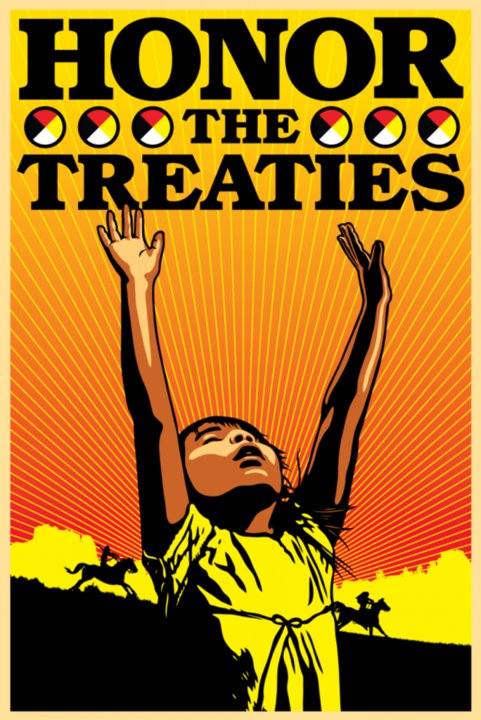
Emphas.is has given Huey, the Lakota people and us the opportunity to see and react to the work in unmissable public locations. It puts it in the face of D.C. politicians. Huey has enlisted the help of Shepard Fairey and artist and activist Ernesto Yerena who created visuals for the Alto Arizona campaign.

Source: http://www.webpages.uidaho.edu/~rfrey/329treaties_and_executive_orders.htm
PRISONER OF WAR CAMP #344
Huey’s photographs depict high unemployment, broken families, alcohol abuse and life expectancy lower than that in Afghanistan. The statistics are shocking.
But more than that, Huey’s photographs show the legacy of the lies and broken treaties of the US government stretching back over a century. If the Treaty of Fort Laramie (1868) had been observed, then the Lakota and associated Sioux tribes would own land stretching across five states.
To refer to the Pine Ridge Indian Reservation as a prisoner of war camp may seem incendiary to some, but this is how many of the Lakota see their existence. The Black Hills have been stolen and the Lakota live on the most infertile land fenced in on all sides by an encroaching dominant culture that they’ve predominantly experienced as oppressing and damaging. The solutions are not simple, but awareness and a will to action is.
Pine Ridge Indian Reservation is prisoner of war camp #344.
EMPHAS.IS
I have offered what support I can to the new crowd-funding platform Emphas.is with articles here on Prison Photography and for Wired.com. Three of the online critics I respect most (Colin, David and Joerg) have also put their weight behind it. I am chuffed to see Aaron’s proposal off the ground and I’d ask you seriously to consider funding the Pine Ridge Billboard Project.

Mock-up of a wall installation using 24x 26″ posters, proposed Pine Ridge Billboard Project
OUTLETS FOR ACTION: Throughout the campaign a website honorthetreaties.org will be formed. Aaron will build the site as a point of reference for those who want to know more about the history and the (broken) treaties of the Sioux and other tribes. There will be direct links to assist grassroots Native non-profits in places like Pine Ridge.The first partner is Owe Aku.
More on Aaron’s blog here.
Buy a 18×24 print signed by Shepard Fairey and Aaron Huey to support the project!

“Tim’s New Office”
Following the Christchurch earthquake of February 22nd, severed and compromised sewer pipes cannot be relied upon. As a result outside toilets, or ‘Long Drops’ have been constructed. A new community website ShowUsYourLongDrop showcases all the creative pooping-pits built in the back-gardens of Christchurch.
From the ShowUsYourLongDrop website:
The earthquake disaster has been a testing time for us Cantabrians and we feel for people who have lost loved ones or property. Our thoughts are with you. During these tough times it is important to be with friends and family and still be able to have a good laugh. Hence the reason for this website. A bit of toilet humour is bound to put a smile on your face even if your having a crappy day!

“The Woodshet”

“The Magic House Long Drop”
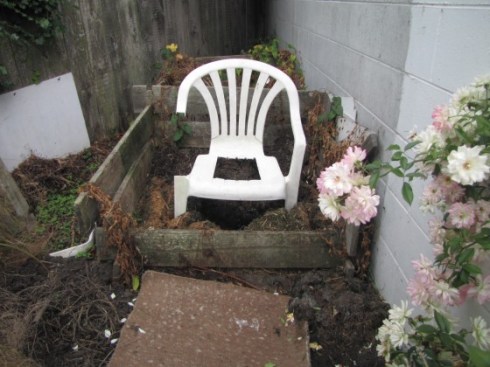
“The Self Composting”

“The Outdoor Beach Special”

“Danger: Poo Below”

“The Lighting Special”
– – – – – – –
Readers. I realise this is again a post off the topic of prisons. I am working on a couple of lengthy pieces so those important politics will return. And besides, one-off and resilient photo communities such as ShowUsYourLongDrop deserve a warm clap and recognition for their humor in the face of great inconvenience.

Joerg‘s been on a collage kick recently and even opened up a new Collage Art category for his blog. I came across the work of John Beech this week (I can’t remember where) and I like what I see. Beech uses recycled/discarded materials in his sculpture and mixed media works, so why not play on the idea in his photo-collage also?
Check out Beech’s Hybrid Dumpster Drawings.
Collage is a deceptively tricky discipline. It seems to me that the best collages are often the ones that exist at the extreme ends of the spectrum. At one end of that spectrum are collages that incorporate fragments too numerous; visual orgies that have the head spinning, for example Neil Chowdury’s photo-montages.
At the other end of the spectrum are those that incorporate the barest elements; John Beech’s use of only two images would be good examples of that, and of course the least an artist can do to qualify their work as collage.
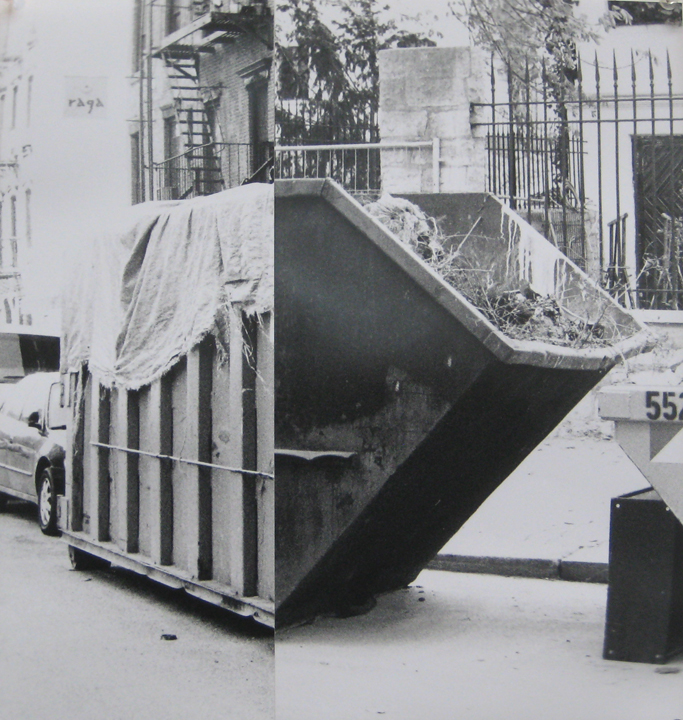
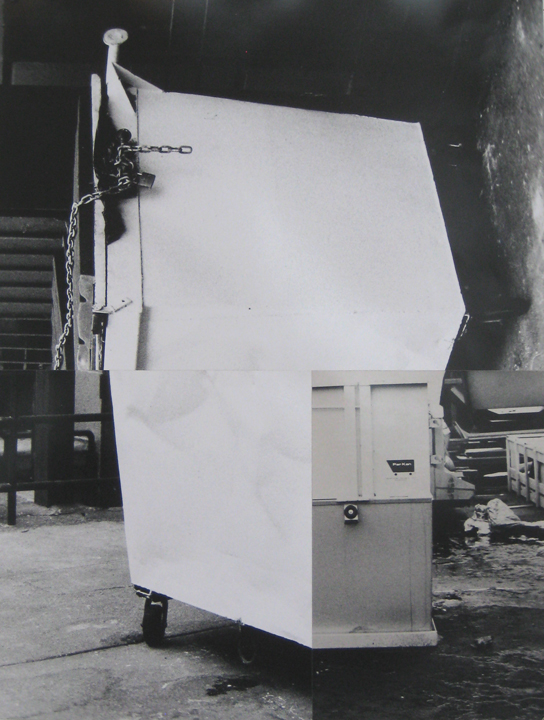
Beech also plays around with metallic tape atop of prints to obscure subjects.


John Beech’s The State of Things is on show at Peter Blum Gallery, 526 West 29th Street, New York, NY 10001
I have a lot of reasons for opposing America’s prison industrial complex, but zealously guarding infirm, hospitalised prisoners (and the wasted money) seems like one we reason should all understand.
This, from the Los Angeles Times:
A degenerative nerve disease has left 57-year-old California inmate Edward Ortiz semi-paralyzed in a private Bay Area hospital for the last year. The breathing tube in his throat tethers him to a ventilator at one end of the bed; steel bracelets shackle his ankles to safety rails at the other.
Still, California taxpayers are shelling out roughly $800,000 a year to prevent his escape. The guards watching Ortiz one day last week said department policy requires one corrections officer at the foot of his bed around the clock and another guard at the door. A sergeant also has to be there, to supervise.

The nine minutes of grainy video footage George Holliday captured of Los Angeles police beating Rodney King 20 years ago helped to spur dramatic reforms in a department that many felt operated with impunity. (George Holliday)
Twenty years ago yesterday, Rodney King got the living shit kicked out of him in Los Angeles.
Amazing as it may seem, those 9 minutes of grainy footage, shot by George Holliday on his clunky Sony Handycam, may never have existed.
At the time, Holliday obviously didn’t know the significance of what he was filming, nor that it would change the consciousness of Black America, the trajectory of the Los Angeles Police Department and race relations in the City of Angels.
This, from the Los Angeles Times:
The simple existence of the video was something unusual in itself. Relatively few people then had video cameras, Holliday did — and had the wherewithal to turn it on.
“It was just coincidence,” Holliday reflected in an interview a decade ago. “Or luck.”
Today, things are far different and the tape that so tainted the LAPD has a clear legacy in how officers think about their jobs. Police now work in a YouTube world in which cellphones double as cameras, news helicopters transmit close-up footage of unfolding police pursuits, and surveillance cameras capture arrests or shootings. Police officials are increasingly recording their officers.

 Prison Photography