
You are currently browsing petebrook’s articles.

After looking at the TSA’s list of airports with Full Body Scanners, I’ve decided to drive to California for the Christmas Holidays. I’d already made the decision to stay in Seattle for Thanksgiving, so no immediate problems.
This post obviously spurred by the story of unlikely hero, John Tyner.
Some of you might be thinking that it’s not a big deal because those images are not saved, stored or transmitted, right. Wrong.
From the list below, if you’re flying anywhere meaningful in the US, some TSA agent is going to ogle your fancies.
Happy Holidays!
Airports who currently have imaging technology:
- Albuquerque International Sunport Airport
- Hartsfield-Jackson Atlanta International Airport
- Baltimore/Washington International Thurgood Marshall Airport
- Boston Logan International
- Bush Houston Interncontinental Airport
- Boise Airport
- Bradley International Airport
- Brownsville
- Buffalo Niagara International Airport
- Charlotte Douglas International
- Chicago O’Hare International
- Cincinnati/Northern Kentucky International
- Cleveland International Airport
- Corpus Christie Airport
- Dallas/Fort Worth International Airport
- Denver International Airport
- Detroit Metro Airport
- Dulles International Airport
- El Paso International Airport
- Fort Lauderdale-Hollywood International
- Fort Wayne International Airport
- Fresno Airport
- Gulfport International Airport
- Grand Rapids Airport
- Harrisburg International Airport
- Harlingen/Valley International Airport
- Honolulu International Airport
- Indianapolis International Airport
- Jacksonville International Airport
- John F. Kennedy International Airport
- Kansas City International
- LaGuardia International Airport
- Lambert/St. Louis International Airport
- Laredo International Airport
- Lihue Airport
- Los Angeles International
- Luis Munoz Marin International Airport
- McAllen Miller Airport
- McCarran International Airport
- Memphis International Airport
- Miami International Airport
- General Mitchell Milwaukee International Airport
- Mineta San José International
- Minneapolis/St.Paul International Airport
- Nashville International Airport
- Newark Liberty International Airport
- Louis Armstrong New Orleans International Airport
- Oakland International Airport
- Omaha Eppley Field Airport
- Orlando International Airport
- Palm Beach International Airport
- Philadelphia International Airport
- Phoenix International Airport
- Pittsburgh International Airport
- Port Columbus International
- Raleigh-Durham International Airport
- Richmond International Airport
- Rochester International Airport
- Ronald Reagan Washington National Airport
- Salt Lake City International Airport
- San Antonio International Airport
- San Diego International Airport
- San Francisco International Airport
- Seattle-Tacoma International Airport
- Spokane International Airport
- T.F. Green Airport
- Tampa International Airport
- Tulsa International Airport
Airports receiving imaging technology soon:
- Chicago Midway International Airport
- Houston William P. Hobby Airport
- Saipan International Airport

It was interesting to watch Marion Jones speak on Monday’s Daily Show. She was locked up for 6 months for lying to federal investigators during the Balco scandal. Jones’ imprisonment included a 45 day stint in solitary confinement.
Jones is now in the very early stages of prison reform advocacy:
“I’m in the process of looking for organizations that I can partner with, get their stories out there, share my experience, use my voice. When I was in prison, some of the women there talked to me and shared their stories with the hope that, because I have a voice on the outside, people will want to hear what I have to say.”
“Too many times, you’ll hear, ‘Aw, there’s just prostitutes or drug-heads or the bottom rung of our society in there.’ Before you jump to a conclusion and make any ignorant or rash comment, take a break – remember, that’s what I’m trying to get out there – find out what you can about the situation and make a smarter response. I’ll do whatever I can do to talk about awareness and change.”
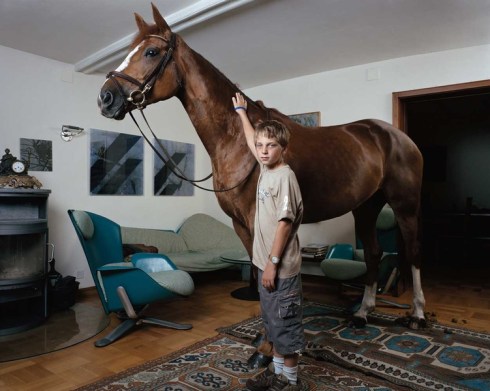
Jon Naiman. Familiar Territory, #21. Chromogenic Print. 32×40″ Image. Unmatted. 3/6. $3600
What is there not to love about Jon Naiman‘s series Familiar Territory? (More here)

Cell with Two Male Convicts
Two months ago, I posted about how the the roundhouse panopticon at Stateville Penitentiary in Joliet, MI had become the subject of art photographers David Leventi, Doug Dubois/Jim Goldberg and Andreas Gursky.
OLD NEWS
These famous names were preceded by anonymous inmate photographers a century previous. Nearly 200 plates from the early 20th century were found by Robert Lawson, a prisoner sentenced to six years in 1969. Lawson was “assigned as an inmate photographer in the Bureau of Identification.”
Lawson: “The B of I maintains mugshots, fingerprints, and criminal records of convicts from the early days of the prison. In a corner of the basement darkroom in a few drawers of an old filing cabinet were several hundred glass-plate negatives which documented Joliet prison around the turn of the century. I spent most of my two years working in these darkrooms, producing a blend of public relations and evidence photographs for the prison administration. The photographs were used in penal publications and were occasionally released to news agencies to illustrate the events and social progress of the prison.”
“The photographs were made by inmate photographers, although their identities still have not been determined. Prison records from 1915 indicate that there were five convicts who listed their previous occupation as photographer. Reports also document that there was a room in the prison designated as the “Photograph Gallery” and that the current warden, Edmund M. Allen, had an annual budget for photographic expenses of almost $1000, approximately three times greater than that of previous administrations.”
“These public relations photographs were taken by an anonymous series of inmate photographers under official direction. It was not necessarily their purpose to create a clear understanding of what prison is and what it does to the minds of those who live there, but it was their purpose to illustrate the progressive changes which were taking place during an era of penal reform which lasted until the beginning of World War I, when public and political attention was diverted to other areas.“
[My bolding]
The collection includes Workplaces, The Grounds, Chaplin, Cells, and Mugshots. A catalogue of the images is available on eBay.
The intriguing story of historical prison photography and later discovery have been reported in publications and featured in James R. Hugunin’s, 1996 survey of prison photography, Discipline and Photograph: The Prison Experience, which is the primary academic work on the history of prison photography in public domain.
Here’s a full list of related links and the list of plates.
Fascinating stuff.

Cell for Female Prisoner

Chaplin with Four Inmate Assistants, ca. 1910
Thanks to Stan for the tip.

The Hell of Copper (L'Enfer du Cuivre). Series: The Hell of Copper. 1800x1200. January-November 2008. Accra, Ghana. © Nyaba Leon Ouedraogo
 Burkina Faso-born Nyaba Leon Ouedraogo is one of the twelve shortlisted photographers for the Prix Pictet.
Ouedraogo’s ‘The Hell of Copper’ (L’Enfer du Cuivre) depicts the Aglobloshie Dump in Accra, Ghana. “From dawn to dusk, dozens of young Ghanians, from 10 to 25 years of age, exhaust themselves […] seven days a week. Their mission is to disassemble the old computers and burn certain plastic or rubber components to cull the precious copper, which will then be resold. Everything is done by hand or with iron bars, makeshift tools found among the refuse. They have neither masks nor gloves. There are not even any functioning toilets,” says Ouedraogo.
Ouedraogo quotes a 2008 Greenpeace report on toxic substances at the site:
– lead: in cathode tubes and monitors, harms the nervous, reproductive, and circulatory systems.
– mercury: in flat screens, harms the nervous system and the brain, especially in young children.
– cadmium: in computer batteries, dangerous for the kidneys and the bones.
– PVC: this plastic used to insulate electrical wires, when burned, gives off carcinogenic chemical substances that can cause respiratory, cardiovascular and dermatological problems.
Ouedraogo’s pictures are good, but I don’t think they are good enough. The story is vital but the images don’t live up to its importance (presuming the 10 images edit for the Prix Pictet are his best works.)
In truth, I don’t want to criticise the work of a photographer from Burkina Faso. When was the last time a photographer from Western, Eastern or Central Africa was shortlisted for a major photography prize? We should be celebrating the recognition. But Ouedraogo shouldn’t win; the project is not polished enough.
For the record, I don’t think big-guns like Taryn Simon or Ed Burtynsky should win either: they don’t need the exposure and their work is familiar, a bit dated and easy to digest.
I hope either Stéphane Couturier or Vera Lutter win.
INTRODUCING PIETER HUGO
Back to Aglobloshie. It’s a familiar subject to us photo-nerds, not least because Pieter Hugo’s Permanent Error about Aglobloshie did the rounds a few months back.
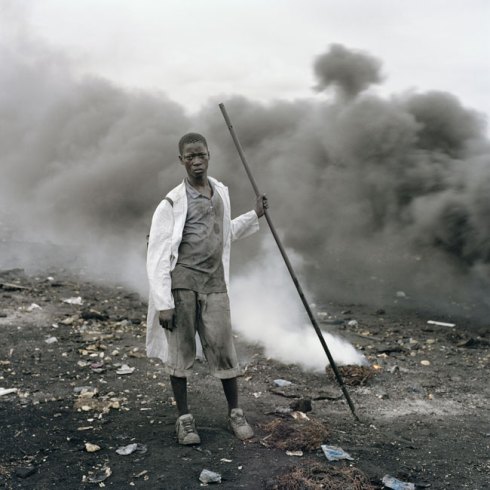
Abdulai Yahaya, Agbogbloshie Market, Accra, Ghana. 2010. @ Pieter Hugo
Hugo was very quick at turning his images round. They were distributed within months of his 2010 visit to Aglobloshie. Yet, it was Ouedraogo who went to the toxic site first; in 2008, a full two years before Hugo set up his camera.
Hugo has been the centre of debates on race and representation before, so it is with even more reluctance I draw the comparison to Ouedraogo. Hugo’s portfolio contains dozens of images and so it can boast a wider view of the poisoned micro-environment. This works in Hugo’s favour.
Both photographers emphasise the prevalence of child labour, the presence of grazing livestock and the use of found tools and noxious open fires to extract copper from the scraps. If you look at the statements by Ouedraogo and Hugo they contain virtually the same info.
Again, it is the story that is of primary importance, here.
The ultimate question then, is which portfolio is best likely to capture the attention and imagination of viewers enough for them to shift their worldview of politics, consumption and globally connected “growth”? (“Growth” is the theme of the Prix Pictet this year.)
Hugo’s work sells in galleries and it made for those gallery sales. It’s also a bleak look at the conspicuous consumerism. Ouedraogo’s work is uses photojournalist angles, some portraits and shots of the expanses of computer carcasses. Ouedraogo’s work is less cohesive. And for some reason I want to say it peels away.
I’m not really convinced by either, but I’d still err reluctantly to the foggy Hugo square.
The one thing Hugo’s work lacks is the sentiment (and hope?) of the picture below, with which Ouedraogo closes his portfolio.

The Hell of Copper (L'Enfer du Cuivre). Series: The Hell of Copper. 1800x1200. January-November 2008. Accra, Ghana. © Nyaba Leon Ouedraogo
The other eleven finalists for the Prix Pictet are Christian Als (Denmark); Edward Burtynsky (Canada); Stéphane Couturier (France); Mitch Epstein (US); Chris Jordan (US); Yeondoo Jung (Korea); Vera Lutter (Germany); Taryn Simon (US); Thomas Struth (Germany); Guy Tillim (South Africa); Michael Wolf (Germany). Biographies here.
UPDATE 11.12.2010, 12.30pm PST: Forsell didn’t win. Announced 11.12.2010 in Bristol, UK Yvonne Venegas won for her portrayal of Maria Elvia de Hank, millionaire wife of an eccentric former mayor of Tijuana. Julian Roeder and Rob Hornstra also made the final three.
This will not put me off making predictions in the future. I’ll just have to adopt unpredictable criteria and decision making to mirror the many diverse jury panels. And I stand by everything I said about Forsell’s ‘Life’s a Blast’.
– – – – –
© Linda Forsell
I’ll admit to being rather deflated after looking over the shortlisted photographers for this years Magnum Expressions Award. Many of the portfolios of 15 images had only one or two photographs that held my attention.
The Magnum Expressions Award is in reaction to the brave new world photographers face; new communities, new audiences, new distribution channels and bold ways of working. It is an award designed – so it says – to reward young photographers surfing the shifting sands beneath the industries footings.
It should be said that most of the 19 shortlisted artists have hunted down engaging subjects. Bepi Ghiotti‘s Sources is an enigmatic thesis on man and nature. Yvonne Venegas’ fly-off-the-wall study of Maria Elvia De Hank wife of an eccentric millionaire and former Tijuana mayor bristles with ambivalence toward the subject.
I was pleasantly surprised to see the presence of two photographers who’ve briefly pricked my attentions. Anastasia Taylor-Lind and Irina Rosovsky both deliver strong entries. (On PP, Taylor-Lind, here and Rosovsky here).
These would be my 3rd through 6th placed finalists, but who’s listening to me, eh?
In at second is Jenn Ackerman. This high finish has little to do with my interest in photography that exposes the shortcomings of the US prison system and everything to do with the excellent way Jenn portrays the daily battles and extreme stress of a prison operating as a makeshift and unsuitable lock-up for men with severe mental health disorders – Trapped: Mental Illness in America’s Prisons. (I’ve featured Jenn’s work here on PP before.)

© Linda Forsell
‘LIFE’S A BLAST‘ BLOWS THE COMPETITION AWAY
And, winning by a country mile is Linda Forsell. Gold star.
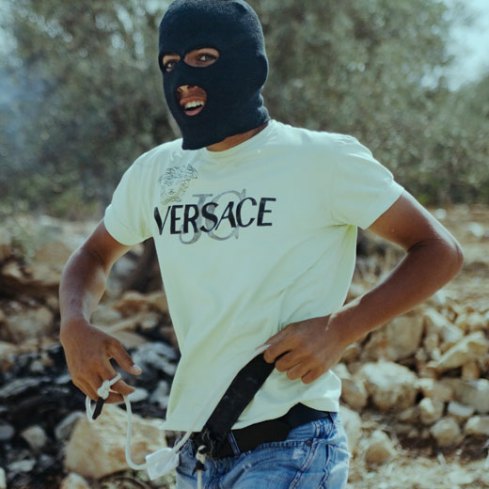
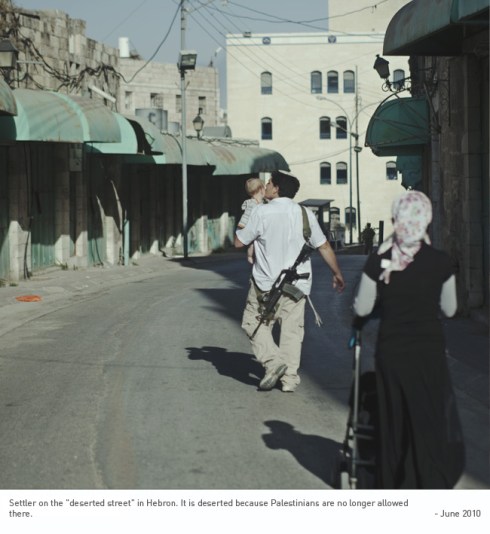
Forsell’s Life’s a Blast is the sweetest, never-escaping-bitter view of Palestine, Gaza & Israel I’ve ever clapped my eyes on. It’s about family more than ideology, but it is never glib. It is work as conscious of history as it is the mores of fashion photography. It’s a slow-ride through the lives of people associated by a larger conflict but not solely defined by it; a stunning presentation of gazes drenched in humanity.
Against all odds, Forsell forces the viewer to think on the stories of her subjects; on the seconds before the shutter snapped and the years yet to come. I have not seen a single project that so swiftly dismantles many of the entrenched tropes of conflict photography. Life’s a Blast shifts perceptions like only the very best of photography can.
© Linda Forsell
The Oracle gathering? An International Mob of Mystery? Well, not exactly but given that Oracle is the main meeting of the world’s most influential people in the museum/fine art photography scene it is amazing the gathering flies under the radar year on year.
I’ve done some internet sleuthing to tell you some of what you need to know about the Bilderberg of the photography world.
Okay, it might not be so cloak and dagger as I have set it up, but The Annual International Conference for Photography Curators dubbed ‘Oracle’ has no web presence and no connection to the circles outside of the attendees. This (presumably intended) detachment is – simply put – a shame. Granted, these are people predominantly involved in museum curating, but still wouldn’t it be great to know what they are talking about when they meet each November?! Museums still feed into the photography ecosystem, and often define it.
Oracle began in 1982 as an informal gathering. In 2003, Deidre Stein Greben wrote, “Attendance at Oracle […] has grown from ten to more than 100 over the last 20 years.”
With such an organically unhurried growth, why should curators care to share their dialogues? Hell, the week might be the closest thing many of them get to a holiday. Add to that the fact that there’s no external promotion or grand narratives to push, it makes sense that no-one would take on the extra workload of interfacing with the public and all that entails.
I also think of photography curators as a similar breed to university professors; the culture of research, writing and custodianship of department agendas does not dovetail with blogging the discoveries and knowledge from their daily work. (David Campbell summarises well how the reluctance of universities to adopt social networking is to their detriment.) It’s a shame. How good would a Sandra Phillips blog be?!
The 2010 Oracle is ongoing right now in Israel (Jerusalem, I think).
This is where my sleuthing gets patchy but other host institutions/cities have included; Museum of Fine Arts, Houston (1992); George Eastman House, Rochester (1993); Washington (1999); Finnish Museum of Photogaphy, Helsinki (2000); Goa, India (2003); Museum of Contemporary Photography, Chicago (2004); Artimino, Florence (2005); Prague, Czech Republic (2006); Center for Creative Photography, Tucson, AZ (2007) and Paris, France (2009).
My guess is attendance is invitation only or some approximation thereof. Just because I gleaned a smattering of names, I’ll share them. Attendees have included Britt Salvesen, Director of photography and prints at LACMA; Doug Nickel, Professor of Photographic History at Brown University; Sunil Gupta, Artist, photographer, curator and educator; Allison Nordstrom, Curator of photography at George Eastman House; David E. Haberstich, Associate Curator of Photographs at the Smithsonian; Celina Lunsford, Director of the Fotografie Forum Frankfurt; Olivia Lahs-Gonzales, Director of the Sheldon Art Galleries in St. Louis; Dr Sara Frances Stevenson, Chief Curator of the Scottish National Photography Collection, National Galleries of Scotland (retired); Mary Panzer, freelance writer & curator of photography & American culture; Ms. Agne Narusyte, Curator, Vilnius Art Museum Photographic Collection, Vilnius, Lithuania; Shelly Rice, Professor of Arts at NYU Tisch School of Arts; Enrica Viganò, curator and fine art photography critic; Duan Yuting, founder of the Lianzhou International Photo Festival; Mark Haworth-Booth, Head of Photographs, Victoria & Albert Museum; Anne Wilkes Tucker, photography curator at the Museum of Fine Arts, Houston; Sandra S. Phillips, Senior Curator of Photography at San Francisco Museum of Modern Art.
Quite the list. And I can think of many other photography curators who presumably would attend (Rod Slemmons, Anthony Bannon, Brian Wallis, Charlotte Cotton, Malcolm Daniel?) Who knows?
It’s not a totally closed shop though. Despite the 2006 shuttering of the Oracle listserv, some plucky “Independents” have set up a NING type forum, Oracle Independents. It is sporadically updated with links to articles and events about historically significant photography. Currently there are 40 members, some names recognisable. But this doesn’t get us to the meat of those dialogues currently ongoing in Jerusalem.
Last thing to say, is that the museum world is separate from the worlds of gallery, photojournalist, fine art, auction house, social documentary, magazine, fashion and art-school photographies. Even if we did have a line in on the world’s leading curators’ discussions, the information may have no bearing on our aims, art or careers. Heck, we might not even be interested. But it’d be nice wouldn’t it?
Not wanting to be pessimistic, but unable to help myself, consider this quote from Marvin Heiferman, freelance author, editor and curator and “champion of the blue-collar nature of the silent majority of photographs.” Bear in mind he’s talking about very early Oracle, but nonetheless, the quote highlights potential disconnects between different orbits of the photography world.
“When I started looking at this new [Postmodern] work, I loved its nonchalance, intelligence and cheekiness, the fact that it was interested in both seeing and seeing through images. The photo world, though, wasn’t as amused, and didn’t have a clue what the small group of us was getting so jazzed up about. Toward the end of my stint at Castelli in the early 1980s—and then when I went off on my own to work with photographers and artists and produce exhibitions—I attended some of the early annual meetings of Oracle. This was a conference of photography curators from around the world who gathered together supposedly to talk about the future of the field, and was funded by Sam Yanes at the Polaroid Corporation. Polaroid supported a lot of progressive photographic projects in the 1970s and ’80s. It was, to say the least, disappointing to me that most of the attendees were more excited to fuss over 19th- and 20th-century work and issues of preservation and storage. But there were a handful of us—including Andy Grundberg, who was writing for the New York Times, and Jeff Hoone from Syracuse—who did our best to raise interest in the new work we were so excited by. No one seemed to care.” (Source)

Huntress with Buck, 2010 from the series ‘Hunters’, © David Chancellor
David Chancellor has won the Taylor Wessing Portrait Prize for his image of a young American huntress astride a horse in South Africa. It’s a worthy winner.
Unfortunately, for web audiences only the five shortlisted portraits are presented on the Taylor Wessing Portrait Prize website. There are 55 more in the accompanying exhibition.
Tom Martin‘s group portrait of children inside Ruyigi prison, Burundi (below, part of flyer) is one of the sixty portraits included in the Wessing show at the National Portrait Gallery, London.

I’ll be following up with Tom shortly for the background on the circumstances of the photograph, which are difficult to say the least; photographer Nathalie Mohadjer has talked at length here at Prison Photography about life in Burundi’s prisons. At 230% capacity, Burundi’s prisons are the most overcrowded in Africa.
THE WINNERS AND THE WINNERS
I don’t want to sound too simplistic here, but any additional exposure to the stories of the dispossessed – even in the context of a £12,000 award – is a good thing. Nathalie Mohadjer commented, “Let’s face it, Burundi just isn’t important to the world”. She has struggled to find interest in her work and I expect Tom Martin has experienced the similar dead-ends.
I am not idealistic and I know that distribution of images only changes little, but in light of the subjects recognised by the Taylor Wessing Prize (TWP) I want to be positive, constructive. The shortlisted entries over the years seem to be those that weigh skilled technique with a careful presentation of unexpected (often disenfranchised) social groups:
Photographic Portrait Prize 2010
Photographic Portrait Prize 2009
Photographic Portrait Prize 2008
Photographic Portrait Prize 2007
Photographic Portrait Prize 2006
Photographic Portrait Prize 2005
The TWP has a social conscience and it plays that to full advantage by picking striking portraits with direct routes to empathy. This is the mark of good photography, no? Everyone’s a winner.
The Taylor Wessing Portrait Prize Exhibition runs at the National Portrait Gallery from November 11th until 20 February and then at the Sunderland Museum and Winter Gardens from 16 April until 26 June.

 Prison Photography