
You are currently browsing petebrook’s articles.
Recently, I published an article on Wired.com about the opulent interiors of private jets. The owners of these jets remain anonymous as photographer Nick Gleis must protect client confidentiality.
For Gleis’ most recent and high profile showing, The Brighton Photography Biennial (BPB) described Gleis’ photographs as aircraft of African dictators. Gleis refutes outright the suggestion. “There are NO African Dictators that own any aircraft I have ever photographed. My clients are hard working people that have been fortunate enough to acquire wealth,” said Gleis via email.
Gleis and BPB need to get on the same page.
THE WEAKNESS OF THE VIEWER, MYSELF
In my mind, the term ‘Dictator’ (applied to any continent) brings up notions of human rights abuse and blood money, and of constructed and contested narratives. There are many contested narratives about African government in the fourth quarter of the 20th century.
My naive understanding of a continent’s countless ruling structures would be ridiculous enough, if I didn’t then try to guess if any of my limited-knowledge-based narratives were to be applied to the lavish interiors of aeroplanes.
I will not apply such narratives to Gleis’ then, but others likely will – especially as long as BPB and other institutions make use of questionable captioning.
MANIPULATING THE IMAGE, MESSAGE
The unavoidable information-gap in Gleis’ imagery is its Achilles heel. My basic point is that that if we as Westerners are suspicious of wealth, we are really suspicious of wealth originating in a developing country.
My argument here is not about Gleis’ imagery, nor about the specifics of any imagery. My argument is about the innate bias of viewers and about how “the Other” is consumed and constructed based upon such biases in the context of image.

EL HADJ MAMADOU KABIR USMAN, Emir of Katsina, Nigeria © Daniel Laine
Think back to Daniel Laine’s African Kings series. It is old work now (completed between 1988/91) but I am still impressed by the access Laine secured – based, I presume, on respect between photographer and subject ruler. But, due to exotic costumes Laine’s work is open to misinterpretation and misappropriation. In the light of BPB’s description, Gleis’ work too is being peddled as something it is not.
Often when I look at photography, I feel as though I am loading an image with my own baggage, criticism, emotion desires to see what I want to see in and about the world.
I am increasingly certain that images are boons to our own narratives and as more and more images fall into our laps and onto our laptops, I worry we are able to create the world we want and avoid the one we don’t.
Ambiguity in images is sustenance for the egos of men and women (but mostly men). Can we escape ourselves enough to view images unbiased?
We might never see Africa, unless, of course, we get on a plane and go there.

HALIDOU SALI, Lamido of Bibemi, Cameroun © Daniel Laine

AGBOLI-AGBO DEDJLANI, King of Abomey, Benin © Daniel Laine

ABUBAKAR SIDIQ, Sultan of Sokoto, Nigeria © Daniel Laine
DANIEL LAINE
Daniel Laine is a former storekeeper, professor, and hotel concierge turned photographer. Between 1988 and 1991 he made twelve trips to the African continent tracking down and photographing figures of royalty, and leaders of kingdoms. During this time he managed to photograph 70 monarchs and descendants of the great African dynasties. The book, African Kings: Portraits of a Disappearing Era was published in 2000 by Ten Speed Press. Laine lives in France.

Michael S. WIlliamson for the Washington Post was inside Deerfield Correctional Center earlier this month and photographed the aging and sick prison population.
From The Washington Post:
“We’re left trying to be both a nursing home and a prison,” said warden Keith Davis

SOURCE: Virginia Department of Corrections, The Washington Post – Sept. 8, 2010
Since the General Assembly abolished parole in 1995, Virginia has been forced to care for more and more elderly prisoners. In 2008, 12 percent of Virginia’s prison population was age 50 or older, up from less than 5 percent in 1990.
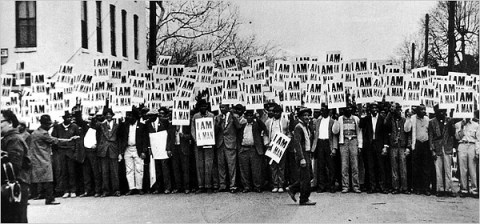
Two stories that broke this week demonstrate the levels to which everything is never as it seems.
The New York Observer describes links between Leslie Deak and funders of the controversial mosque, the CIA and U.S. military establishment have gone unacknowledged.
Meanwhile, The Commercial Appeal in Tennessee reports famed and revered Civil Rights Photographer Ernest Withers doubled as FBI informant to spy on civil rights movement.
Democracy now states, “Withers’s alleged involvement was revealed because the FBI forgot to redact his name in declassified records discussing his collaboration.”
Withers died in 2007.

Thanks to Stan for the tip off.

© Evan Bissell
Artist Evan Bissell brought together a group of teens who had not known each other previously, but shared a common circumstance; they were children of men incarcerated at San Francisco County Jail.
The project, What Cannot Be Taken Away: Families and Prisons Project, spanned 9 months.
Bissell and the teens shared writings and audio to establish themes for their work. Later they would visit family in SF County Jail and take photographic portraits to work from. Eventual they mounted a show at SOMArts in San Francisco.
I am a little unsure as to the ultimate claim the students have on the final product. Evidently, they decided the elements and the design, but every piece is finished with the polished painting skills of Bissell’s brush. But of course, it wasn’t only these large portraits on view; exploratory/experiential paintings of the students were displayed and the centre-piece of the show was an installation piece.
Despite the apparent dominance by Bissell over the final product, the intangibles of the collaborative project – including but not limited to discussion, new ideas, “healing & justice”, friendship, self esteem – far outweigh a critic’s (my) reserve.
I highly recommend you download the PDF time-line; it offers an impression of the shared politics of the project. Also the process describes the engagement between teacher and student.
PHOTOGRAPHY?
The tie in comes from a quote by Bissell, “I was unfortunately not allowed to photograph our workshops in the jail, so all of the pictures come from our meetings with the youth.”
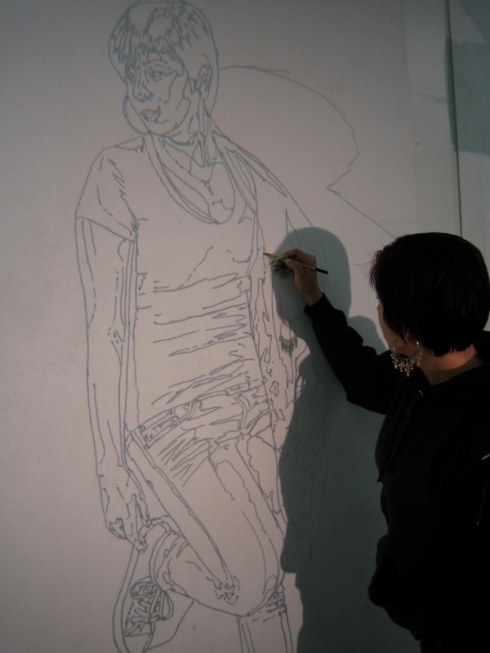
© Evan Bissell
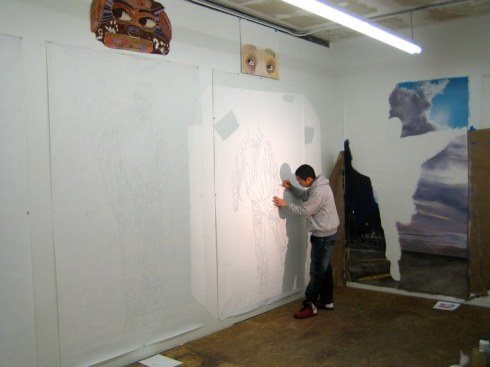
© Evan Bissell

© SOMArts
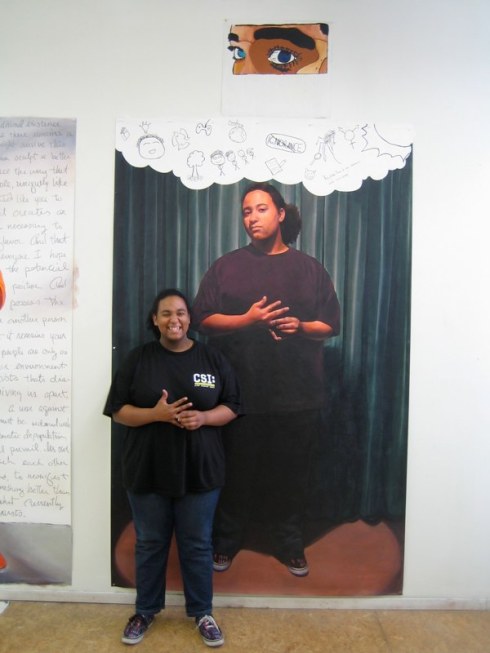
© Evan Bissell

© Evan Bissell
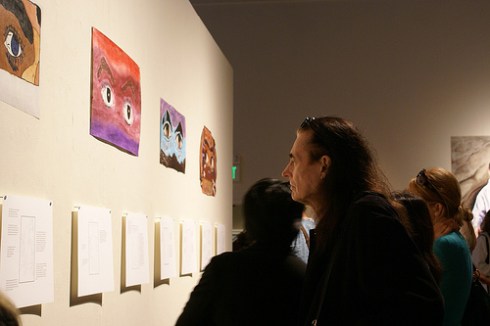
© SOMArts

© SOMArts
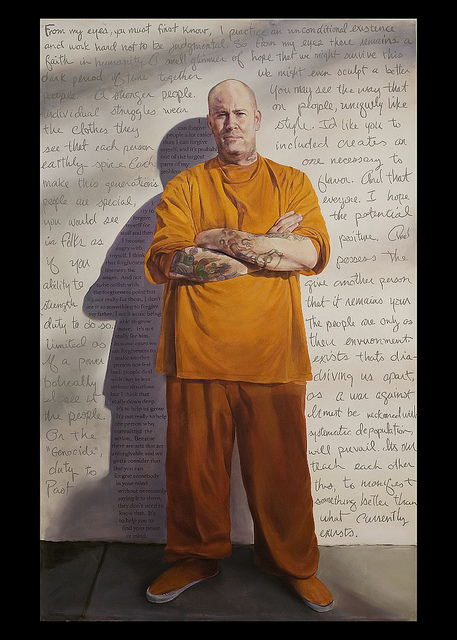
Image credit: Joe, by Evan Bissell, acrylic paint on board. © SOMArts
What Cannot Be Taken Away: Families and Prisons Project. Closing September 19th 12:00-2:00 at SOMArts – 934 Brannan St. in San Francisco (at 8th Street).
All images from Bissell’s WCBTA website and SOMArts Flickr.

Frozen Lake & Cliffs, Kaweah Gap, Sierra Nevada, California, 1932 © Ansel Adams
A couple of months ago I went to Sequoia National Park. Our itinerary was grueling and didn’t help when we took the wrong mountain pass on the penultimate adding 30 miles to our trip. Twice (in and out) we went over Kaweah Gap.
I saw the Ansel Adams image above somewhere else recently but it was without a caption. It looked a lot lie Kaweah Gap but then again a lot of Sierra Nevada lakes look rather spectacular. Anyway, I was glad Doug Stockdale offered a caption and its location.
Whichever way the Ansel Adams/Uncle Earl saga plays out (they’re having a joint show now!) I just wanted to say it is not easy to lug any weight, including heavy camera equipment up to 12,000 feet. They are both as fit as pack horses.
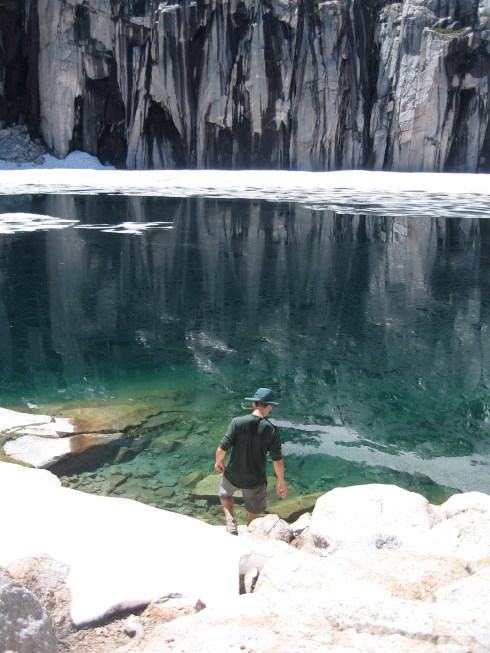
Joel at Frozen Lake & Cliffs, Kaweah Gap, Sierra Nevada, California, 2010 © Pete Brook
UPDATE: For more visuals go to:
http://www.flickr.com/photos/8883932@N02/4027649839/in/photostream/
http://www.speakingloudandsayingnothing.blogspot.com/
– – – –
If JR went to Navajo land, he’d hang out with James “Chip” Thomas.
Just love this guy.
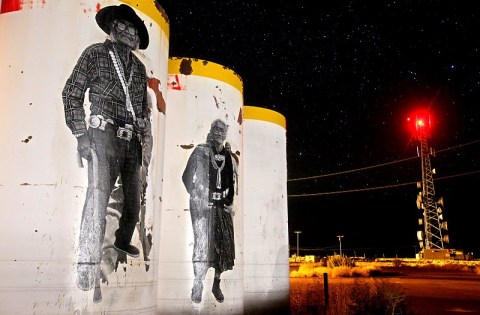
Grey Mountain, artwork by Chip Thomas © Erika Schultz
Just got in from the NW Photojournalism meet. Room chock full of talent including Matt Lutton (of Dvafoto fame) Theo Stroomer, Tim Matsui, Ken Lambert, David Ryder and John Malsbary.
Let me track back a week though.
SOME THOUGHTS AND CONTEXT ON NAVAJO GRAFFITI
A friend of mine who I’ve seen only twice in two years visited Seattle last weekend. He’s Native American … what white folks would call Navajo, but what he refers to as Dineh or Dine (pronounced d-Nay). We were talking about youth culture on the reservation and I mentioned passing through Window Rock (a junction with two gas stations, some vernacular murals and loose packs of dogs). He tells me I was in the wrong part of Navajo Reservation …
Anyway, the murals had me thinking. I saw graffiti on Navajo land – some of it good, some of it terrible; some of it lazy tags, some of it a bit more invested – and I wondered about the social context of these scrawls, paintings and artwork. I proposed to him that a long term photography project NAVAJO GRAFFITI could capture these temporary art interventions. The project would include interviews about the grafs and the social strata from which they emerge. It seemed like it could be a meaningful, novel photography project, a stellar book. Maybe?
In my mind (a place I often invent projects I’d like to see and promote) I envisioned image-making that could incorporate the narratives of a marginalised people without relying on cliches of documentary photography. The grafs could be photographed in the medium format stillness that is all too often wasted on garages, topiary and mall parking lots.
Just a thought.
Thinking on, my friend was as stumped as I to think of any photography work that the Navajo had been able to present, let alone self-represent.
BACK TO NW PHOTOJOURNALISM
The co-organiser of NW Photojournalism is Erika Schultz a PJ at the Seattle Times. When I got home, I checked out her blog. On which, I was blown away to find graffiti on Navajo land. I’d call it street art, except there’s only the open Black Mesa surrounding.

Grey Mountain, artwork by Chip Thomas © Erika Schultz
The work is by Chip Thomas an artist, self taught photographer and Health Services Physician who has lived on Navajo land for 16 years or more. He may not be Navajo by blood but I can be quite certain he has the rights of the Navajo/Dineh people close to his pounding heart.
I want to see more of this. I am not a photographer. Why aren’t photogs out on Native American lands finding more nuanced ways of telling the stories of the people?
The only Native American photographer I’ve identified is Tom Jones of the Ho Chunk Nation, and he is a long, long ways from the Western Deserts; of a different people.
So, two things: 1) Tell me about more Native American photographers (I want to stand corrected) and 2.) Somebody consider a project along the lines of NAVAJO GRAFFITI (I would if I could, but I don’t know cameras).
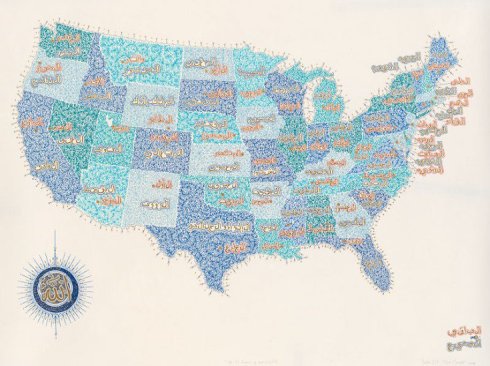
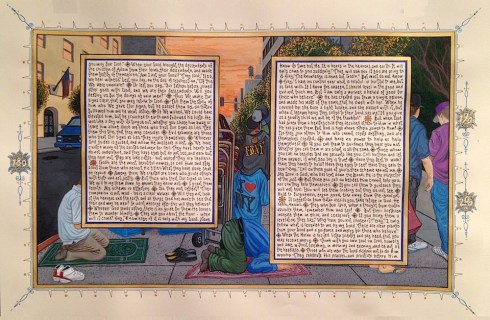
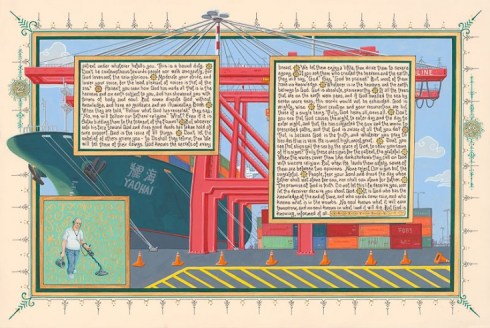
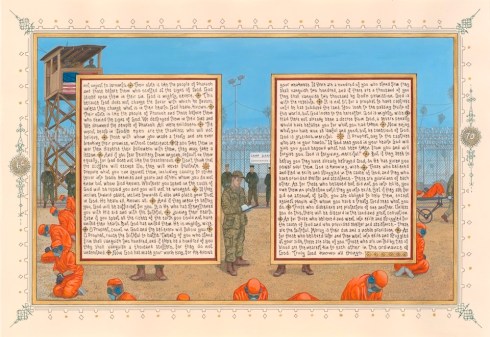
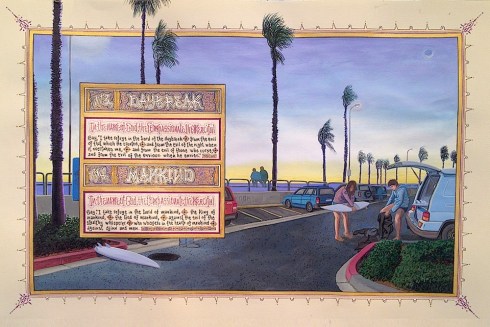
“Through the American Qur’an series, Birk presents a new version of this holy book that is more accessible and also shows how the teachings can be applied to the daily experiences of American life.” (Source)
Not photography, not prisons, but very timely; Sandow Birk’s American Qur’an.
Since 2004 Birk has been transcribing the entire Qur’an into English, illustrating each sura (or chapter) with paintings evoking Persian miniatures, but depicting everyday scenes in America. According to the press release, the Detroit-born, California-based artist “hopes to reflect how consistent the similarities are in the teachings of Islam, Judaism and Christianity. To bring this to light enables more understanding and compassion, versus fear of the unknown … ” (Source)
This is the type of reflection that should be made in our current times, instead of this nutter and his offensive fetish for fire. Thankfully, the AP will not distribute images of idiots burning Qu’rans, during the so-called International Qu’ran Burning Day. Ugh.
– – – – –
To my mind, Sandow Birk is the greatest working political illustrator. His clever manipulation of the landscape genre for his Prisonation series was an intelligent, elegiac take on California’s 33 facility prison industrial complex. (I referenced his work reviewing the recent and excellent City Lights publication PRISON/CULTURE.)
– – – – –






 Prison Photography