
You are currently browsing petebrook’s articles.

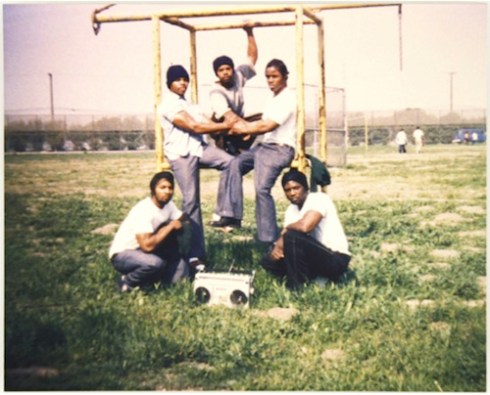
The website Dangerous Minds picked up my story Prison Yard to Paris Photo LA: How an Art Market Hustle Put a $45K Price-Tag on Prison Polaroids about the rapid inflation of price of a few hundred lost Polaroids.
I am not surprised by the art market capitalising on this subculture within its general thirst for vernacular photographs. I do urge caution though; the people who made and are in these photos are not the ones profiting from their cultural appropriation.
There are two general and conflicting positions on this matter.
The first position, expressed by Dangerous Minds says it’s a good thing for folks who were inside because they can potentially make money.
“Whether the art market is fetishizing African-American gang members or not, the likely result of the exorbitant price for these photos will be to incentivize owners of similar collections to make them public, which is good news …”
Potentially. Maybe.
Even if someone in the photos is impartial and happy to let their image loose on the market, are they likely to have the connections to buyers and the desire to negotiate a deal? My thinking is that the art market benefits those in it and the dealers will be the ones with the luxury of time, network and collateral to leverage most profit from exchanges of collections such as the Los Angeles Gang and Prison Photo Archive.

The second position on all of this, by contrast, at the World’s Best Ever blog post from which Dangerous Minds sourced the story has an alternative view. One comment reads:
“also we paid for them pic someone stole them from poppy or pj and east coast has nothing to do with new york its in la and who gives you guys the right to post or flicks some of us or out and would like to forget about that time in the 80s.”
Who gives you the right? Who gives us the right?
Who polices this stuff? Nobody. Who is responsible for these images being on the market? A uncoordinated group of individuals. Who is responsible for these images being on the Internet? I am. The original Harpers Books listing from which I sourced the images was deleted after sale. I had to use Google cache and Wayback Machine to source the jpegs, after which I gave them a permanent home under an article with good SEO returns. Otherwise, these images would’ve been and gone. But my intervention allowed them to be copied, shared and has made them quite permanent on the web.
What gave me the right to condemn these images to permanence and deny the subjects their right to forget?
Gary Younge nails it again. This time on Donald Trump’s appeal among a scarily significant portion of Americans:
Trump articulates the frustration and bewilderment of that section of uneducated, unskilled, low-paid white America, whose wages have stagnated and social mobility has stalled that is nostalgic for its local privileges and global status. In recent times, they have lost wars, jobs, houses and confidence.
So when he brands Mexicans “rapists”, Chinese “cheats” and all Muslims potential threats he gives free rein to their insecurities about an increasingly cosmopolitan and less predictable world they feel they have been excluded from.
To that extent, his base is not too different from that of the Front National, which just triumphed in the French regional elections, Ukip or any of the range of far-right parties currently making headway in Europe.
Full article: Donald Trump shows hate speech is now out and proud in the mainstream

In Newcastle, England? Or near? This Wednesday, 9th December 2015 at 5.30pm, Dr. Dominique Moran, Reader in Carceral Geography at the University of Birmingham (who you should follow on Twitter at @carceralgeog) is giving a lecture given the tantalising title What Is Prison (Not) For, and What Can(‘t) It Do?
It’s the inaugural Annual Lecture of the Social & Cultural Geographies Research Group at Northumbria University. And you should go.
BLURB
Although prisons and criminal justice systems are integral parts of governance and techniques of governmentality, the geographical study of the prison and other confined or closed spaces is still relatively novel. The sub-discipline of carceral geography has established useful and fruitful dialogues with cognate disciplines of criminology and prison sociology, and is attuned to issues of contemporary import such as hyper-incarceration and the advance of the punitive state. It has also used the carceral context as a lens through which to view concepts with wider currency within contemporary and critical human geography. Thus far, it has made key contributions to debates within human geography over mobility, liminality, and embodiment.
Carceral geography brings to the study of prisons and imprisonment an understanding of relational space, as encountered, performed and fluid. Rather than seeing prisons as spatially fixed and bounded containers for people and imprisonment practices, through prison systems straightforwardly mappable in scale and distance, carceral geography has tended towards an interpretation of prisons as fluid, geographically-anchored sites of connections and relations, both connected to each other and articulated with wider social processes through and via mobile and embodied practices. Hence its focus on the experience, performance and mutability of prison space, the porous prison boundary, mobility within and between institutions, and the ways in which meanings and significations are manifest within fluid and ever-becoming carceral landscapes.
This lecture draws upon ongoing ESRC-funded research within the UK prison estate, to consider how the philosophical purposes of imprisonment are manifest in the built environment, and the ways in which the nature of carceral spaces affects the experience of incarceration.
DETAILS
¡Refreshments from 5pm!
Room B0001, Ellison Building, Northumbria University, NE1 8ST
Here’s a map (PDF).
Free, but register here.

From Thomas Mailaender’s book ‘Illustrated People’ which won the Paris Photo+ Aperture Foundation Award for “Photobook of the Year 2015”
–
THREE WEEKS AFTER THE PARIS ATTACKS, I’D LIKE TO SAY THESE THINGS
Paris Photo 2015 will be remembered for reasons we never wanted.
Photographers went to Paris to see old-friends, hob-nob with moneyed institutions and to blur the lines between work and vacation. Some of them ended up documenting one of recent memory’s worst terror attacks.
Paris Photo opened the doors to the Grand Palais the day before the bombs shook Paris and 130 lives were taken. One of the biggest international photo events on the calendar, artists, publishers, gallerists, collectors and enthusiasts descended on the French capital for four days of viewing, networking, buying and selling.
After the tragic events of November 13th, Paris Photo was cancelled. No one was thinking about art sales. No one was talking about awards. Shuttering the event was the only sensible and respectful decision to make.
As with any massive event, though, the activity and conversation surrounding Paris Photo had long led up to the long-weekend. Check the social media timelines of any of the 147 galleries or the 60,000 visitors to understand anticipation and the pre-sales hype. Paris Photo can be career-defining, it can provide a crucial contact, it might be a platform to test or showcase ideas. And then there’s awards too.
On Thursday November 12th, Aperture announced the winners of the 2015 edition of the Paris Photo–Aperture Foundation Photobook Awards.
Some people say the best way to move forward is, after the memorials, to live life as you would. To continue with a full life. I would have written about these awards before the attacks and so now, three weeks on, I feel I should write about them still. I cannot make sense of murderous ideology, but I can make sense of books, photos and how they exist in the world.
Below, in each of the four categories, I offer some analysis followed by Aperture’s official blurb and videos. I end with some concluding thoughts about the four entrants considered in unison.
What To Make of the Winners?
Let’s do things the backward way round and start with the Special Jurors’ Mention category as opposed to the three main categories.
Special Jurors’ Mention
Will Steacy
Deadline. b.frank books (Philadelphia, 2015)
Designed by Will Steacy
MY THOUGHTS
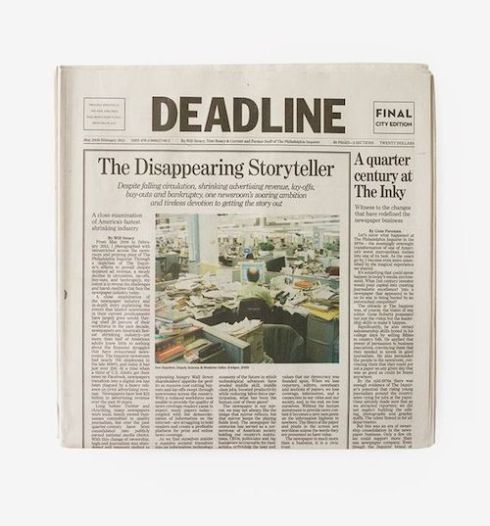
Will Steacy’s Deadline is my book of the year (slide 42), so a tip-of-the-hat here is no surprise. Deadline is about the heritage of storied newspaper Philadelphia Inquirer and about the forecasted chaos of downsizing. It was printed on the same presses that churned out the Inquirer over decades.
Deadline is a look to the past with an eye on the future. Most of all, it’s a tribute to the working man. When labor movements are usually talked of in the past tense, Steacy is putting workers’ issues into art world discourse, reconnecting art with politics.

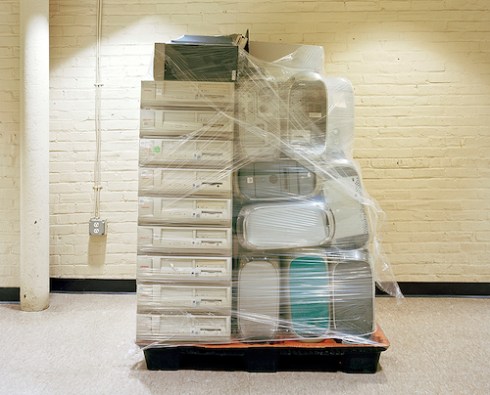

Union membership has fallen from 1 in 3 workers to 1 in 10, over the past 50 years. I’m no blind preservationist, but I do want to know that progress is made for the benefit of all and not at the expense of any. As I wrote for time:
“Fanatical in its view of both the newsroom and the printing presses, Deadline honors the labor of the copyboys, the reporters, the inkers and the editors equally. Decorated journalists reflect back on the Inquirer’s “Golden Age” and Steacy’s dad reflects on generations of their family working in newspapers. In five sections, the amount of research, fact-checking, phone-calls, line-editing and captioning in Deadline is astounding.

Deadline is dense, daring and difficult to pigeonhole; I think that’s why it got the special mention but not one of the category gongs. It didn’t fit neatly, but it was impossible to ignore.
OFFICIAL APERTURE BLURB
Will Steacy’s Deadline is a newspaper about a newspaper: the Philadelphia Inquirer, where he spent five years photographing the newsroom, employees, and printing plant. Thanks to the Internet, most newspaper staffs are a fraction of what they once were. The Inquirer is no exception, and Deadline chronicles its history — with texts by current and former staff, and archival photographs alongside Steacy’s own — through to its very uncertain future; the final pages see the formerly prominent newspaper moved into a much smaller office.
For Steacy, who comes from a family of newspapermen, this story is personal — his father was an editor at the Inquirer for nearly thirty years, till he was laid off while Steacy was working on this project. The materials, design, and printing quality of his son’s contribution are all in line with family tradition (it was even printed at the Inquirer’s own press), but the focus has been turned inward. As Christoph Wiesner comments, “it serves both as a history of the journalism sector and a work of subtexts, revealing a process of deconstruction or mise en abyme.” Deadline is less a case study than it is a eulogy.
Winner of Photobook of the Year
Thomas Mailaender
Illustrated People
Archive of Modern Conflict and RVB Books (Paris, 2014)
Designed by Thomas Mailaender and Rémi Faucheux.
MY THOUGHTS
One thing’s for sure: there’s no other photobook like it. Whatever gaveThomas Mailaender the idea to burn images onto people’s skin with UV light? I can’t work out if Illustrated People is fringe genius or just a gimmick, but the answer to the question is less important than the inquiry. For the deeper you go on these photos the more disturbing shit gets.
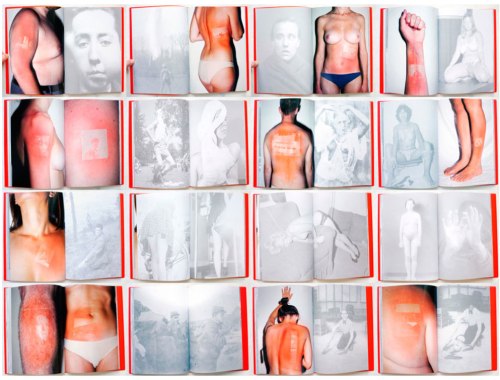
Let’s start with the easy obvious stuff, though. The coupling of images from the Archive of Modern Conflict on dull paper in washed out B&Ws with glossy glaring blood reds is very striking. It’s a catchy reference to red-top newspapers, so activist posters, to Soviet graphics to political and military propaganda.
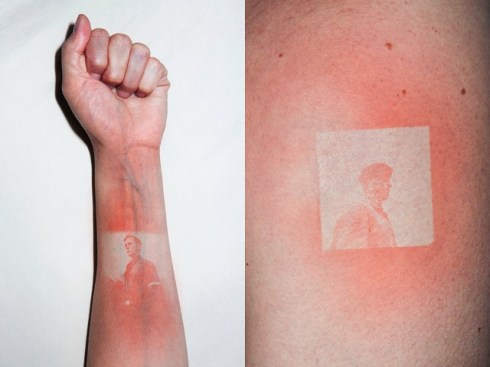

It’s strange that we might be put off by Mailaender’s violence toward his volunteers’ bodies. After all, these are images are taken from an archive devoted to war and technological chaos fo the 20th century. By comparison to any bullet or nuke, Mailaender’s work is playful. Maybe that’s the point? Is Illustrated People a manic embrace of disorder and a Dr. Strangelove-esque riding of the bomb?
Yet, even in acknowledgement — and some celebration of — Mailaender’s flippant wit, I can’t stop thinking that these are like some scorched-earth futuristic nightmare. Like this is sci-fi gone awry; a vision of a time in which humans are branded with culture, not creators of it, and a dystopia in which bodies are a drain on resources on an overheated, water-scarce planet. Or given the side-boobs and pin-up girls, is Illustrated People just a photo-sadist’s wet dream? That I’m still guessing is (and talking) is a good sign. Can. Not. Unsee.
OFFICIAL APERTURE BLURB
When artist Thomas Mailaender was given access to the Archive of Modern Conflict’s photo archives, he decided to “print” some of the negatives he found onto a whole new medium: the human body. Using a UV lamp, Mailaender projected these negatives onto models’ pale skin, leaving sunburnt imprints of the images.
Full-color documentation of this performance alternates with archival images inIllustrated People, a playful softcover book encased in a translucent red plastic jacket. While the archival images have a faded appearance, printed in black-and-white on plain matte paper, the “sunburn” pages are bright and glossy. “What’s interesting to me is the relationship between the immaterial archive and the living bodies,” says Yannick Bouillis. “He made something that goes beyond just the selection of images — he’s putting pure culture onto something natural, the body.”
Winner of Photography Catalogue of the Year
Diane Dufour and Xavier Barral
Images of Conviction: The Construction of Visual Evidence
LE BAL and Éditions Xavier Barral (Paris, 2015)
Designed by Coline Aguettaz and Xavier Barral.

The Images a Charge/Images of Conviction book cover features a photo by Rodolphe A. Reiss, rendered in the negative, showing a demonstration of the Bertillon metric photography system.
MY THOUGHTS
Images of Conviction was one of the curatorial highlights of 2015, but a great exhibition doesn’t always guarantee a great catalogue, so it’s wonderful that the excellence of Dufour and Barral’s presentation of material on walls is matched by their presentation of content on paper.
Coincidentally, like Mailaender’s book, the only time grayscale is punctuated in this catalogue is by the red tones and exacting dots. Many of the images here are drawn from government archives, official reports, military imaging or sites of forensic investigation (even if the photographers, Meiselas below for example, are not forensic photographers).

Grace A-South, Koreme, North of Iraq, June 1992 © Susan Meiselas, Magnum Photos.
Images Of Conviction brings together ten case studies in which images were used to establish truth and narrative in the wake of death — be that of a single person, of a religious tale or of an entire people.
I think of Images Of Conviction as the sister exhibition to the Tate’s epicConflict Time Photography in 2014. But whereas the Tate focused on the changing types of photographs made in response to conflict over time, Dufour and Barral focus on the changing technologies use to make photographs. Whereas the Tate considered subjective response (prints, photobooks, memorial), Dufour and Barral are concerned with the application of objective fact. Whereas Tate was sympathetic to artistic response, Dufour and Barral’s framework has little room for it.
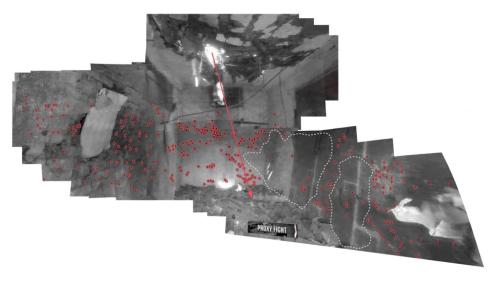
Photography extract from Decoding video testimony, Miranshah, Pakistan, March 30, 2012 © Forensic Architecture in collaboration with SITU Research.
In an uncomfortable echo of Mailaender’s work we see the body as a battle ground. Mailaender subjects are willing participants but, by contrast, Dufour and Barral show us images in which the dead are drawn into space of the contested narrative. Here, dead bodies are used to to deliver or deny accusations of a fatal crime against them.
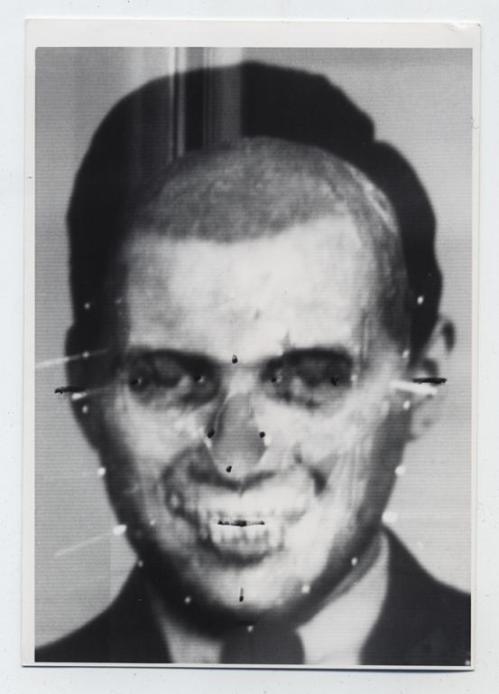
Richard Helmer’s face/skull Mengele superimposition 1985 © Photo Richard Helmer Courtesy Maja Helmer, 1985.
Folks in the art-world often forget that photography underpins judicial, political, labour and territorial infrastructures. Images Of Conviction reminds us that pretty pictures are just papering the cracks over fizzing, and sometimes terrifying, realities.
OFFICIAL APERTURE BLURB
In this meticulously designed catalogue, photography itself is put on the witness stand. Published to accompany an exhibition of the same name that originated at LE BAL, Paris, Images of Conviction is a fascinating historical survey of the ways photography has shaped official versions of truth — from the Shroud of Turin to crime-scene photography of the freshly dead, to video evidence of drone strikes.
The design is sedate but never boring, alternating between pale gray and clean white paper. The images are all reproduced in black and white, with a chilling negative image printed on the cover. “Everything is made so that the catalogue stays neutral, but not cold,” says Julien Frydman, who also praises the diverse, well-edited texts. The volume offers a variety of answers to the question posed by editor Diane Dufour in her introduction — “How does the image take shape in truth-seeking scientific and historical discourse?” — without losing its sense of mystery.
Winner of First Photobook
Daniel Mayrit
You Haven’t Seen Their Faces
RIOT BOOKS (Madrid, 2015)
Designed by Verónica Fieiras and Daniel Mayrit

MY THOUGHTS
The former Arsenal and Brazil midfielder Gilberto Silva expressed his dismay this week that next to no professional footballers were speaking outabout the FIFA corruption scandal that is tearing the heart out of the beautiful game. Maybe it’s that the story is old or maybe it’s that we don’t know how or where to pinpoint our anger at white collar crimes?
Despite millions of people losings their homes, pensions and security, still no-one has been prosecuted for their role in the housing crisis and consequent global meltdown. Daniel Mayrit’sYou Haven’t Seen Their Faces uses news and public domain images to mimic CCTV captures. The 100 people featured in this stack of butcher-paper fly-posters are those deemed most powerful in the City of London in terms of policy, politics, and those in control of banks, corporations and regulatory bodies.

The title is a cheeky inversion of Margaret Bourke-White’s landmark You Have Seen Their Faces (1937) a book about poverty in the Southern states. In the 20th-century we thought we could, as a society, come together and solve social ills. Now, however, we struggle to know from where the confusion festers and we rely pathetically on mischievous artists to out the beneficiaries of 21st-century capitalism.
Images were once tools of humanitarian witness, now they’re cheapened, desperate and frustrated gestures toward the insulated power-classes.
OFFICIAL APERTURE BLURB
Daniel Mayrit plays with the semiotics of law enforcement in You Haven’t Seen Their Faces. Full-bleed close-ups of the declared “100 most powerful people in the city of London” are printed in the style of grainy CCTV footage, with condemning information against them scrawled on every image. The book is a response to police fliers handed out after the 2011 riots in London, when surveillance images of alleged rioters’ faces were publicly distributed in a presumption of guilt. Mayrit flips this visual language on those believed responsible for events that are arguably far more damaging: the recent economic crises that have wracked Europe.
Yannick Bouillis calls the design “streetwise”; held together by screws at the top, the images are printed on lightweight brown pages akin to butcher paper, and fastened to stiff cardboard. A map of the suspects’ headquarters is tucked into the back.
Conclusions
It was not obvious to me until I really approached the final drafts of this review how depressing the four photobooks are in conglomeration. In them we have the slow death of free press, corporate criminals at large, homicide, dispute, intimate violence, microcosms of global warming, total surveillance, harrowing medical procedures, genocide, labor camps and the havoc of the markets.
The Paris attacks exploded out of fear, hatred, deep-level antipathy and dehumanisation. ISIS’ acts of terror are a symptom of profound division: Western military meddling and foreign bombs in the Middle East + Whackball religious ideology = Crumbling social fabric. Unfortunately, I think that the attacks will also serve as cause; the cause of more military meddling and fundamentalism.
The international community, and the French people in particular, have already shown that they will not be divided by murderous acts. Nor should France sacrifice its ideals of liberty, equality and brotherhood in response to the extremist nutters. However, increased military incursions into Syria and strikes on ISIS will, I fear, only poor flames on the fire.
France launched attacks on ISIS positions the Monday after the attacks. President Obama has sent U.S. troops to carry out raids throughout ISIS-held territory. This week, the British and German governments voted to launch airstrikes in Syria.
Seeing Is Power
And so we have two types of “sight” in the Global War on Terror (GWOT). Abroad, is drone recognizance, military mapping and satellite imagery providing data upon which awesome bombardments are planned. At home, throughout European cities and transit hubs, citizens are subject to pernicious and exacting CCTV. In both cases, the application of these technologies is meant to prevent further killing (perversely, in the case of guided-bombs, by killing targets not civilians) but also to establish moral cause and “truth” in the aftermath of death. CCTV will be used as evidence. News channels will be fed footage of bombs striking combatants through air vents. Facial recognition software will identify people IRL and in the digital realm at exponentially faster rates.
This writer cannot see how more bombs in a region already pummeled into unknown levels of chaos is likely to help, but geopolitical strategy is above my pay grade. Righteous anger is an understandable response, but should it make for armed retaliation? Let’s just say this writer is comfortable deferring to Nicolas Hénin, a man who was held hostage by ISIS, who cautions against massive military airstrikes:
While we are trying to destroy Isis, what of the 500,000 civilians still living and trapped in Raqqa? What of their safety? What of the very real prospect that by failing to think this through, we turn many of them into extremists? The priority must be to protect these people, not to take more bombs to Syria. We need no-fly zones — zones closed to Russians, the regime, the coalition. The Syrian people need security or they themselves will turn to groups such as Isis.
The fallout from the tragic events of November 13th will inevitably involve more bloodshed.
Anxiety reigns currently. That is understandable. Some reaction to the anxiety is less understandable. Sometimes, it is easy to overlook or downplay the constant state of vigilance in which people, and especially government agencies, operate. The Paris attacks revealed the threat is real.
As much as the Paris Photo-Aperture Photobook Awards reflect cultural production, and as much as cultural production reflects common concerns and public psyche, we can identify in these four winners the trauma and violence that bubbles constantly under the surface in our global community
These four books are not entirely unrelated to the violence that broke the peace in Paris three weeks ago. They are documents of our time and, sadly, they deal with miseries that harken back long before these tense times.
The Paris Photo-Aperture Foundation award winning photobooks on view
Aperture Gallery, New York (December 12, 2015–February 8, 2016); Huis Marseille, Amsterdam (December 2015–January 2016); Scotiabank CONTACT Photography Festival, Toronto (May 1–31, 2016); Self Publish Riga, Riga Photomonth, Latvia (May 12–June 3, 2016); 15th International Festival of Photography in Łódź, Fotofestiwal 2016, Poland (June 9–19, 2016); Landskrona Foto Festival, Landskrona, Sweden (August 19–27, 2016).
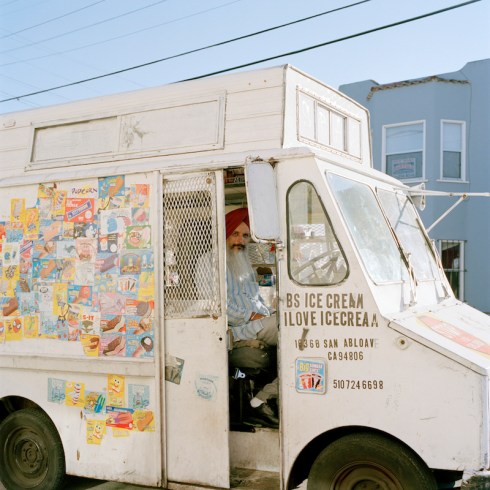
Paccarik Orue. BS Ice Cream, I Love Ice Cream, 2010. From the series ‘There is Nothing Beautiful Around Here.’
When mentioning, yesterday, that the Status Update book is now on sale, I listed the press thus far. Hours after I published that post, Michael Shaw published his own — a review of the show at Reading The Pictures. More accurately a review of the edit of images within the projects.
Shaw’s review, titled Silicon Valley in the Mirror pairs some images and makes juxtaposition between others. It’s full of the pep and the frenetic keen-eyed we’ve come to expect of RTP articles.
I think Shaw is being deliberately provocative putting Silicon Valley front and center of the title and piece; he knows Rian Dundon, Catchlight and I wanted to create a show that went beyond the “tech narratives” but Shaw, to be fair, makes good points to say that all aspects of this Bay Area region are (knowlingly or unknowingly) in response or conversation with tech monies, people, culture and economies.
On Talia Herman‘s photographs of her family and his comment that “the symptom on the flip side of the [tech] boom is narcolepsy” I reckon Shaw misinterpreted the images and our curation. If there’s a slowness in the countryside and in the last embers of counter culture, it’s still a chosen sleepier pace; a calm, not a fatigue.
I love, though, what Shaw had to say about Paccarik Orue‘s portrait of a Sikh ice-cream vendor in Richmond:
“So much for virtual reality and commodification. In Orue’s photo, a sense of place (and respectful commerce, too) comes from identity and ritual, faith and ethnicity, as well as all the old flavors of the neighborhood.”
Good stuff.

WARM OFF THE PRESS
The Status Update publication which accompanies the exhibition of the same name is now available.
If you’d like a copy email me at prisonphotography(at)gmail[dot]com. Retailing at $25.
A perfect-bound, 128-page, softcover book featuring the work by Lily Chen, Janet Delaney, Sergio De La Torre, Rian Dundon, Robert Gumpert, Pendarvis Harshaw, Talia Herman, Elizabeth Lo, Laura Morton, Paccarik Orue, Brandon Tauszik, Joseph Rodriguez, Dai Sugano and Sam Wolson.
Introduction by Raj Jayadev, coordinator for Silicon Valley De-Bug and an interview with San Francisco Public Defender Jeff Adachi.
5.5 x 8.5 inches
ISBN 978-0-692-55576-7
Edition of 1,000 (November 2015)
Designed by the genius Bonnie Briant.
Produced by Catchlight, Status Update curated by Rian Dundon and myself is an exhibition of photography and video about change, chance and inequality in the San Francisco Bay Area. It premiered at SOMArts in San Francisco in November 2015.
PRESS
Laurence Butet-Roch reflected for Time: Witness the Complex Evolution of the San Francisco Bay Area
California Sunday Magazine gave us a showing: Long Exposure: New Exhibit Captures Residents Experiencing the Boom and Bust of the Bay Area
Mark Murrmann wrote a glowing preview for Mother Jones: These Photos Show the Bay Area You’ll Never See From a Google Bus
Stanford Ethics students got to grips with the show: Adjusting our Focus: the Tech Boom through a Different Lens
Mashable threw down a gallery: Photos Capture Inequality and Change in San Francisco Bay Area
Wired offered great support with Laura Mallonee‘s feature: Capturing the Bay Area’s Diversity — and Rapid Change
Erin Baldassari for the East Bay Express reviewed the show with focus on Oakland-based artists: Beyond Black and White: Nuanced Ways of Documenting the Housing Crisis
Silicon Valley DeBug, with whom we partnered in the show posted for their committed South Bay community and following.
And finally, I was interviewed by Doug Bierend for Vice: ‘Status Update’ Captures the Evolution of the Bay Area
GET IT NOW
The book’s going to last longer than any of the prints and beyond next years traveling exhibit. Whether it will last as long as the issues that are percolating here in the Bay Area and Silicon Valley, we’ll see.
If you’d like a copy email me at prisonphotography(at)gmail[dot]com. Retailing at $25.

This morning, I took my eye off the prize. I succumbed to surface and to common narrative.
“60-years ago today Rosa Parks sat on a bus, held a mirror up to a racist United States, changed history,” I tweeted.
What I said was true … but it was reductive. And it was in fewer than 140 characters. For a moment, I settled.
We need courageous historical moments as way-markers and inspiration in the ongoing fight for equality, and we mustn’t mistake them for job done or mission accomplished. What she started, we must still continue.
“Social justice requires social action,” says Mike Lee, Executive Director of Philadelphia Lawyers for Social Equity (PLSE) an organisation with whom I am allied and who responded to my tweet by pointing out that since Rosa Parks was fingerprinted and booked into jail, over 70 million people have joined her in law enforcement and FBI criminal databases.
“Rosa Parks was arrested while demanding social equity,” wrote PLSE in an email this morning. “This creation of her criminal record is often cited as the tipping point for the civil rights movement of the 1950’s, 1960’s, and beyond.”
Rosa Parks changed history but she didn’t heal all social ills.
70 million is quite the acumulation of permanent information. Quite a new order of magnitude in state control. Have the advances we’ve made in employment opportunity, and even educational opportunity, been met with anything close to equality within the machine of criminal justice? I don’t think so. Permanent records have permanent effects and debilitate people in their efforts to move forward in life with secure housing, jobs and access to social services.
“It is estimated that one in five Philadelphians has a criminal record,” says PLSE which has, in recent years, expunged over 5,500 criminal records in Philadelphia County for 3,000 low-income individuals. PLSE conducted over 200 educational know-your-rights workshops about criminal records creation, dissemination and destruction. It has donated over $5,000,000 of pro bono legal representation and facilitated 900 hours of AmeriCorps community service in expungement hearing representation. PLSE settled two employment discrimination cases based on criminal history.
Let’s honour Rosa Parks in a continuation of her fight for equal rights. Let’s act, not just talk. Do, not just ‘Like’. And perhaps today, on Giving Tuesday, Give?
I was asked to nominate a book for TIME’s Best Photobooks of the Year 2015 list. So I chose a newspaper.
Will Steacy‘s Deadline is an absolute cracker. One for the working man.
I was proud to nominate Deadline because is brings attention to, as Steacy describes, “the silent army, the gears of the working press, the behind-the-scene workers whose eyes, ears and hands touch a story before it goes live/printed and after the reporter hits send.”
Here’s what I wrote:
Appropriate design and layout are central to a photobook. A newspaper format was the obvious choice for Deadline, Will Steacy’s homage to, an examination of, a downsizing Philadlephia Inquirer.
But after making the obvious choice, Steacy had a long way to go and a high standard to meet. Deadline is a workers’ history of a paper that in the eighties was known as the “Pulitzer Machine.”
Fanatical in its view of both the newsroom and the printing presses, Deadline honors the labor of the copyboys, the reporters, the inkers and the editors equally. Decorated journalists reflect back on the Inquirer’s “Golden Age” and Steacy’s dad reflects on generations of their family working in newspapers. In five sections, the amount of research, fact-checking, phone-calls, line-editing and captioning in Deadline is astounding. A collaborative and self-reflective cousin of the newspaper format it references and reveres. Unrepeatable. Unbeatable.
Steacy can breathe easier, now, after completing the epic project.
“This, for me, was an initiation into my family’s newspaperman club and as close as I will get to calling myself a sixth generation newspaper man.”
From where I stand, Steacy looks like a newspaper man. You?


 Prison Photography