
You are currently browsing petebrook’s articles.
… in the Feature Multimedia Category.
Mike Davis that is. A man who 3 days ago almost gave up on multimedia. For which, I said he had failed logic.
Is this all a ruse; a brilliant marketing strategy? Had he forgotten he’d photo edited Leah Nash‘s work with which Ian McCluskey was to work his producer magic? Is Davis self-loathing?
More to the point, well done to Leah Nash for some wonderful images, for giving her subject wide scope to describe her own experiences, and for securing the funding for this story along with four other parts. The series was published by Portland newspaper Street Roots, which provides vending opportunities, income and housing for 100s of people in Portland, OR.

Anne Bauer lies with her Scoreboard in her Portland, OR home. Bauer has Aspergers Syndrome. Photo Credit: Leah Nash. (Source)
From The Comfort of Acceptance.

James Evers, an inmate at the California Men’s Colony, shaves Joaquin Cruz, 60, a convicted killer with Alzheimer’s disease. Photo Credit: Todd Heisler/New York Times
NEW YORK TIMES ON-THE-MARK WITH MULTIMEDIA
On Saturday, the New York Times ran an excellent and timely multimedia piece about California prisoners with Alzheimer’s disease and other types of dementia.
Dementia Behind Bars, produced by Nancy Donaldson, is accompanied by the article Life, With Dementia by science writer Pam Belluck.
Donaldson’s 7 minute video also focuses on the prisoners who are the primary caregivers (the state cannot afford professionals). The success of the multimedia piece is due to many factors:
– Great stills from Todd Heisler, giving the story space to breathe.
– The use of black and white, knitting video and still.
– Full description of the issue at hand; since 1995, in the U.S. the number of inmates aged 55 and older has almost quadrupled, to nearly 125,000. Longer sentencing as part of mass incarceration means these inflated numbers will remain for decades.
– Meaningful quotes.
– Dialogue between “patient” and caregiver.
– Interviews with caregivers.
– An overall focus on the caregiver/patient relationships that confound stereotypes.
To hone the story, Belluck, Donaldson and Heisler made repeated visits to California Men’s Colony in San Luis Obispo, CA. “I visited the California prison twice last year … staying for about four days,” says photographer Heisler on the New York Times’ Lens blog.
The situation in California is, to a degree, desperate but unfortunately not unique. To train lifers to administer daily care is a cost effective solution to a problem the CDCr is unprepared for. Belluck explains the costs:
New York has taken the top-dollar route, establishing a separate unit for cognitively impaired inmates and using professional caregivers, at a cost of about $93,000 per bed annually, compared with $41,000 in the general prison population. Pennsylvania and other states are giving mental health workers special dementia training.
But some struggling prison systems, including those in Louisiana and California, are taking a less expensive but potentially riskier approach. They are training prisoners to handle many of the demented inmates’ daily needs.
I applaud Belluck, Donaldson and Heisler for their well-rounded piece of journalism that stays clear of sugar-coating the issue (they describe the horrific details of the mens’ original crimes).
PHOTO EDITOR MIKE DAVIS OFF-THE-MARK WITH MULTIMEDIA
Why am I making such a fuss over Heisler, Donaldson and Belluck’s work? Well partly because of Mike Davis’ latest blog post.
Mike Davis’ Does Story Telling Lose in Multimedia is a poorly-argued position on multimedia. Usually very helpful with his industry insider’s voice, Davis has not met his usual standards. Shame.
Davis’ logic is flawed. Let me quote (in bold) and question his three-point disappointment.
1. Thou shalt approach subject matter that mostly happened in the past.
Please show me something in journalism of any medium that has happened in the future. Or, if we are to yearn for the present, does Davis want only live-feeds of events on our TVs and computers?
2. Thou shalt point a video/audio producing machine at a person looking at said machine and ask them questions, as the primary story telling medium. (You may separate said audio from said video with papal dispensation.)
So we shouldn’t interview subjects? Maybe guess what they’re thinking? Do away with quotes? Or should subjects have wireless lapel mics attached when they’re not paying attention?
In good multimedia, the questions are not the content; the answers are. To incorporate them involves, yes, separating and editing audio.
3. Thou shalt make video of something in the present tense that may or may not have anything to do with that past event and then overlay that video cleverly with the interview audio to suggest a connection between the two, without being too misleading.
If there is a gross deception that occurs whereby the mix of audio and video manipulates a story, then this is not the fault of the format, but the poor skills of the creator. If Davis spots it then viewers will too.
On the idea of misleading the audience, maybe Davis is holding too much on to old rigid rules of journalism? The multimedia producers I have spoken to are very clear that while they are reporting a situation, they are doing so with a personal verve. Multimedia has more facets and more production than say a text article or photo-essay. It is layered and if used properly can tell stories VERY effectively.
Multimedia incorporates hard facts but also the producers’ own interpretations of the contexts for those facts. I would call this space between non-fiction and interpretation, storytelling. Good storytelling involves the teller; we rely on his/her skills to walk us through the story.
I can appreciate that Davis may have had a couple of painful experiences judging multimedia competitions but for him to lament the medium is too much of a generalisation and ironically, misleading itself.
As David Campbell noted, Davis offers no examples of poor multimedia. So let me offer some examples of good multimedia:
Intended Consequences by Jonathan Torgovnik/MediaStorm.
Trapped, by Jenn Ackermann.
Afrikaner Blood, by Elles van Gelder & photojournalist Ilvy Njiokiktjien
Alternatively you can trawl the archives of Interactive Narratives or MediaStorm. In the face of such an amount of excellent storytelling, Davis’ position is simply off-the-mark.
AGING PRISONERS PREVIOUSLY ON PRISON PHOTOGRAPHY
Geriatric Prisoners
Dying In Prison
“I don’t want to die in jail. Do you want tot die in jail?”
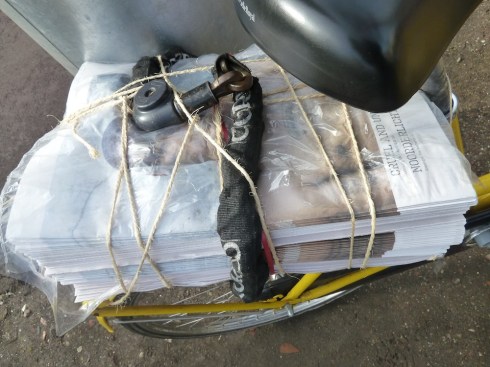
Last week, I explained why Hester Keijser and I made a newspaper instead of a traditional exhibition catalogue. One of our reasons was so that we could playfully distribute the information in the exhibition at no cost to the public; to unexpected and unexpecting people.
This week, Gemma Thorpe and I handed out 100 copies to people on the streets of Amsterdam.

This is 3,100 copies, not 100.
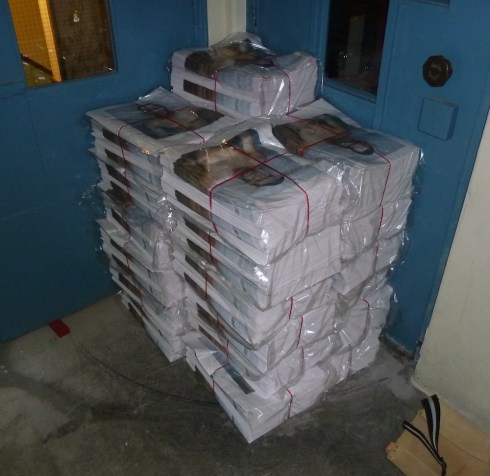
We began by rolling them into tubes, tied with string.
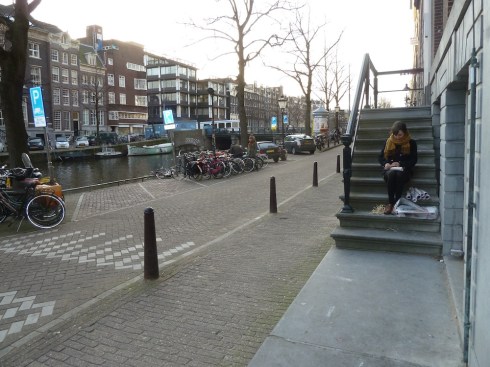

Giddy with anticipation.

We’d just been to see the Joel Sternfeld show and the excellent Arnon Gundberg exhibit Les vacances de Monsieur Grunberg at FOAM photo gallery.
FOAM wouldn’t allow us to leave copies in it’s reception, so we began distributing outside.
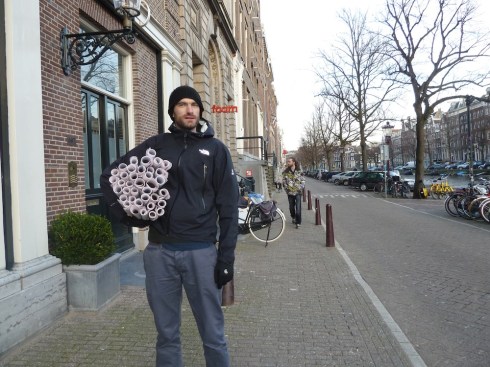
This man said he’d read it on the train.

We left a few copies in appealing bicycle baskets.

While I ate my chips and mayo, I handed them out on a street corner outside a jewelers.

This guy wanted one.

We stopped by a couple of weed coffeeshops …

… and left them in the magazine racks.
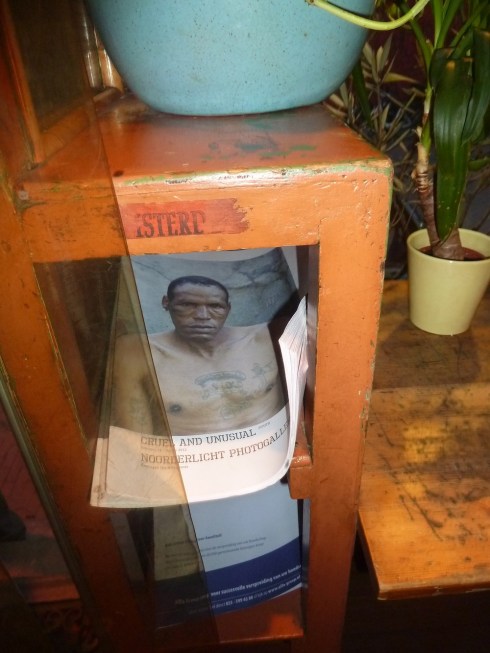
This lady was happy with her copy.

And so was the man at the Turkish Kebab House. We left a few more on his counter for his customers.

Know your audience. It was an English language publication after all.

As dusk fell, just a few more left to give out.

The final five went with us to the pub …

… where this man wanted to take our portrait. We said no, but his disappointment was allayed by a copy of the Cruel and Unusual newspaper.

And, not happy with one European country, the next day the final few copies got left at Manchester Piccadilly train station.

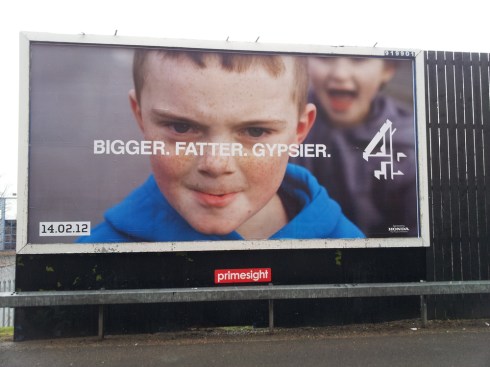
Channel Four in the UK has launched this controversial ad campaign for a new series of ‘My Big Fat Gypsy Wedding.’ Image by Ross McCullough.
This post has nothing to do with prisons, but as you know I’m appalled when imagery is not used responsibly.
In the past 24 hours I’ve come across two advertisement campaigns that are beyond indecent. I am incensed.
The situation is more galling given the fact that both advertisers are groups that I’d expect to have an enlightened approach to the politics of representation.
CHANNEL FOUR
In the UK, the usually responsible Channel Four has launched a controversial ad campaign for a new series of ‘My Big Fat Gypsy Wedding.’ Emblazoned across image of gypsy youth are the words: BIGGER. FATTER. GYPSIER.
Matt Daw, Projects Manager at PhotoVoice today said:
The first two words just seem inappropriate. The last is inconceivable in today’s world. In short, the advert presents a boy’s recognisable face and asks us to make a huge number of assumptions about him based on his being a member of an ethnic minority. No other context is offered.
Members of the Hackney Traveller community have said:
These adverts are stigmatising us by the words and pictures they use. This programme is turning us into something that we are not’.
Manchester-based journalist and photographer, Ciara Leeming who has worked extensively with Roma (European travellers in the UK) groups tweeted that the campaign was “downright racist.”
Photovoice will be picketing Channel 4 today.
PETA
Meanwhile, the animal rights group PETA wants to fight cruelty against animals by making light of violence against women.
The premise of their latest TV campaign is ludicrous: If your boyfriend becomes vegan, he’ll immediate be such a “stud” that you should be ready for sex marathons so violent, he’ll put your head through the wall … resulting in a neck brace. After that he’ll send you down the road – in your underwear – to buy post-coitus vegetables.
Unbelievable.
This is the latest of PETA’s “ads” produced for web distribution with the intention to shock and no hope of making it on to TV. But still.
What is wrong with you people? Oh yeah, you’re single minded advertisers with dollar signs obscuring your view of the sensible and right.
Matt Bors, my favourite Portland-based cartoonist batters PETA with his post, PETA Targets No One Ever With Its Latest Campaign: “I’m big into not injuring the women I have sex with or bashing their heads into walls.”

PRINTED MATTERS
For the upcoming Cruel and Unusual exhibition, Hester Keijser and I opted for a newsprint catalogue. We did this for several reasons.
Firstly, the message behind the exhibition is one that calls for political thought and hopefully political change. Shifts in attitudes come about through public education; it made sense to distribute information as far and wide as was possible. Not everyone can afford a photobook/catalogue, but 4,000 free copies of a newspaper nullifies the issue. Some might call the newspaper medium democratic, but I just call the solution common sense. 
Secondly, we had a lot of photographers to feature. 32 pages of a tabloid-sized newspaper is a sizable amount of column inches with which to fairly deal with the many issues in the photographers’ works.
And third, Hester and I wanted to bring attention to the fact that [photo]bloggers continue to shape, react to, and distort new media economies. As we say in our curatorial statement:
“Cruel and Unusual looks at the utility of freelance online publishing. As bloggers with academic backgrounds, we happily invest time and intellectual capital in our research and writing. Our blogs and those of colleagues have become resources – almost contemporary libraries – that others utilize and perhaps even capitalise upon. For a host of reasons, printed journalism is in decline. Simultaneously, bloggers refine their messages unhindered. Related, but not necessarily causal, we want to acknowledge these two trends and the disruption at hand.”
We aren’t particularly worried about not knowing what the future holds, because for now we are propelled by opportunities to create things in the present.
SOME OTHER NEWSPRINT PHOTO PUBLICATIONS
Most people are probably aware of Alec Soth’s Last Days of W. President Bush was a constant source of partisan news stories, and Op-Ed’s on Bush were divided and divisive. Given that Bush was a leader who orbited world events without necessarily controlling them and given that he was a Commander-in-Chief whose war cabinet tried to warp media to its own message, Soth’s use of a newspaper is ironic and appropriate. Jeff Ladd noted that Soth’s subjects look worn out and exhausted as if reflecting the American psyche after eight years of Bush. A newspaper will soon yellow and show aging – perhaps Soth hoped his newspaper would be short lived like the memory of Bush and the reparations required following his presidency?
Recently, Harry Hardie at HERE has collaborated on two newsprint photo publications.
CAIRO DIVIDED (32 pages) sequences the photos of Jason Larkin with an authoritative essay (in both English and Arabic) by Jack Shenker about suburbanization around Egypt’s capital. Since January 25th of 2011, Egypt has not been out the news, and yet this project is not about revolution. It is however about poverty, wealth and class stratification and as such provides a good context for the revolution in Egypt. Excellent design with eye-opening photographs. Highly recommended. More info here.
Guy Martin’s The Missing is borne of a collaboration between Panos Pictures, HERE and Martin’s alma mater The University of Falmouth. Each of its 48 pages has a large image of a missing poster photographed by Guy Martin. The posters “adorned the walls of the courthouse and justice rooms on Benghazi’s seafront.” Martin estimates that in Libya, 30,000 men are missing after the 8 month conflict. As such, the quasi-legal vernacular documents he re-photographed in-situ were the making of “communal place of memory and mourning.” The newspaper acts as a bulletin existing somewhere between the makeshift and the permanent; between memory and knowing; and – as with those pictured – in ambiguous flux with time. More info here.
Shifting gears, Portrait Salon 11 is not about political events. It is, however, a political stand against institutional exclusion. In the tradition of the 1863 French Salon des Refuses, the London-based Portrait Salon is a curated showcase of photographs that were submitted but not selected for the prestigious Taylor Wessing Photographic Portrait Prize. The use of a newspaper is a mischievous challenge to the immobility of a gallery exhibition that chose 60 works from 6,000 submissions; the newspaper can move cheaply and in large quantities beyond gallery walls. Furthermore, the accompanying Portrait Salon exhibition projected portraits in order to include more photography and not be limited by physical space. The exhibition and newspaper were organised by Miranda Gavin, Wayne Ford and others. For purchase.
I’ve highlighted these projects and in each case tried to justify why the choice of newsprint was appropriate and theoretically consistent. I believe that the Cruel and Unusual newspaper is those things too.
CRUEL AND UNUSUAL: AVAILABLE ONLINE
A non-printable, non-downloadable, non-alterable screen-preview version is available online.
Starting February 18, the newspaper is also available for free in the Noorderlicht Photogallery and for sale in the webshop.
The exhibition is split into two sections: 1, a traditional presentation of 11 photographers, and 2, a heady mayhemic wall of work-prints, background material contact sheets from Prison Photography on the Road (PPOTR).
Similarly, the newspaper is divided into two sections. A 20 page PPOTR pullout is enveloped in 12 pages of descriptions of the photographers in the main part of the exhibition.
Below are the opening page and the back page of the PPOTR pullout. The portrait on the opening page was made by Tim Matsui who documented my workshop at Sing Sing Prison.

The back page is a list of 32 of our favourite international photography blogs with QR codes linking to their websites. This was our cheeky riff on the classifieds section of newspapers!

And below are two pairings of PDF pages and Hester’s photographs of the actual printed object. The paper is really beautiful … so Hester tells me; I’ve not held one yet! I would like to thank the designer Pierre Derks who worked with Hester and I. He has expertise, patience and put in some hard graft.


In the past when I have discussed prison Polaroids, I have said they are perhaps one of the more significant subsets of American vernacular photography, and that they are not easily found online and that, due to their absence, our perception of prisons and prison life continues to be skewed.
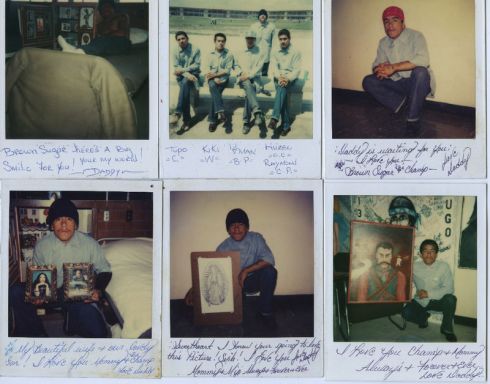
Well, times change and that position now deserves correction. I have noticed a few collections coming online recently. Not least the Polaroids from Susanville Prison on the These Americans website. (Also, check out the new PRISON subsection of the site.)
Online, I have identified some increase in the number of contemporary prison visiting room portraits and, as in the case of These Americans, collections of older, scanned images.
I would suppose that many Facebook users have scanned visiting room portraits and added them to profiles but, only visible to friends, those social network image files have not been reproduced for public consumption or commentary. We might think of Facebook photos and albums as digital versions of the mantlepiece, i.e. seen only by close friends and family.
ONGOING FOCUS
“Prisoner-complicit” portraits (for want of a better term) are taking up a lot of my thoughts currently.
Yesterday, I had a workshop with the #PICBOD students at Coventry University, in which I assigned readings on Alyse Emdur’s visiting room portrait collection, prison cell phones as contraband, prison cell phone imagery as cultural product, a new Tumblr In Duplo that compares publicly available mugshots with publicly available Facebook profile pictures, and the racket that underpins the posting and removal of mugshots to the searchable web.
Particularly with cell-block-cell-phone images, we should anticipate a glut of prisoner-complicit photos in which prisoners – to a greater degree – self represent.
We should realise that this is the first time in modern history that prisoners have presented themselves to the internet and thus permanently to the digital networks of the globe. My hunch is that this may be significant, but really, it’s too early to tell.
We can note that in this video, most of the images seem to originate from the same cell phone camera in the same prison. We might surmise there is no epidemic of illicit and smuggled images yet. To further this inquiry, I hope to get some information from the maker of said video.
In the mean time, I’ve been in touch with Doug Rickard who administers These Americans as well as the wonder-site American Suburb X. I asked him about his recently published Susanville Prison Polaroids:
Any idea who took them? (any marks/prison-stamps on verso?)
Probably a visitor or another inmate? I have a set (10 or so) of the main inmate (“Johnny”) that you see in many of the “Susanville” single poses, posed with “Brown Sugar” (his girlfriend/wife) and his son “Champ”, a boy that grows from 1-3 years old in the various pictures (see below).
What years do you think they span?
I can only find one date, 10-24-80. You would think that they were 90’s, but for sure, it says 80.
What makes this collection so fascinating to me is that the operator(s) appears to have had free reign of cells, tiers and the yard to make these single and group portraits. One of the PICBOD students at Coventry today wondered where their supply of Polaroid film came and then to where the images were eventually dispersed outside the prison.
We could only conclude that this prisoner and his group of friends had special privileges and access. From all of my research into (vernacular) prison photography – specifically prisoner-made photography – this sort of arrangement/privilege does not exist in American prisons today.
MORE ON THESE AMERICANS
http://www.theseamericans.com/media/minnesota-mugshots/
http://www.theseamericans.com/prison/last-prisoners-leave-alcatraz-1963/
http://www.theseamericans.com/prison/visiting-hours/
http://www.theseamericans.com/prison/prison-collection-%e2%80%9cjoliet-state-prison%e2%80%9d-1963/
http://www.theseamericans.com/prison/florida-collection-jack-spottswood-sunbeam-prison-camp-1950/
http://www.theseamericans.com/prison/california-collection-san-quentin-prison-1925-1935/
http://www.theseamericans.com/prison/polaroid-collection-mcneil-island-prison-wa-1970s/
– – – – – – – – – – – – –
Thanks to Peg Amison for the tip.
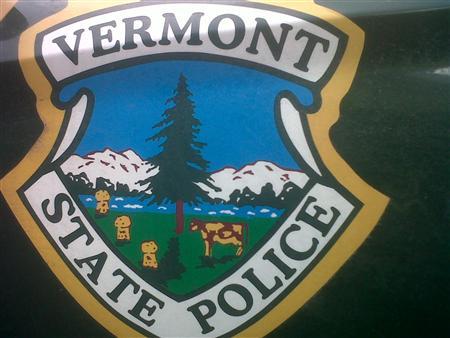
The Vermont State Police emblem is pictured in this undated handout photo received by Reuters on February 2, 2012 from the Vermont State Police.

Call it petulance, call it resistance, call it subversion, call it opportunism, call it what you want. I’ll call it damn funny.
Vermont prisoners modified the State’s official police insignia, sneaked an image of a pig into the design and saw it printed up on 30 police cruisers that patrolled the roads for a year.
That the amended design went unnoticed for so long is really the story for me. It was finally picked up by a trooper who was inspecting his car while out on the job.
PRISON LABOUR HAPPENS
I suppose the other startling aspect to this story is that it will alert many Americans to the fact that prisoners carry out jobs that we might not expect of an incarcerated class. Most might think it’s foolish to give prisoners even the opportunity to interfere with the emblems of law enforcement, but when it comes to the economics of prison labour, there’s a whole unique logic to be discovered.
I don’t think there’s a license plate in the country that isn’t pressed inside a prison. Each state usually has one prison workshop to punch those out. Prisoners make text books, boots, flags, mattresses, office chairs, floor stripper. They harvest collards and tomatoes, pick almonds and box eggs. In California, the huge Prison Industry Authority (PIA) distributes milk and even produces meat.
Low cost production of goods is practiced in the private as well as public prisons. Depressingly, the ever conniving business lobby-group ALEC have led the loosening of laws to secure cheap prison labor for private business.
May I recommend the article, The Hidden History of ALEC and Prison Labor as a good introduction to the problematic trend and philosophical shift away from rehabilitation and toward profit:
Although a wide variety of goods have long been produced by state and federal prisoners for the US government—license plates are the classic example, with more recent contracts including everything from guided missile parts to the solar panels powering government buildings—prison labor for the private sector was legally barred for years, to avoid unfair competition with private companies. But this has changed thanks to the American Legislative Exchange Council (ALEC), its Prison Industries Act, and a little-known federal program known as PIE (the Prison Industries Enhancement Certification Program). While much has been written about prison labor in the past several years, these forces, which have driven its expansion, remain largely unknown.
If you want to know more about the intersects of business and incarceration, I recommend the book Prison Profiteers, edited by Paul Wright and Tara Herivel.
More on the VT police emblems here. Thanks to Matthew Spencer for the tip.

Ava DuVernay took home the U.S. Directing Award gong in the Dramatic category at last nights Sundance Festival Awards.
DuVernay’s film Middle of Nowhere is about a happily married woman who then finds herself with an incarcerated husband. “[In film] we are used to seeing these visits, and the women leaving out the prison gate. The story returns to the men inside, but what happens to these women?” asks DuVernay.
 “The epidemic of incarceration really effects black and brown communities.” explains DuVernay, who’d seen the struggles in her own community.
From the Sundance website:
‘What happens when love takes you places you never thought you would go? When her husband, Derek, is sentenced to eight years in a California prison, Ruby drops out of medical school to maintain her marriage and focus on ensuring Derek’s survival in his violent new environment’
This is of course great news for Ava, but also great news for the public to whom Ava has given the chance to get inside the stories of millions. When a loved one is locked up, wives, girlfriends, children, husbands, partners and family members are constantly working their own paths through concurrent but very different types of “sentence.”
For me the most joyous thing about this win is that this is a prison movie that doesn’t centre on an action packed break-out, or an unlikely lifelong flicker of hope, or the violence of prison gangs as “the other”. It’s non-sensational and human. Bravo Ava!
INTERVIEW AND TRAILER
BIOGRAPHY
In addition to her latest feature film, Middle of Nowhere, Ava DuVernay’s directorial work includes the critically acclaimed dramatic feature I Will Follow, as well as the musical documentaries This Is the Life and My Mic Sounds Nice. The UCLA graduate is the founder of the African American Film Festival Releasing Movement, better known as AFFRM.
(Found via: AFRICA IS A COUNTRY)

 Prison Photography