
You are currently browsing the category archive for the ‘Activist Art’ category.
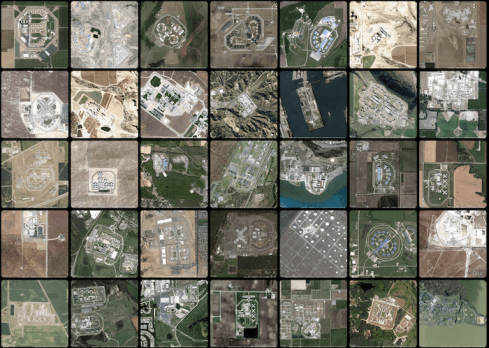
PRISON MAP
Prison Map is the most complete visualisation project of America’s prison system that I’ve come across. No surprise that it takes the form of satellite imagery and no surprise it was made with the aid of computer code.
Prison Map is the work of Josh Begley, an Interactive Telecommunications graduate student at NYU. He developed the project as part of Jer Thorp‘s Data Representation class.
The title is a little misleading. “It’s not a map,” says Begley, “It’s a snapshot of the earth’s surface, taken at various points throughout the United States. It begins from the premise that mapping the contours of the carceral state is important.”
A premise I can agree with. In my meagre attempts to comprehend the size and impact of contemporary prison construction, I’ve compared state-commissioned aerial photography with the fine art photography of David Maisel. I’ve also admired the Incarceration Nation project by non-profit Thousand Kites using roving Google Earth imagery to describe penal architectures (although the manual labour behind Incarceration Nation always seemed to big and ultimately wasteful; an irony not lost for a project commenting on the wasteful prison industrial complex.)
Begley had made cursory use of the CDCr’s own aerial photographs for his earlier Prison Count, but that project is shallow by comparison to Prison Map.
SIGNIFICANCE
Prison Map both orders and exposes the sprawl of prisons in our society; Begley was motivated by the frustration that words and figures often fall short. Again, it is a premise I’m very sympathetic to. What difference does it make if the figure you use to describe an invisible problem has an extra zero or not?
“When discussing the idea of mass incarceration, we often trot out numbers and dates and charts to explain the growth of imprisonment as both a historical phenomenon and a present-day reality,” says Begley. “But what does the geography of incarceration in the US actually look like? What does it mean to have 5,000 or 6,000 people locked up in the same place? What do these carceral spaces look like? How do they transform (or get transformed by) the landscape around them?”
TOOLS
Begley used the Correctional Facility Locator, a project of the Prison Policy Initiative (PPI)*, as his primary tool. The Correctional Facility Locator database includes the hard-to-locate latitude and longitude coordinates of every carceral facility counted in the 2010 US census.
Begley notes that the Correctional Facility Locator is the first and only database to include state and federal prisons alongside local jails, detention centers, and privately-run facilities. 4,916 facilities in total. It is the only such database of which I’m aware.
Using the Google Maps API and the Static Maps service, Begley and Thorp wrote a simple processing sketch that grabbed image tiles at specified latitudes and longitudes, saving each as a JPEG file. The processing sketch cycled through 4,916 facilities.
Some of the captured images were more confusing than instructive – and dealing with nearly five thousand images proved unwieldy – so Begley selected “only” 700 (14%) of the best photos. If you want to see Begley’s entire data set, you can do so here.
USES
The question that this project raises is what can be done with this visualised data to effect change and propel social justice? Artist Paul Rucker used maps created by Rose Heyer (also of PPI) to compose Proliferation. Begley has culled the images; what digital collaging, comparative analysis and collaborations can be constructed with the images?
Perhaps information is more important than images? Toward the end of his TEDxVancouver Talk, Jer Thorp (Begley’s NYU professor) talks about how data represents real life events and their associated emotions. Movements mapped to, fro and between prisons may begin to describe the mass movement within mass incarceration. Specifically dealing with New York State, the Spatial Information Design Lab at Columbia University investigated these types of visualisation with its Million Dollar Blocks project.
An App about the forced migrations within the prison industrial complex is waiting to be built. The first stumbling block is access to data. The prison system is not renowned for being open with its information.
– – – – – – – –
If you’d like to know more, Josh Begley can be contacted at josh.begley[at]nyu.edu
– – – – – – – –
Thanks to Sameer Padania for the tip.
– – – – – – – –
*PPI is one of the most imaginative research groups illuminating the dark recesses of our carceral landscape. PPI Director, Peter Wagner, was a PPOTR interviewee last year offering passion and intelligent analysis of the prison industrial complex. I’ve been aware – and made use – of many PPI resources in the past, but until now was unaware of the Correctional Facility Locator. Kudos to PPI.

April 4th is the United Nations’ International Day for Mine Awareness.
Raphaël Dallaporta‘s Antipersonnel is a typology of these little fuckers that take doors off armoured vehicles and dice humans into small bloody portions.
Photographed against a black backdrop with the high production value of advertising photography, Dallaporta in some ways disarms us (‘xcuse the pun). Dallaporta’s work has some of them looking more like Tamagotchi’s than instruments of war. If we’re not careful, we might forget that for most of their existence these objects are either being put together in a factory, stored in cache or waiting to blow. They’re a one purpose gadget with only negative outcomes.
Human’s piece the deathly components together and then bury them under shallow soil in full knowledge they’ll exist quietly, perpetually, until someone or something presses down a medium amount of load. Yes, it’s all or nothing for these little fuckers.
But, I am anthropomorphising. These objects are not to blame. We are to blame. You can fire 1000 rounds from a gun and you cannot know how many will achieve their destructive purpose. But 1000 landmines are going to rip apart 1000 lives. They’re a guaranteed return. They are the absolute in nihilism and hate. That’s why it is important to distinguish antipersonnel mines from other weapons and that is why it is good the UN leads an effort to see them banned.
The UN:
Since the Convention on the Prohibition of the Use, Stockpiling, Production and Transfer of Anti-Personnel Mines and on Their Destruction, commonly known as the Anti-Personnel Mine Ban Convention opened for signature in 1997, 156 countries have ratified or acceded to it. More than 41 million stockpiled anti-personnel mines have been destroyed, and their production, sale and transfer have in essence stopped.


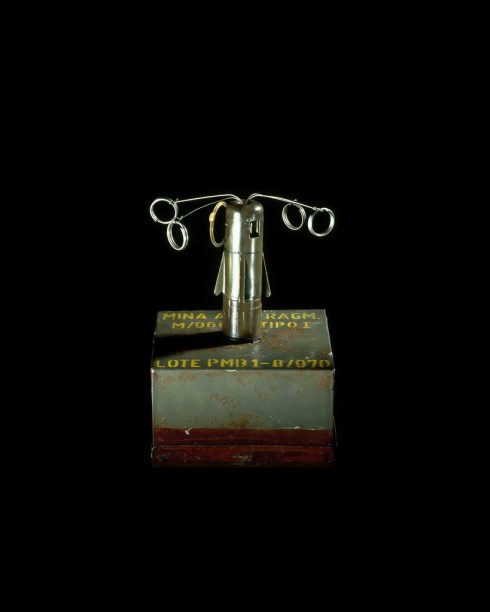
All images: Raphaël Dallaporta
Over the past decade, documentary filmmaker Edgar Barens has explored the many issues at play in the American criminal justice system.
For his most recent project Prison Terminal, Barens was granted unprecedented access to the Iowa State Penitentiary (ISP).
Prison Terminal is a moving cinema verité documentary that breaks through the walls of one of America’s oldest maximum security prisons to tell the story of the final months in the life of a terminally ill prisoner and the hospice volunteers, they themselves prisoners, who care for him.
The Iowa Department of Corrections allowed Barens round-the-clock access to the ISP hospice and almost uniquely – to my knowledge – a space for him to cobble together living quarters and a production studio in the prison’s basement.

Jack “Comrade” Hall. Hospice Patient, Iowa State Penitentiary.
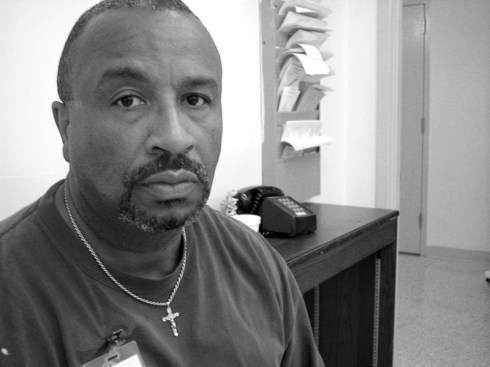
Bertram “Herky” Berkett. Inmate Hospice Volunteer
Prison Terminal is more than a documentary: it is a hub for information and context. You’ll need to spend some time with the biographies of those involved, a host of video shorts and general essays about the prison industrial complex.
Prior to working in Iowa, Barens also documented the hospice program at Angola Prison – a well photographed program probably best known through Lori Waselchuk’s Grace Before Dying.
These two hospice programs remain exceptional in America’s correctional landscape, but it is Barens’ hope that Prison Terminal will assist in making these services permanent throughout U.S. prisons, ensuring that inmates no longer have to die alone.

Charles “Woo” Watkins. Inmate Hospice Volunteer.

Larry “Big Papa”. Hospice Patient
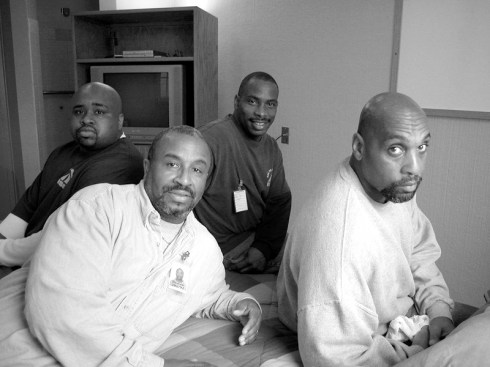
Inmate Hospice Volunteers (Front: Bertram Berkett, Michael Glover Back Row: Michael Williams, Charles Watkins.)
BIOGRAPHY
 Edgar Barens received his Bachelors degree and Masters of Fine Arts in Cinema and Photography from Southern Illinois University, where he concentrated on photography and film production. His body of work includes documentary films, experimental shorts, music videos and public service announcements, which have been screened at film festivals, conferences, broadcast internationally as well as distributed educationally.
You can view all Prison Terminal videos here.
Follow Prison Terminal on Twitter
All images © Edgar Barens
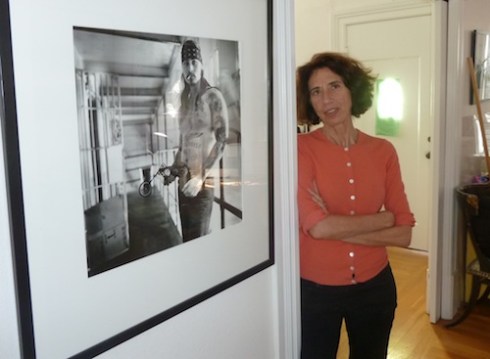
There were two categories of interviewees I planned to connect with during PPOTR – photographers and prison reformers. I didn’t expect to meet many individuals who satisfied both definitions. Ruth Morgan does.
Morgan became director of Community Works, a restorative justice arts program in the San Francisco Bay Area in 1994. Prior to that, she was director of the Jail Arts Program, in the San Francisco County Jail system (1980-1994).
It should be noted that the county jail system is entirely different to the state prison system and operate under separate jurisdictions. County jails hold shorter term inmates.
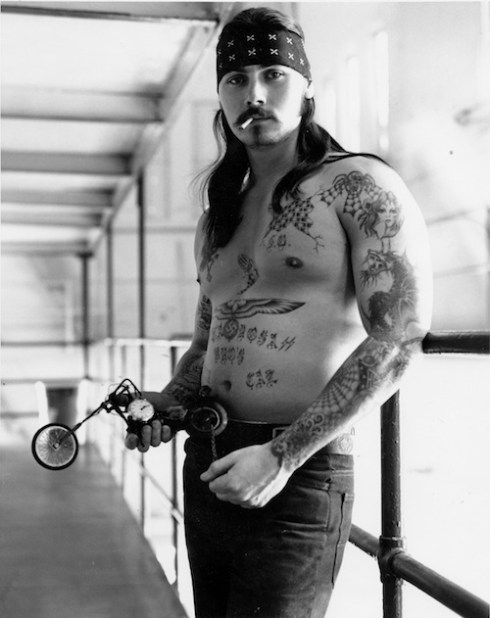
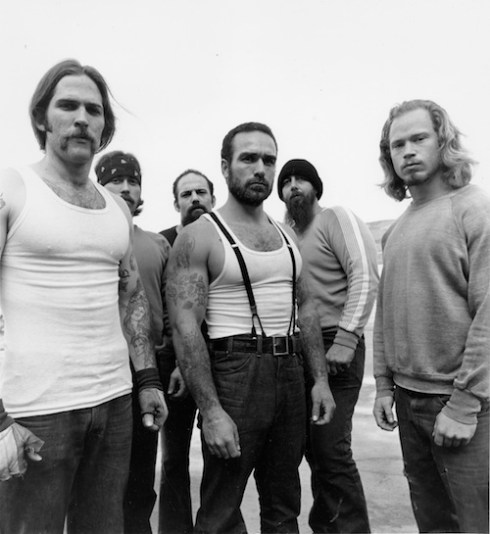
For three remarkable years, Morgan and her colleague Barbara Yaley had free reign of San Quentin State Prison to interview and photograph the men. In 1979, it was the sympathetic Warden George Sumner who provided Morgan and Yaley access. In 1981, a new Warden at San Quentin abruptly cut-off access.
“I think there were a few reasons [we were successful],” explains Morgan. “Despite the fact I was a young woman, I had a big 2-and-a-quarter camera and a tripod and so they took me seriously. That helped us get the portraits and the stories we did.”
The San Quentin News (Vol. I.II, Issue 11, June, 1982) reported on Morgan and Yaley’s activities. The story Photo-Documentary Team Captures Essence of SQ can be read on page 3 of this PDF version of the newspaper.
Ruth and I talk about how the demographics of prison populations remain the same; her original attraction to the topic; the use of her photographs in the important Toussaint v. McCarthy case (1984) brought by the Prison Law Office against poor conditions in segregation cells of four Northern California prisons; why she never published the photos of men on San Quentin’s Death Row; and the emergence, funding for, and power of restorative justice.
LISTEN TO THE DISCUSSION WITH RUTH MORGAN ON THE PRISON PHOTOGRAPHY PODBEAN PAGE


PRINTED MATTERS
For the upcoming Cruel and Unusual exhibition, Hester Keijser and I opted for a newsprint catalogue. We did this for several reasons.
Firstly, the message behind the exhibition is one that calls for political thought and hopefully political change. Shifts in attitudes come about through public education; it made sense to distribute information as far and wide as was possible. Not everyone can afford a photobook/catalogue, but 4,000 free copies of a newspaper nullifies the issue. Some might call the newspaper medium democratic, but I just call the solution common sense. 
Secondly, we had a lot of photographers to feature. 32 pages of a tabloid-sized newspaper is a sizable amount of column inches with which to fairly deal with the many issues in the photographers’ works.
And third, Hester and I wanted to bring attention to the fact that [photo]bloggers continue to shape, react to, and distort new media economies. As we say in our curatorial statement:
“Cruel and Unusual looks at the utility of freelance online publishing. As bloggers with academic backgrounds, we happily invest time and intellectual capital in our research and writing. Our blogs and those of colleagues have become resources – almost contemporary libraries – that others utilize and perhaps even capitalise upon. For a host of reasons, printed journalism is in decline. Simultaneously, bloggers refine their messages unhindered. Related, but not necessarily causal, we want to acknowledge these two trends and the disruption at hand.”
We aren’t particularly worried about not knowing what the future holds, because for now we are propelled by opportunities to create things in the present.
SOME OTHER NEWSPRINT PHOTO PUBLICATIONS
Most people are probably aware of Alec Soth’s Last Days of W. President Bush was a constant source of partisan news stories, and Op-Ed’s on Bush were divided and divisive. Given that Bush was a leader who orbited world events without necessarily controlling them and given that he was a Commander-in-Chief whose war cabinet tried to warp media to its own message, Soth’s use of a newspaper is ironic and appropriate. Jeff Ladd noted that Soth’s subjects look worn out and exhausted as if reflecting the American psyche after eight years of Bush. A newspaper will soon yellow and show aging – perhaps Soth hoped his newspaper would be short lived like the memory of Bush and the reparations required following his presidency?
Recently, Harry Hardie at HERE has collaborated on two newsprint photo publications.
CAIRO DIVIDED (32 pages) sequences the photos of Jason Larkin with an authoritative essay (in both English and Arabic) by Jack Shenker about suburbanization around Egypt’s capital. Since January 25th of 2011, Egypt has not been out the news, and yet this project is not about revolution. It is however about poverty, wealth and class stratification and as such provides a good context for the revolution in Egypt. Excellent design with eye-opening photographs. Highly recommended. More info here.
Guy Martin’s The Missing is borne of a collaboration between Panos Pictures, HERE and Martin’s alma mater The University of Falmouth. Each of its 48 pages has a large image of a missing poster photographed by Guy Martin. The posters “adorned the walls of the courthouse and justice rooms on Benghazi’s seafront.” Martin estimates that in Libya, 30,000 men are missing after the 8 month conflict. As such, the quasi-legal vernacular documents he re-photographed in-situ were the making of “communal place of memory and mourning.” The newspaper acts as a bulletin existing somewhere between the makeshift and the permanent; between memory and knowing; and – as with those pictured – in ambiguous flux with time. More info here.
Shifting gears, Portrait Salon 11 is not about political events. It is, however, a political stand against institutional exclusion. In the tradition of the 1863 French Salon des Refuses, the London-based Portrait Salon is a curated showcase of photographs that were submitted but not selected for the prestigious Taylor Wessing Photographic Portrait Prize. The use of a newspaper is a mischievous challenge to the immobility of a gallery exhibition that chose 60 works from 6,000 submissions; the newspaper can move cheaply and in large quantities beyond gallery walls. Furthermore, the accompanying Portrait Salon exhibition projected portraits in order to include more photography and not be limited by physical space. The exhibition and newspaper were organised by Miranda Gavin, Wayne Ford and others. For purchase.
I’ve highlighted these projects and in each case tried to justify why the choice of newsprint was appropriate and theoretically consistent. I believe that the Cruel and Unusual newspaper is those things too.
CRUEL AND UNUSUAL: AVAILABLE ONLINE
A non-printable, non-downloadable, non-alterable screen-preview version is available online.
Starting February 18, the newspaper is also available for free in the Noorderlicht Photogallery and for sale in the webshop.
The exhibition is split into two sections: 1, a traditional presentation of 11 photographers, and 2, a heady mayhemic wall of work-prints, background material contact sheets from Prison Photography on the Road (PPOTR).
Similarly, the newspaper is divided into two sections. A 20 page PPOTR pullout is enveloped in 12 pages of descriptions of the photographers in the main part of the exhibition.
Below are the opening page and the back page of the PPOTR pullout. The portrait on the opening page was made by Tim Matsui who documented my workshop at Sing Sing Prison.

The back page is a list of 32 of our favourite international photography blogs with QR codes linking to their websites. This was our cheeky riff on the classifieds section of newspapers!

And below are two pairings of PDF pages and Hester’s photographs of the actual printed object. The paper is really beautiful … so Hester tells me; I’ve not held one yet! I would like to thank the designer Pierre Derks who worked with Hester and I. He has expertise, patience and put in some hard graft.


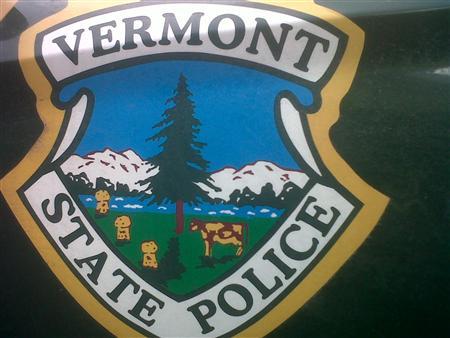
The Vermont State Police emblem is pictured in this undated handout photo received by Reuters on February 2, 2012 from the Vermont State Police.

Call it petulance, call it resistance, call it subversion, call it opportunism, call it what you want. I’ll call it damn funny.
Vermont prisoners modified the State’s official police insignia, sneaked an image of a pig into the design and saw it printed up on 30 police cruisers that patrolled the roads for a year.
That the amended design went unnoticed for so long is really the story for me. It was finally picked up by a trooper who was inspecting his car while out on the job.
PRISON LABOUR HAPPENS
I suppose the other startling aspect to this story is that it will alert many Americans to the fact that prisoners carry out jobs that we might not expect of an incarcerated class. Most might think it’s foolish to give prisoners even the opportunity to interfere with the emblems of law enforcement, but when it comes to the economics of prison labour, there’s a whole unique logic to be discovered.
I don’t think there’s a license plate in the country that isn’t pressed inside a prison. Each state usually has one prison workshop to punch those out. Prisoners make text books, boots, flags, mattresses, office chairs, floor stripper. They harvest collards and tomatoes, pick almonds and box eggs. In California, the huge Prison Industry Authority (PIA) distributes milk and even produces meat.
Low cost production of goods is practiced in the private as well as public prisons. Depressingly, the ever conniving business lobby-group ALEC have led the loosening of laws to secure cheap prison labor for private business.
May I recommend the article, The Hidden History of ALEC and Prison Labor as a good introduction to the problematic trend and philosophical shift away from rehabilitation and toward profit:
Although a wide variety of goods have long been produced by state and federal prisoners for the US government—license plates are the classic example, with more recent contracts including everything from guided missile parts to the solar panels powering government buildings—prison labor for the private sector was legally barred for years, to avoid unfair competition with private companies. But this has changed thanks to the American Legislative Exchange Council (ALEC), its Prison Industries Act, and a little-known federal program known as PIE (the Prison Industries Enhancement Certification Program). While much has been written about prison labor in the past several years, these forces, which have driven its expansion, remain largely unknown.
If you want to know more about the intersects of business and incarceration, I recommend the book Prison Profiteers, edited by Paul Wright and Tara Herivel.
More on the VT police emblems here. Thanks to Matthew Spencer for the tip.

Ava DuVernay took home the U.S. Directing Award gong in the Dramatic category at last nights Sundance Festival Awards.
DuVernay’s film Middle of Nowhere is about a happily married woman who then finds herself with an incarcerated husband. “[In film] we are used to seeing these visits, and the women leaving out the prison gate. The story returns to the men inside, but what happens to these women?” asks DuVernay.
 “The epidemic of incarceration really effects black and brown communities.” explains DuVernay, who’d seen the struggles in her own community.
From the Sundance website:
‘What happens when love takes you places you never thought you would go? When her husband, Derek, is sentenced to eight years in a California prison, Ruby drops out of medical school to maintain her marriage and focus on ensuring Derek’s survival in his violent new environment’
This is of course great news for Ava, but also great news for the public to whom Ava has given the chance to get inside the stories of millions. When a loved one is locked up, wives, girlfriends, children, husbands, partners and family members are constantly working their own paths through concurrent but very different types of “sentence.”
For me the most joyous thing about this win is that this is a prison movie that doesn’t centre on an action packed break-out, or an unlikely lifelong flicker of hope, or the violence of prison gangs as “the other”. It’s non-sensational and human. Bravo Ava!
INTERVIEW AND TRAILER
BIOGRAPHY
In addition to her latest feature film, Middle of Nowhere, Ava DuVernay’s directorial work includes the critically acclaimed dramatic feature I Will Follow, as well as the musical documentaries This Is the Life and My Mic Sounds Nice. The UCLA graduate is the founder of the African American Film Festival Releasing Movement, better known as AFFRM.
(Found via: AFRICA IS A COUNTRY)
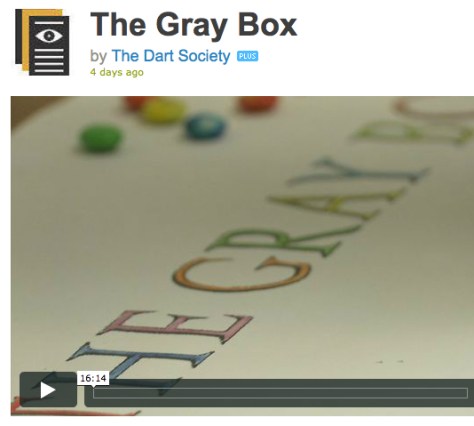
I feel I’ve tried and fallen short in elucidating the core of the matter as regards solitary confinement. When I watched The Gray Box, by freelance journalist Susan Greene and DAX Films, I knew it was something I had to share.
The Gray Box speaks as I never could; it has voices of experience. You’ll be awed by the psychological terror they describe and by the activities isolated prisoners employ to remain sane.
Of all the many battles at hand for prison reformers, it is felt that the campaign against the over-use of solitary confinement in American prisons is an issue that currently resonates enough with the public to effect some policy change.
The anti-Solitary bloc has simplified its message saying that solitary confinement does permanent damage to the mind of he or she imprisoned; a view backed up by medical science.
Publics are also more educated about isolation – and the manipulation/interrogation techniques associated with it – because Guantanamo prison has been regularly discussed in the media for over a decade.
Essentially, the knowledge that solitary destroys people is knowledge that anyone on the political spectrum can understand and oppose. From the hardcore secular ACLU to coalitions of churches, the voices in opposition to solitary confinement are wide and varied. Even so, we do still see some prisons such as Rikers Island which are bucking the trend and pushing for the to use of more solitary confinement.
Furthermore, the few actions of what we might refer to as prisoner resistance include calls to curtail the use of solitary confinement. (This is something Isaac Ontiveros covered when we discussed the California hunger strike).
Solitary confinement is not an issue I feel I’ve adequately discussed here on the blog. I’ve brought up it’s historical genesis; I’ve discussed isolation in and out of prisons; and I’ve referred you to stories about infamous U.S. prisoners such as Robert King and Leonard Peltier who served and are serving time in isolation.
Truly, if you want to know about the abusive use of solitary confinement in US prison’s follow James Ridgeway’s vital journalism at Solitary Watch.
Ridgeway, a voice you can rely on, says about the film and of Greene’s article The Gray Box: An Investigative Look at Solitary Confinement:
This is one of the most comprehensive articles ever written about solitary confinement in the United States, and is particularly noteworthy for including the voices of prisoners, obtained through correspondence with those buried in isolation. It is also passionate and personal.
JOURNALISTS
Susan Greene is a former-columnist at the Denver Post who often wrote about the widespread use of solitary in Colorado’s prisons and at the federal supermax, ADX Florence.
James Ridgeway was interviewed by the Dart Center and talked about the murky statistics and exchange of (mis)information about American prisoners in solitary.
Joseph Rodriguez alerted me to this film. Joseph’s own work Re-Entry in Los Angeles appears among the Spring 2012 Dart Society Reports.
The Dart Society Reports distributes journalism about trauma, violence and human rights.

 Prison Photography