
You are currently browsing the category archive for the ‘Activist Art’ category.

In a massive 3×9-metre grid, Daniel Schwartz‘s Corrections (above) tiles a satellite view of every facility in the United States’ federal prison system. It’s a literal but effective means to describe the frightening scale of mass incarceration. If we bear in mind that the federal system houses approximately 210,000 prisoners, which is less than one tenth of the total prison population in the US only, then Corrections assumes an even more terrifying edge.
Schwartz created the images, I presume, by means of a customised script based upon the publicly available Google Map API. GPS coordinates inserted into the customised script allow for an automatically captured a satellite view and .jpg of sites (prisons in this case) when the script is run. I make this assumption because this was Josh Begley’s method in creating Prison Map, a similar project.
Corrections presents 1,218 facilities, about one fifth of the 6,000+ locked facilities in the US–including state, county, private and immigration prisons. To present all of the types of all of the United States’ prisons facilities would require a lot of wall space and a lot of double-sided sticky tape. I know this because as part of the Prison Obscura exhibition, I printed 392 images from Josh Begley’s Prison Map. and put them on walls. (See the heavily illustrated point below)
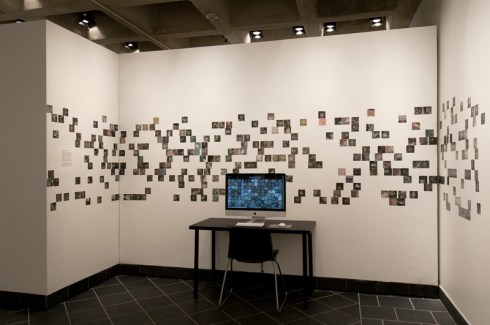
Prison Map, part of the exhibition ‘Prison Obscura’ at Haverford College, PA
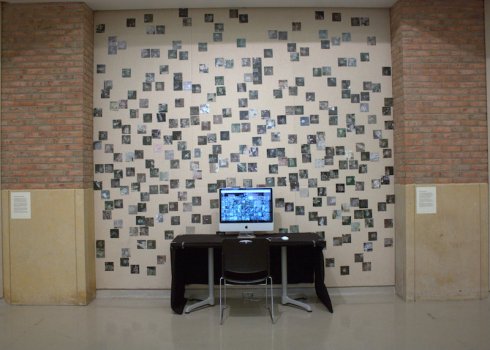
Prison Map, part of the exhibition ‘Prison Obscura’ at the University of Michigan, MI

Prison Map, part of the exhibition ‘Prison Obscura’ at Parsons New School, NY

Prison Map, part of the exhibition ‘Prison Obscura’ at Scripps College, CA

Prison Map, part of the exhibition ‘Prison Obscura’ at Newspace, Portland, Oregon
It was my intention to provide a visual backdrop to the computer/screen/console in the gallery at which people navigated Prison Map. Begley had, up to that point, never printed out the images from Prison Map (he did later make and sell large fine art prints), but physical objects were never the primary purpose of the project. Rather, Prison Map was an experiment how Google Earth could be manipulated to produce an image-set based upon a dataset; an experiment in how a corporation’s empire of images could be bent toward a social justice conversation. I’m speculating on this because I wonder if, after the point of automated capture, Schwartz intended to print out Corrections and stick it on a wall? There are arguments for doing so as valid as those for maintaining it as a virtual user experience. I should give Schwartz a phone-call.
I mention this, also, because there are other parellels between the work of Schwartz and Begley. In tackling the issue and enormity of the US/Mexico border, Begley made the film Best of Luck with the Wall and Schwartz made two accordion books. Both stitched together staellite images that tracked the entire border. One virtual, one physical.
On the topic of gun use, Begley made Officer Involved, which automatically captured Google Street View (GSV) scenes of the sites in which law enforcement officers killed a citizen, and Schwartz made Death By Gun, which maps firearm homicides in Los Angeles County carried out by citizens.
Both Schwartz and Begley are interested in tempting users to reimagine their smartphones’ purpose. Both are interested in having content “enter” the phone in real time. Once installed the Death By Gun app automatically saves the auto-generated images to the camera-roll. Begley’s MetaData+ app sends push notifications to your phone each time a confirmed US drone strike occurs.
Unsurprisingly, these two artists who are connecting the dots between non-human camera operation, emerging datasets and power as it relates to cyber-infrastructure, are both peering at surveillance too. Begley’s Profiling.Is usurps the photographs made by the NYPD during covert surveillance of Muslim owned businesses in New York City. While in Geo-fragments Schwartz uses GSV to automatically compose collages of sites a person (I presume himself) travels to over a 24 hour period based upon the GPS data *broadcast* by his smartphone.
What Now Then?
I’ve discussed the work of Begley and Schwartz at length because I feel they’re heading toward some very fruitful areas in which state and corporate power is challenged, if not subverted. We would do well to follow. Sure, putting the real estate portfolio of the Federal Bureau of Prison on a single wall makes for a stark visual argument–how can you not be effected by prisons filling your entire field of vision? Especially when each tile is only 4×6 inches and still the entirety towers over you.
Bringing the virtual into the real world can be a very canny strategy as Bernie Sanders showed recently in his commandeering of a Trump tweet and printing it out for the house floor. But visual effects work only in one place at one time. By contrast, superpowers’ surveillance and data gathering is non-stop. Consider that a citizen has the capacity to manipulate Google’s benign platforms but the US military has the power to plug in any data set of coordinates and launch a thousand drone strikes.
Beyond the information war in which art is essentially engaged against state and corporate malfeasance, art clearly has limited power. It is here that hacktivism and cyber-insurgence emerge as both tactic and necessity. Begley and Schwartz’s artworks reveal the gross concentrations of power inherent to astronautic surveillance but they do not fight it. They alter public perception of the oppression, but not the apparatus of oppression. Cyber-sabotage that downs, damages or compromises the apparatus is the front line of the fight. What does that mean for artists? Is hacktivism now the most crucial form of resistance? Is hacktivism art? Just spit-balling here.

Angelo on his cell bunk
–
Marc and Brett of Temporary Services shared a tribute to Angelo this week. They collaborated together on Prisoners’ Inventions, and although I never knew (very few people did) Angelo (not his real name, his artist name), I wanted to mark his passing here on the blog.
Prisoners’ Inventions started as a collection of more than one hundred annotated illustrations of inventions that Angelo made, saw, or heard about while incarcerated. From homemade sex dolls, salt & pepper shakers to chess sets, from privacy curtains and radios to condoms and water heaters–all “attempts to fill needs that the restrictive environment of the prison tries to suppress,” writes Temporary Services.
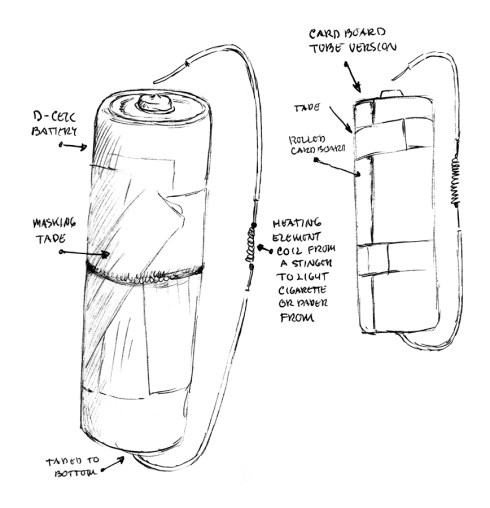
Battery Cigarette Lighter
It seems so long since Prisoners’ Inventions landed on my radar and even then, I was years late to the project. Someone showed me a copy of the book in 2011. But the first edition of the book was published in 2003, and new editions followed. In 2003 and 2004, Prisoners’ Inventions was presented as an exhibition at MassMOCA, complete with a full replica of Angelo’s cell, and later travelled to numerous venues. Around that time, international press blew up around the originality and the cheekiness of it all. This American Life did a bit.
Prisoners’ Inventions set a standard in many ways for artists and incarcerated individuals working in tandem–the way Angelo insisted on anonymity; the way Temporary Services held the space; the way together they let the illustrations do the work; the manner in which they (despite the barriers and censorship) communicated transparently and studiously; the way they fired public imagination with recognitions of human spirit, ingenuity and agency among a prison population so frequently vilified; the way Angelo and Temporary Services resisted any over-politicization of the project; I could go on and on.

Coat Hanger
Too often we think of art as being things not doings, as objects not relationships or as things that can exist on a shelf instead of in our hearts and minds. While Angelo and Temporary Services made objects based upon the drawings, objects were never the goal. Prisoners’ Inventions existed to demonstrate the innate creativity we all hold and also the potential in even simple written (and drawn) correspondence. It was about meaningful relation and understanding of people in very different circumstances. Temporary Services call Angelo their greatest ever collaborator, which is a huge statement from an art collective known for it communal underpinnings.
“Angelo’s writings and drawings about the creativity he observed in prison collapsed the distinctions between art and everyday survival,” said Temporary Services. “He transformed our thinking in ways that have influenced everything we’ve done since.”
In truth, Prisoners’ Inventions has influenced many an artist’s thinking and methodology since.

Steamer Cooker
A common problem with artwork that deals (even tangentially) with the issue of mass incarceration, or with prisoners directly as art makers, is that the art can often fail to break down the inherent power imbalance; that the prisoner is packaged by the outsider for outside public consumption. Furthermore, some art and language can’t help but fall into patronizing stereotypes about how the artist is helping the prisoner … and that the prisoner is helpless. Prisoners’ Inventions never trivialised, infantilized or boxed Angelo’s work. Nor did Temporary Services and Angelo ever try to argue it was something it was not which I think is a reflection of their trust, equity and confidence.
“People seem willing to accept the inventions of prisoners as creative objects that merit our attention and thought without us having to force them into goofy critical constructs like *Outsider Art*,” said Temporary Services in the book Prisoners’ Inventions: Three Dialogues (PDF). “These objects don’t need critical help to become interesting. New terminology does not need to be invented to create a niche market or new genre for a stick of melted-together toothbrushes and bits of metal that can be used to make apple strudel in a prison cell.”
If you can take the time to read Prisoners’ Inventions: Three Dialogues, please do. It lays out the origins, conversations, adaptations and logistics of the multi-year project. It elaborates on subtle concepts. It shows that good art rests on a solid idea and no-bullshit presentation of the idea. The way Prisoners’ Inventions moved through cultural space, both IRL (galleries, vitrines, fabricators’ hands) and virtual (image, video, online featurettes, audience mind and assumption) and through real economic systems is fascinating. The way Temporary Services discuss the negotiation of these things in relation to their promises and shared goals with Angelo is grounding and, I think, instructive.

Stinger (Immersion Heater)
Marc and Brett explain that since Angelo’s release in 2014 he lived quietly in Los Angeles, keeping to himself, catching up on TV and films he missed while locked up for 20 years. They also mention that Angelo had to wait until release before he could see and hold a book of his drawings; the prison administration banned any copies entering the prison because (and you can’t help but laugh) the drawings would show Angelo how to jury-rig objects and homebrew solutions!
The threat was imagined and the logic flawed, of course, but this brings me to a final point. Prisoners’ Inventions did not advocate for Angelo. Never did he and Temporary Services get involved in discussions about his case or legal matters. Not once did the work threaten prison security or reveal anything unknown to nearly every prisoner locked up in America. Opportunities for meaningful, collaborative and non-combative artwork within the prison industrial complex are few and far between. I think it is vital that we recognize art and activity that amplifies the existence of some without ignoring that of others; that we seek projects that lift us all. Mass incarceration is a depressing thing, but there are moments of humor, surprise quirk and enlightenment. Be ready for them! Prisoners’ Inventions succeeded in closing the gap between us and them without forcefully or uncomfortably insisting on the defining terms of us and them. Prisoners’ Inventions occupied a rarified space and we do well to learn from it.


I’ll close with a story about when, during a cell search, guards found photos of the full replica of Angelo’s cell.
“Stunned and angered that an inmate had somehow acquired photos of his own cell, the guard demanded information on how he got the pictures. When Angelo pointed out the fabricators’ subtle discrepancies in the cell recreation and explained a little about the exhibition, the guard’s anger quickly turned to wonder and amusement.”
Angelo, you mined your memory, you humbly shared your knowledge, you made drawings that confounded expectations and shifted minds. You never wanted fame or fortune. You made a thing that will last. RIP.


Screengrab from the header of the PDF of Day 3 (third installment) of the Complicity Cleanse
–
BETTER AT SMARTPHONE
There’s a bunch of things you can do to begin 2017 as less of a slave to your screens and phones. Lots of benefits to be had. You can ignore Tangerine-in-Chief-Twitter bile and be a better person! And I can take my own advice.
It does seem like a lot of us freaking out about our Internet diet.
“On average we spend 6 hours a day on our mobile phones. That means for everyone who only spends 2 hours a day on their phone, someone else is spending 10 hours,” writes Rik Arron. “Since the invention of email and then the rapid growth and use of mobile devices and social media – stress/anxiety/depression related work days lost has increased year upon year at an alarming rate, now costing US industry $300 billion a year.”
Marcus Gilroy-Ware says we use our smartphones for ONLY three hours day, but that doesn’t get us off the hook, because …
“From worrying reports of smartphone addiction,” writes Gilroy-Ware, “to the identification of smartphone faux-pas such as “phubbing”, [snubbing someone in a social setting by looking at your phone instead of paying attention] to the news that seven in 10 Americans have used a smartphone behind the wheel and one in 10 people check their phone during sex, the belief that smartphones are harmless is increasingly untenable.
During sex?! What the the is wrong with people?
SCREEN TIME
Do social media messagings, in aggregate, create your worldview? Does your smartphone function as an extension of your body? What are your happiness levels?
Seems to me we’ve got some choices.
- We can all throw our devices off the roof and go farmstead. (Not going to happen).
- We can accept our cyborg selves and just try to be the best digital slaves we can. Embrace being numb. (More likely to happen for some).
- We can carefully administer our relationship to technology. (Probably the most realistic, and at least there’s an ongoing conversation).
Option 3 also provides the hope that we can leverage technology to our own advantage instead of just handing over our social graph for Silicon Valley to make money on … and the governments to snoop on … and the corporations to purchase … and the hackers to compromise.
Option 3 allows us the possibility to actively shape our diet of screen-fed-info. May I recommend therefore, at the start of 2017, The Complicity Cleanse.
Between now and the Jan 21st Women’s March on Washington, the Complicity Cleanse delivers daily bites of strategies, words, podcasts and exercises to reminder us of our own power. These are things you consider on your own in quiet, or activities you sit down for with one or five of your closest mates.
SIGN UP FOR THE COMPLICITY CLEANSE
It’s a toolkit to being present with our world and it challenges. Some might scoff at the idea that we can fight police brutality and prisons by thinking and talking. But what else leads to consciousness? What else precedes the fight? What other process arrives at the best strategies?
Put together by a collective of social justice folks, The Complicity Cleanse can help you divest from the structures of oppression. High quality, recent resources in the realms of environmental protection, feminism, anti-corruption, anti-capitalism, anti-racism, community empowerment, anti-Islamophobia, the opposite to sexism, homophobia and transphobia. Sometimes it is profound information disguised as digestible affirmation. It’s a collection of 101 syllabi that posh college students pat tens of thousands for. It’s delivered right to your inbox.
One more thing, it’s for everyone! A lot of people get scared because they think lefties and radicals are militant. Some are, which is okay. Most are passionate, which is power. All are loving, which is important if social justice is to spread among peoples’ hearts. If the system is broken, show that it is broken. If we’re all worse off, then demonstrate that. If you’re argument is closer to truth then it’s merely a case of lovingly and consistently letting others in. Lots of political speak, unfortunately, gets heated and shouty. I like the humour and self-positioning of the Complicity Cleanse folks. I republish their call for involvement below.
WHO IS THE COMPLICITY CLEANSE FOR?

Anyone surprised by the election outcome. Really this was made for you. If you were surprised, or didn’t think that it was possible that a celebrity bully, openly endorsed by the KKK, with zero political experience, who grabs pussy whenever he feels entitled to it, could be elected by the people (Electoral College Scam) of the United States, forgive yourselves and in the space of forgiveness make room to learn a little more, change a little more, do a lot more.

You voted for this guy. No shame. We know you are just “fiscally conservative”. If you voted for this guy but somewhere in your heart there is a soft space for groups maligned by his campaign–this is for you… and the future of your tax returns, congrats.
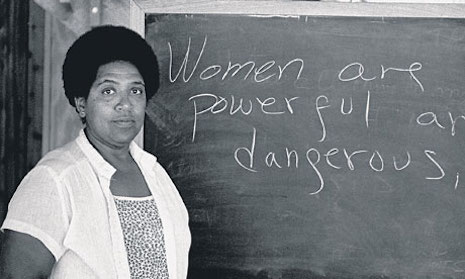
People who know who this is. If you are already involved in social justice movements, but you were caught off-guard by this election victory–this cleanse is for you.
Answer: Audre Lorde, if you didn’t know that–this Cleanse is for you.
People Of Color. First thank you for everything you and your ancestors have contributed to this country in spite of every violent hurdle thrown at, against, towards, and literally through you. The Complicity Cleanse is also for you. There is so much we need to share with each other– and this cleanse was written by a diverse group of human doings who believe that to be the case- we tried to be as inclusive as possible, if we fucked up– its an oversight, let us know. We all need to do better.

Uhm, yep definitely for you.

Neoliberals/Millenials/Academics, you are in all the other boxes, but we know you like to be acknowledged individually–look if you have a lot of overly academic language around racism, and heterosexism there’s probably a little emotion that could be tapped into–and possibly a little more grasping of classism, so sign up, tweet, post, share, IG, IM, FB, IDK, LOL.

Modern Day Yogis. Yep, you. You’re doin’ good, and you look good too– now do more. The ancient Rishis didn’t risk their lives to develop this practice just so you look better with a shirt off– this practice was designed to make you feel better, so you do more. Why build such a beautiful big ship if its just gonna be docked all day in breathable pants, take that thing into the turbulent seas. You know how to be productively uncomfortable, now channel that training to the betterment of others. Namaste.
SIGN UP FOR THE COMPLICITY CLEANSE
Basically we all could benefit from time spent with each other, time spent learning with and about each other–simply less time spent thinking about ourselves. This cleanse is most effective when done in groups or unexpected partnerships so we become more accountable to each other–all of us together, even the non humans. So we remember that ultimately we belong to each other, so we remember we are most effective together.

–
It’s not even December, but I’m getting my pick for photobook of the year pick out the way early. My choice for 2016 is the ‘Apple Cabin 2016 Calendar‘ by Sean Tejaratchi.
Advertising is super-weird, but our eyes and minds quickly become accustomed to its garish agenda. We are exposed to 5,000 ads daily. We ambulate through three dimensions constructed from image-planes urging us to buy buy buy.
Some ads are ingenious, most are not, and most follow formulas. Tejaratchi tweaks the grocery-store insert formula with nasty little words and plucky phrases. He shows advertising to be the creepy thing it is. In the Apple Cabin calendar he takes a pop at foodstuffs that are luminous, canned, mysterious. As food-desertification checkers its way across the United States, we’re reminded that many Americans eat stuff closer to Soylent Green than fresh farm greens.
Tejaratchi undermines the footings to advertising generally. The ‘Apple Cabin 2016 Calendar’ is the anti-ad; the anti-Times Square; it’s the opposite of political pantomime; it’s a gross mirror to the fact an orange man-baby tantrumed his way to the White House by means of simplistic and fear-based messaging.
In a rather humorless year, thank god for Tejaratchi.




–
Louisiana State Penitentiary, known commonly as Angola, is the largest maximum security prison in the United States. Of its 6,300 prisoners, over 85 percent are serving life. This shocking fact is due to Louisiana’s harsh sentencing laws. Activists and reformers who fight against Life Without Parole (LWOP) sentencing refer to life sentences as “death by incarceration”. If we focus on the fact of death–as opposed to focusing on the crime, transgression, legal proceedings, or behaviour of the men during their incarceration at Angola–then we see with stark clarity the brutality of the system.
The catastrophic results of LWOP are many, but perhaps one that isn’t so obvious is an emotional turmoil surrounding the death of prisoner’s loved ones during incarceration. What do prisoners think about, do about and cope with when they hear of death beyond the prison walls? What are their responses to sudden death in free society when they’re condemned to a slow, slow death inside the prison industrial complex?
These questions were the starting point for Stories from Prison/Honoring Ancestors, a collaborative project led by Benjamin D. Weber in collaboration with Angola prisoners, their friends and family and students at the University of New Orleans (UNO).
“Due of the length of their sentences, most of Angola’s prisoners have experienced the loss of a loved one while they have been locked away,” says Weber. “Prisoners are quick to remind you, many are doing life for non-violent offenses and many others for first offenses that would not carry such a sentence in just about any other state.”
Weber decided to create a collaboration in which a group of allies could commemorate prisoners’ loved ones who had passed. The commemorations would be directed by prisoners.
Weber distributed forms at Angola on which prisoners could tell a story about a loved one who had died, and request for them to be commemorated in specific places that were meaningful to them. The prisoners chose whether they wanted their story to be shared publicly or not.
All of the commemorations, photographs and supporting documents are presented in interactive map form at the Stories from Prison/Honoring Ancestors website.
Groups of UNO graduate and undergraduate students and Weber performed the commemorations. They then mailed letters and photographs to the prisoners.
“Prisoners requested all sorts of different actions to be performed,” says Weber. “We released balloons inscribed with special messages, visited grave sites to recite poems, placed flowers and a bingo chip atop a waterfall, and even improvised a dance with relatives.”
In the process, Weber and the UNO students discovered that the photographs fell secondary to the performances and commemorations. The photographs are important documents, but creating the photographs was not the primary focus during the commemorations. When it came time to commune and be present with one another, making photographs didn’t always seem important, mindful or, frankly, appropriate.
“Many [photos] were snapped on students phones as we sought to document what we were doing without interrupting it too much,” says Weber.
Such adjustments to behaviours and goals were typical of Stories from Prison/Honoring Ancestors and, indeed, are common to similar socially engaged projects.
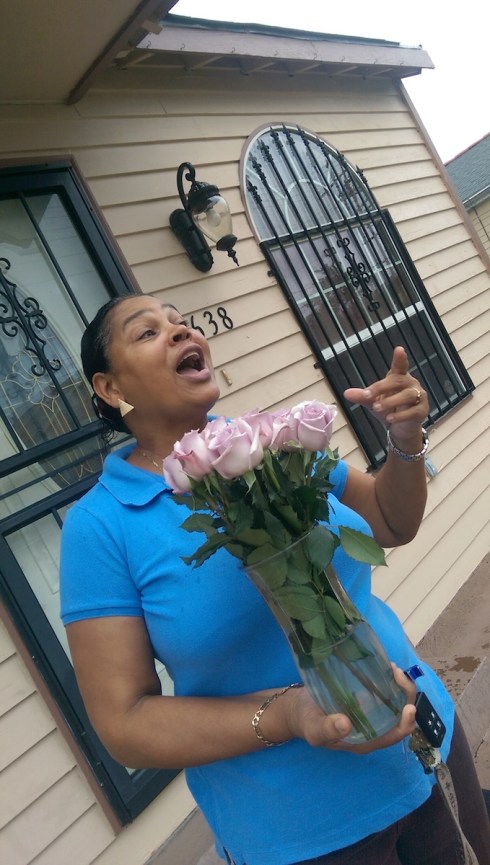
Weber was kind enough to speak about the motives, the involvement of the community, the students’ learning and the outcomes of the project. Here, we publish a Q+A and photographs fulfilling the requests of Gerald Davis, Derrick Allen, David Wilson and starting (below) with Elmo Duronselet
–
Elmo Duronselet

–
Q + A
Prison Photography (PP): Your PhD covers the eighty years between the Civil War to the end of WWII. You have many intersecting interests in prisons, policing, society. How do you summarize the origins and growth of the prison industrial complex in the United States?
Benjamin Weber (BW): There are a number of reasons why the dissertation covers that particular time period. The first is the massive expansion of racialized incarceration that took place after the Civil War, triggered in part by the “convict clause” of the 13th Amendment which allowed for the perpetuation of slavery and involuntary servitude as “punishment for a crime.”
I see the origins of this expansion of the prison system as being bound up with war-making and imperial expansion, first across the continental U.S. and then, especially after 1898, overseas. That’s why the dissertation focuses on practices of confinement and forced labor in places like the Pacific Northwest, the Panama Canal Zone, and the Philippines. I believe that if we can understand these things as part of a history of racial domination in U.S. empire, we might be able to think more clearly and critically about how to fight against them in the present. Or to put it slightly differently, if we can better understand the origins of the problem, as you point out, we might better understand the range of possible solutions.
PP: Where does your interest in incarceration stem from?
BW: I believe the problem of mass incarceration to be the defining social justice issue of our generation.
My academic interest comes from a place of trying to understand how various forms of injustice have operated and how people have struggled to combat them in the past, and the present. My personal commitment comes from experiences visiting friends and former students in jails back in California and witnessing first hand the way that young people, particularly people of color, are treated by the police and prison systems.
Working alongside others who have friends and family members who are locked up provides example after example of how terribly broken and institutionally racist the system is.
–
David Wilson


–
PP: You’re at Harvard. This project was at the University of New Orleans. Was this first project for which you’ve travelled and worked with students elsewhere? I ask this because I wonder if it could function as a pilot; with elements that are all replicable by you, or others?
BW: This project came together the way it did largely because my partner and I moved to New Orleans so she could do residency in her hometown and I could finish writing the dissertation and start in on the book manuscript down here. The timing worked well because UNO Professor Molly Mitchell was interested to have the Midlo Center participate in the States Of Incarceration national public history project. So, I agreed to come help run the Louisiana piece of that project.
The Midlo Center has a visiting scholars program that could be replicated by other universities. In terms of replicable elements, I think the workshop or toolkit model tends to be more common when it comes to traveling to work with students from other universities. It worked really well, for instance, to have Mark Strandquist come and do a workshop with my students and I’ve talked with him and many others about how to share materials, strategies, and best practices about teaching issues of racism and mass incarceration. There’s already some really great stuff out there as well; The Knotted Line, as one example, has some pretty creative and inspiring examples of educator resources and curriculum guides for teaching about the prison industrial complex.
PP: The methodology of the project was inspired by Mark Strandquist’s Windows From Prison, but there’s a key difference between the methodology of Strandquist’s project and yours: You are convening a group at a specific place for an action and memorial. Place and gathering is important, for example, in Photo Requests From Solitary by Tamms Year Ten, I was always thrilled by Rachel Herman’s photograph of Bald Knob Cross for Willie Sterling because Mr Sterling understood he could use the general offer to make a photograph to bring/force people together in a physical space, beyond the prison walls.
How important was it for you to convene a group? Was that the core of the project? What does that convening do?
BW: The Tamms Is Torture project is an amazing example, and reminds me in some ways of the role of art-activists like Jackie Summell and Brandan “BMike” Odums in the campaign to free the Angola 3 down here in Louisiana. The comparison with Rachel Herman’s photo is really apt, because we definitely saw ways that prisoners improved upon our project design in precisely this same way.
There were cases where they would write in a person’s name in the line that asked where they wanted us to perform the commemoration. They explained that we could best honor their deceased loved ones by talking, singing, and even dancing with their living relatives. These were some of the most moving experiences for everyone involved.
PP: How did your discussions with students differ or remain the same throughout this project as compared with lectures/seminars in the classroom about incarceration?
BW: In his workshop, Mark Strandquist encouraged us to do the commemorations in groups and spoke about the importance of embodied learning. This type of convening allowed for conversations that could never happen inside a classroom. It was also profoundly moving to see how people of different faiths and spiritual traditions talked and went about honoring ancestors, as it were.
–
Derrick Allen


–
PP: What were the responses of family and friends of the prisoners with whom you contacted and held memorials?
BW: There was definitely a range of responses, from the cautiously apprehensive to the overwhelmingly appreciative. Some relatives who weren’t especially religious were suspicious at first that we belonged to a church group, while others who were more religious promised that God reserves a special place in heaven for people who take time to do this kind of work on behalf of their friends and family locked away in the Louisiana State Penitentiary.
Some were somber in their recollections about deceased loved ones, while others laughed and joked as they told stories about the person a given prisoner had asked us to commemorate. When we went to find Elmo’s aunt Tamika and do a dance, as he requested, at first she laughingly begged us not to, but we all felt like we needed to honor his request down to the letter so ended up doing a little dance right there on her front doorstep.
Occasionally, interactions turned into more sustained collaborations. Liz, whose fiancé is at Angola, not only performed the commemoration along with us but has stayed involved with the project and will be coming with us to the States of Incarceration exhibit launch in New York City.
PP: Have you received feedback from Gerald, Derrick, Elmo, David or other prisoners about the photo/results of the project?
BW: We received thank-you letters from several of them, and some have carried on extended letter-writing exchanges with my students and I.
Derrick wrote to us that receiving the letter and pictures from the commemoration “kind of felt like the service itself to me,” and signed off with this quote: “there are things we don’t want to happen, but have to accept, things we don’t want to know but have to learn, and people we can’t live without but have to let go.”
Sean told us that “when my days get gloomy, now I have the memories of what you all have done for my mother and for me.”
Gerald and Hannah have now written upwards of ten letters back and forth. And the forms of communication flow in other ways as well. Liz’ fiancé called her during an event we were having at the Ashé Cultural Arts Center, for example, and we were able to put him on the microphone to speak to the audience.
Gavin spoke to one of his family members on the phone and had her email me for him to clarify some things about the commemoration we were planning for his father who had recently passed away.
–
Gerald Davis

–
PP: Shortly after you made this work with prisoners of Angola, the longstanding warden Burl Cain resigned amid still-as-yet unclear accusations of shady business dealings. What was your experience working with Cain? Did the prisoners have anything to say about his regime? What lies in store for Angola in the wake of Cain’s departure?
BW: I worked primarily with the staff at Angola’s prison museum, but did have to get approval for the pilot project from Warden Cain’s chief of security and the public relations manager there. There is always a period of transition where people are worried about how things were shift around and shake out when an entrenched figure like Burl Cain leaves a prison like Angola.
The prisoners we worked with didn’t say anything specifically about Warden Cain. Some mentioned being optimistic that the new Louisiana Governor, Democrat John Bell Edwards, will have a better stance on pardons and clemency than Bobby Jindal, the outgoing Republican Governor. As one of them put it in a recent letter to me: “The new governor is supposed to open up doors for some offenders a little early…”
I’m honestly not sure what lies in store for Angola in the wake of Cain’s departure, but I do know that we all need to continue doing absolutely everything we can to address the shamefully high rates of racial disparity in incarceration in Louisiana and around the country, and stop putting so many people in cages period.
Because we know that prisons don’t work.

–
I can’t go to this but everyone in the Bay Area should.
–
Fighting Mass Incarceration: Strategies for Transformation
277 Cory Hall (off Hearst Ave) UC Berkeley
April 12, 2016
3:30pm-5:00pm
Discussion led by James Kilgore
THE BLURB
With the sudden trendiness of opposing mass incarceration, Dr. James Kilgore will critically examine the idea that bipartisan unity and legislative change hold the key to transforming the criminal justice system. Dr. Kilgore will outline how his book, Understanding Mass Incarceration: A People’s Guide to the Key Civil Rights Struggle of our Time, and what it aims to achieve as well as discuss the potentials/pitfalls of the present moment in the struggle to end mass incarceration.
Kilgore argues that the key to this issue is to build a large social movement led by those who have been critically impacted by mass incarceration. It is a movement that makes alliances with those fighting other key struggles of our time (climate justice, gender justice, economic justice, etc.) and creates a collective alternative.
Topics will range from building out from the New Jim Crow analysis in relation to race, class and gender, examining political processes like reparations and Truth and Reconciliation Commissions as processes for transforming the criminal legal system and how we collectively imagine alternatives while fighting for important reforms.
KILGORE
Dr. James Kilgore is an activist, educator, and writer based at the University of Illinois. His most recent book is Understanding Mass Incarceration: A People’s Guide to the Key Civil Rights Struggle of Our Time. He is also the author of three novels, all which he drafted during his six and a half years in federal and state prisons in California.
DETAILS
277 Cory Hall (off Hearst Ave) UC Berkeley
Tuesday, April 12, 2016. 3:30pm-5:00pm
I mean really, at this point, what should we expect? I’m getting sick and tired of centrist, rightwing (and older) Americans ignoring the wonderful examples repeatedly set by youngsters about humane ways to treat one another.
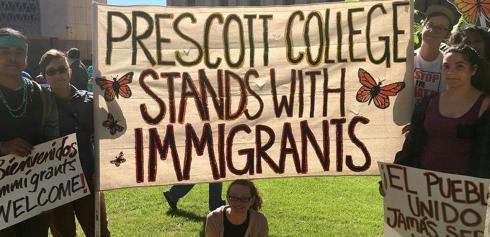
Latest example? In Arizona, the students of Prescott College, a small liberal arts school focused on environmental education, recently voted by a huge majority to initiate a $30 added charge to their annual tuition fees. The $15,000 that will be raised is to pay for a scholarship for one undocumented person to attend the college.
It’s laudable. It’s community minded. It’s called the Freedom Education Fund.
A few things to note first.
- This was a student led initiative.
- No faculty or administrative body foisted this upon the kids.
- This is a relatively small gesture: This fund will assist one teenager from an estimated 65,000 undocumented high-school graduates each year. (Only 10,000 of those graduates enroll in college each year.)
- This is a massive gesture in Arizona, a state in which voters approved Prop 300, a 2006 ballot measure, that prohibits students from paying in-state tuition and receiving federal and state financial aid if they cannot prove they are in the U.S. legally. Prescott College, a private institution, is exempt from the law which polices only public colleges and universities. Here then, relatively privileged kids are acknowledging and acting upon their privilege. This is Millennials being global citizens. Meanwhile the powerful in our world are hoarding and secreting cash left, right and centre!
Really, what is wrong with rightwing media like Fox and Breitbart who cast this empowered and beautiful move by students as a “levy” and a sneaky, “mandatory” subversive maneuver? What are right-wingers so fearful of? What whinging, narrow-focus on the world do you grip when youth solidarity bothers you but bloody-minded racism you let pass? What small world does one inhabit, if youngsters’ kindness to one another is cause for contempt?
Hurrah, kudos and all the very best to the students at Prescott College. Don’t listen to the haters and don’t let them distract you from the love you bear, the values you hold and the structural tweaks you make in the cause of social justice.
–
More at Mic and Phoenix Times.

–
There’s a massive prison labor protest in the offing.
If plans go according to plan, a coordinated and rolling series of shut downs will begin September in prisons across the United States.
Prisoners are staging the walk out to protest “wages” as low as 20cents/hour. Even well paid prison jobs rarely pay more than a dollar an hour, before deductions. (The top earners in the Federal Prison Industries and UNICOR earn $1.15/hour, before deductions).
Supporters of the strike are arguing that prison labor is modern day slavery. I can’t argue with that. The 13th Amendment to the U.S. Constitution, which abolished slavery, also maintains a legal exception for continued slavery in prisons. It states “neither slavery nor involuntary servitude, except as a punishment for crime whereof the party shall have been duly convicted, shall exist within the United States.”
I don’t know how many hundreds of thousands of prisoners work in prison factories and the like. 21,000 alone work in the Federal system.
Prison labor is not an issue entirely ignored by artists. In the past, Sheila Pinkel shone a light on the issue. Currently, Cameron Rowland is doing the same.
WHY DON’T WE SEE PRISON LABOR?
There are many grievances prisoners have with their detention. If outside society humors any of them, it usually humors calls for safe and sanitary conditions. Rarely, do you find outsiders calling for fair and equitable pay for the 40 hour weeks (or more) that prisoners work for pennies on the dollar. We make calls for secure and clean conditions because we’d not want to suffer squalor. Why then can we not make calls for the abolishment of legal slavery in the form of prison labor? Perhaps because we can imagine the smell of a putrid cell tier, but we cannot picture what prison work looks like?
Well, prisoners do everything from stuff mattresses to refurbish wheelchairs; make school dinners to shape Wendy’s and McDonald’s beef patties; stitch Victoria’s Secret panties to manufacture US military uniforms. Prisoners work as outsourced and subcontracted labor for corporations such as Boeing, Whole Foods, Walmart, Starbucks and Verizon. Prisoners man call centers for any number of private companies.
–

Prisoners work as operators at a call center in Snake River Correctional Institution. Perry Johnson Inc., a south Michigan based consulting firm has employed SRCI prisoners for over a decade. Little has been published online about the SRCI call center in recent years. Here’s a 2004 article about it.
–
Prisoners organizing the strike are not making demands or requests in the usual sense. They are calling each other to action in the hope that coordinated refusal to work will cause the prison industrial complex to creak so significantly that the nation will notice.
If critical mass is achieved, creaks and cracks will occur. A significant portion of America’s prison systems are built upon the cost savings, management philosophies and bottom line economics permitted by prison labor.
The planned action is essentially a good old strike, but of course, the repercussions for prisoners could be much more severe than the average worker: lockdown, solitary confinement and/or infraction charges that might jeopardize future parole.
WHY SEPTEMBER 9TH?
On Sept. 9th, 1971, prisoners shut down and took over Attica, New York’s most notorious prison. A total of 43 people were killed in the Attica prison riots—one of the darkest chapters in American penal history.
RECENT PRISON PROTESTS
Prisoners and their supporters can take heart and inspiration from prison strikes in recent years. The most well known would be the Prisoners Hunger Strike in California (2011-2013). The Free Alabama Movement in 2014 work stoppage garnered much attention. As did the 2010 Georgia Prison Strike. Hunger strikes at Ohio State Penitentiary, Menard Correctional in Illinois and at Red Onion Prison in Virginia flew under the radar of mainstream press. In December, women prisoners at Yuba County Jail in California joined a hunger strike in solidarity with women held in immigrant detention centers in California, Colorado and Texas.
Some actions have already kicked off in Texas.
There are many threads to the argument against prison labor, but none is better than outsiders making the leap to demand an end to exploitation that they would not tolerate for themselves or their loved ones. Remember, work programs and industries often operate in replacement of legitimate education and rehabilitation services.
Learn more at the Incarcerated Workers Organizing Committee.
Download the 2016 National Prison Strike pamphlet here.

 Prison Photography