
You are currently browsing the category archive for the ‘Amateur’ category.

The BBC reported today that Italy was to open its first prison to serve specifically transgender prison population. In terms of its policy and service, such a move is welcome and progressive.
The US, however, doesn’t have specific institutions for its transgendered inmates, instead it employs the following policy:
This rigid policy can result in housing a woman (male-to-female trans) with a male inmate in the same cell. When this occurs, violent and/or sexual assault is common. Karen Franklin PhD posits that the prison system in the US establishes for transgendered youth a track toward future incarceration;
So Italy is leading by example? Well, yes and no. The prison at Pozzale (near Florence) was formerly a women’s prison subject to senior staff abuses, consequent court battles and ongoing bureaucracy ensuring mismanagement of resources. Recently it has housed only two inmates while other prisons in the area were overcrowded. The transgender prison is the socially-responsible solution; a new start for an institution with a corrupt past.
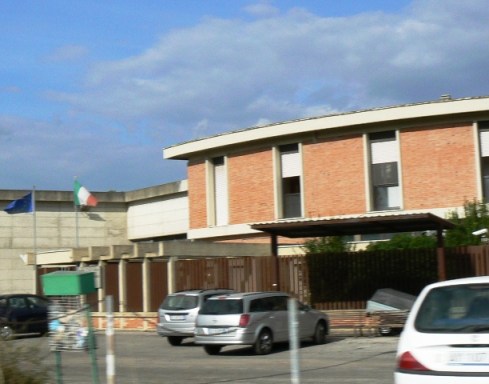
There is a total dearth of photographs of this institution, but also of trangender prisoners in the media today. I hadn’t paid it any thought until I was pressed to search for images for this post. I hope and expect that photojournalists will document activities at the prison once the new inmates arrive. It is a worthy story; there is a need. I suspect the Italian authorities would want to put a positive media spin on the story, and also on the trangender realities that are unfortunately still uncomfortable and/or controversial for some members of the public.
Further reading
The first Spaniard to discover the island was Juan Manuel de Ayala in 1775, who charted San Francisco Bay and named the island “La Isla de los Alcatraces,” which translates as “The Island of the Pelicans,” from the archaic Spanish alcatraz, “pelican”, a word which was borrowed originally from Arabic: al-qaṭrās, meaning sea eagle.
Source
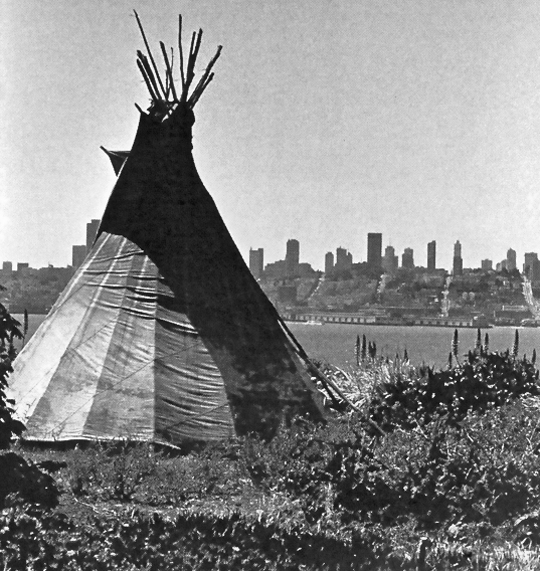
Last Friday, I posted a well received interview with Ilka Hartmann, a photographer of the Indian Occupation of Alcatraz. In a quick follow up I wanted to share with you two things:
1. The above photo because I think it is wonderful.
2. CNN’s feature in which Adam Fortunate Eagle talks of the effect the Occupation – the most important event in Native American history since the 1876 Battle of the Little Bighorn – had for establishing and progressing the Native American’s call for awareness, rights and reparation.

Still from video shown to the Baha Mousa public Inquiry showing Corporal Donald Payne, formerly of the Queen's Lancashire Regiment, shouting and swearing at hooded Iraqi detainees.
The British Army is facing accusations as serious as those leveled against the US military at Abu Ghraib.
Let me offer some context of UK Army abuses in Iraq.
Only one British soldier has ever been sentenced to prison for detainee abuses in Iraq. He is Corporal Donald Payne. Above is a still from this very disturbing video which was released in June of this year into the inquiry of Baha Mousa‘s death. A long-running and contradicting narrative followed this case since Mousa’s death in 2003 and the opening of the first inquiry in 2006. BBC has a timeline.
It seems that Corporal Payne and the six other soldiers aquitted during this inquiry may not have been the only British soldiers involved in abuse. I must say that these allegations are still just that – they are unproven, yet to be fully investigated.
Robert Verkaik of the Independent has pursued this story here and here:
The 33 new cases, which form part of a pre-action protocol letter served on the MoD last week, include allegations of mock executions, dog attacks, rape, exposure to lewd acts and exposure to pornography. The abuses are alleged to have occurred in 2003 – the time as Baha Mousa’s torture and death.
It is suggested it has taken so long for the allegations to come about because the Iraqi’s were fearful of reprisals during the British occupation of Southern Iraq. UK forces pulled out in April, 2009. Three camps are named: Shaat-al-Arab camp (shown below), Shaaibah British camp and Akka in Al-Zubayr.

Shaat-al-Arab camp, Southern Iraq
Details of abuse:
In May 2003, a 16-year-old Iraqi was among a group of Iraqis taken to the Shatt-al-Arab British camp to help fill sandbags. When the Iraqi youth, who wishes to remain anonymous, and his friends had filled the available sandbags, a British soldier indicated that he should enter a room, from where he assumed that he was to retrieve more sand bags, he says.
On entering the room, he claims he saw two British male soldiers engaged in oral sex. As soon as the two men saw him enter, they started to beat and kick him, he alleges. When he fell to the floor, one of the men held a blade to his neck while the other soldier stripped him naked. Although he screamed in protest, the two British soldiers, one after the other, raped him.
More:
They took off our blindfolds and I could see that we were surrounded by seven or eight soldiers. There were five of us. They asked us to pick fights with one another, or fight them. They were laughing at us and taking photos with digital cameras. They made us squeeze in pile-up, as in Abu Ghraib prison photos, while a soldier stood on top of us and started shouting and laughing. I felt so humiliated and treated as a toy they messed up with.
They picked further on a younger man who was good-looking. They made him strip naked and started messing with his penis and taking photos. “On one occasion I refused to pick a fight, then a soldier kicked me hard on my back, which made me fall on the floor. He started hitting me with a baton on my knees. Then he used an electric baton on different parts of my body.”
Source: Independent Saturday, 14 November 2009
Of course one wonders now whether the investigations will publish the photographic evidence or if it will be used only internally.
Personally, I have no desire to see these images. I sympathise with arguments to say that only through release of such images can the world know the full extent of what happened, but I also doubt what we can actually and accurately “know” from photographs that we wouldn’t otherwise learn through full disclosure and description of events.
It is extremely unfortunate that both Google and Daylife image searches for “Shaat-al-Arab camp” result in this image.

British soldiers share a laugh as their comrade walks around dressed as Borat, the Kazakh journalist played by British comedian Sacha Baron Cohen, during Christmas celebrations at the Shatt al-Arab camp in the southern Iraqi port city of Basra on December 25, 2008. The Iraqi parliament has voted to allow the presence of non-US foreign troops after December 31, giving British troops a legal basis to remain beyond the expiry of a UN mandate. © ESSAM AL-SUDANI/AFP/Getty Images
But the madness, brevity, violence, stress, justified escapism, testosterone and “laws” of war are vastly different than in any other milieu.
It just seems to me that the internet has collided stories and images here that could be as valid a critique of 20th century war as any of the great American Vietnam films.
____________________________________________________________
Interestingly, Shaat-al-Arab camp was erased by Google from their maps three years ago for security reasons. This action seems warranted as Shaat-al-Arab camp was a common target for insurgents – as Abu Ghraib was. Details are described half way through this article.
Thanks to Sean for the tip off.

Aside the Coca-cola vending machines and Cheetos, portraits and photo-keepsakes are probably the most ubiquitous objects in prison visiting rooms.
I have speculated before about a massive, dispersed collection-without-walls made up of the millions of prison Polaroids; a sprawling, bittersweet and neglected vernacular photo-archive of true American experience.
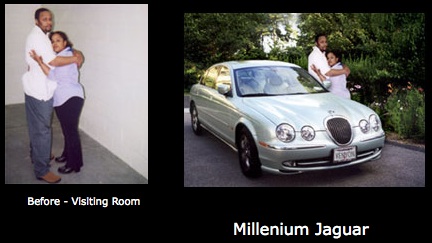
Polaroid cameras are still the standard for prison visiting rooms as they provide instant results and they don’t have the “security issues” associated with he transferability of digital files. No matter the format, Friends Beyond the Walls will help construct your photo-idyll:
There is plenty of scope here to pour scorn upon the low-brow photo-manipulation, and there is (justifiable) reason to question the financial gains of the company involved in providing such a basic service, but I won’t go there.
People aren’t stupid. They won’t invest their emotions in “Composite Magic” if they don’t want to. But if someone does make use of this service then so be it – we all spend silly money on items foreign and bizarre to one another.


I will say this: prisoners and their families develop fast and hardened interactions with correctional authority. The procedures of the visit become as routine as picking up the paper or grabbing a morning coffee. It makes sense that some of that population would take the opportunity to leave that dictated reality behind and reclaim (visual) identifiers that don’t belong to departments of corrections and criminal justice.
Therefore, the only real way to discuss this niche photo-aesthetic and grow a legitimate appreciation would be to talk to the sitters, consumers and owners of this niche photo-aesthetic. That could be the territory for anthropologists and sociologists or, as easily, it could be the chatter of ordinary people who still take an interest in other ordinary people.


A Developing Story is a new joint venture by Johnny Bennett, Phil Maguire and Benjamin Chesterton of duckrabbit.
In an email a few months ago, Ben said to me his interest lies in “getting under the skin of NGOs” and have them realise that they can deliver their stories and campaigns in far more effective ways. A Developing Story wants the stories told in Government & NGO international development campaigns to outlast the short term objectives of said campaigns.
A Developing Story proposes that the media of these campaigns is deposited in a common silo, accessible by all (usually under a Creative Commons license) so stories – once created – can tell themselves infinitum.
Given the primacy of Creative Commons and open-source content, Matt and Scott at DVAfoto needed clarification on A Developing Story‘s impact on the photographer (which was provided). I have fewer worries as I feel this venture is aimed at transforming media sharing practices among government funded and NGO initiatives rather than another pressure on the distribution and remuneration of individuals’ works.
I would anticipate that the payments made to photographers and journalists by media campaign management will continue and that photographers will take on assignments in the knowledge that their work can be used repeatedly for non-profit purposes.
That said, A Developing Story is very open to individual contributions. This is the most relaxed approach to collaboration I’ve witnessed!
So, as Ben asked, “Can You Help?”

Three months ago, I wrote about Silja Talvi‘s excellent book Women Behind Bars.
It turns out the Texas Department of Criminal Justice also noticed it. They banned it – along with another book, Perpetual Prison Machine by Joel Dyer. Both books are distributed by Prison Legal News – a phenomenal non-profit based here in Seattle that educates America’s incarcerated class on its human and legal rights.
Prison Legal News has launched a lawsuit against staff and senior officials of the TDCJ. Money is not as issue here, principle is. “PLN is seeking compensatory, punitive and nominal damages plus declaratory and injunctive relief for violation of its rights under the First and Fourteenth Amendments, as well as attorney fees and costs.”
WHAT TO DO
Visit Change.org and read my brief article.
Download the full PLN lawsuit (PDF).
Sign the petition to the TDCJ for reversal of their censorship policy.
In the past I have provided varied perspective on Guantanamo. I put together a rudimentary Directory of Visual Resources. I alerted readers to important coverage of exceptional events here and here (granted, all events related to Gitmo are out of the extraordinary) and I have provided reflection on Guantanamo through the lenses of Bronstein, Clark, Gilden, Linsley, Pellegrin, Toledano and Lieutenant Sarah Cleveland.
Ultimately, none of these posts come close to describing or making sense of that most nonsensical of places. And so to ACLU’s latest video. My good mate Stan (cheers pal) posted earlier today:
Elsewhere, a friend of Prison Photography alerted me to the online journal JumpCut. Julia Lesage has assembled the most comprehensive webpage of Guantanamo links I’ve ever come across. Some of the links are already 404, but I would encourage you to peruse – I have still not exhausted the many resources. Leasge also contributes to the Spring 2009 issue with a section on ‘Documenting Torture’.

Past and present ruminations about what is and isn’t a photograph have been a source of frustration for me. For one, people can draw whatever lines they wish to determine the point at which manipulation tricks out a photograph and thus qualifies it as photo-illustration. And for another, as Errol Morris keeps banging on about, ALL photography is lies (and manipulation).
These debates are not about truth. Interventions – power relations, habit, photographic custom, complicity among subjects, props, political agendas (and framing), cropping, tweaking of exposure levels before and after development, digital alterations – mean that photography can never be, will never be truthful.
People forget that often it is the ingenious tricks that have spurred the largest wonder among viewing public – think Oscar Rejlander’s Two Ways of Life, Spirit Photography and – in a different sense – Ansel Adams’ Zone System.
It is therefore, with some relief that an artist like Azzarella comes along using photo-manipulation as the tactic and purpose for his work.
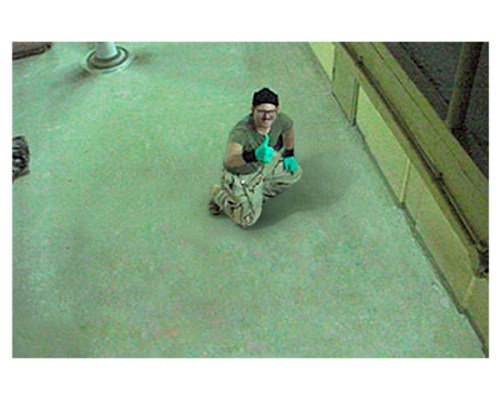

Last week, I questioned Anton Kratochvil’s Homage to Abu Ghraib, mainly because I think it makes little contribution to the discourse on the political aesthetics of Abu Ghraib. The blurry references to torture in Kratochvil’s images are in response only to a personal, conscious and willing point of view. I understand that Kratochvil’s work was an exercise in self-therapy but that shouldn’t stop me comparing it to Azzarella’s broader concerns about more general and unconscious reactions to well-circulated images.
If I w re to wr t th s sent nce wi h lette s m ss ng, you can still read it. The human brain is a wonderful instrument drawing on past experience to quickly filter out the non-possibilities. Just as the brain instantaneously deciphers gaps in text so it does with gaps in images.
With every passing hour the Spectacle suffuses itself further. It isn’t so much us reading images but images reading us. Our involuntary responses to images are predictable, predicted, precoded. The redacted action of violence in Azzarella’s pictures plays second fiddle to the original image, for it is the original image we drooled over and devoured.
The hooded detainee, dead student, wailing child or falling soldier needn’t even be present; our internal, emotional feedback spun by these images will forever be the same. We fill in the gaps and short circuit to prescribed disgust, sadness and politics, thus confirming our prevailing bias.
Azzarella’s works expose the fraud in us all … and our cheapened, robotic response to image.

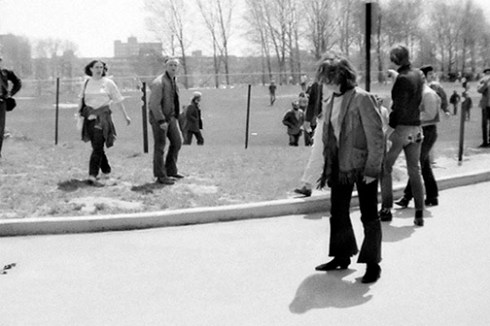
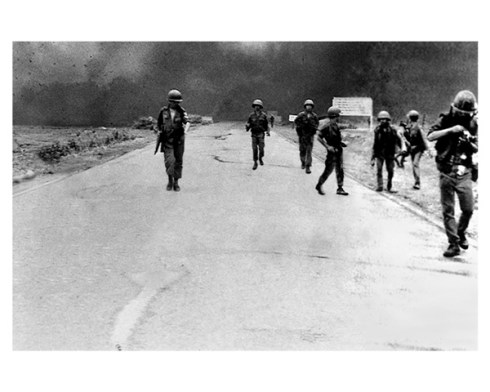
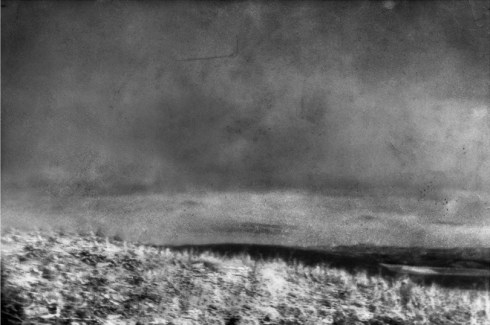
ALL IMAGES © JOSH AZZARELLA. FROM TOP TO BOTTOM: UNTITLED #13 (AHSF); UNTITLED (SSG FREDERICK); UNTITLED #24 (GREEN GLOVES); UNTITLED #35 (CAFETERIA); UNTITLED #39 (265); UNTITLED #20 TRANG BANG; UNTITLED #43 (PAR115311).

 Prison Photography