
You are currently browsing the category archive for the ‘Amateur’ category.

Discombobulated
I was delighted to find this collection of “Jail Finds” recently. It is a quiet statement amidst the cacophony of dross we are subject to daily.
The person who documents these notes, scribbles and profundities works for a volunteer library service serving the local Dane County Jail and operated by the University of Wisconsin in Madison.
These are things I find abandoned in books or stuffed on the book cart at the jail where I volunteer. A little context: these come from a county jail, not a state prison – a very important distinction. Most inmates (approx. 75%) are short-term “holds.” They’re there awaiting trial (meaning they couldn’t afford bail); on probation violations; or are federal prisoners being shuffled around the system. About 1/4 are women and 1/3 are minorities. The vast majority stay less than 30 days.
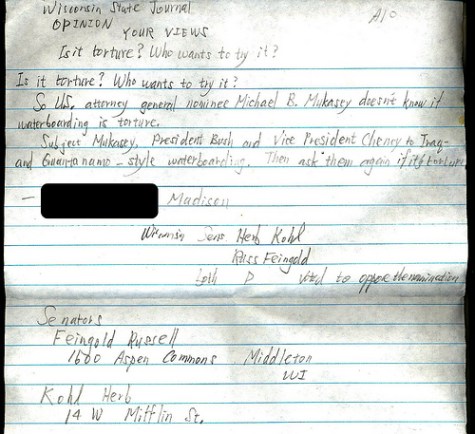
"Subject Mukasey, President Bush and Vice President Dick Cheney to Guantanamo style Waterboarding. Then ask them if it is Torture."

Events and Consequences

Health Testing Request
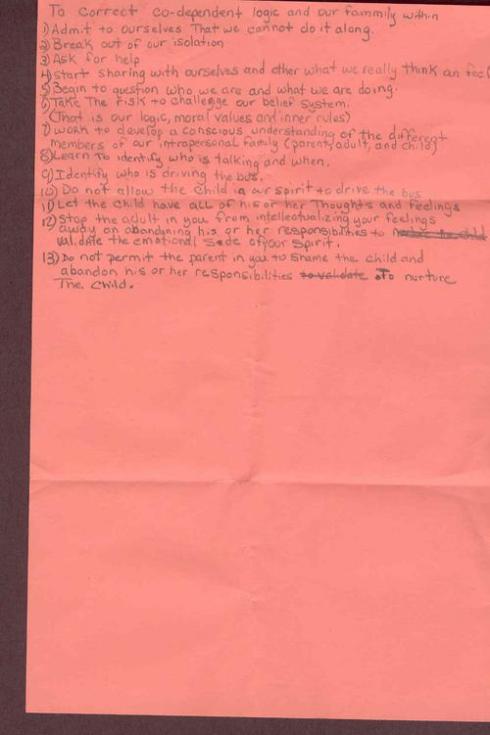
Childhood and Adulthood
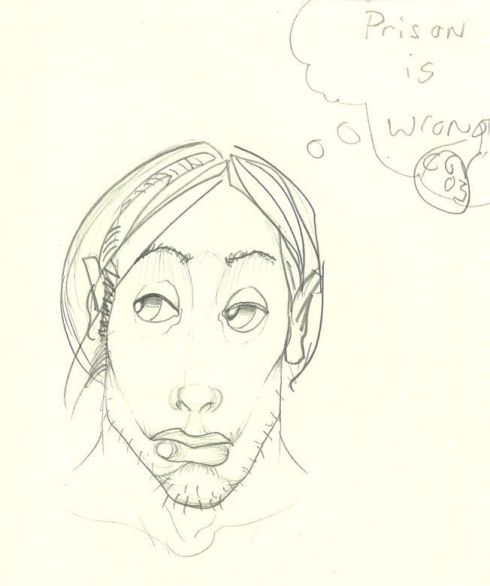
Prison is Wrong
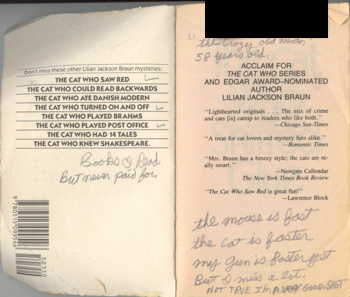
The Mouse is Fast, The Cat is Faster, My Gun is Faster Yet, But I Miss a lot. NOT TRUE, I'M A VERY GOOD SHOT

Vocabulary

Letter of pledges, hopes and favours.
What ties these examples and the other 100 or so in the collection is humanity and surprise. Humanity we should hope of all and surprise we should absolutely insist on from all. Some of these scribbles are penitent in the old fashioned ideal, some are reflections of harsh reality.
I wouldn’t argue, that in my mini-curation, I may be biased. I have picked the most appealing and the most redemptive of scripts, but I feel this only goes some small way to redress the imbalance of mainstream media that a) simultaneously condemns and sensationalises criminals and b) cares little for the transgressor once locked away.

"God give me serenity to accept the things I cannot change and give me valour to change those I can. And wisdom to recognize the difference. May your will be done and not mine."
Robert Walsh contacted me recently to alert me his 2007 project at Delta College, Stockton, with instructor Kirstyn Russell. I asked Mr Walsh to explain the context of the series.
The story is not complicated. I have been a moderately serious photographer since the late 60s, when I got my first real job, working in the camera department of a large discount store. I have kept at it, off and on, for 40 years.
I got a job with the Department of Corrections in 1980 and worked at Deuel Vocational Institution (DVI) for 24 years, retiring as a Lieutenant 4 years ago.
A couple of years after I retired I approached the Warden, who was about to retire himself, and asked for access to shoot a photo essay of the prison.
I promised that I would go to great lengths to ensure that there were no recognizable images of inmates (legal issues) or staff (personal/professional issues) and would give the Department veto authority over any photo with any possible security issues. It worked out, and they had no issues.
I shot about 200 frames of 35mm, 120 and large format B&W negative, and ended up with a collection of 20 prints which I put in the book Images of the Gladiator School, along with a few pages of text. The text is still evolving.
The photos were shot over two days in the fall of 2007. I was trying to convey the visual impact of the institution without showing any people, both for obvious legal reasons and as a technical/artistic “challenge” for lack of a better way of putting it.
Robert Walsh
Mr Walsh sent me through the series’ twenty images, from which I selected six.
Of the remaining fourteen, two of Mr Walsh’s photographs were of receding cell tiers, so they couldn’t be included by virtue of a pledge. Two more were of receding corridors, so I extended the pledge. Three other prints that stood out were exterior shots of the yards at DVI. They depicted similar spaces to those of elementary schools – I plan to return to these in a later post.
I choose a single photograph for its own reason and five others for shared reasons.
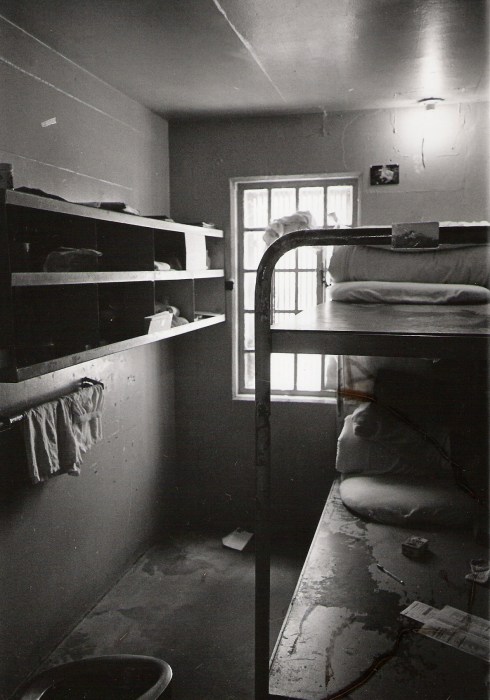
The image of the cell (above) is musty, scuffed and miserable as cell really get. Debris that lurks on the cold surfaces.
Mr Walsh actually provided two prints of the cell image; the other being less textured, darker and crisper. The other image also didn’t exhibit the same surface damage. The reproduction (above) was preferred because of its subtle mood of disintegration.
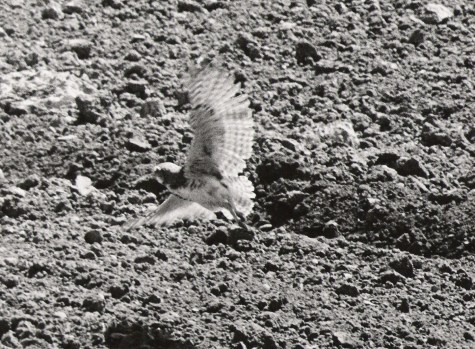
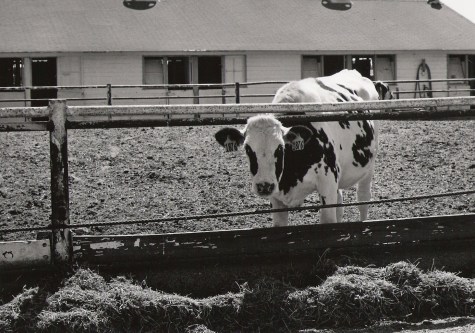
The remaining five were chosen because they express something of the action of the photographer. Away from the static buildings and fences, Mr Walsh has gone searching for anomalies amid the rigid penitentiary structures. The portrait of the cow is suitably awkward, the disturbed furrows of the field from which the owl flies are repeated in the pock-holes of the target range, repeated in the bullet-holes of the target-paper.
Robert Walsh

Robert Walsh
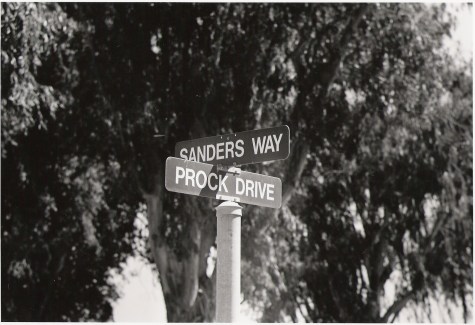
Palm trees. This is the West or Southwest, this is the land of middle distance road signs. This could be the work of John Divola‘s Correctional Officer Alter-Ego.
Robert Walsh
Robert Walsh

Robert Walsh
Mr Walsh challenged himself to “convey the visual impact of the institution” doing so with “no recognizable images of inmates or staff”. Bar two images, his compositions omit the activities of human life. Somehow, these five images specifically, give me the sense of human life recently fled or snuffed out entirely.
Whether Mr Walsh intended it, I find some of these images a little unnerving. The series is entitled Images of the Gladiator School based on DVI’s violent reputation between the 60s and early 80s. The project could as easily be called Ghosts of the Gladiator School.
Thanks to Robert Walsh for his time, words and images.
“Prison Polaroids: A Dispersed Portrait of American Life”
I was speaking to Sheila Pinkel recently about photography within prisons. She said only once had she been inside a prison with a camera of her own. We shared wonder at those photojournalists who through luck or nous gain access within US sites of incarceration.
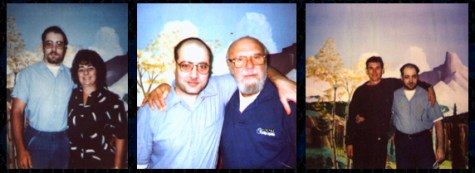
Sheila explained that photography was conducted in the visiting rooms. Standard practice is for a correctional officer or fellow inmate to operate a Polaroid camera and sell the Polaroids at $2 each.
Imagine those Polaroids gathered together and the dialogue they’d rouse as a collection. But this portrayal of America is dispersed, and its dialogue is absent.

Susanville

Susanville
Dr Maria Kefalas, Assistant Professor of Sociology at the University of Chicago noted the collection and display of Prison Polaroids in Promises I Can Keep, a book about mothers’ poverty in the US:
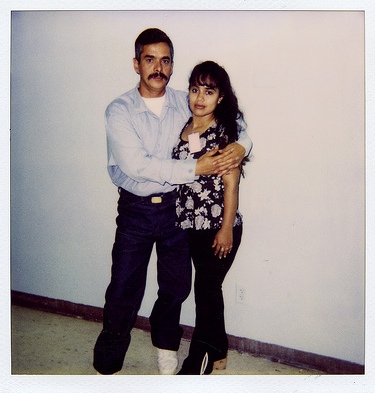
In the course of Kefalas’s fieldwork she was invited into more than a dozen living rooms that displayed a “Prison Polaroid”, sometimes held to the wall by a thumbtack or tucked into a framed family portrait on the television set. Prisoners, she learned, can have these taken for only (sic) a few dollars at the prison commissary and usually pen cheerful descriptions such as “Happy Birthday” or “I love you” on the back. When family members come to visit, the commissary photographer will, for a fee, commemorate the occasion with a keepsake Polaroid. One mother showed Kefalas a photo album of Polaroid photographs taken in the prisons’ visiting area – each commemorating one of the few times her daughter and her child’s father had been in the same room together over the course of the six years old’s life. the photos typically feature the inmate in his fluorescent orange department of corrections jumpsuit against a backdrop of a tropical beach scene, perhaps to give the illusion to the loved ones back home that their father is not in prison, but taking a much needed vacation.

San Quentin
San Quentin
After some digging I found this account:
In the processing room there is an inmate store where one can buy articles made by inmates and also buy these cards for $2, good for a snapshot of you and your friend taken in front of this large poster of a waterfall in the woods. I got one of these cards and when my friend and I went to get our picture taken I asked if we could have the dining room and everybody in it in the background. This was a big no-no, as people might be recognized in the photo. I didn’t know. We had our picture taken by an inmate with a Polaroid camera who later passed out the photos to the different tables. It turned out real nice.

San Quentin
Visitors are prohibited from bringing their own cameras or phones to the majority of US correctional facilities. Frequently the visitor buys two, one for the mantelpiece at home and one to return to the inmates cell. But there is no negative – just as there is no album. The Polaroids are dispersed across a nation. I think it would be fascinating to such Polaroids together.
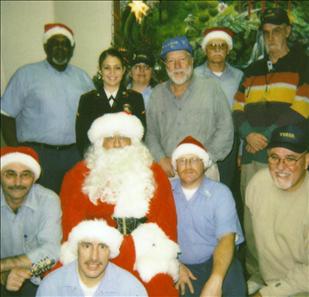
Santa with VVGSQ members and supporters. San Quentin Prison visiting room - December 18, 2005. The VVGSQ has always supported the San Quentin Christmas Toy Program with toy donations as well as by running the program each year. The Warden has authorized the VVGSQ to sponsor this program and the group purchased the "Santa" suit, beard and wig that is used for an appearance of Santa to the children each year at the visiting room. The program benefits all the children who come to visit family at San Quentin during the Christmas season. Started in 1988, December 2008 will be the 20th year the program has been giving toys to the children who visit San Quentin.
In piecing together this online group of images, I found it difficult to come across images. This does not surprise me.
In what circumstances do people scan their Polaroids of a prison visit for online upload? Just a few; friends & family with blog updates; purveyors of the macabre; journals of the death-row inamtes; inmate support groups and children’s rights organisations.
Please alert me to any other sources.
_______________________________
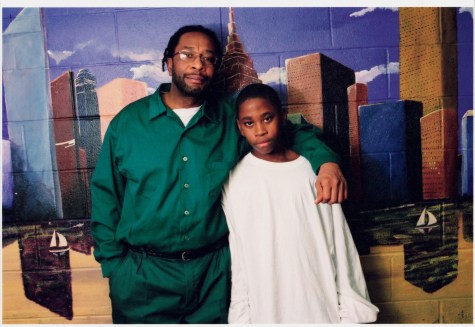
This is not a Polaroid but it is an image I came across here, with the enlarged image here. I had to include it. I challenge readers to find a better photographic portrait. The adult fights back tears and the child is solemn. Standing for the photo – for pride and for necessity – is a struggle for the father. The personalities are so strong, I wonder what words they have spoken to one another. Surely, the father’s outward show of emotion is typical of the sadness adults bear when behind bars, away from their children. I have no children. I can’t begin to know, even by comparison. These two portraits would excel as individual shots; to put them together is to light a firecracker under the seat of emotive curiosity.
Father and Son
I also found this image on Flickr, which has a stark backdrop by comparison.
Jail Visit?
Thoughts?
How about that as a potent exhibition just waiting to come together? Millions of Prison Polaroids in frames & drawers; homes & cells across America. The dispersed portrait of incarcerated Americans could be assembled in one place. The scale would be overwhelming and the juxtapositions endless. Let me know if the notion intrigues you as much as it intrigues me.
BURN Magazine, under the fiscal umbrella of the Magnum Cultural Foundation, have announced a $10,000 grant “to support [the] continuation of the photographer’s personal project. This body of work may be of either journalistic mission or purely personal artistic imperatives”
I am encouraging people to take on the difficult task of securing prolonged and necessary time with a prison/jail/detention-centre population in order to faithfully describe the stories and systems of its particular circumstance. On top of that your product must be “work is on the highest level”.
It’s a tall order but if you have carried out portrait or documentary photography in a site of incarceration before (I know many of you), then submit an application to continue that critical and valuable work. It will have to better than my attempt.

San Pedro Prison, La Paz. July 2008.
Hmm. On the same day I encourage photographers to attempt access into sites designed to be impenetrable, the government and police in my home country have introduced “laws that allow for the arrest – and imprisonment – of anyone who takes pictures of officers ‘likely to be useful to a person committing or preparing an act of terrorism’.” (British Journal of Photography via In-Public)
BURN Magazine is a new(ish) venture by David Alan Harvey whose got a Magnum portfolio and his own internets.

Modified captions on Colin Powell’s grainy images.
According to Joseph Pine we all crave – and will buy – authenticity these days.
According to Errol Morris we are more inclined to find authenticity in grainy low resolution images.
ERROL MORRIS: But, as we become more and more sophisticated about images — about how images are processed — haven’t we become more sophisticated about detecting fraud? Photoshop manipulations are relatively easy to detect. They fool the eye, but they don’t necessarily fool the expert.
HANY FARID: The answer is: yes and no. It depends on the image source. So, if we have the raw files[8], if we have the original footage from someone’s digital camera, you can’t fool us anymore. We have enough technology today where, given the camera, the original images that came off the camera, we can tell if you’ve manipulated them. If, however, you are talking about an image that has been cropped and reduced and compressed and posted on the web, then we might be able to do it, but there’s no guarantee. The task is decidedly harder because a lot of information has been thrown away. You’ve compressed the image; you’ve resized it. This is why all the Loch Ness monster and ghost images are always so tiny and grainy, because then you can’t see the signs of tampering. With low-res images it’s much harder to detect a fake. Definitely, when we have a high-res original image, we are much better at it.
[People often trust low-res images because they look more real. But of course they are not more real, just easier to fake. We look at picture of Nessie (the Loch Ness Monster). It’s grainy, fuzzy. It’s hard to make anything out. You never see a 10-megapixel photograph of Big Foot or the Abominable Snowman or the Loch Ness Monster. One explanation is: these monsters don’t exist. But if they did exist — so the thinking goes — they are probably unwilling to sit still for portraiture. The grainy images are proof of how elusive Nessie can be. This belief extends to documentary filmmaking, as well. If it’s badly shot, it’s more authentic. – E.M.]
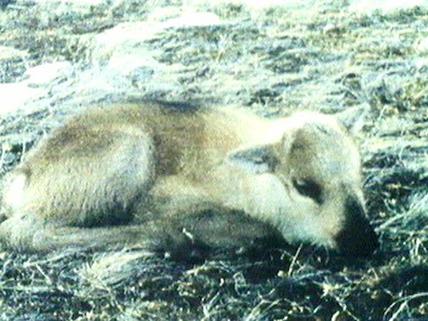
Grainy image of Caribou. From the Film Board of Canada, who gave Boards of Canada a name.
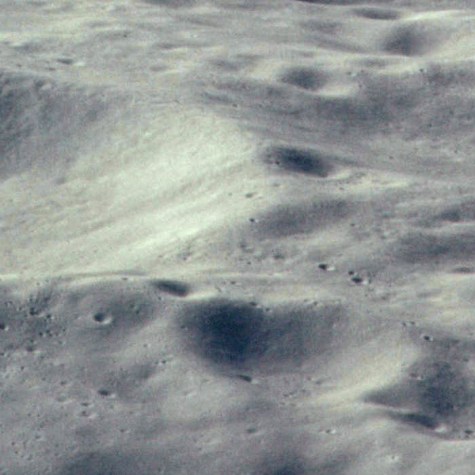
Grainy image of moon surface

Grainy image of Pentagon
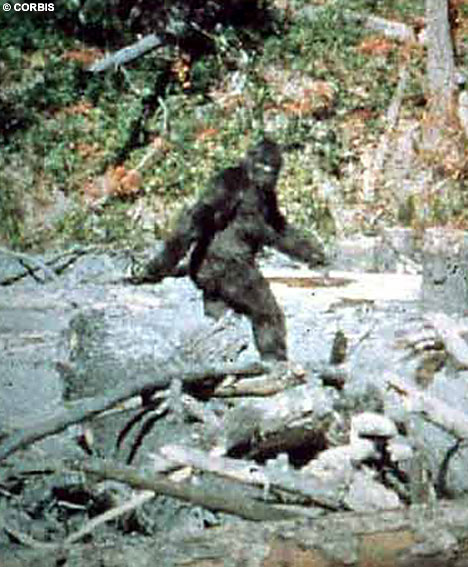
Grainy image of man in a flamboyant hirsute
Flicking through my old bookmarks, I was pleasantly bothered by bumping into the Corrections Photography Archive (CPA). This is a great small collection of prints organised by theme and location. Unfortunately, the online form doesn’t work so I can’t learn more about CPA just yet. I now the collection is larger than that number digitized for the interwebs.
A couple of my favourite groupings are Music (for fun) and Dining Rooms (which arranges itself as a Becheresque typology of prison food halls). In the end, I decided to use the collection twofold; 1) as counseling for myself, and 2) as a guarantee for the readers.
FROM THIS POINT FORWARD,
I PLEDGE NOT TO POST IMAGES OF RECEDING CELL BLOCK TIERS.
Regardless if the tiers recede to the brightest white or darkest gray. Regardless of the cause. When given a choice between a receding cell-tier-photograph and another, I will take the other. Let us exhaust this inevitable angle of all incarceration-based-photojournalism. Let us gloss over those photographs and move to the other images, which will be the ones to make the story anyway.
PURGE!

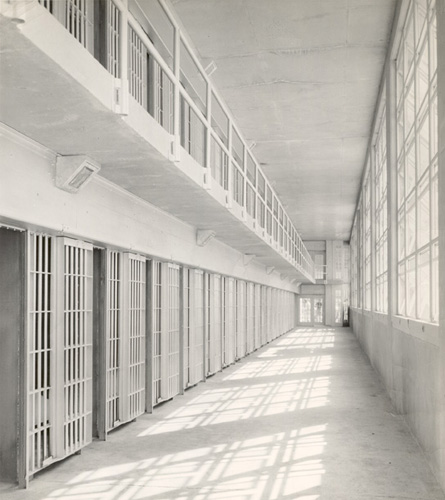

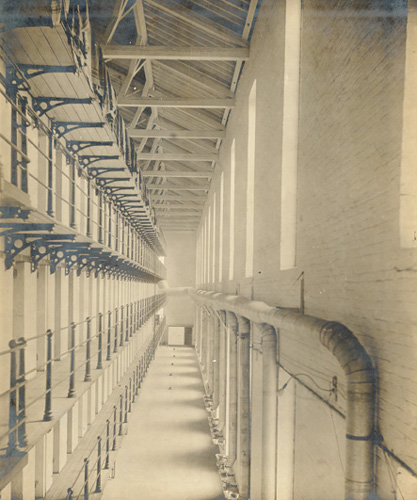

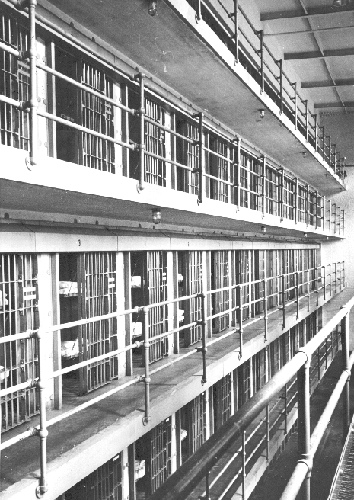

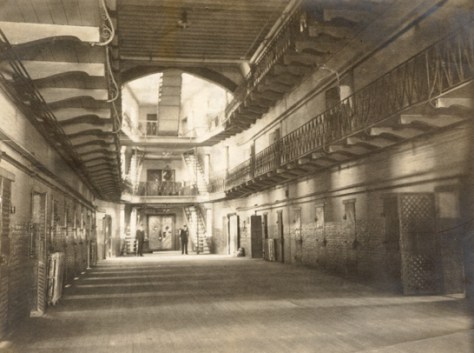

Official Blurb: The American Prison Society Photographic Archive records collection was acquired by the Eastern Kentucky University Archives in 1984 through the auspices of Dr. Bruce Wolford of Eastern’s College of Law Enforcement. Dr. Wolford received the photographs in 1979 from William Bain, instructor at the Kentucky Bureau of Training. In the 1960s Mr. Bain, a former staff member of the American Correctional Association, conceived the idea of a pictorial history of the American prison. With the aid of David A. Kimberling, a prison inmate and photographer, Bain had photographs copied from the American Correctional Association archives plus ones he received from various federal and state correctional facilities throughout the United States. In addition to the copies, which comprise the negative part of the collection, he acquired many original black and white photographic prints. Finally in 1978 through the work of Anthony P. Travisono, executive director of the American Correctional Association, Bain’s dream, The American Prison: from the Beginning. A Pictorial History, was published.
The photographic collection is rich in its depiction of early twentieth century prison life and conditions. The collection covers numerous subjects such as prison living conditions, recreational activities, industries, hospital care, corporal punishment, work gangs on the farm and quarries, vocational activities, weapons confiscated, prison architecture, and the death house. A few of the images are of prison officials, primarily in the federal penitentiary system.
Images from Top to Bottom. All images courtesy of Corrections Photographic Archive
1. One of the cell corriders in the old penitentiary for males on Welfare Island. Note the distance of the cells from the outside walls and windows and the consequent limitations of light and ventilation, especially needed on account of the absence of toilets in the cells, 1924.
2. Isolation unit at Huntsville, Texas, 1953. Photo by Frank Dobbs.
3. Eastern State Penitentiary in Philadelphia, Pennsylvania. Section of E.D.C.C.
4. Heating pipes in cell house at Indiana State Prison.
5. “A” block (North extension “outside cells”) 352 cells now used by Reception Center. Folger Adams Locking, December 5, 1946.
6. West cell block, Central Prison, Raleigh, North Carolina.
7. New Hampshire State Prison, portion of cell block.
8. No Information available.
9. Central aisle, Work House, Blackwell’s Island, New York.
Spurred by the wonderful news over at The Impossible Project that Polaroid Film is getting a second chance, I delved (via its “friends” links) into Polanoid.net. Whereupon, I found this small and particular photo-series by Lars.blumen.

Hohenschönhausen. Credit: lars.blumen
The Hohenschönhausen Memorial in Berlin is an active community/museum organization that fosters education and understanding with regards political imprisonment. The refreshingly transparent website even concedes crucial gaps in knowledge. “The history of the Berlin-Hohenschönhausen prison site has not yet been researched in sufficient detail. There is, as yet, no general overview detailing the social background of the prisoners, nor the reasons for their imprisonment, nor their length of stay. In fact, we do not even know exactly how many prisoners were kept here over the years.”
I am given the impression a precious sense of purpose & justice drives this shared project. Elsewhere on the site, their call for research is inspiring.

Hohenschönhausen. Credit: lars.blumen
The reason this set fascinated me so much was that it seemed so immediately incongruous. It is wonderful incongruity. With Polaroid one expects sanctified family portraits (60s, 70s) or blurred disco memories (80s, 90s). Polaroid of the 21st century has been largely an indulgent affair. Lars.blumen has given us a rare treat. He ‘captured’ the most infamous site of Soviet Secret Police interrogation and detention within 10 single polaroid frames.

Hohenschönhausen. Credit: lars.blumen
Lars.blumen’s project, done without fanfare nor nostalgia, uses the visual vocabulary of the past. Just to make things interesting, the prison (at he time of Polaroid) would never have been observed, nor documented, in this same manner.
The polaroids are remarkable for what they aren’t. They aren’t actual images from the era of the Stasi. And this era is that to which now all energy – as a Memorial – is focussed. The photos are a requiem for the stories and faces of the prisoners never recorded. I think this is why the Hohenschönhausen Memorial has such an emphasis on documenting oral testimony and experiences of prisoners.

Hohenschönhausen. Credit: lars.blumen
No people, no prisoners, no players in these scenes. The hardware of the site and the illusion of time passed. Understated.

Hohenschönhausen. Credit: lars.blumen
The texture reminds me of old family portraits in front of the brick of Yorkshire and Merseyside. In front of churches and on door steps.

Hohenschönhausen. Credit: lars.blumen
Outside are cameras, inside is bureaucracy. Still lured by Polaroid nostalgia, the sinister reality of the images creeps up slowly. The minimalist composition of the Frankfurt school is at use here, but Lars.blumen uses a medium that predates the movement. It’s all very disconcerting.
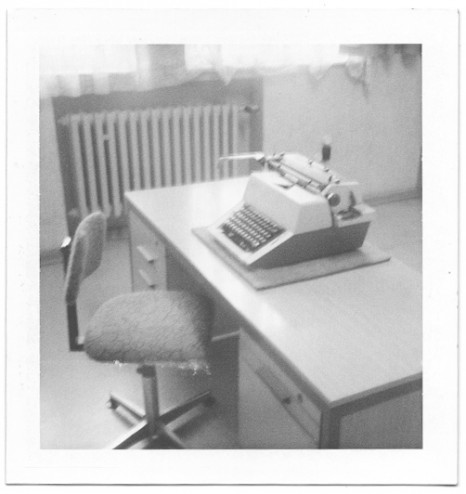
Hohenschönhausen. Credit: lars.blumen
Why do I respect these images? Because they are unique and, even to some degree, challenging. I cannot celebrate these images because of their history – they have no history. I cannot celebrate a familiar style – they are recuperations of contemporary German photography. They are idiosyncratic one-offs.

Hohenschönhausen. Credit: lars.blumen
Is it really this intentional? I wonder now if Lars.blumen just had a reel of Polaroid film to burn and that day he happened to be at the Hohenschönhausen Memorial?
If anyone cane help me with Lars.blumen’s identity I’d be grateful!
Official Blurb: The site of the main remand prison for people detained by the former East German Ministry of State Security (MfS), or ‘Stasi’, has been a Memorial since 1994 and, from 2000 on, has been an independent Foundation under public law. The Berlin state government has assigned the Foundation, without charge. The Foundation’s work is supported by an annual contribution from the Federal Government and the Berlin state government.
The Memorial’s charter specifically entrusts it with the task of researching the history of the Hohenschönhausen prison between 1945 and 1989, supplying information via exhibitions, events and publications, and encouraging a critical awareness of the methods and consequences of political persecution and suppression in the communist dictatorship. The former Stasi remand prison is also intended to provide an insight into the workings of the GDR’s political justice system.
Since the vast majority of the buildings, equipment and furniture and fittings have survived intact, the Memorial provides a very authentic picture of prison conditions in the GDR. The Memorial’s location in Germany’s capital city makes it the key site in Germany for victims of communist tyranny.
One last thing. May I recommend you spend time with the lovingly assembled staff portrait gallery at the Impossible Project.
lax |laks| adjective
1 not sufficiently strict or severe : lax security arrangements at the airport | he’d been a bit lax about discipline in school lately.
2 careless : why do software developers do little more than parrot their equally lax competitors?
It is perhaps easy to forget there once was an era when the prison in society was less useful. By 1905 when this picture was taken, there were only two prisons in California (San Quentin and Folsom) and it would remain that way for another 30 years. Much of the detention and incarceration was done through an smattering of local jails and jail houses for work crews.

Alum Rock Jail. Alice Iola Hare, ca. 1905. On the back of the photograph is written, "Much of the original road into Alum Rock Park was built by County Jail prisoners who were housed - and guarded - in these shacks. The roofed structures and the open one (stockade?) behind them stood for many years after the road building job was completed."
This image of Alum Rock Jail, Santa Clara County was taken originally by Alice Iola Hare, was then part of the Arbuckle Collection and eventually went digital as part of Silicon Valley History online.
The description is right; this is a shack more than jail. The fabric of the structure did not discipline the inmates at Alum Rock, it was the guard’s rifles and the open countryside that asserted control. The physical make-up of this carceral structure is a world away from the SuperMax US society now relies upon. And for that reason, and for the indulgence of punnery, I want to refer to this example of historical jails as a “SuperLax” Prison.
What would people at the beginning of the 20th century have made of 16ft razor wire, heat sensing detection equipment, opticons and magnetic locks? I suppose the one piece of equipment they may have shared with their contemporary guards would be dogs, but they probably didn’t call them “K9 units” back then. I doubt they’d developed rubber bullets in 1905 either…

 Prison Photography