
You are currently browsing the category archive for the ‘Amateur’ category.

“I spent so much time counting down the days to my court date when I would sit in this very holding cell for about 7 hours. If court is at 9, they bring you down to the holding cell at 5AM and don’t bring you back up until after 2PM count. On one hand it was nice to have all that time to think, on the other the anxiety was a full-time job,” says ihatechoosingausername.
–
Yesterday ihatechoosingausername posted some snaps from jail alongside stock pics and some funnies too. It is niftily titled So I Just Came Home From Jail.
In 13 images (make sure to click to see the full gallery after the 10th image) and a few words she describes her entry and exit from Henrico County Jail in Virginia. her past addiction and wish to stay clean, her new felony record, the struggles to find work, her imminent homelessness and her frank cluelessness on what is next.
It went viral. Over 340,000 views at the time of writing.
In an update, ihatechoosingausername said:
Wow, Imgur, the support I’ve received after making this post has been absolutely amazing! Thank you so much for the kind words. Also, through this post I got to talk to one of the people who fed me while I was homeless in the park last winter and let him know just how much good he’s doing in the world by giving sammiches to the homeless.
This is not an obvious feel good story but there’s a realness about ihatechoosingausername’s words that leave us hoping it will become one. Time will tell. I wish ihatechoosingausername the best of luck.
No trolls in sight. To you Internets, well done for not being a dick.
“If a book can have a trailer, I guess this is sort of that,” wrote Steve Davis in his email this morning.
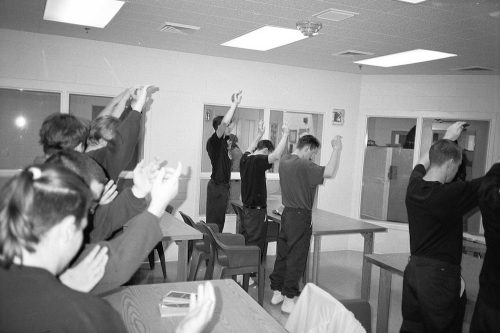
Me Steve have a long history* but that in no way discredits what I am about to say. Whether I am biased or not (I am) this video absolute nails it. Why? The process of image-making is often messy. It get messier the more people are involved. Making photographs inside a prison — for Steve and his students — involves local authorities, management and staff. Everyone thinks they have a say or a role. If everyone is a photographer, then everyone is a photo-critic, or worse, everyone is the Photo Police.


Steve saw nice things and he saw absolutely devastating things. He met kids raised to be racists and they were very personable. He encountered kids stuck in the system and devolving to the oppressed and hardened personalities required for survival. He met staff who were moving heaven and hell to give these troubled kids the best shot at the rest of their lives, and he met adults who had already written them off and goaded the kids.
As Steve says, layers of contradictions and complex challenges exist in juvenile detention facilities. These images will not give you any easy answers; they will probably throw up more questions.
This is the best, quickest and truest introduction to Steve’s series Captured Youth that currently exists. If you like what he says an dyou like the images then pre-order the book of this work Unfinished at Minor Matters Books.

*Steve Davis was my first ever interview on Prison Photography. That happened because he was geographically the closest when I started the site. He didn’t have to say yes to the interview but he did. I must have done something right because a year later he invited me to his class to give a lecture. Steve Davis’ student were the first college students I ever presented material to. Years ago, when I was going through a really hard break-up and needed to get out of town, I headed down I5 and crashed on Steve’s couch for a couple of nights. Photographs made by incarcerated boys and girls who were students in his workshops feature in Prison Obscura. Next year, Prison Obscura will be shown at Evergreen State College in Olympia, Washington. Steve is the coordinator of the photography program at Evergreen and introduced the show to the gallery’s curator. Steve is a friend.
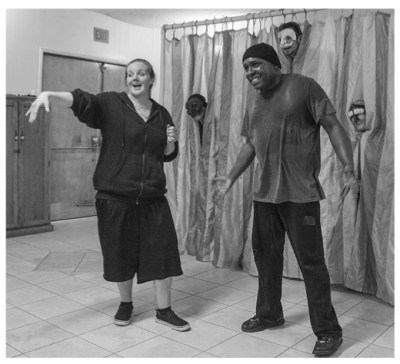
In the conventional definition of the word, there are not many funny things about prison. In spite of that, those oppressed by the system are still leveraging humour in order to process and overcome America’s dehumanising and oppressive prison industrial complex.
The Poetic Justice Project (PJP) is a case in point.
“Poetic Justice Project is California’s only theatre company comprised of formerly incarcerated actors appearing in plays that examine crime, punishment and redemption,” explains PJP whose latest production is INSIDE/OUT: A Comedic Look At Prison and Re-Entry
PRESS RELEASE
Bay Area audiences will witness a unique marriage in June: the happy union of a 500-year-old art form with cutting edge social justice theatre. Poetic Justice Project will present its Commedia Dell’Arte play, INSIDE/OUT, at St. Mary’s Center in Oakland and on Alcatraz Island.
Commedia Dell’Arte is a style of masked, improvisational slapstick comedy that dates back to 16th Century Italy. INSIDE/OUT follows character Damian from prosecution to prison to parole as he wears whatever mask he needs to survive. Damian is saved by the love of a good woman, and by his determination to never return to prison.
The play is directed by Gale McNeeley, a graduate of the Neighborhood Playhouse in New York City, the Dell’Arte International School of Physical Theatre and Scuola Internazionale Dell’Attore Comico in Italy. INSIDE/OUT was co-created by McNeeley and actors Leonard Flippen, Jorge Manly Gil, Janet Guess, Nick Homick and Caroline Taylor-Hitch. The actors have all been incarcerated—in prison, jail or juvenile facilities. Most have no previous theatre experience when they come to Poetic Justice Project.
INSIDE/OUT shows Friday, June 19 at 6 p.m. at St. Mary’s Center, 925 Brockhurst St., Oakland. Tickets are $15 and available from Brown Paper Tickets, 800-838-3006, and at the door. On Saturday, June 20 at 2 p.m., there is a free performance on Alcatraz Island.
Based in Santa Maria, the project was founded by Artistic Director Deborah Tobola in 2009. Tobola and Poetic Justice Project recently received the the Santa Barbara County Action Network’s “Looking Forward” Award for Leadership and Vision.
Poetic Justice Project It is a program of the award-winning William James Association, which provides arts instruction to prisoners, people on parole and probation, and youth at risk of incarceration.
QUESTIONS? MEDIA CONTACT
Deborah Tobola, Artistic Director
tel: (805) 264-5463
eml: deborah@poeticjusticeproject.org
P.O. Box 7196
Santa Maria
CA 93456

FIRST EXPOSURES
In a necessarily generic statement about the project, San Francisco’s teen photography program First Exposures says its online exhibition Communication “explores how the photograph communicates meaning and the different ways in which that meaning can be interpreted based on context.” That’s a broad way of saying that their activities are rooted in developing visual literacy AND photography skills. The teenage image-makers have use antique processes, and made exquisite corpses, biographical images and studies of work and family.
In a city that is currently quite-very hard to love, I think it is absolutely essential to find things in San Francisco that are pure and you can admire. As a writer, I think it is important — everywhere and always — to recognise voices that emerge not out of market needs but out of community needs. These are the two reasons at the top of a long list as to why I am applauding both the First Exposures program and the products of its young participants.
Everything that the pros are doing these kids are doing.
– If you like A Piece Of Cake, First Exposures has its Exquisite Corpse.
– If you like Anna Atkins and Lochman & Ciurej, First Exposures has it’s own Cyanotypes.
– If you like the self exposition and exchange in work by Jeremy Deller or, say, Bayete Ross Smith and Hank Willis Thomas in Question Bridge, First Exposures has Letters To A Stranger.
– If you like Arnold Newman, you’ll dig First Exposures’ response to his work Zoomed In.
– If you like LaToya Ruby Frazier‘s depictions of family and Paul Graham‘s depictions of labour, then First Exposures has Work/Family for you.
– If you are into the collaborative portraiture of Anthony Luvera, Wendy Ewald or Eric Gottesman, you’ll love First Exposures’ Portrait/Self-Portrait.
The kids stay in the picture!
Recognition, too, to the unnamed staff and volunteers who facilitate these youth photography program. In San Francisco and elsewhere.
ELSEWHERE
Literacy and personal development through photography is a familiar notion. Programs for youth include The In-Sight Photography Project, Vermont; Leave Out ViolencE (LOVE), Nova Scotia; Street Level Media, Chicago; Picture Me at the MoCP, Chicago; Youth in Focus, Seattle: Focus on Youth, Portland; Critical Exposure, Washington DC; Eye on the Third Ward, Houston; and AS220 Youth in Providence, Rhode Island.
Incredibly, Young New Yorkers (YNY) actually uses photography (as well as video, illustration and design) as intervention in the cogs of the youth justice system.
“The criminal court gives eligible defendants the option to participate in Young New Yorkers rather than do jail time, community service and have a lifelong criminal record. The curriculum is uniquely tailored to develop the emotional and behavioral skills of the young participants while facilitating responsible and creative self-expression,” says YNY.
Also in New York, is JustArts Photography Program (formerly the Red Hook Photo Project). The exhibition Perspectives featured the photographs of teens from Red Hook, Brooklyn. The JustArts Photography Program (more here and here) is run through the Red Hook Community Justice Center (RHCJC).
I encourage you to find programs in your local area and contribute.
MORE?
Please feel free to name other programs in the comments that I’ve not included here.

I was interviewed by ACLU recently: Prisons Are Man-Made … They Can Be Unmade.
The Q&A focuses around the exhibition Prison Obscura and you’ll notice a return to many of my favourite talking points. Still, the work never ends, and I know that ACLU will push out — to an expanded audience — my argument that we should all be more active and conscientious consumers of prison imagery. My thanks to Matthew Harwood for the questions.
AS220 Youth
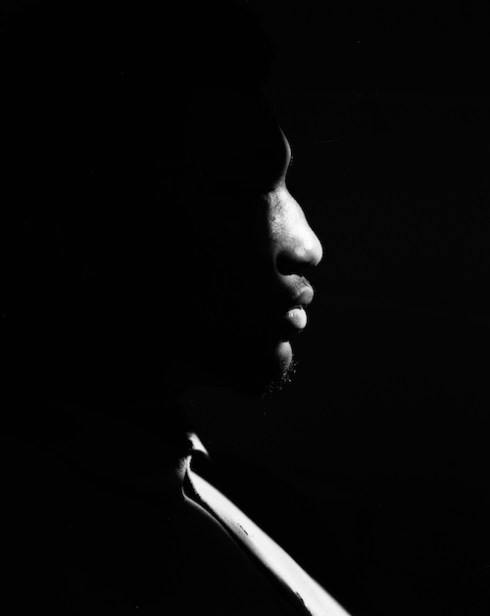
There are very few organizations like AS220 Youth.
Sure, there’s lots of teen-focused arts organizations across the country but few have achieved the long-lasting and diverse roster of programming and results that AS220 boasts. AS220, similarly to many orgs use arts to connect and empower youth. Very few organizations, however, go into juvenile prisons to deliver photography education. AS220 does.

Very few organisations go into juvenile lock-ups to begin programming in order that they may continue it upon release of the teen with whom they work . AS220 does.
Such continuum is practical AND hopeful. It says ‘We are with you, wherever you are. We share your goal to live free once more.’
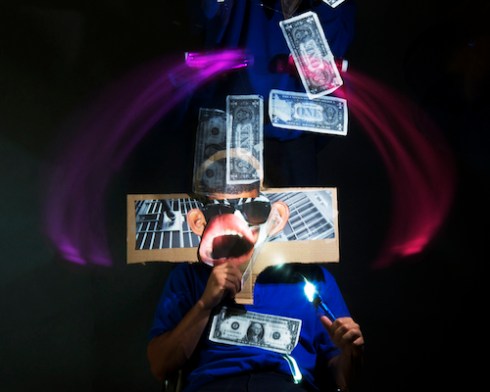

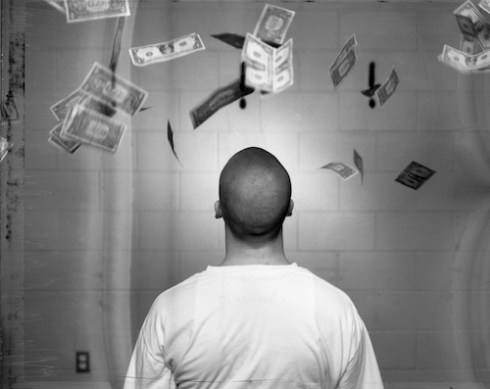
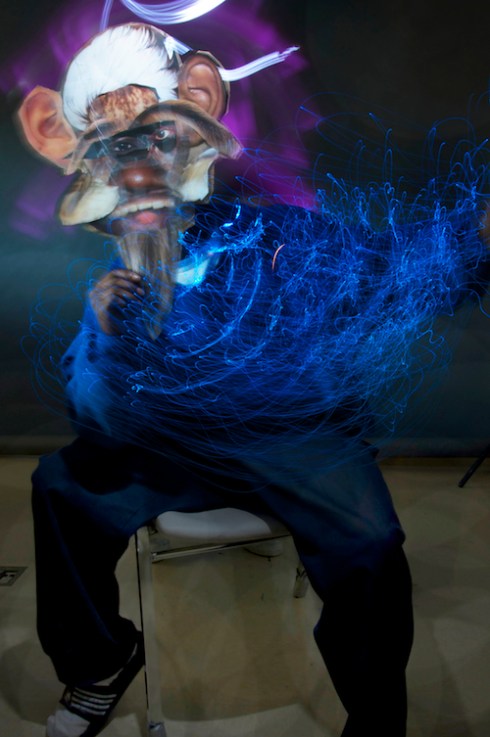
AS220 Youth, based in Providence, Rhode Island, gave me the warmest welcome a few years ago. They opened the door so that I could do a workshop with their incarcerated students. I gave a public lecture on my developing ideas about prison imagery. I interviewed the staff and helped students with portfolio reviews. My eyes were open to what a community can be.
Not only did the people stay in my thoughts, the work did too. In late 2013, I included light-paintings made by youth incarcerated at the Rhode Island Training School in Seen But Not Heard (Belgrade, Serbia) a photography exhibition about U.S. juvenile detention. If AS220 Youth did not exist we wouldn’t see these views of the world created by kids who are locked up.


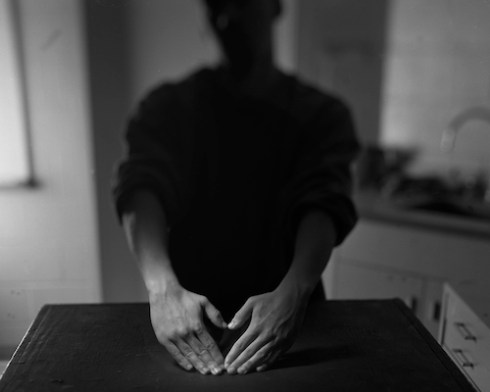

I’ve written about AS220’s youth programs before. I have noted how rare it is that photo programs are inside juvenile detention facilities. AS220 is doing things no-one else can do, or have the imagination to do. You’ve no reason not to help them out.
For the first time in AS220 Youth’s 15-year history, it is conducting a individual giving campaign. They’ve turned to IndieGoGo to push alternative revenue streams having seen public money dry up. AS220 Youth has about half the staff this time last year, and yet it is serving more students than this time last year.
“Since I have been working at AS220 Youth,” says Youth Photography Coordinator, Scott Lapham, “five of my students have been accepted and have gone to or are going to RISD, one to Hampshire, one to the School of Visual Arts, one to Savannah College of Art and Design and one to Mass Art. All of these students are from poor/poverty backgrounds and all but one are students of color. While I couldn’t be prouder of those stats an equally ambitious and important accomplishment is working with students from what we have termed Post Risk backgrounds to achieve emotional and economic stability as adults.”
Bravo to Lapham, his colleagues and the AS220 students.
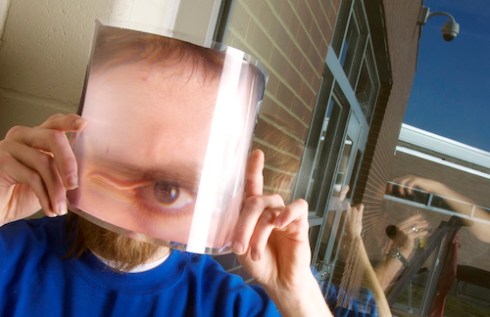
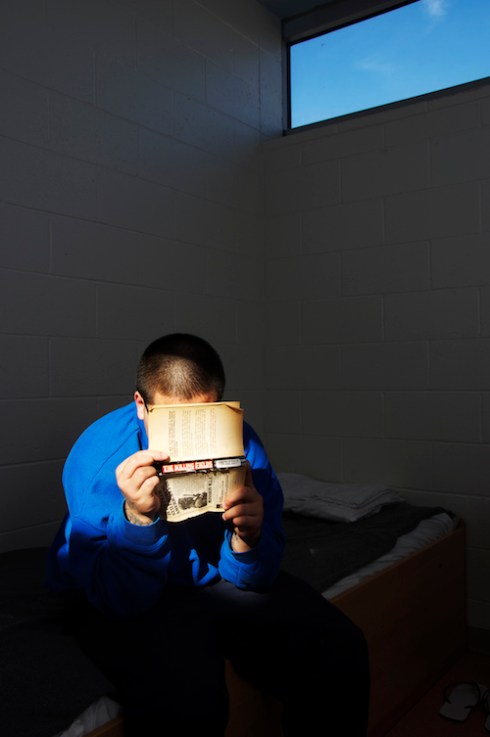

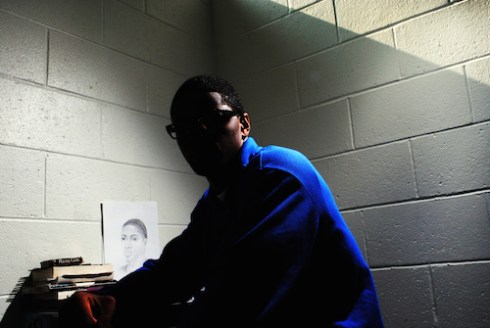
MONEY, MOVIES, PHOTOS
Help them continue their valuable work: visit the AS220 Youth Futureworlds IndieGoGo page.
Check out more about AS220 Youth program Photo Mem. See the students’ portfolios.
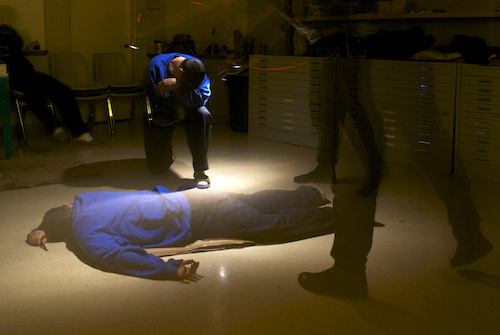
Above is a video about a public art project AS220 Youth made. Throughout this post are images made by youth incarcerated at the Rhode Island Training School.

Manchester United play Liverpool on a pitch surrounded by watching prison inmates. Photograph: Ronald Kabuubi/EAPPA images/Demotix
This week, it was great to see the Guardian publish a long read about the knockout football tournament at Luzira Upper Prison in Uganda. The article’s author, football historian David Goldblatt, argues that football has helped transform Luzira UP from Uganda’s most notorious prison to one in which self-discipline, shared goals, and self-policing shape the friendly culture..
Read: The Prison Where Murderers Play For Manchester United
Pain, shame, stagnation are not tolerated at Luzira. It is a prison with fixed but fair sentences (no Life Without Parole) and a mandate to prepare prisoners for release. Don’t get me wrong, it’s no cake-walk but the prisoners’ buy-in to the social structure and how football feeds positive engagement between prisoners and prisoners & staff is exemplary.

Nigel Boyle playing at Luzira Upper Prison, Uganda, summer 2014.
You might recall that 5 month’s ago I published an interview with Nigel Boyle, an Englishman and U.S.-based academic specialising in the economics of global football. He reported witnessing the same community as Goldblatt.
“It was the friendliest ‘friendly’ game I have ever played in,” said Boyle. “In fact all games at Luzira are played in a very gentlemanly fashion – the prison soccer association constitution demands it and sets explicit standards for player and fan behavior, above anything FIFA can manage.”
Of course, the shocking scandals over at FIFA are a lighting rod for irony right now. We have long known about FIFA’s corruption but the stunning series of arrests of high-profile FIFA leaders — after US Attorney General Loretta Lynch’s years long investigation — comes at a perfect time.
When money becomes the driving force, football loses its soul. The Ugandan prisoners playing here for a new jersey and share of a slaughtered goat are the true heart and soul of the sport.
All this leads me to ask, who are the real crooks?

For the past 18 months, the Philadelphia Lawyers for Social Equity (PLSE) and the People’s Paper Co-op (PPC) have partnered in creating client art as part of the PLSE’s Criminal Record Expungement Project (CREP) clinics. While CREP lawyers, grads and volunteers are pulling up criminal records, assessing eligibility and triggering first steps of expungement, the PPC has been taking physical copies of those records and with clients, shredding and pulping them.
New paper is made from old records, upon which clients write what they are and what their future is without the millstone of a record and its associated barriers to entry into work, housing and education. A Polaroid or digital snap of the client accompanies the testimony. Fantastic artistic strategy.
The result is a massive “quilt” of such testimonies — a detail is shown above and the collection is shown below hanging behind a speaker addressing a PPC event.

NEW YORK, TOMORROW
The People’s Paper Co-op has been selected to be part of the New Museum’s Ideas City Festival this weekend. It’ll be displaying the quilt and talking about the project. Representatives of PPC and PLSE will be in the PPC Mobile Studio parked in front of the New Museum tomorrow, Saturday May 30th, from 12-6pm.
If you are interested in the intersection of art and legal advocacy on behalf of those with criminal records stop by!PPC and PLSE’s collaboration was one of 110 projects chosen to represent how artists are responding to changing urban spaces.
I’ve sung the praises of PLSE before. PPC was co-founded by friends of the blog Courtney Bowles and Mark Strandquist. Below is a small selection of images from the workshops and PPC events that Bowles and Strandquist have carried out during their SPACES residency at the Village of Arts & Humanities in Philadelphia.
PLSE and PPC’s work has been featured in Philadelphia Inquirer, Wall Street Journal, NBC and City Paper, to name a few.


 Prison Photography