
You are currently browsing the category archive for the ‘Documentary’ category.
UPDATE 11.12.2010, 12.30pm PST: Forsell didn’t win. Announced 11.12.2010 in Bristol, UK Yvonne Venegas won for her portrayal of Maria Elvia de Hank, millionaire wife of an eccentric former mayor of Tijuana. Julian Roeder and Rob Hornstra also made the final three.
This will not put me off making predictions in the future. I’ll just have to adopt unpredictable criteria and decision making to mirror the many diverse jury panels. And I stand by everything I said about Forsell’s ‘Life’s a Blast’.
– – – – –
© Linda Forsell
I’ll admit to being rather deflated after looking over the shortlisted photographers for this years Magnum Expressions Award. Many of the portfolios of 15 images had only one or two photographs that held my attention.
The Magnum Expressions Award is in reaction to the brave new world photographers face; new communities, new audiences, new distribution channels and bold ways of working. It is an award designed – so it says – to reward young photographers surfing the shifting sands beneath the industries footings.
It should be said that most of the 19 shortlisted artists have hunted down engaging subjects. Bepi Ghiotti‘s Sources is an enigmatic thesis on man and nature. Yvonne Venegas’ fly-off-the-wall study of Maria Elvia De Hank wife of an eccentric millionaire and former Tijuana mayor bristles with ambivalence toward the subject.
I was pleasantly surprised to see the presence of two photographers who’ve briefly pricked my attentions. Anastasia Taylor-Lind and Irina Rosovsky both deliver strong entries. (On PP, Taylor-Lind, here and Rosovsky here).
These would be my 3rd through 6th placed finalists, but who’s listening to me, eh?
In at second is Jenn Ackerman. This high finish has little to do with my interest in photography that exposes the shortcomings of the US prison system and everything to do with the excellent way Jenn portrays the daily battles and extreme stress of a prison operating as a makeshift and unsuitable lock-up for men with severe mental health disorders – Trapped: Mental Illness in America’s Prisons. (I’ve featured Jenn’s work here on PP before.)

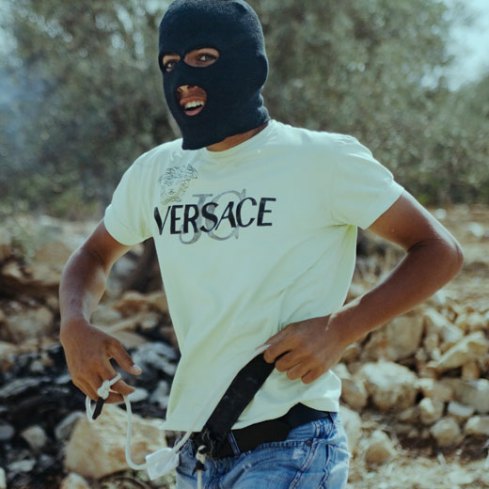
© Linda Forsell
‘LIFE’S A BLAST‘ BLOWS THE COMPETITION AWAY
And, winning by a country mile is Linda Forsell. Gold star.
Forsell’s Life’s a Blast is the sweetest, never-escaping-bitter view of Palestine, Gaza & Israel I’ve ever clapped my eyes on. It’s about family more than ideology, but it is never glib. It is work as conscious of history as it is the mores of fashion photography. It’s a slow-ride through the lives of people associated by a larger conflict but not solely defined by it; a stunning presentation of gazes drenched in humanity.
Against all odds, Forsell forces the viewer to think on the stories of her subjects; on the seconds before the shutter snapped and the years yet to come. I have not seen a single project that so swiftly dismantles many of the entrenched tropes of conflict photography. Life’s a Blast shifts perceptions like only the very best of photography can.
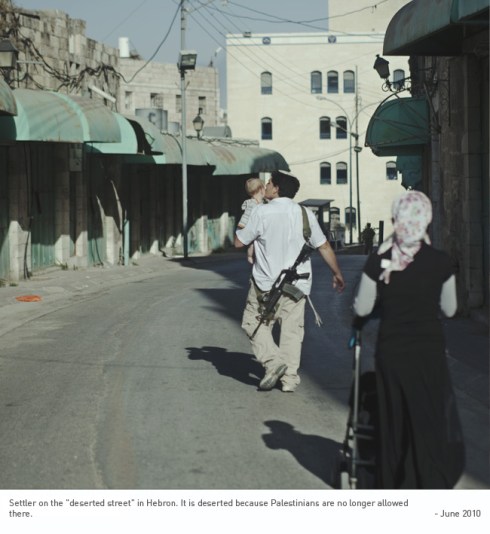
© Linda Forsell

Huntress with Buck, 2010 from the series ‘Hunters’, © David Chancellor
David Chancellor has won the Taylor Wessing Portrait Prize for his image of a young American huntress astride a horse in South Africa. It’s a worthy winner.
Unfortunately, for web audiences only the five shortlisted portraits are presented on the Taylor Wessing Portrait Prize website. There are 55 more in the accompanying exhibition.
Tom Martin‘s group portrait of children inside Ruyigi prison, Burundi (below, part of flyer) is one of the sixty portraits included in the Wessing show at the National Portrait Gallery, London.

I’ll be following up with Tom shortly for the background on the circumstances of the photograph, which are difficult to say the least; photographer Nathalie Mohadjer has talked at length here at Prison Photography about life in Burundi’s prisons. At 230% capacity, Burundi’s prisons are the most overcrowded in Africa.
THE WINNERS AND THE WINNERS
I don’t want to sound too simplistic here, but any additional exposure to the stories of the dispossessed – even in the context of a £12,000 award – is a good thing. Nathalie Mohadjer commented, “Let’s face it, Burundi just isn’t important to the world”. She has struggled to find interest in her work and I expect Tom Martin has experienced the similar dead-ends.
I am not idealistic and I know that distribution of images only changes little, but in light of the subjects recognised by the Taylor Wessing Prize (TWP) I want to be positive, constructive. The shortlisted entries over the years seem to be those that weigh skilled technique with a careful presentation of unexpected (often disenfranchised) social groups:
Photographic Portrait Prize 2010
Photographic Portrait Prize 2009
Photographic Portrait Prize 2008
Photographic Portrait Prize 2007
Photographic Portrait Prize 2006
Photographic Portrait Prize 2005
The TWP has a social conscience and it plays that to full advantage by picking striking portraits with direct routes to empathy. This is the mark of good photography, no? Everyone’s a winner.
The Taylor Wessing Portrait Prize Exhibition runs at the National Portrait Gallery from November 11th until 20 February and then at the Sunderland Museum and Winter Gardens from 16 April until 26 June.
UPDATED: 9:30AM PST, NOV. 10TH
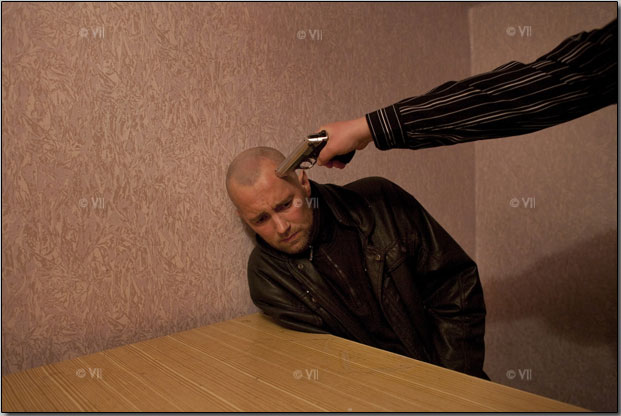
Car thief. © Donald Weber / VII Photo
Since first coming across Donald Weber‘s series Interrogations, I wondered how the hell Weber got the shots and how he handled the ethics of the work. Colin Pantall tapped him up and got some answers.
Weber:
“Watching the methods was not pleasant. Humiliation, violence, degradation. How could you not be repulsed? But the reasons I was there were not for judging them, but was to actually show something very special in the terms of the secrecy of the act. I made a special document precisely because it was about the ‘absence of the void,’ that it showed humans at their most vulnerable and most cruel. This series could easily be judged along the same lines as a war photographer that constantly gets criticized for not doing anything, for not jumping into the fray.”
I’m going to sit on the fence on this one, but I can see a lot of criticisms heading in Weber’s direction. I will say that this is not a cheap project; Weber has demonstrated his commitment to the former Soviet countries.
If we demand photographs to make us think, photographs to show us things we would not otherwise see and for photographers to be cognisant of – and close to – communities in which they work, these are the types of images that will result.
UPDATE
9:30AM PST, NOV. 10TH
As you know, so often I think it is important that a photographer really describes the circumstances of their work. Donald Weber must be aware that I harp on about access (as it relates to photography in prisons) because he emailed me and asked me to pass on this information:
Weber:
“As you know, I’ve spent almost six years living and working in this area. On my very first trip I met a police detective with whom I got along with. Over time, we developed a bond and a trust. Every trip I would bring him photographs and was always very upfront with my work, who I was and what I was doing. Never hiding the results, however critical they may be of him and the methods the police employ.”
“About five years ago I witnessed my first interrogation, and was utterly shocked at its violence, not just physically but mentally as well. Solzhenitsyn talks for almost a third of his book The Gulag Archipelago about the nature of interrogation, and the importance of the interrogation not just through Soviet history, but universally. He would think everyday about the moment of his interrogation how he was broken, and everyday about the moment of his execution. So, the seed for this story was planted.”
“For obvious reasons I could not just ask to photograph inside an interrogation. As my work progressed, so did my police contact, who rose over time to the rank of Major. He had gained a position of authority to grant permission. Since we had spent so many years together photographing, he was aware of my methods and how I worked. We rarely spoke to each other, during work or after hours. I felt it best to maintain as much distance as possible but still respectful of his role. When he finally granted permission he still made me work for the access to the actual accused.”
“I sat almost everyday for four months on a bench in a hallway of the police station waiting with the people who were to be interrogated. The first month, not a single frame was photographed. Each day I would show up 9am, and leave approximately 12 hours later. Most days were spent with nothing to photograph, many of the accused were not interested in having there photo taken. On average, I was lucky to photograph maybe two people a week over a four month period.”
“This was not simply a case of walking in saying hello as a privileged Westerner and flashing my camera around. This was a project five years in the making. So before anybody rushes to quick judgement, I felt the facts as to how the work was created should be shared.”
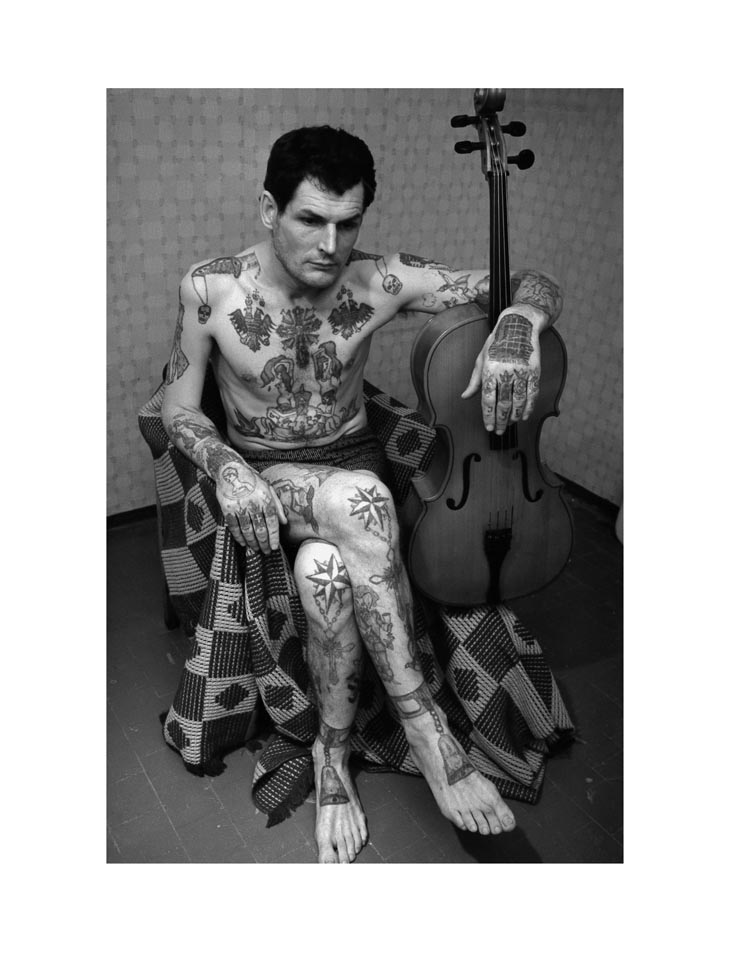
Sergei Vasiliev‘s photographs of Russian Criminal Tattoos are part of a three part encyclopaedia/archive on the subject. Vasiliev photographed between 1989 and 1993 in prisons and reform settlements across Chelyabinsk, Nizhny Tagil, Perm and St. Petersburg.

Vasiliev’s portraits are accompanied by over 3,000 tattoo drawings made by Danzig Baldaev during his time as a prison guard between 1948 and 1986. Baldaev had supported of the KGB who used his illustrations to develop intelligence on the convict class.
Three volumes of the encyclopaedia have since been published by FUEL Designs:
” [The documentation of] Tattoos were Baldaev‘s gateway into a secret world in which he acted as ethnographer, recording the rituals of a closed society. The icons and tribal languages he documented are artful, distasteful, sexually explicit and provocative, reflecting as they do the lives and traditions of convicts.”
“The accompanying photographs by Sergei Vasiliev act as an important counterpart to Baldaev’s drawings, providing photographic evidence of their authenticity. […] In these images the nameless bodies of criminals act as both a text and mirror, reflecting and preserving the ever-changing folklore of the Russian criminal underworld.”
Baldaev’s drawings and Vasiliev’s portraits are currently being exhibited at 4 Wilkes Street, London E1 6QF (30 October to 28 November 2010).
The Guardian has this review of the book/exhibition. More about Baldaev in particular at Design Observer.
RESOURCES
Image gallery.
From FUEL Publishing are three video shorts [1], [2], [3] of the drawings and photographs.
More can be found on Vasiliev‘s work at Michael Hoppen Gallery, Saatchi online (images) and the PhotoEye book review.
Found via Eight:48.com


PREVIOUSLY ON PRISON PHOTOGRAPHY
I’ve posted before about prison tattoos:
Prison Tattoos and the Photographers’ Intrigue
Klaus Pichler: Central European Prison Tattoos, Taxidermy and Beguiling Portraits of Odessans
Detached, formaldehyde-soaked, preserved, studied: The tattooed skin of Polish prisoners
Bob Gumpert on Foto8, on Prison Tattoo Codes
BIO
Sergei Vasiliev was born in 1937 in Chelyabinsk, Russia. After graduating from the MVD Academy, Moscow, he became a staff photographer for the newspaper ‘Vecherny Chelyabinsk’, where he has worked for the past thirty years. he has received many honours including International Master of Press Photography from the International Organization of Photo Journalists (Prague, 1985), Honoured Worker of Arts of Russia, and the Golden Eye Prize. His work has been exhibited internationally and is held in numerous museums’ collections. He is author of more than twenty books, including ‘Russian Beauty’, (1996) and ‘Zonen’, (1994).
Former Vietnam veteran, prison inmate and junkie (“once the needle goes in it never comes out”), Clark has a kind of coiled, unpredictable energy.
– Tobias Grey (‘Photographer Larry Clark’s muses’, Financial Times, Oct. 30, 2010)

Billy Mann 1963. © Larry Clark/Luhring Augustine, New York and Simon Lee Gallery, London.
Printed on the salmon-pink pages of the FT (the global leader in financial news), Larry Clark‘s latest interview about his counterculture subjects and his casual anti-commercial philosophy carries some irony.
Then again, perhaps not. Clark’s refusal to market and remarket his books and prints has led to scarcity – the result? Prices have been driven up:
“Clark refused to let either of his most famous books, the harrowing and explicit Tulsa and Teenage Lust, be republished. He finally did a couple of print-runs with Tulsa 10 years ago, but Teenage Lust is still out of circulation and as such a valuable collector’s item. Earlier this year, at an auction at Sotheby’s in London, a single print from Teenage Lust sold for £7,800.”
In his fifties, Clark learnt to skate to keep up with his cast for Kids. He believes that to photograph a youth culture you have to be in it. It must be difficult for Clark to have the city hall in Paris ban under-18s from entry to Kiss the Past Hello, his exhibition at Musée d’Art Moderne, “I think it’s just the stupidest thing in the world,” says Clark. “I think it’s an attack on youth and on teenagers in general.”
It’s difficult to argue against Clark’s indelible mark on American visual culture. Every hipster, skater, urban-wannabee and romantic sees their lives through the American-Apparel-Levi’s-Ryan-McGinley-Dash-Snow-Hamburger-Eyes-Zoolander-Derelicte images that advertisers, Polaroid & film enthusiasts create as facsimiles to Clark’s seductive and brutal works.
Again, irony reigns as advertisers define a slightly mucky but not diseased world in which they can place their products; a world that looks like Clark’s but is some distance from it. With that in mind, I think Tobias Grey‘s point has some weight:
“As a contemporary and admirer of Diane Arbus and W Eugene Smith, Clark is perhaps the last survivor to bridge the classic era of black-and-white photography and the present.”
Clark has ran and defined the continuum.
Read the article. Clark’s closing empathy for childhood movie stars is surprising and honest; he made collages to honor them.
‘Kiss the Past Hello’, Musée d’Art Moderne de la Ville de Paris, until January 2 2011.
PHOTOGRAPHY COVERAGE IN THE FINANCIAL TIMES
Like last weeks FT article on Leibowitz’s interaction with the market, this portrayal of Clark and his motives is well-written, even endearing. The FT Weekend has had articles on Martin Parr and Cameraless Photography in recent weeks too.
It was a mandatory choice of an airmiles-earned printed daily that brought the FT to my door, but I’ll admit I’m looking forward to my Saturday morning reads more and more.
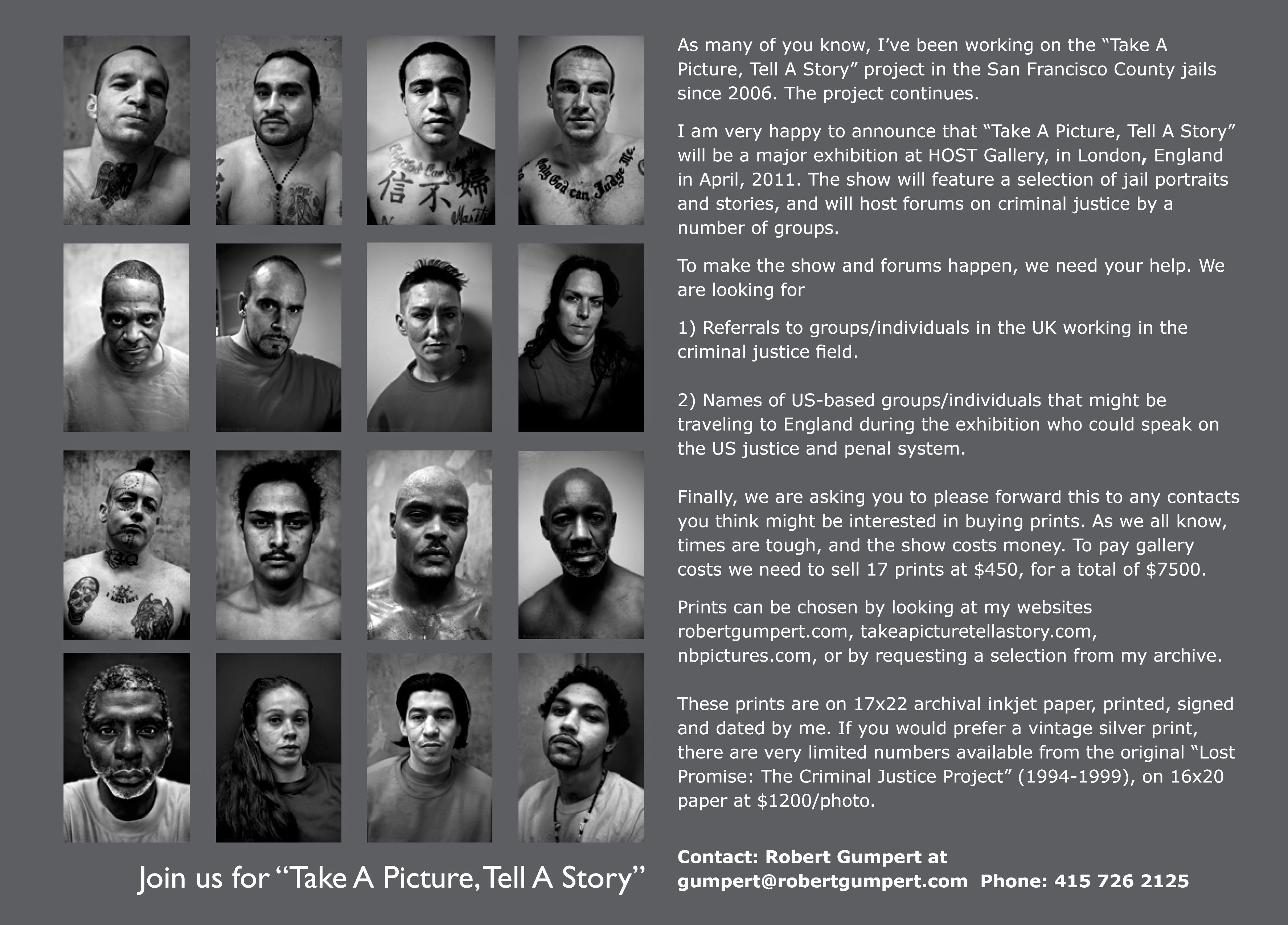
Good friend Bob Gumpert will be showing his portraiture from the San Francisco and San Bruno county jails at HOST gallery in London in April of next year.
From Bob’s email this week:
As many of you know I’ve been working since 2006 on the “Take A Picture, Tell A Story” project in the San Francisco County jails. The project continues. I go into the jails about three times a month and post to takeapicturetellastory.com as time and stories allow.
The show will host forums on criminal justice by a number of groups. To make the show and outreach happen we need your help with the following:
1) Referrals with groups/individuals in the UK working in the criminal justice field.
2) Names at US based groups/individuals that might be traveling to England during the exhibit who could speak on the US system.
3) Forwarding this note and flyer to your any of your contacts that might be able to help with contacts or might be able to help with funding by purchasing a print.
Obviously, I have a wild bias in seeing work such as Bob’s getting a wide audience.
Yet, photography from prisons/jails tests the theory that photography shows and delivers stories we otherwise would not see. Bob’s portraits and audio gives voice to the marginalised. Whatever the reasons for their incarceration, no one deserves to be made invisible. Bob’s work empowers his subjects and reveals the limitations of our criminal justice systems.
So, friends stateside and over there in Blighty, get your thinking caps on and see if you can help spread the word and find him some allies (and cash?)


Golf Five Zero watchtower. Crossmaglen, South Armagh, Northern Ireland, UK. © Jonathan Olley.
Last month, I had a jolly nice chat with a jolly nice chap about what all this means at Prison Photography. Where’s this open journal taking me?
I said if I took this whole thing to the academy, it could be as simple as a historic survey: The Uses of Photography to Represent, Control and Surveil Prison, Prisoners and Publics in the United States (1945 – 2010).
I was encouraged to ditch the historical view and engage the modern. Ask myself, why should anyone care about prisons? Only a small minority care now and that status quo has remained for many reasons tied up in the antagonisms of capitalism. Would a historical survey change minds and attitudes or just lay out on paper the distinctions most people have already made between themselves and those in prison?
Perhaps people would care more if the abuse of human rights that exists within the criminal justice system of America were shown to impinge on everyone, not only on those caught in its cogs?*
What if we consider the methods and philosophies of management used by prisons and identify where they overlap with management of citizens in the “free” society. Think corporate parks, protest policing, anti-photography laws, stop and search, street surveillance, wire taps, CCTV.
My contention has always been that there was no moral division or severance of social contract over and through prison walls. For me it’s never been us & them; it is us & others among us put in a particular institution we call prison.
But, now I am seeing also, there is an ever decreasing division of tactics either side of prison walls. Strategies of management and technologies of discipline perfected in prisons have crept into daily routine.
What has this emphasis on containment and of monitoring – at the expense of education and social justice – done to our society and to our expectations of society?
SURVEILLANCE/CCTV IN PHOTOGRAPHY
And now for the tie in with photography…
Thinking about surveillance, obviously we have the big show at Tate from this Summer, Exposed: Voyeurism, Surveillance & the Camera with its devoted section to CCTV. (Jonathan Olley‘s work from Northern Ireland is the standout.)
But I always think back to Tom Wichelow‘s series Whitehawk CCTV (1999), possibly because he insists it is not a criticism of CCTV just a look at the politicisation of the human subject viewed through its lens.
Most remarkable in the series is the trio of images of the tragic site of a murder. They reveal to us that looking and bearing witness can be an act of respect as much as that of curiosity as much as an act of control. We are all compelled to look, but some observers are recording the feed and have a disciplinary apparatus to back it up.

Untitled (CCTV footage). Young family visits murder site. Brighton 1999. © Tom Wichelow

Untitled. Friends of murdered boy visit the site. Brighton 1999. © Tom Wichelow

Untitled. Resident reveals murder site outside her bungalow window. Brighton 1999. © Tom Wichelow
– – –
*There’s a simple argument that we all suffer because our tax dollars support a broken system that makes us no safer.

Private Residence (Owners Deceased). South Philadelphia. November 4, 2008. Copyright © 2010 Ryan Donnell. All Rights Reserved.
Ryan Donnell‘s ‘Behind The Curtain‘ is just fantastic and surprising.
There is a long interview about the series on Eat The Darkness blog.
“When the 2008 election came around I was feeling a little weird since I wasn’t doing anything of importance photographically or journalistically, and it was such an IMPORTANT election (remember that feeling?). So I felt I should participate somehow. I started researching some of the more unusual sounding polling places in the city. The Philadelphia Elections Board actually posts a list of all the polling stations and every place has a small description next to the address, such as “Residence” or “Storefront” or “Water Department Laboratory.” So I made a list of the weirdest sounding places, packed-up my Hassy, tripod and film in my car and basically just drove all over the city of Philadelphia for about 10 hours on Election Day. I’ve done that every election since Nov. 2008.”

 Prison Photography