
You are currently browsing the category archive for the ‘Documentary’ category.

© Neelakshi Vidyalankara
For her Babies Behind Bars series, Neelakshi Vidyalankara visitied the Bedford Hills Correctional Facility in Westchester County, the largest maximum security women’s prison in New York state.
“The prison opened in 1901 and has hosted many infamous women prisoners (including Kathy Boudin, Jean Harris, Carolyn Warmus, Sante Kimes and Pamela Smart). It is also one of a few women’s prisons in the USA that allow pregnant prisoners to keep their newborn babies with them for the first 12 – 18 months of their life. The Bedford Hills nursery has existed in some form since 1901 and was created to help foster a stronger attachment between mother and infant, improve parenting skills and reduce a mother’s chances of recidivism,” says Vidyalankara.
Qiana did a short interview with Neelakshi last year.
Previously, I have noted the work of Patricia Aridjis and Angela Shoemaker, both of whom have documented maternity and motherhood while incarcerated.
What do I want from this year? I want to continue the fun I have researching. I want a rip-roaring online symposium on race, diversity and photography. I want to be continually surprised by the things I discover. I want to deliver juxtapositions that make one pause. I want to do more interviews with photographers. I want to talk to more people in prison education. I want to change one persons view and then move on from there.
Covering Photography is the type of site I love to stumble across. Much like PhotoEphemera it is a site of tangential but significant importance to the role of photography in wider culture.
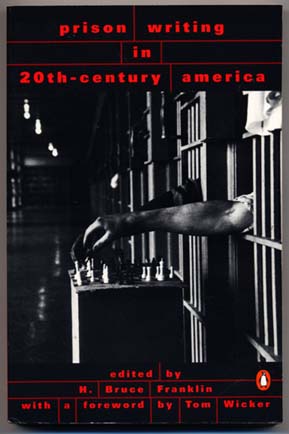
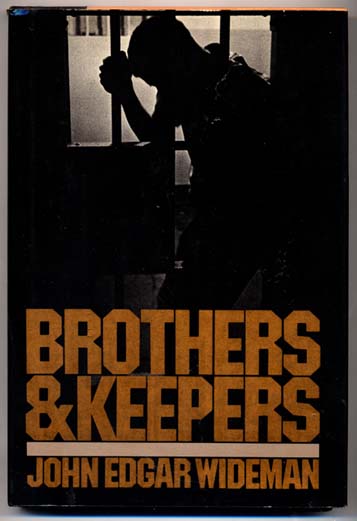
There are four books in the archive that feature prison photography. I have talked before about Cornell Capa‘s commitment to prison issues. Danny Lyon‘s career as a journalist is indelibly tied to American prisons. Arthur Tress and especially Charles Gatewood are not known for their prison photography.
I have bunched book covers with hand-picked works of each photographer as a playful convergence to kick off the new year.
ARTHUR TRESS

Halloween © Arthur Tress

Link
CORNELL CAPA

Russian and American soldiers, part of the Allied occupation forces, at a multinational party, Berlin 1945. © Cornell Capa/Magnum
Link
DANNY LYON
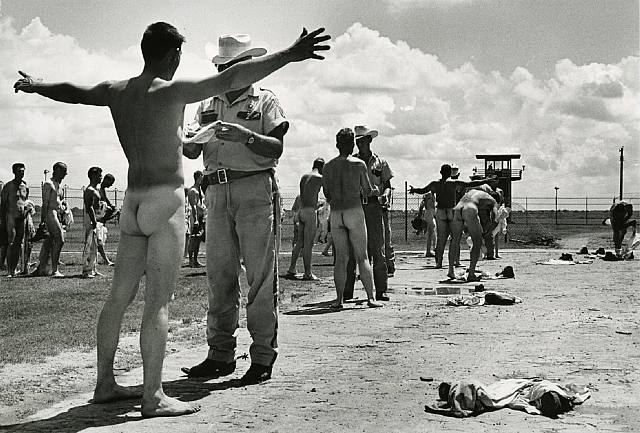
Texas Prison, Ramsey Unit © Danny Lyon

Link
CHARLES GATEWOOD

Wall Street © Charles Gatewood
Link

Greg Kahn documented Douglas Bolden, 52, following his release. Bolden lives in Fort Myers Florida, cares for four children and at the time of the photo-essay was struggling to find work.
I have featured stories on the difficulties and shock of reentry into society before – in one case with an elderly man following a 50 year sentence and in the other a wrongfully-convicted, consequently exonerated man.

Daniel Etter‘s project from Hohenschonhausen piggybacks on the story of Norbert Krebs to shape the narrative. Krebs was imprisoned in Hohenschonhausen – the primary Stasi Prison in the GDR – for questioning the reliability of election results. He now leads guided tours. In sites such as these, it is a solemn privilege to hear the first-hand experiences of anyone persecuted by prior political powers.
It is as much a dilemma for communities and nations as it is an opportunity to write and affirm history, when former prisons are repurposed. Prison museums, peace museums and memorials are all common solutions to the troublesome, contested and understandably hated sites.
Prison museums are very common – here’s a (non exhaustive) list of links.
US
Alcatraz Island
Texas Prison Museum
Angola Prison Museum, Louisiana
San Quentin Prison Museum
Folsom Prison Museum
Eastern State Penitentiary
Sing Sing Prison Museum
Old Montana Prison Museum
Burlington County Prison Museum
Museum of Colorado Prisons
Wyoming Frontier Prison
Elsewheres
Dartmoor Prison Museum, England
Lancaster Castle, England
The Clink Prison Museum, London
Robben Island Museum, South Africa
Port Arthur Historic Site, Tasmania, Australia
Fremantle Prison, Western Australia
Abashiri Prison Museum, Japan
The Changi Museum, Singapore
Kresty Prison Museum, St. Petersburg, Russia
If your interest is piqued, consult this huge inventory of prison museums from across the globe.
And here’s a random selection of photographs of a selection of prison museums.
Note: I have touched upon Hohenschonhausen before here and here.
I’ve gotten to know Adam Westbrook‘s work through mutual online friends. I signed up for his Twitter feed about the same time I did for the RSS feed on John Hirst’s Jailhouselawyer’s Blog.
John Hirst served 35 years for murder and now writes and advocates for prisoners rights. This year he has contributed at the Guardian.
It’s good to see these two folk collaborate.


This post is a while overdue. As I am sure you know, Medecins Sans Frontier launched Condition: Critical this year. It is a website to bring together the many stories of victims of the war, assemble video and photo tools for activism and to leave messages of support. That’s right … no money, just a letter and awareness.
As part of the effort, my mate Ben has had his hand in the first four videos pushed out to the world. Ben’s summary of this conflict and humanitarian situation;
“Its the world’s deadliest conflict since the second world war and yet the majority of people have never heard of it. According to the IRC at least at least 5 million Congolese have died in more than a decade of conflict sparked off by the 1994 genocide in neighboring Rwanda. Most of the deaths are linked to a lack of medical facilities as the ability to access medical care in Eastern Congo has crumbled with the war.”
Ben’s team trained the comms people out in the field to gather stories and then they edited it to relay the stories in a powerful, respectful way. First hand tales and simple honest images. No gore, only testimony.
Drawing the War is the troubling tale of a boy carried away by opposition forces and set to work.

There are four videos from the MSF Condition Critical campaign on duckrabbit vimeo profile. The other three are Mishoka’s Story, Bahati’s Story, and Francoise’s Story.
So it seems that Ben has had some success in challenging and changing the public relations that non-profits and charities have to their global audience. Now all he, us and the people of Congo require it awareness, effort and mindshare.
Ben has asked us to do one or four of four things: 1. Leave a message of solidarity on the map; 2. Twitter about it and link to it on Facebook (for Twitter use #conditioncritical); 3. Embed one of the video’s on their blogs; 4. Write something about the project. Tewfic, Mark, Charlie, Mediastorm, Daniel and Boing have done their bit. Pass it along.
WHILE WE ARE ON MSF
I also recommend following the MSF Photoblog, managed by Bruno Decock (I think) as it endeavours (commendably) in public to deliver relevant balanced, effective, non-sensational and representative photographs of Africa. Not easy!
Photographers Dominic Nahr, Julie Remy, Martin Beaulieu, Robin Meldrum, Yasuyoshi Chiba and Cedric Gerbehaye have been involved in the collaborations with MSF for Condition Critical.
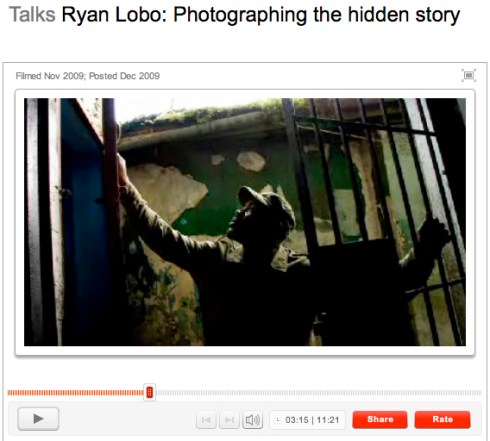
Ryan Lobo talked about three of his projects at a recent TED conference. The first story Lobo told stopped me in my tracks.
Lobo photographed Joshua, a man formerly known as General Buttnaked, who had committed heinous crimes against humanity during Liberia’s civil war. Joshua is now a baptised evangelist and as he entered villages across Liberia again, he did so not to destroy them but to ask for forgiveness.
The level of forgiveness that he asks for is galling to the Western mind. 10,000 lives. The ask itself is cruel.
During the war Joshua fought naked (hence the name). He murdered, raped and tortured thousands of Liberians. He corrupted hundreds of youngsters inducting them into war, enforcing his command over the boy-soldiers with unspeakable brutality. They are now destitute; many addicted to drugs. Heroin is commonly abused.
Joshua spoke from a soap box to crowds often including his victims. Lobo admits he thought Joshua would be killed by the mob in a short time after beginning the tour.
But Joshua was not killed.
How do we tally this story of redemption (if that term is not obnoxious in this instance) and this version of restorative engagement between perpetrator and victim with our Western codes of justice?
And as Lobo asks, does forgiveness replace justice?
I have no answers.
[Author’s Note: This is the first in a three part series on prisons in Africa. Through the lens of three different photojournalists, we will see the conditions and lives within prisons of Guinea, Burundi and Sierra Leone.]

© Julie Remy. Inscriptions by young prisoners.
Julie Remy has photographed stories in Rwanda, Mali, Zambia, Malawi, and for her series on prisoners – Guinea.
In September 2008, Médecins Sans Frontières (MSF) began an emergency intervention in the civilian prison of Guéckédou in southeastern Republic of Guinea. Remy’s documented the food and medical aid effort.
“We have problems with food and illness here. There are no medications. There is no doctor. Since 2007, 30 people have died here and the doctor didn’t come.” Inmate, 19 months in prison
Guéckédou was over-crowded, unhygienic and without proper ventilation. As a result, some inmates were malnourished, most dehydrated and many with respiratory and skin diseases. It was recorded that prisoners with tuberculosis shared cells with the general population. Incubation of disease was a major concern.
I have no idea how the prison conditions of Guéckédou compare fifteen months on.

© Julie Remy. At the Guéckédou Civilian Prison, inmates wash only with water on a non regular basis. This prisoner shows the photographer his scabies. Due to poor sanitation prisoners suffer various skin diseases.
Remy worked in dark surroundings. As MSF vouched, “The scene that meets the eye upon entering the chambre noire “dark room” is beyond belief. Some 26 prisoners, crammed into a space of about three by four meters, can only be made out by squinting.” These images are part of a specific, urgent campaign, so it would be offensive of me to pay them any aesthetic critique. The awareness is what matters here.
MSF made good use of Remy’s photographs to produce a short video explaining the situation and dire need for intervention.
I’d like to emphasise that Remy (as a photographer) and MSF were in Guéckédou because of extreme circumstances at the national level. The poor conditions in the prison can be attributed to a number of larger structural instabilities. The men in these photos are one constituency suffering from a regional crisis. MSF explains; “The failure to ensure basic minimum standards in Guinea’s prisons can be linked to the country’s generally poor human and economic development. Ongoing instability and conflict in neighboring countries have long impacted on Guinea, while strikes and civil unrest have emerged in-country over the past few years. The ongoing international increase in food prices, especially in 2008, has exacerbated Guineans’ already precarious living standards and food insecurity.”
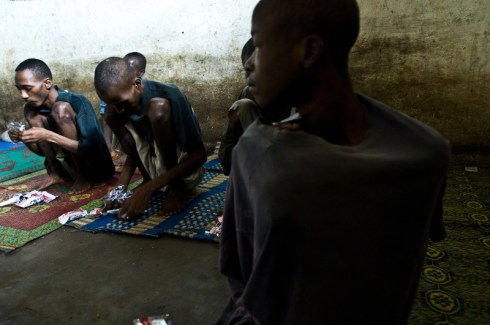
© Julie Remy. Malnourished prisoners received plumpy nut provided by MSF at the Guéckédou civil prison.
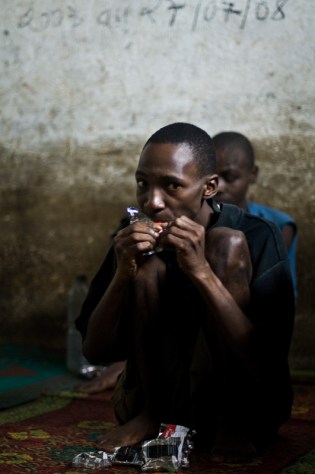
© Julie Remy. Malnourished prisoners received plumpy nut provided by MSF at the Guéckédou civil prison.
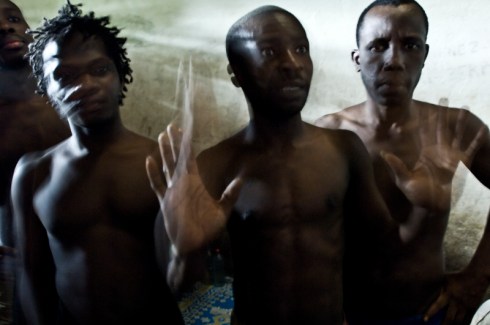
© Julie Remy. A prisoner tells us that he is innocent. That he has done nothing and still has not been judged. He says he does not know why he is held here in the “Chambre noire” where a dozen prisoners are tied to a bar and held with another dozen in a barely lit cell. Guéckédou civil prison.
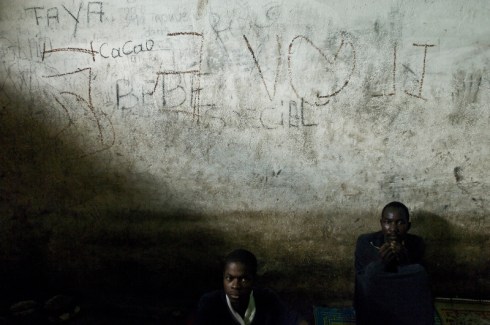
© Julie Remy
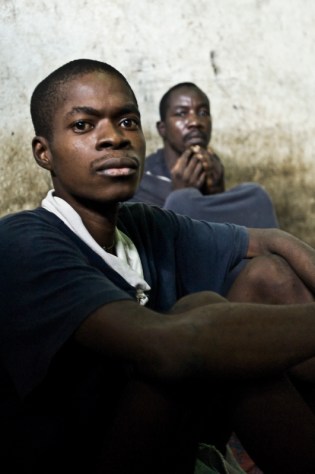
© Julie Remy
When the opportunity arises, I think it is important for audiences to view images like those two above within each others context. The first image is a dank, alienating environment in which the oppressive shadows and walls dominate. Whereas the second image (probably taken within a matter of seconds) is a well lit portrait centred on the gaze and associated emotions of the man; the prison environment is not stated. Precisely because MSF and Remy were present due to the physical effects of this environment on these men, both are valid photographic approaches.
The consequent written report from this aid intervention released in February 2009 continued with a call for systemic reform:
“Although the sub-standard conditions in Guinean prisons can be attributed partly to poverty and the country’s limited resources, these factors alone do not explain the absence of response to recurring malnutrition and the unacceptable living conditions in Guéckédou and other prisons. Guinean national authorities bear the ultimate responsibility to uphold the fundamental human rights of its inhabitants, including its incarcerated population.”
I, like many others invested in the photojournalism/documentary community, want to see less images of suffering in Africa and more images of the uneventful days; the boring normal times, perhaps some quiet smiles and tears. Add to that some local African photographers and we’re on the right track. (See recent commentary by Paul Melcher, Daniel Cuthbert and Ben Chesterton for more on this).

© Julie Remy
In closing I’d like to offer a caveat for the three part ‘Prisons in Africa’ series.
African prisons – that is, sites of incarceration across a land mass the size of Western Europe, Argentina, China, India and the USA combined – are each unique. Generally, conditions will be poorer than in prisons of developed nations, but every prison has its own culture, rules and circumstance. In Africa, as in the rest of the world, prisons usually exhibit the worst of a nation; retribution and anger, neglect and apathy.
Photographers are compelled to visit prisons known to them through local knowledge or national notoriety; we must expect there is a story to be told. The prisons I will feature in this three-part series will not be pleasant, but I think the three featured photographers are sincere and the stories are important.
While the men in these images may deserve pity, Africa as a continent does not. Africa deserves our respect and our time.
Nations in Africa, as with all places featured in the photojournalism we consume, should be places we think about visiting. I seriously encourage anyone and everyone to make an extended visit. Opportunities to dilute the media images of places and people with first hand interaction with those places and people will only have positive results. If only we had the opportunities, good reason and resources to visit and live in new places frequently.
(Disclosure: I lived in East Africa for five months. That time made more complex and less harried my perspective of the world. The largest culture shock was returning to the UK.)
__________________________________________________________
Official Bio: Julie Remy is an award winning documentary photographer specializing in human rights, health, travel and the environment. What she captures through her viewfinder and what she tells in written word she believes will contribute to bringing hope and respect and perhaps assist in gaining access to the care and knowledge they deserve.

 Prison Photography