
You are currently browsing the category archive for the ‘Fine Art’ category.

Natasha, Women’s Prison, 2009. © Michal Chelbin
For the past three years, Michal Chelbin has made portraits in the prisons of Russia and Ukraine. You can see a selection of the works from her series Locked on the New Yorker Photobooth blog.
Chelbin’s doleful portraits are striking – something different – and, of course, given their subject matter I was compelled to mention them here. However, without any specialist knowledge of the prisons in Russia and Ukraine, I struggled to think of a worthwhile statement to accompany with them. Is it enough for me just to say that work is beautiful and interesting? I don’t think so.
Therefore, this conundrum becomes the focus of this short post.
The way Chelbin describes it, her portraits are the first step on a journey (of undetermined length) to at least attempt to “know” her subjects:
“When I record a scene, my aim is to create a mixture of plain information and riddles, so that not everything is resolved in the image. Who is this person? Why is he dressed like this? What does it mean to be locked up? Is it a human act? Is it fair? Do we punish him with our eyes? Can we guess what a person’s crime is just by looking at his portrait? Is it human to be weak and murderous at the same time? My intentions are to confuse the viewer and to confront him with these questions, which are the same questions with which I myself still struggle.”
It seems to me that this the type of curiosity we should expect of all photographers and their works; it’s partly how we are drawn into the previously unknown.
But the unknown has its dangers. As Fred Ritchin stated:
“Photography too often confirms preconceptions and distances the reader from more nuanced realities. The people in the frame are often depicted as too foreign, too exotic, or simply too different to be easily understood.”
Beautiful photography is easy to come by these days, and so, for me at least, viewing beguiling portraiture becomes an act of enjoying the beauty but then stepping further and using it to get at something deeper. That might involve a dialogue with someone over coffee; it might be to find comparative examples [1, 2, 3, 4, 5, 6, 7]; it might be to read up on the conditions for juvenile prisoners in Russian prisons; it might be to read the photographer’s statement or even contact the photographer directly to seek the missing pieces.
Photographs, and particularly portraits, are often a door unlocked but often in our busy lives we don’t even try the handle.
Perhaps now is a good time to return to some thoughts on what makes a great portrait, here and here.
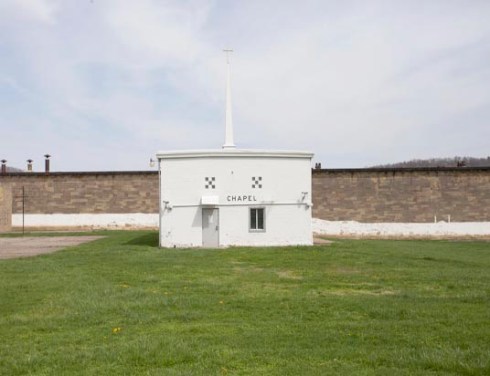
Church within West Virginia Penitentiary, 2011
Emily Kinni, recent recipient of a Tierney Fellowship, has an intriguing project named Where Death Dies for which she has photographed former execution sites and decommissioned execution chambers, electric chair and death apparatus.
New Jersey State Prison was the site of executions until the Garden State outlawed the death penalty in 2007, and West Virginia Penitentiary ceased as the site of state executions in 1959.
West Virginia Penitentiary itself was decommissioned in 1986 and has since become a tourist destination; on view is ‘Old Sparky‘, the prison’s once-used electric chair. Kinni photographed a basketball court where the execution chamber used to be sited.
This is a young project and potentially still in the making. Having being named a Tierney Fellow though, it is likely Kinni will move away from this subject matter. The primary goal of the Tierney Fellowship is:
“to find tomorrow’s distinguished artists and leaders in the world of photography and assist them in overcoming the challenges that a photographer faces at the beginning of his or her career. […] At the end of the one-year grant period, recipients are expected to present a new body of work.”
We’ll keep our eyes peeled.
As a footnote, comparable projects on death chambers would be Lucinda Devlin’s Omega Suites and Mark Jenkinson’s Death Row.
Thanks to Hester for the tip off. View the other 2011 Tierney Fellows here.

Shack on the outskirts of town @ Jehad Nga
Last year, in response to Jehad Nga‘s Turkana portfolio, I said, “consumers of media haven’t changed enough, and Nga has hardly changed at all.” My criticism was that Nga had adopted the same chiaroscuro technique for the Northern Kenyan tribesmen as he had U.S. Marines, Somali pirates and Kenyan boxers.
It was my first real foray into negative criticism* and to my surprise Nga emailed and said he could agree with a lot that I said. That opened up a year long dialogue that resulted in an interview recently published for Wired.com.
In the Wired interview, Nga explained he had recently been on special assignment with a second unit crew on the shoot of a feature length drama. Nga who lives mainly in Nairobi, with an apartment in NYC, has spent most of his professional life in the heat and bustle of North Africa, sub-Saharan Africa and the Middle East.
“It’s very different to Africa,” Nga told me, “Barrow, Alaska was important to me; it’s inhospitable, it’s a challenge to survive. Aesthetically, it is lush for picture taking. It is stark and apocalyptic, but I responded to the bleakness. The harshness isn’t because of violence or outside incursion. It’s seasonal, it just is.”
I was pleased to see then that John Bailey‘s well-written and meaty blog for the American Society of Cinematographers (ASC) had featured a selection of Jehad’s work.
See for yourselves how this work differs wildly, and read in my interview why Nga really needed a change.
______________________________________________________
* If you recall, Marc Feustel took umbrage at the prevalence of overly positive reviews)

Angola prison rodeo © Sarah Stolfa
Philadelphia based photographer Sarah Stolfa, best known for The Regulars, a portrait series of punters at the bar she tended, has posted some new work on her website.
Pallbearers struggling with a casket, an elegantly dressed African-American lady with a gun holster, a man with a singed blanket stood in a charred field, a long-limbed man with leather bible, public urination, public housing; this is a visually uneasy but coherent edit and presumably the result of a road trip.
Also included are two photographs from the prison rodeo at Louisiana State Penitentiary (one and two). I am uncovering more and more photo projects from this particular event and I’m still working out what, if anything, this relatively high level of exposure means within the specialist sub-sub-genre of prison photography.
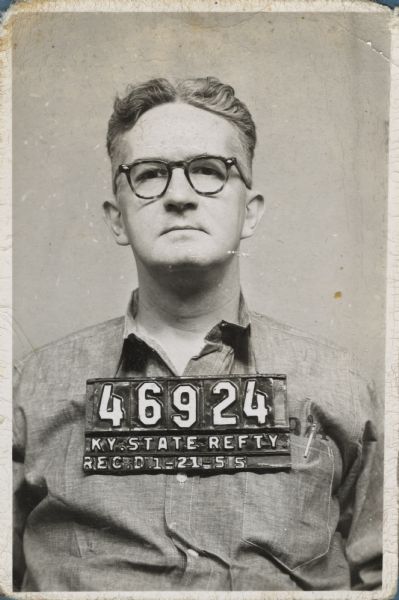
CARL BRADEN
I was surfing through the Wisconsin Historical Archives, like you do, and came across the above image of Carl Braden.
Braden and his wife Anne Braden were journalists-turned-activists who were part of the union movements and later the radical interracial left of the 40s and 50s. The Braden’s bought a house on behalf of the Wade family, their African American friends in suburban Louisville, Kentucky. When neighbours found out a Black family had moved in they burnt a cross outside the house and went after the Braden’s. Carl was charged with sedition in what is known as the Wade Case. Carl was sentenced to 15 years and served 8 months, eventually paying $40,000 to get out.
The Anne Braden Institute (ABI) now operates out of the University of Louisville. The ABI has a Flickr stream of scenes from her full life.
KARL BADEN
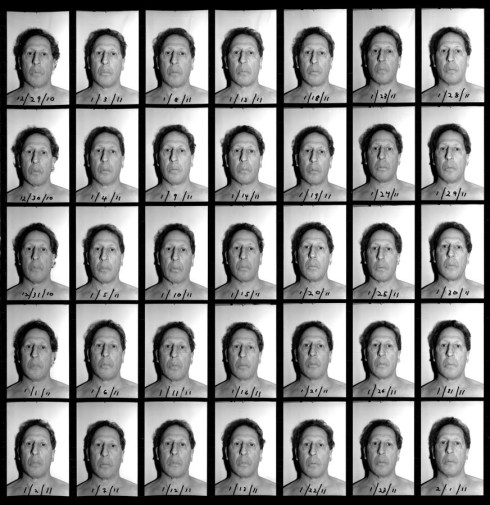
Karl Baden has chosen to put himself in the picture everyday for 24 years. Somewhere he has set up a self-imposed mugshot identification room. All these can be seen at his website Every Day.
It’s worth noting that Baden and Noah Kalina are the original and best for these vaguely masturbatory, mirrored versions of themselves in time-lapse. Others include a girl with a nice set of scarves, two dudes (one and two) with beard-growing missions, a guy with an 800 day commitment and Homer Simpson.
There is also Diego Goldberg who self-documents he and his family once a year, every year on the 17th June.
Baden has established a unique set of data for a limited case study in visual anthropology. The date runs like an I.D. number at the bottom of his shots.
As Baden describes the project, he removes emotion and variables from the photography, just as police or criminal justice photographers do for mugshots:
Every Day is performed within a set of guidelines. […] Reserved exclusively for this procedure are a single camera, tripod, strobe and white backdrop. […] I use the same type of high-resolution film (Kodak Technical Pan until it was discontinued in 2007, Ilford Pan F since then) and the same strobe lighting. The camera is always set and focused at the same distance. When taking the picture, I try to center myself in the frame, maintain a neutral expression and look straight into the lens.
Baden lists the key tenets of Every Day to be mortality; incremental change; obsession (its relation to both the psyche and art-making); and the difference between attempting to be perfect, and being human. I’ll grant him those things, but I also wonder is does the project not feel like a sentence?
And my question to you, readers, is what should we make of this type of project? It could be just inventive fun or it might be one of the most present-minded approaches to photography there is? I can’t decide.

INTRODUCTION
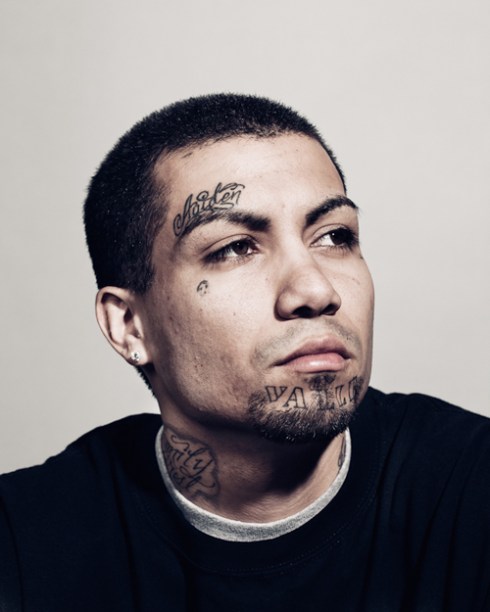
Los Angeles based photographer, Adam Amengual says of his series Homies:
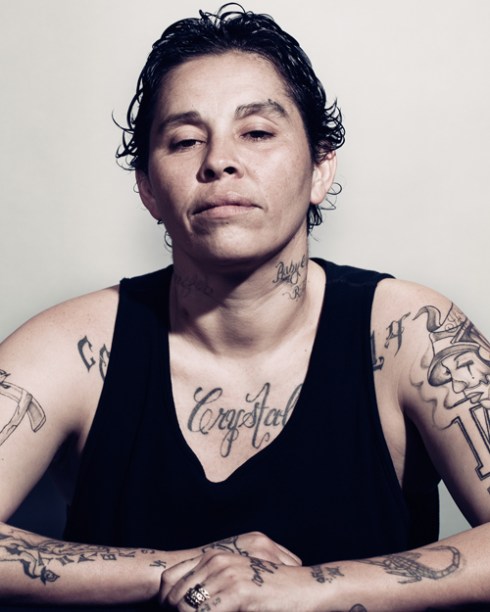
“Through the help of the non profit Homeboy Industries I photographed people who have made the decision to change their lives for the better. The people in these images are current or former gang members and most had spent time incarcerated before walking through the doors at Homeboy Industries. Through a variety of services, Homeboy Industries helps these men and women redirect their lives and provide them with hope for their futures.”
Homies is very striking; the unorthodox subjects under studio lighting both captures and confuses the imagination when reading the portraits. Not surprisingly, Homies has done the rounds recently, appearing on Wesley, Kate and Joerg‘s blogs. I wanted to find out more about the community at Homeboy Industries, about Adam’s decision-making and about his reception at Homeboy when he turned up with his gear.
CONVERSATION
Prison Photography: Were you invited along to Homeboy Industries or did you approach them?
Adam Amengual: I approached them. The subjects are a mix of employees, active and non-active gang members who are seeking one of the many services that Homeboy provides.
I heard a story on NPR about Rev. Greg [Boyle] and Homeboy Industries, which sparked my interest to explore the story photographically. It was a six month process, stemming from my initial contact, to the shoot, and then finally the follow up interviews.
PP: Why were you motivated to make this series?
AA: I have been interested in gangs and cults for a long time. I am very interested in why people join these kinds of groups. Simply put, they are looking for love and a sense of family. Gangs, for example, take advantage of people who have emotional needs that were not fulfilled at home. That is not the case with every single person that joins a gang, but definitely the majority.
Tim Hetherington talked about how his documentary pictures came from a place of personal curiosity. It was a way to locate himself in the world. I relate to that. I use photography as an excuse to meet people or to answer questions that I am interested in. Homeboy turned out to be a venue for me to fulfill my interests in gangs through pictures. Additionally, the current and former gang members have a very distinct looks; I knew it would make for a visually interesting project.
I’m very interested in how people can break a family’s misfortune or shake an inherited “curse” such as addiction, racism, or gang affiliation. It’s very easy for children to repeat a parent’s mistakes. It takes so much effort, courage, and persistence to take a stand and say, this will not happen to my children. After interviewing a few of the people in my pictures I came to understand that the majority of them are trying to be a better example for their kids.

PP: Describe the reputation of Homeboy Industries in Los Angeles and how it relates to the particular gang culture and the cycles of crime that exist in LA. I’m asking what the public know and think of this type of program. Are they supportive/proud? Do they care?
AA: Unfortunately, I do not think that most Angelenos are all too aware of Homeboy Industries and the great work that they are doing. I often have to explain what the organization is when I am talking about my project. But, I will say that most people are very interested when I explain how the organization works and what it’s all about. So, that is certainly a very good thing.
As for the people that have heard of Homeboy, they are very supportive, but usually they just think it’s a place for job training. People are pretty blown away when I list all the classes, counseling, tattoo removal provided by Homeboy. Don’t get me wrong, job training is a huge part of what they do there and it makes the biggest difference, but all the other services in combination with the job training make Homeboy very effective.
PP: Is Homeboy Industries distinctly Angeleno?
AA: Homeboy Industries is distinctly Angeleno. You hear that right out of the mouths of the people who work there, as well as from those that use their services. People travel from all over the country and the world to study what Rev. Greg has created. Time and time again you will hear people say that there is only one Homeboy Industries. They don’t mean “we’re better than you”, they’re just speaking to the fact that it is such an incredibly unique place.
PP: Your work was recommended to me by your former instructor Stephen Tourlentes. I have featured his work on Prison Photography before. Tell us about your education, your philosophy and what you think are the responsibilities of photographers.
AA: I really appreciate Steve sending you my work. I was a teaching assistant for his lighting class. I studied fine art photography at Mass Art in Boston.
I did not plan on studying fine art photography specifically, but I fell into it; I actually rebelled against it for a number of years. Even while I was in school, I wanted to be a commercial photographer, and at that time I had it in my head that Mass Art was cheating me out of something that other more commercial programs were offering.
Little did I know that the ideas professors Stephen Tourlentes, Nickolas Nixon, Abelardo Morell, and Laura McPhee were instilling in me would mold me into the artist and photographer that I am and continually strive to be.
At Mass Art I was schooled in what it meant to be a visual artist and that makes more sense to me now than it ever did before. It’s like the lessons your parents teach you when you’re a kid that you totally don’t get at the time.
Photography is a like trade in a lot of ways; a metal worker can just make guide-rails for stairs or she can be a sculptor. Both take a lot of talent and training, but they are very different mindsets. I’ve learned a lot over the last seven years by assisting commercial photographers – great technical skills, work ethic, and business sense, but all of that, in a sense, I got paid to learn. My professors at Mass Art taught me a way of thinking that’s a lot harder to learn outside of an academic setting. Unless you have an amazing circle of artist friends that are constantly talking about your work and its’ context to the world, you will have a hard time seeing your work from a fine art point of view. I’m not sure if I always had that in me, or if a seed was planted and it took a bit of schooling and time to mature, but I see myself as an artist first and a photographer second.
Photography is very important as a document, a reference for viewers to understand the past and people & places that they’ll not interact with in person.
As for the responsibilities of photographers, that is a hard one. I know what I feel to be my responsibility, especially with my personal work, and that is to make honest pictures. I have a lot of friends in both the fine art world and the commercial side of photography, and I like that. I enjoy discussing the strengths and weaknesses of both worlds, but commercial photography (advertising and editorial) tends to not ask as many questions.
You can compare the world of cinema to the world of photography. There is documentary film-making like Restrepo, moving narratives like in The Kings Speech, or popcorn-mindless-fun like Transformers. There’s a lot of variety and they’re all entertaining on some level. It really depends on the viewer to make the choice on what they want to consume because if there is an audience someone will produce for it.

PP: You’ve said that in the future you would like to photograph juveniles sentenced to life without parole (LWOP). Why this particular group?
AA: Juvenile lifers are a group that I am really drawn to “putting a face on”. A lot of times you hear statistics, particularly ones that relate to the prison system, and it upsets people or makes them feel like something is wrong. But, truthfully, those statistics are just a bunch of words and numbers. When you actually see a person that is affected by the system, then the meanings within the issue make lasting and meaningful impressions.
I had heard some statistics about LWOP juveniles and asked who are these kids? What is their story?
I saw a documentary When Kids get Life on PBS, it was informative but it only covered a few stories in Colorado. Many other states impose this sentence, and I would like to show more broadly who these people and families are. One of the men I photographed and interviewed for Homies was sentenced to life at 17. He spent 27 years behind bars. Why did he end up there? The easy answer is a violent crime, but the harder question to answer is why did he commit that crime in first place? I’m sure that if you took a look at 50 people serving time in prison you could find a lot of similarities in their formative years.
Furthermore, the idea of youth in our culture, what most people envision as the best years of your life, is the opposite of being stuck in prison. I think this is an idea that could be understood in a visual manner and could make a strong point when looking at a portrait of someone in that position.
PP: What are your general thoughts on the prison systems in the US – from your own perspective and also the perspectives of those you’ve photographed.
AA: Prisons are an example of what American culture does best, we look for the quick and easy way to “fix” anything. Get fat, get plastic surgery, something you bought breaks, throw it out. We have a hard time looking at the source of problems and want to just sweep many away.
I am currently reading Gabor Mate’s book In the Realm of Hungry Ghosts. Gabor talks about how at one point it was thought that genes made you a drug addict and this was accepted so quickly because as a society we want to say that a person was messed up from the get go, had no chance, that there was nothing we could do. As it turns out, genes have only the slightest effect on how a person develops negative issues in life. How a person is raised and early life experiences is what really determines the kind of functioning role they will have in society. Treating society with preventative medicine, to make sure people do not commit crimes, join gangs, etc. is a lot harder to do.
Almost every person I talked to at Homeboy, that had done any kind of serious time, said that prison just makes you an even worse criminal. To quote one of my subjects, “You go in there with the weed problem you come out strung out on dope…” Another thing that I was told is that the longer you are in there, the more you have to adapt to being in prison and learn to survive. Then you have to re-adapt to “normal society” once released. If you do not re-adapt and most do not, that prison mentality will cause you to end up right back in there.
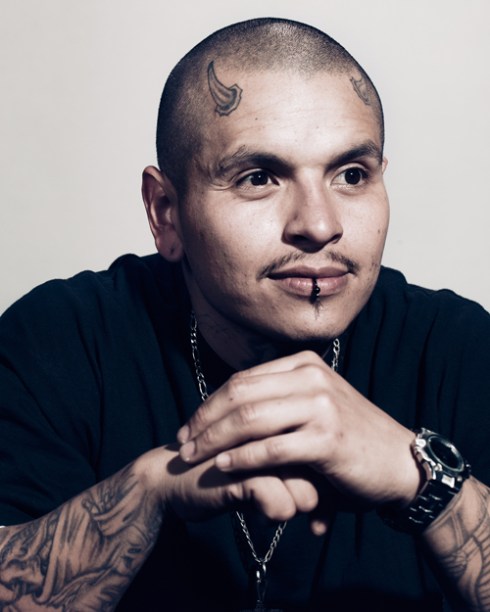
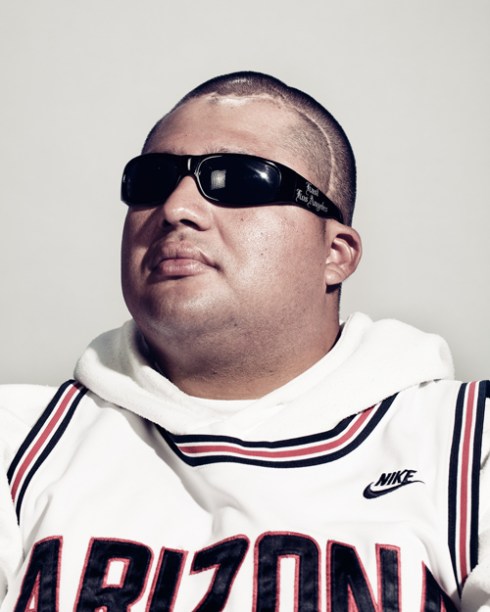
PP: I don’t usually ask about techniques or lighting (I am not a photographer), but your Homies portraits have a particular look. Explain your choices in setting up the portraits.
AA: A few of my biggest influences in photography are Thomas Struth, Rineke Dijkstra, and Stefan Ruiz. All three have worked in the portrait style that I chose for this series. Studio portraits satisifed both logistic and aesthetic concerns.
When I first approached Homeboy Industries, I wanted to photograph a subjects in their home environment, but it was made fairly clear from the start that I would not be able to do that. I was told that if I was more than welcome to shoot on Homeboy’s premises. I knew I did not want the Homeboy facility to overpower the individuals I was making portraits of, and to do that I needed to visually remove the environment.
When shooting a studio style portrait I sometimes like to use a bit more of a hyper-real light source, nothing over the top, but a light that has a physically descriptive character to it. It cannot be too distracting. I don’t want the viewer paying more attention to the lighting than the actual subject.
For three reasons, I wanted these pictures to be a tighter crop. One, I have always been really into Flemish Portrait paintings from the 17th century. The lighting and chest up crop was, in my opinion perfected by painters like Van Dyke. Two, I wanted to focus on the face as well as the hands; tattoo culture is such a big part of their appearance that I really wanted to show those details. Three, shooting in this style begs a comparison to a mug shot. A majority, if not everyone in this series has had a mug shot taken of them at one time in their past. I feel I have flipped that old image of them showing them as proud and iconic. It is a visual metaphor for the transformation they are bringing to their own lives.
PP: Did you give your subjects direction? What did they want to convey through your photographs.
AA: I gave them only a few cues. Everyone that I photographed were all proud to be at Homeboy and proud of why they were there. They know that they are taking steps in the right direction, and I really wanted to capture that. I mentioned old painted portraits, pride and stoicism, to make sure they got the idea that I wasn’t looking to make a smiley Sears portrait. I photographed them digitally so I was able to show them exactly how their pictures were going to look and feel. I think this really helped with the collaboration.
When first photographing someone there is always a trust to be gained, this can take anywhere from a few seconds to an hour, even more sometimes. After the first few people at Homeboy saw how the images were going to look, more and more people then wanted to be photographed. I believe they felt it was a chance to document and celebrate this positive action in their lives. It was an incredible experience to be a part of.


© Marjorie Jean-Baptiste/Fotokonbit
After my extended commentaries on photography in Haiti after the January 2010 earthquake, I’d like to bring attention to a non-profit producing and teaching photography workshops and putting cameras in the hands of Haitians.
FotoKonbit is a non-profit organization “created to empower Haitians to tell their own stories through photography. […] Inspired by the Creole word “konbit” which can be defined as the coming together of similar talents in an effort towards a common goal, we use our skills as photographers, educators, and artists to make a positive difference, through photography. By partnering with established Haitian organizations, FotoKonbit is uniquely positioned to inspire hope through creative expression and provide Haitians with the opportunity to document their reality and share it with the largest possible audience.”
The FotoKonbit team is made up of Frederic Dupoux, Ralph Dupoux, Maggie Steber, Marie Arago, Noelle Theard, Tatiana Mora Liautaud and Edwidge Danticat.
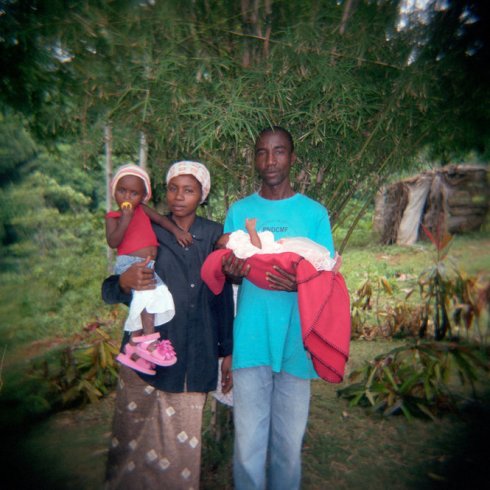
As TIME notes:
One of the most innovative uses for the photographs has been as documentary evidence for aid organizations. During three recent workshops for teenagers and younger adults living in tent communities, participants were asked to photograph aid efforts that they thought were successful, and to demonstrate needs that had not yet been met. Fotokonbit’s partnership with the American Embassy helped to get the work seen by the international aid community in Haiti.
In addition to these laudable humanitarian uses of Haitians photographs, is the simple fact that these images represent something distinctly different to the majority of Western media. How often have we seen naked, entranced worshipers prostrate in the waterfalls of Saut d’Eau? And how often are photographs from Haiti wrought with some outsider hyperbole or gratuitous pain? I don’t want to vilify photographers, especially as many such as Jonas Bendiksen and Louis Quail are committed to nuanced story telling.
Just to say that perhaps the mundane serenity of the landscape photograph below probably would not appear in our mainstream media.
And the market shot is just beautiful.


More images at TIME LightBox.

Madrid Prison © Gunnar Knechtel
Tree lined corridors and green lawns; swimming pools and squash courts; but this is not suburbia, this is Madrid VI prison. I know very little about the Spain’s prison system. In fact, the only time it has featured on Prison Photography was as it related to Mathieu Pernot ‘s photographs of family screaming over the walls of a Barcelona jail. It would be speculation to wonder if Gunnar Knechtel’s series Madrid (2004) depicts the world into which Pernot’s subjects howled. Instead I, and we, shall reply upon the information provided by COLORS Magazine Issue 50:
“Madrid VI prison (opened 1998) is staffed not by guards but by funcionarios, unarmed civilian servants with college degrees. It’s part of a prison culture that according to one funcionario aims to foster “a certain level of mutual respect and trust” between inmates and staff.”
To American eyes, Knechtel ‘s photography may appear to describe something other than a prison. The human-scale of the design contrasts the dominant modes of American incarceration, especially the dehumanizing Supermax.
Where it makes no effect on function, recently-constructed Spanish prison design includes manipulation of colour, sight-lines and landscaping to lessen the psychological impact of these confined spaces. But more than that, Spanish prisons – as depicted here by Knechtel – provide health and recreational facilities to nurture humanity. No more is this nurturing in evidence than in the prisons’ policies toward family and reproduction.
“A [prison reform] law – the new Spanish parliament’s first piece of legislation – was passed in 1979. It guaranteed prisoners all their civil rights, withholding only their freedom of movement.” Other improvements include monthly family visits in private rooms, as well as conjugal visits with spouses, partners, or even prostitutes is specially designated bedrooms. In the mixed prisons, male and female inmates are allowed to begin relationships and if the prison director agrees can meet and use private rooms as an official couple. Homosexual relationships are also permitted.”
Since 1979, Spain has built 57 prisons that adhere to these standards; each one at an average cost of $42 million. The focus on conditions came about following the demise of Franco‘s Fascist regime (Franco died in 1975, but a new constitution was not passed into law until 1978.) During the dictatorship, many politicians were held in Spanish prisons overseen by Franco’s notorious military police. When these men and women returned to the legislature, prison reform was a top priority.
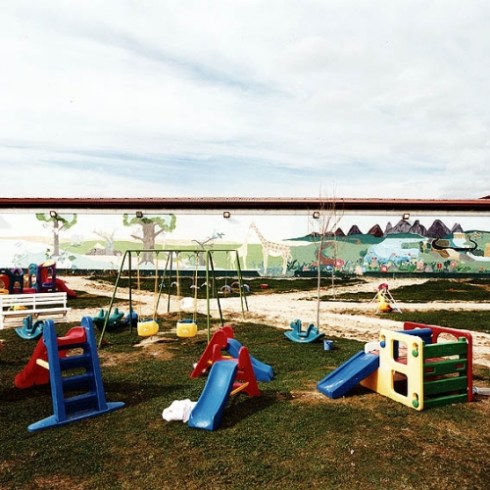
Madrid Prison © Gunnar Knechtel
Many U.S. prisons with stable populations allow for conjugal visits (“trailer visits”) as an earned privilege for prisoners. For prisoners fortunate enough to have the option, trailer visits provide invaluable human contact; a type of contact that is never forthcoming in dominant prison culture. And this applies to all types of contact, from time with a sexual partner to a weekend with the extended family. Trailers in U.S. prisons are beyond the body of the prison proper, often in a self-contained secure spaces; architectural afterthoughts. By contrast, in Spain the philosophy of the family has shaped the spatial fabric of many prisons.
In terms of child-rearing, there are a handful of pioneer facilities in the U.S. Three of these facilities have been documented by three conscientious female photographers – Cheryl Hanna Truscott at the Residential Parenting Program, at Washington Corrections Center for Women (WCCW); Angela Shoemaker at Prison Nursery at Ohio Reformatory for Women, Marysville, Ohio; and Neelakshi Vidyalankara at Bedford Hills Correctional Facility in Westchester County, the largest maximum security women’s prison in New York state.
In the U.S., at those rare Mother Units, law allows mothers to keep their newborn babies with them until 18-24 months. In Spain, the age is 3 years. From the same issue of COLORS, a mother describes her dilemma:
“My daughter turns three in a couple of months and it’s difficult for me to be separated from her. She’s been with me since she’s been a baby but I can already see that she needs something different. When they take her on excursions to the zoo or to the mountains, I see that she’s really happy. She knows that she has to ask permission for everything; she knows that there are people in charge. She says, “Mommy, tell the lady to open the patio door”, and she knows that she has to respect those in charge.”
No one would want to argue a child should remain with its parent in a state of suspended freedom indefinitely, but discussion about the legal age limit to which they remain together is valuable.

Madrid Prison © Gunnar Knechtel
Whether it two years or three years, the eventual separation of mother and child, or mother and father from child can only be a gut-wrenching unbearable event. Having said that, any parent would surely bear such pain in return for the pleasure of bonding with their children over even the shortest time-span.
Social psychology has shown the most significant bonds and rapid cognitive development occurs in the baby’s earliest months and years. As such, the benefit to mother and child cannot be denied.
The U.S. prison system does not provide the type of Family Unit deicted by Knechtel in which incarcerated parents can (if approved) raise a child jointly. Spain has actualised one of the most progressive penological practices by including the father within a more complex understanding of family. The needs of children are often the same as the needs of the parent.
Knechtel’s photographs are by no means extraordinary, but as with most prison photography projects, it’s the debate about the unseen world they give rise to, that defines their worth. The ambiguity of prison architecture punctuated by soft furnishings and children’s toys fairly reflects the conflicted reality for parents behind bars.
Gunnar Knechtel’s website:
http://www.gunnarknechtel.com/stories-id-488.html

Madrid Prison © Gunnar Knechtel
THE CONTINUING BLOGGING COLLABORATION
Thanks oncemore to Aline Smithson who transcribed. This is our second collaboration done in the interets of shared learning and proof that the photo-blogging community is alive, strong and charitable. Part one: A Visit to ER: Thoughts on Torture, Invisible [War] Crimes and X-Ray Imaging as Evidence. Below is a photograph of Aline’s feet from her portfolio Self-portraits.


 Prison Photography