
You are currently browsing the category archive for the ‘Fine Art’ category.

Carandiru, Sao Paulo, SP, Brazil – 2003 © Pedro Lobo
Four South American penitentiaries feature in Pedro Lobo‘s series Espacos Aprisionados/ Imprisoned Spaces; Itaguy, Bon Pastor and Bela Vista prisons in Medellin, Columbia and the infamous Brazilian prison Carandiru in Sao Paulo.
Pedro Lobo has posted an edit of prison images on his website (27 images). A larger selection can be found at Lobo’s Photoshelter gallery (86 images). Selected works are also posted to Lightstalkers (13 of 30).
I think his images from Carandiru – which he shot shortly after its 2002 closure and demolition – are the most cohesive as a group, and it is a selection of those I include here.

Carandiru, Sao Paulo, SP, Brazil – 2003 © Pedro Lobo
Lobo adopts a common approach to prison interiors as he does to the vernacular architecture of slums and to adapted religious spaces. Lobo is interested in the strain between the inhabitants control over the space, and the control of the space over its inhabitant. Read in the details, it is – strangely – a very compelling tension.
Lobo: Brazilian inmates call their cells “barracos” (barracks, tents, shacks) the same word used for their houses in the “favelas”, where most of them come from. As in my previous work, I tried to show their efforts to make their living quarters as dignified as their meager resources allowed for.
In this prison, inmates were allowed intimate visits twice a month and made all efforts to clean and decorate their cells prior to these encounters. The art work on walls and doors are reflections of order and chaos – creativity in adversity – and revealing of their desire for freedom, material residues of the only allowed forms of self-expression. It is sad to know that all vanished when the buildings were demolished.
These images reflect the responsibility with which I use my work. They are not about crime, or criminals, poverty, or misery, but about human beings who found, or placed, themselves in extremely adverse situations and decided not to give up the struggle for a dignified existence. (Source)

Carandiru, Sao Paulo, SP, Brazil – 2003 © Pedro Lobo
In some cases the interiors are bare and contemplative; images 2 and 3 could be the cells of religious devotees. In other cases (image 1) the intrigue is in the particulars. Look closer. What’s behind the curtain?
Especially because Carandiru no longer stands (it has, like so many former prisons, become a museum) Lobo’s pictures should be treasured. Don’t be surprised if these images reemerge, possibly in the form of a book, and probably tied into his wider body of work.
PEDRO LOBO
Pedro Lobo (Rio de Janeiro, 1954) is a Brazilian photographer currently living in Portugal.
He has exhibited his work in Brazil, Denmark, Germany, Colombia and in the United States. He has photographed slums, favelas and prisons. His images of known as Carandiru (later demolished) in Sao Paulo were shown in the exhibition “Imprisoned spaces/Espaços aprisionados” at Blue Sky Gallery, in Portland, Oregon, in 2005.
His first one-man show in Portugal was “Favelas: Architecture of Survival“ at Museu Municipal Prof. Joaquim Vermelho in Estremoz.
He has taken part in other exhibitions such as REtalhar2007 in Centro Cultural do Banco do Brasil in Rio de Janeiro and “Via BR 040 – Serra Cerrado”, with Miguel Rio Branco, Elder Rocha, etc in Plataforma Contemporânea of the Museu Imperial of Petropolis, in 2004 and 2005.
Pedro Lobo, a Fulbright Scholar, studied photography at the school of the Boston Museum of Fine Arts with Elaine O’Neil and Bill Burke and at New York’s International Center of Photography (ICP). From 1978 to 1985 he worked for the Brazilian Landmark Commission (Fundação Pró-Memória) as a photographer and researcher. In 2008, he was awarded the first prize at Tops Festival in China.

Bas Princen in partnership with the Architectural Firm OFFICE just received the Silver Lion at the Venezia Biennale in the Architecture category.
His photography is nothing short of stunning. He succeeds on making weird places look even weirder, his images are less forced than Burtynsky but deliver the same inevitable punch of awe and depressing.
We are but ants making larger and larger hills to obliterate the memory of inadequacy delivered by the last.

Alerted to the fact by mrs. deane

© Kenneth Jarecke
Ken Jarecke (blogs at Mostly True) is a world-renowned photojournalist and founding member of Contact Press Images, an illustrious photo agency based in New York.
On Friday he poured his heart out at Tiffin Box:
No, I’m sad and ashamed to report that my lack of desire stemmed from nothing more than a lack of money. More specifically, the constant worry, and the ongoing struggle to pay the bills had taken its toll.
It’s sad, because I didn’t become a photojournalist to get rich (I was never that crazy or misguided). I’m ashamed because much of my money problems were the direct result of poor or stubborn decisions that are completely my fault.
He doesn’t hold back:
Pride and arrogance, a nasty couple of vices. As you can imagine, the only people to suffer from the choices I made was my family. Over the past few years, we’ve cut expenses, and eliminated most of the extras that come with family life, in my vain attempt to reinvent the editorial market and make things right (vanity, there’s another one).
Although I never stopped loving being a dad or a husband, the only thing I accomplished was to give my family a grouchy dad who hated making pictures.
Also recently, one of his daughters got serious ill, it gave him new perspective, Jarecke’s’s not proud anymore, he’s not too worried about bills, he’s taking portrait jobs, having a print sale and moving forward. He just wants more than ever to be a better dad and husband.
It seems to me that Jarecke has said what many are feeling. Bravo Kenneth for your honestly and vulnerability!
This is funny, and could launch a thousand visual studies crit papers.

Remember Hugh Hefner and co. just sank $900,000 into saving and preserving this sign.
Found via i heart photograph
CONVERGENCE?
Stock vs. Fine Art; Standard view vs. Privileged view etc …
Worth contrasting Getty’s butchering with Emily Shur’s Hollywood Sign, Los Angeles, California. Featured on Shur’s blog.


Leventi, David - Stateville, Joliet, IL
Following my recent post of David Leventi‘s work, a reader contacted me to alert me of the potential (and presumably happenstance) development of Stateville Correctional Center, Joliet, Illinois as an art object.
Consistently through the representations of Stateville is the description of the roundhouse as one of the last remaining prisons in America adhering to the Panopticon model developed by Jeremy Bentham.
Let us be clear, the Panopticon is an outdated and abusive model for corrections; it relies on a small number controlling a large number through the threat of constant supervision. Modern correctional management must look beyond disciplinary techniques based upon spatial arrangement and look toward truly transformative (educational) engagement with prison populations.
Still one can only speculate that the roundhouse prison is of interest to artists primarily because of its “purity” of form as understood – and communicated – through the formal qualities of composition within the photographic print.
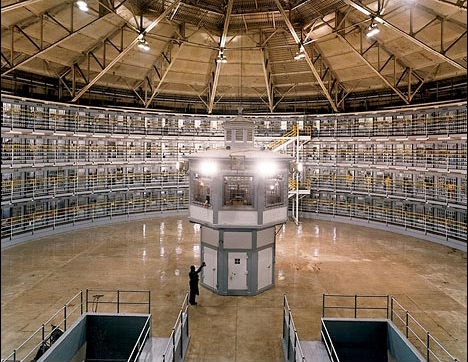
USA. Illinois. 2002. Stateville Prison. F house. There were originally four circular cell houses radiating around a central mess hall. The buildings were based on Jeremy Bentham's 1787 design for the panopticon prison house. The first round house was completed in 1919, the other three were finished in 1927. F house is the last remaining panopticon cell house. It's used for segregating inmates from the general prison population and for holding inmates who are awaiting trial or transfer. -Doug DuBois & Jim Goldberg.
In 2002, Doug Dubois, along with Jim Goldberg, went to Stateville Correctional Centre, and took a picture (above) of the prison’s interior. The New York Times later published the photograph.
A while later, Dubois found out that Andreas Gursky had too gone to Stateville, apparently inspired by Doug and Jim’s photograph and took a picture himself (below). Gursky has admitted in his career he finds ideas for images in newspapers and other popular media. Gursky’s image put in context here, at the Brooklyn Rail.
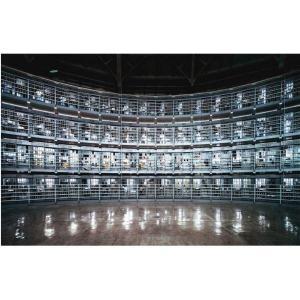
Andreas Gursky, “Stateville, Illinois” (2002), C-print mounted on Plexiglas in artist’s frame. Courtesy Matthew Marks Gallery, New York.
So, this raises questions. Has Stateville prison inadvertently become a tease, and a subject for curious photographic artists?
Do the individual activities of artists have a bearing on one another? Should these images exist within the same discourse? Do photographic attentions of the 21st century have any relation to the need and stresses of current correctional politics in Illinois?
Does the ascendancy of Stateville onto gallery walls effect any significant – or measurable – impression of Stateville prison within public consciousness?
Or are Dubois, Goldberg, Gursky and Leventi just continuing an intrigue which has continued throughout the decades?
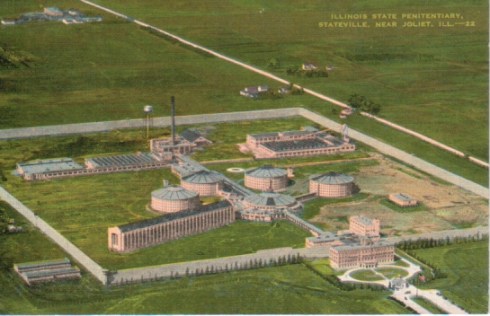
Postcard: Stateville Penitentiary, near Joliet, Illinois (ca. 1930s).
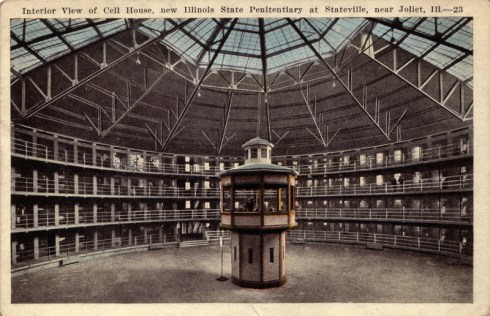
Postcard of an American panopticon: "Interior view of cell house, new Illinois State Penitentiary at Stateville, near Joliet, Ill." Source: Scanned from the postcard collection of Alex Wellerstein. (Copyright expired.)
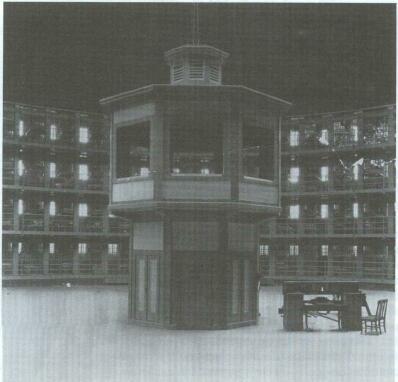
Photo of guard tower in round house at Stateville. Courtesy of Illinois State Historical Library. The second state prison was authorized at Joliet in 1857. It was built by convict laborers. That 135-year-old Joliet prison still houses more than 1,100 inmates. Meanwhile, Stateville. prison, also in the Joliet area, opened for business in 1917.

Inmates at Stateville Penitentiary in 1957. (Sun-Times News Group file photo)

Prison guard in a security tower, Stateville Penitentiary, Joliet, Illinois, USA. © Underwood Photo Archives / SuperStock
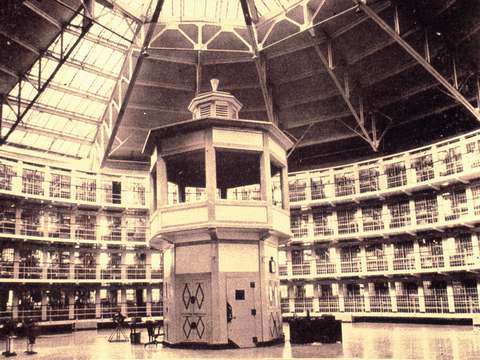
Panoptic guard tower at Stateville Prison, Stateville Prison (US Bureau of Prisons, 1949, p. 70), 1940s
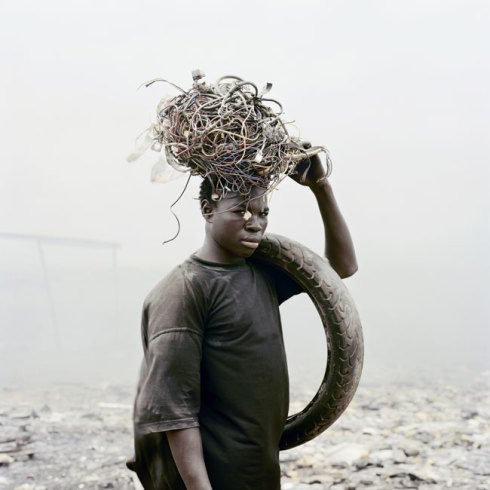
Yakubu Al Hasan, Agbogbloshie Market, Accra, Ghana 2009
Pieter Hugo’s series Permanent Error appeared in last weeks New York Magazine under the title A Global Graveyard for Dead Computers in Ghana.
The style is not too distant from Nollywood or The Hyena & Other Men, the former of which dusted up a small (and in my opinion, unnecessary) brouhaha last year about neo-colonialism/exploitation in photography.
Hugo’s case, in this instance, is not helped by the fact that the NY Times magazine piece is purely a gallery with no journalist elaborations, save the captions.
The merits and shortcomings of Hugo’s photographic approach is only half the issue; our denial of the extent of racial and economic inequality colours our response.
Hugo graduated in 1994. In this interview (which I think I came across amongst James’ youtube feast) Hugo gives an interesting perspective on how his work fits historically in the South African tradition.
“The photography in South Africa comes from a very political background. Pre-1994, it was an extreme situation here. And if one had the skill you had a certain responsibility to inform the world what was happening here. It was very much all black and white. This is wrong and this is right. There are good guys and there are bad guys.
That’s all changed now. Guys that were good are now bad and the lines aren’t as distinct as they were. […] Things are more complex […] One of the things I hope people get when they look at my pictures is that things are complex.”
This still might not excuse an aesthetic that aggressively depicts African subjects as “the other”, but then, what split second act of opening the shutter is not a machine-mediated differentiation between user and subject?
AFTER THOUGHT
The overtly-political nature of South African (photojournalism) photography is something David Goldblatt, as an art-documentarian, had to negotiate himself away from. And yet, as Fred Ritchin remarks, “during Goldblatt’s career, which began in the early 1960s, nearly everything that he saw was contextualized by the distorting prism of apartheid.”
This makes me wonder if there’s been an adequate survey of ‘South African photography from the second half of the 20th century’ toured on an international stage. If there has been, please let me know.

La Fenice, Venice, Italy, 2008. © David Leventi
I first saw one of David Leventi‘s Opera House prints at Exposed, the 2009 Critical Mass Top 50 exhibition at the PCNW, Seattle in March this year. To be honest, I struggled to access it. I am grateful therefore, for his interview with Sarina Finkelstein in which Leventi outlines his motivations and emotional response to these architectures. Toward the end, Leventi discusses his recent interest and move toward roundhouse prisons as subjects – and how they compare to opera houses:
“[Stateville Correctional Center, Joliet, IL] happens to be a reverse opera house. It has basically the same architectural structure as an opera house, but the difference is in who is observing who. In an opera house, the audience of many is observing a few. In a jail, it’s the reverse, giving me the opportunity as a photographer to better understand what it must feel like to be a tenor performing for a full house, albeit with a captive audience.”
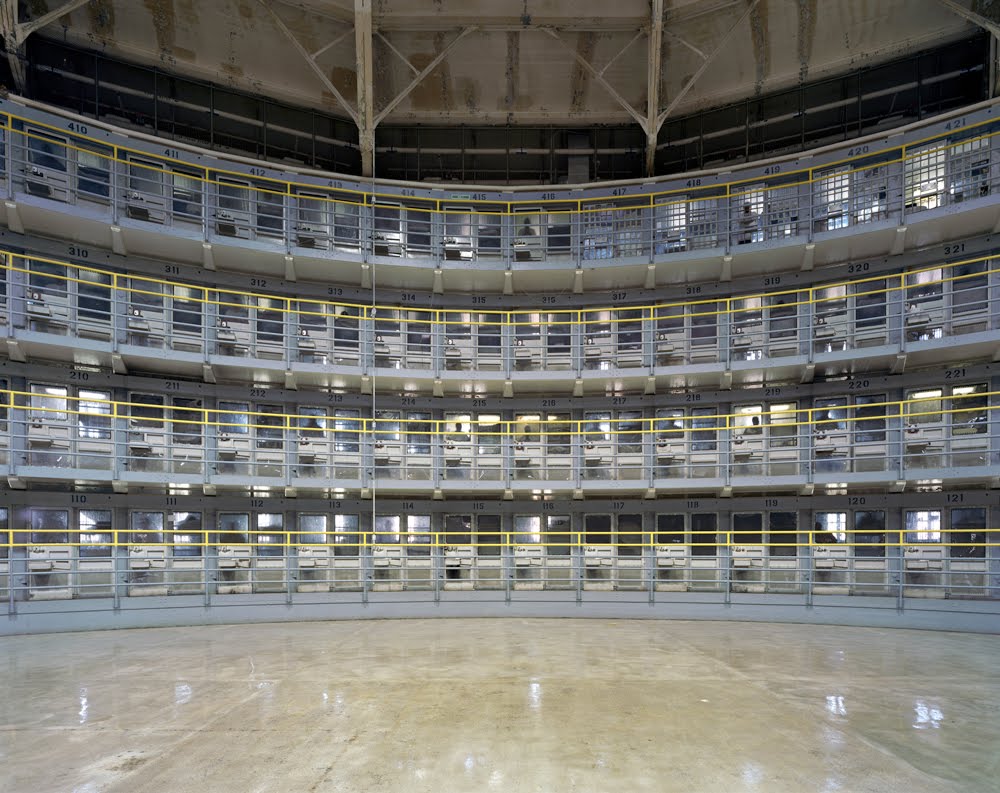
Prisoners in their cells, Stateville Correctional Center, Joliet, IL, 2010. © David Leventi
Leventi adds, “I have always had stage fright. Photographing from the center of a round prison is pure anxiety. The in-mates are all yelling, jeering, talking, in cacophony. You become the center of attention and taking the photograph becomes a performance in itself. At first, I was really intimidated, but then I blanked everything out and focused on photographing. It must be the same for the performer.”
Leventi adds that in the case of both opera houses and prisons, access is the most difficult aspect of his work. No surprise there!
All interesting stuff. I’ll be eager to see his continued progress on this subject matter. Roundhouse prisons are a rarity these days; Bentham’s Panopticon is more likely to crop up in discourses on philosophy than it is in those of criminology or correctional management.
Leventi’s images of opera houses and Stateville prison are reminiscent of some of Richard Ross’ photographs from Architecture of Authority. And, likewise, Leventi plans to look at churches and religious buildings, presumably drawing more parallels between these complete spaces.

 Prison Photography