
You are currently browsing the category archive for the ‘Fine Art’ category.
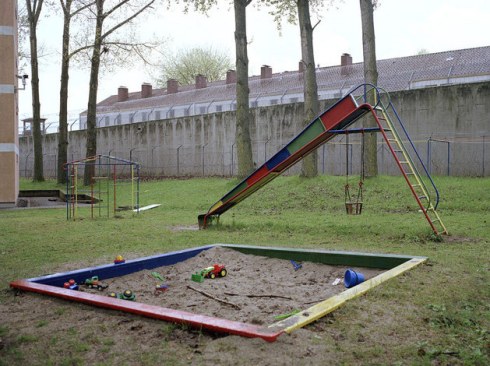
In Germany, as in most European nations, prisons often lie within towns and cities; European prisons & jails are older than the housing estates and urban developments that, ultimately, came to surround them.
In Britain, castle-like Victorian-era prisons were the dominant type until the seventies when they were replaced by draft-proof, medium-sized institutions in rural locations. Bricks and mortar made way for concrete & razor wire. That said, a few town-centre “citadels” such as Preston Prison and Lancaster Castle still operate within Her Majesty’s Prison Service, the latter dating back to the 14th century!

In the American penal landscape, a high proportion of prisons (and all new builds) are outside of conurbations – sometimes isolated in the mountains or desert, sometimes just within grasp of a rural town to prop or establish a local economy.
Christiane Feser‘s photographs could not be mistaken as American, just as the New Topographics couldn’t be mistaken for anything but American. I don’t want to say Feser’s series Prisons is typically German, because I don’t know what that means. Instead, I will say it is typically Northern European. Feser’s photographs embody the spirit of pedantic spatial ordering which I have observed not only in Britain and Germany, but also Austria and the Netherlands.
We don’t know the specific locations of these prisons so we can not know the construction dates. Given the carceral/residential interplay we can say that if Feser’s images aren’t about the zoning of space, they are about a time before zoning dominated civic-planning.

“When I photographed the prisons I was interested in how these prison walls are embedded in the neighbourhoods,” said Ms. Feser via email. “How the neighbours live with the walls. There are different strategies. Its a little bit complicated for me to write about it in English …” Feser’s images do the talking.
Feser’s world is one of silence, order and manicured nature. Her images evince a harmony between the prison, its neighbours and vice-versa. We witness no trauma here.

Feser has obviously decided to omit humans from her compositions. The neighbourhoods are well tended and so presumably inhabited. One presumes the neighbourhoods are occupied daily, and yet we see no cars in driveways nor bikes on the street. Feser almost suspends belief. Are these actual places? Is this a toy-town?
Why does Feser rely on manicured topiary and brick pointing of the absent inhabitants to illustrate the “different strategies”? Is Feser suggesting a common psychology between prisoners and residents?
Have the neighbours adopted psychologies of seclusion and discipline as exist in the prison next door? Can penal strategies of control transfer by osmosis through prison walls and throughout a community? Or are certain personalities attracted to these new build estates? Are a portion of these homes reserved for prison staff? Or has Feser’s clever framing and omissions just led the viewer along these lines of inquiry?
Many would think in this peculiar carceral/residential inter-relationship the prison dominates, overbears. I doubt it. I contend those who live in such locales influence the institution also. The two agents in this relationship aren’t separate; they are drawn to one another and they overlap.
Feser uses visual devices to point toward this overlap. Angles of the oblique walls, dead ends, tended verges and brown-toned brickwork repeat through the series; sometimes these elements are part of prison fabric, sometimes part of a house.
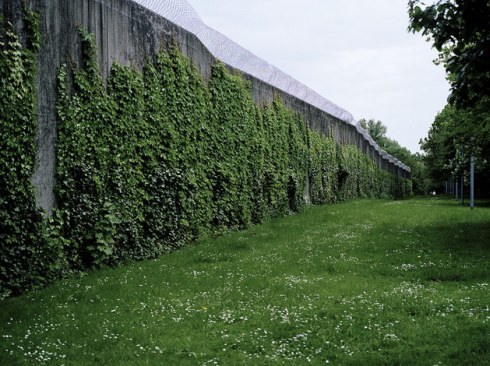
There exists no hierarchical coda in Feser’s images as all the surfaces are equal. One has to pay attention to figure out which architecture is carceral, and which is not. Even the barbed wire doesn’t confirm it totally as (in England at least) one commonly sees barbed wire and glass shards lining the walls of merchant-yards and back alleys.
Feser’s photographs cradle a palette of grey concrete & skies; dense greens and the browns of brick & mortar. This is Germany, but it could as easily be Lancashire housing estates, Merseyside new towns or the reclaimed industrial sites of Scottish cities.

So how about it America? You are the land of the suburb and subdivision. You may not be familiar with a socio-spatial history that favours the awkward in-fill of urban and semi-urban space over the encroachment on to undeveloped land. It’s alright. Prisons needn’t be invisible and we needn’t be afraid. Locks and keys work as well on your street as they do in up-state, high-pain, back-water seclusion!
The location of prisons matters because when prisoners are sent to facilities on the other side of the state, families are likely to visit less. The commitment of time and money required to make such a lengthy trip usually precludes the poorest families from the essential and simple act of visiting a loved one. Research has shown the largest single factor in a prisoner successfully reentering society and not re-offending is the maintenance of family ties and the continued support it provides.


All images © Christiane Feser. Used with permission.
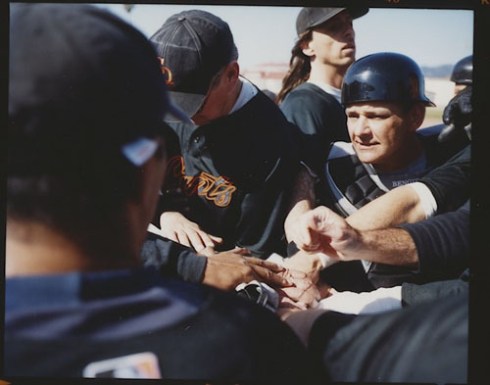
Last week, I threw up a quick post featuring Emiliano Granado’s website images of his photographs of the San Quentin Giants. Here, Granado shares previously unpublished contact sheet images, his experiences and lasting thoughts from working within one of America’s most notorious prisons.


What compelled you to travel across the US to photograph the story at San Quentin?
This was actually a magazine assignment for Mass Appeal Magazine. However, the TOTAL budget was $300, so it really turns out to be a personal project after the film, travel expenses, etc. So, the simple answer to the question is that I’m a photographer. I’m curious by nature. Part of the reason I’m a photographer is to study the world around me. I like to think of myself as a social scientist, except I don’t have any scientific method of measuring things, just a photograph as a document.
With that in mind, it would be crazy of me to NOT go to San Quentin! I’d never been in a correctional institution but I’ve always been fascinated by them. If you look through my Tivo, you’ll see shows like COPS, Locked Up, Gangland, etc. I was also a Psychology major in college and remember being blown away by Zimbardo’s prison experiment and other studies. Basically, it was an opportunity to see in real life a lot of what I’d seen on TV or read in books. And as a bonus, I was allowed to photograph.

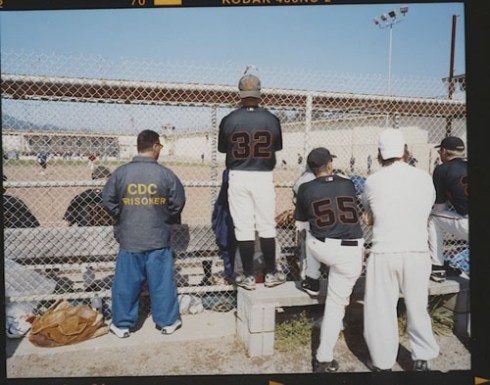
What procedures did you need to go through in order to gain access?
I was amazed at the lack of procedure. The writer for the story had been in touch with the San Quentin public relations people, but that was it. There was plenty of other media there that day. It was opening day of the season, so I guess it made for a minor local news story.
I’m pretty sure SQ prides itself in being so open and showcasing what a different approach to “reform” looks like.
It is my opinion that San Quentin is one of the best-equipped prisons in California to deal with a variety of visitors. Did you find this the case?
Definitely. Access was very easy. They barely searched my equipment! Parking was easy. I was really surprised at how easy and smooth the process was. Not to mention there were many other visitors that day (an entire baseball team, more media, local residents playing tennis with inmates, etc).
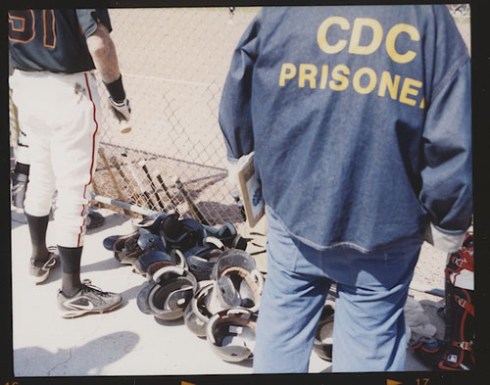

Did your preparation or process differ due to the unique location?
Definitely. I usually work with a photo assistant and that couldn’t be coordinated, so I was by myself. I packed as lightly as I could and prepared myself for a fast, chaotic shoot. Some shoots are slow and methodical, and others are pure chaos. I knew this would be the latter.
One thing I didn’t think about was my outfit. SQ inmates dress in denim, so visitors aren’t allowed to wear denim. Of course, I was wearing jeans. The officers gave me a pair of green pajama pants. I’m glad they are ready for that kind of situation.
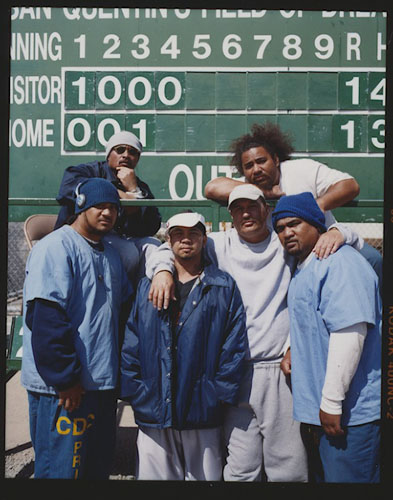
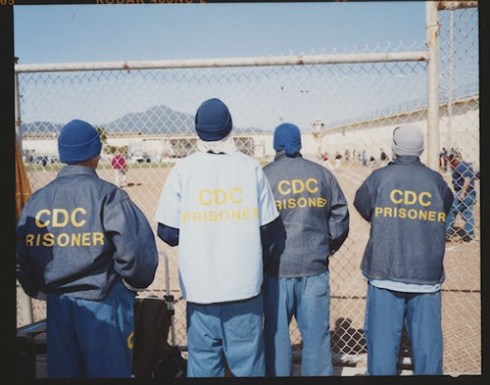
You are not a sports shooter per se. You took portraits of the players and spectators of inmate-spectators. How did you choose when to frame a shot and release the shutter?
Correct. I’m definitely not what most people would consider a sports photographer. I don’t own any of those huge, long lenses. However, I photograph lots of sporting events. I think of them as a microcosm of our society. There are lots of very interesting things happening at events like this. Fanaticism, idolatry, community, etc. Not to mention lots of alcohol and partying – see my Nascar images!
Hitting the shutter isn’t entirely a conscious decision. That decision is informed by years of looking at successful and unsuccessful images. It’s basically a gut instinct. There are times that I search for a particular image in my head, but mostly, it’s about having the camera ready and pointed in the right direction. When something interesting happens you snap.
There are photographers that come to a shoot with the shots in their head already. They produce the images – set people up, set up lighting, etc. Then there are photographers that are working with certain themes or ideas and they come to the location ready to find something that informs those ideas. I’m definitely the latter. There is a looseness and discovery process that I really enjoy when photographing like this. It’s like the scientist crunching numbers and coming to some new discovery.


A lot of photo editors say the story makes the story, not the images. Finding the story is key. Do you think there are many more stories within sites of incarceration waiting to be told?
I’m not sure I agree with that. I always say that a photograph can be made anywhere. Even if there is no story, per se. I definitely agree that a powerful image along with a powerful story is better, but a photograph can be devoid of a story, but be powerful anyway.
Every person, every place, everything has a story. So yes, there are millions of untold stories within sites of incarceration. Hopefully, I’ll be able to tell some of them.
Having had your experience at San Quentin, what other photo essays would you like to see produced that would confirm or extend your impressions of America’s prisons?
Man, there are millions of photos waiting to be made! I’m currently trying to gain access to a local NYC prison to continue my work and discover a bit more about what “Prison” means. Personally, I’d love to see long-term projects about inmates. Something like portraits as new inmates are processed, images while incarcerated, and then see what their life is like after prison. Their families, their victims, etc. And of course, if any photo editor wants to assign something like that, I’d love to shoot it!

Anything you’d like to add to help the reader as they view your San Quentin Baseball photographs?
Yes. When I walked in to the yard, I didn’t know what reaction I would get from the inmates. Everyone was super friendly and willing to be photographed. Everyone wanted to tell me their story. I’m not sure how different their reaction would have been to me if I didn’t have a camera, but I was pleasantly surprised. At first, I felt like an outsider and fearful, but after an hour or so, I felt comfortable and welcome. It was a weird experience to think the guy next to me could be a murderer (and there were, in fact, murderers on the baseball team), and not be afraid. There was this moral relativism thing going on in my head. These people were “bad,” yet they were just normal guys that had made very big mistakes. I left SQ thinking that pretty much any one of us could have ended up like them. Given a different set of circumstances or lack of access to social resources (e.g. education, money, parenting, etc) I could very easily see how my own life could have mirrored their life.
And finally, can you remember the opposition?
I don’t remember who they were playing, but I do remember that their pitcher had played in the Majors and even pitched in a World Series. I believe the article that finally ran in Death + Taxes magazine mentions the opposition.
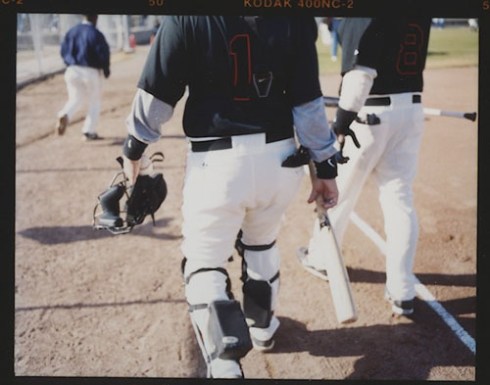
ALL IMAGES © 2009 EMILIANO GRANADO
Authors note: Huge thanks to Emiliano Granado for his thoughtful responses and honest reflections. It was a pleasure working with you E!
Housekeeping. At the end of my previous post on Emiliano’s work, I postured when San Quentin would get more sports teams for the integration of prisoners and civilians. Emiliano has answered that for me in this interview. He observed locals playing tennis and also states San Quentin also has a basketball team.
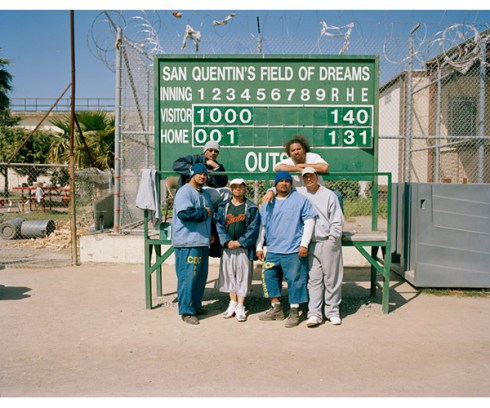
With Emiliano‘s permission I have lifted these images straight from his website. We are working together on an interview for a second post on his work (scheduled for next week). It will include previously unpublished and untouched images from his contact sheets. Please stay tuned for that. Meanwhile enjoy my personal selection of six preferred prints.

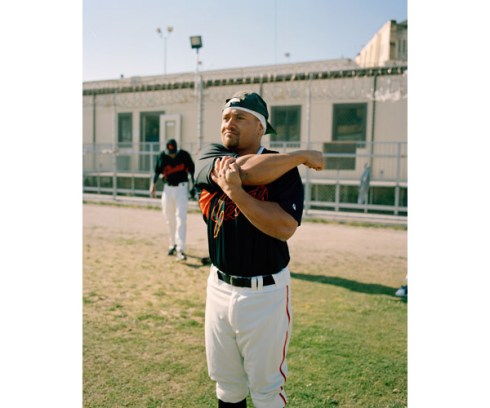


ALL IMAGES © 2009 EMILIANO GRANADO
_____________________________________________
The San Quentin Giants are well known in the San Francisco Bay Area. I have met a couple of guys in the past who’ve played inside the walls during regular season – it is not unusual.
In an ideal world, the to and fro of public in and out of prison would be without restriction, threat or security protocol. This way, society could fear inmates less and inmates would not be institutionalised to the extent they are today.
I realise this is pie-in-the-sky thinking as the minority of seriously dangerous prisoners necessarily dictate the need for stringent controls. Still it doesn’t mean that increasingly trusted and regular contact between inmate and no-inmate populations cannot be our ideal to shoot for. Smaller and purposefully designed institutions would certainly be the first step in this sea change.
The scheduled games for the San Quentin Giants baseball team are the closest approximation to genuine & normalised interaction between inmate and non-inmate populations. When will San Quentin get a basketball team? Or any other teams for that matter?
____________________________________________
Check out these sources for further information on the San Quentin Giants. Press Enterprise – Long Article and Audio, Mother Jones article – Featuring Granado’s photography, California Connected – Video, Christian Science Monitor – Long article and video, NPR Feature – Audio.
And, if you are really engrossed you can always purchase Bad Boys of Summer, a recent documentary from Loren Mendell and Tiller Russell.

Woman in cell, playing solitaire. ca. 1950. Nickolas Muray. Transparency, chromogenic development (Kodachrome) process. George Eastman House Collection - Accession # 1983:0567:0151
I was blown away last month when the indicommons feed landed Nickolas Muray’s colour commercial photography on my desktop. Muray’s commercial work is fresh, witty, a sock in the eye and an all round feast of fun. The fact I haven’t any knowledge ofi the advertised products makes my enjoyment all the more visuocentric and naive. And that’s okay … every so often.
Pop music sprouted in the fifties, right about when this image was taken. I have Alma Cogan playing in my mind as I browse Muray’s commercial kodachrome prints. Visually, Woman in Cell, Playing Solitaire is an alterworld mash-up of Jehad Nga and Edward Hopper. Don’t you just dig those colours? None of the psychological edge though; the lady, despite being locked up, hardly looks harassed or without hope. Rather, she looks bored.
To continue the fest of technicolour, let me include the image below. Admittedly, it stretches the theoretical parameters of this blog but I would argue the subject is relevant. Depicted is the harsh subjugation of fowl to sites of incarceration – evidenced by the chicken wire and possibly even the girl’s well-disguised, maniacal grasp of the hat!
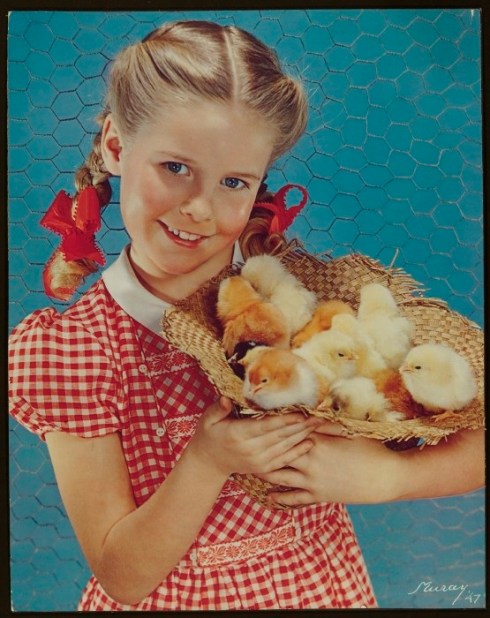
American Cyanamid Girl with Straw Hat Full of Chicks, 1947. Nickolas Muray. Color print, Assembly (Carbro) Process. George Eastman House. Accession # 1971:0048:0017.
To end on a serious note, I knew of the exceptional George Eastman House collection, but was frequently frustrated by the archaic platform of its website. Browsing was not fun. To GEH’s credit they recognised this enfeeblement and avidly committed important works to the Flickr Commons project. Kudos to them. We are all the better for it! I am just happy an image came along with vaguely carceral imagery, providing me an excuse to share.
_________________________________________
Nickolas Muray (American, b. Hungary, 1892-1965) immigrated to the United States in 1913, working first as a printer and then opening a photographic portrait studio in Greenwich Village in 1920. He became well known for his celebrity portraits, publishing them regularly in Harper’s Bazaar, Vanity Fair, Vogue, Ladies’ Home Journal, and The New York Times. After 1930, Muray turned away from celebrity and theatrical portraiture, and became a pioneering commercial photographer, famous for establishing many of the conventions of color advertising. He is considered the master of the three-color carbro process. Muray’s portraits of Frida Kahlo are well known and well-loved.
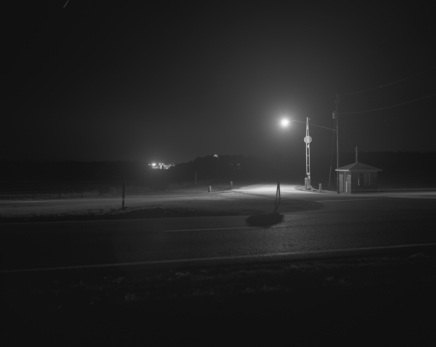
Alabama Death House Prison, Grady, AL, 2004. Silver print photograph. © 2009 Stephen Tourlentes
Stephen Tourlentes photographs prisons only at night for it is then they change the horizon. Social division and ignorance contributed to America’s rapid prison growth. Tourlentes’ lurking architectures are embodiments of our shared fears. In the world Tourlentes proposes, light haunts; it is metaphor for our psycho-social fears and denial. Prisons are our bogeyman.
These prisons encroach upon our otherwise “safe” environments. Buzzing with the constant feedback of our carceral system, these photographs are the glower of a collective and captive menace. Hard to ignore, do we hide from the beacon-like reminders of our social failures, or can we use Tourlentes’ images as guiding light to better conscience?
Designed as closed systems, prisons illuminate the night and the world that built them purposefully outside of its boundaries. “It’s a bit like sonic feedback … maybe it’s the feedback of exile,” says Tourlentes.
Stephen Tourlentes has been photographing prisons since 1996. His many series – and portfolio as a whole – has received plaudits and secured funding from organisations including the John Simon Guggenheim Foundation, the Massachusetts Cultural Council and Artadia.
Stephen was kind enough to take the time to answer Prison Photography‘s questions submitted via email.
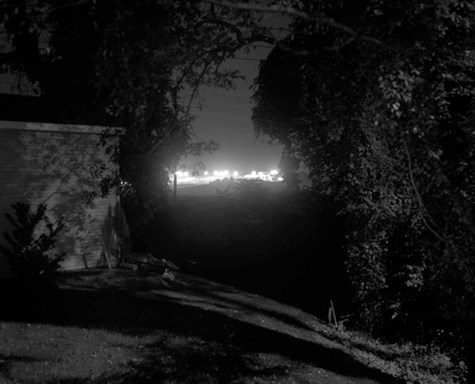
Penn State Death House Prison, Bellefonte, PA, 2003. © 2009 Stephen Tourlentes

Carson City, Nevada, Death House, 2002. Gelatin silver print. © 2009 Stephen Tourlentes

Blythe Prison, California. © 2009 Stephen Tourlentes
Pete Brook. You have traveled to many states? How many prisons have you photographed in total?
Stephen Tourlentes. I’ve photographed in 46 states. Quite the trip considering many of the places I photograph are located on dead-end roads. My best guess is I’ve photographed close to 100 prisons so far.
PB. How do you choose the prisons to photograph?
ST. Well I sort of visually stumbled onto photographing prisons when they built one in the town I grew up in Illinois. It took me awhile to recognize this as a path to explore. I noticed that the new prison visually changed the horizon at night. I began to notice them more and more when I traveled and my curiosity got the best of me.
There is lots of planning that goes into it but I rely on my instinct ultimately. The Internet has been extremely helpful. There are three main paths to follow 1. State departments of corrections 2. The Federal Bureau of Prisons and 3. Private prisons. Usually I look for the density of institutions from these sources and search for the cheapest plane ticket that would land me near them.
Structurally the newer prisons are very similar so it’s the landscape they inhabit that becomes important in differentiating them from each other. Photographing them at night has made illumination important. Usually medium and maximum-security prisons have the most perimeter lighting. An interesting sidebar to that is male institutions often tend to have more lighting than female institutions even if the security level is the same.
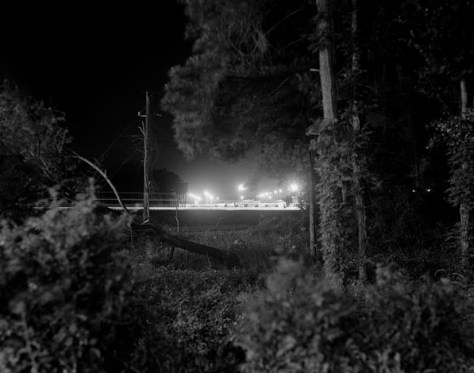
Holliday Unit, Huntsville, Texas, 2001. Gelatin silver print. © 2009 Stephen Tourlentes
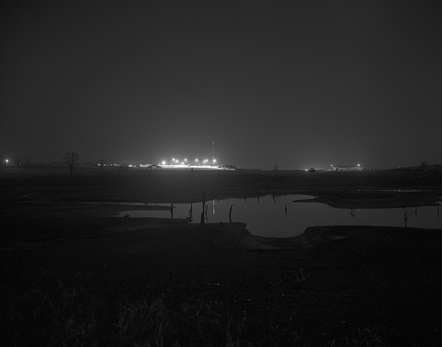
Springtown State Prison, Oklahoma, 2003. Archival pigment print. © 2009 Stephen Tourlentes
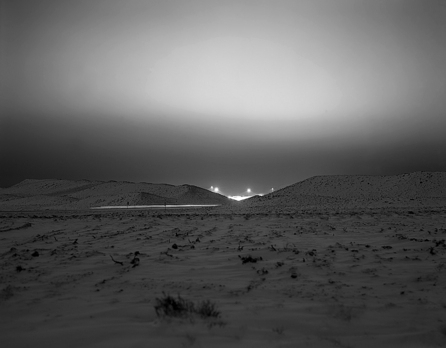
Death House Prison, Rawlins, Wyoming, 2000. Archival pigment print. © 2009 Stephen Tourlentes
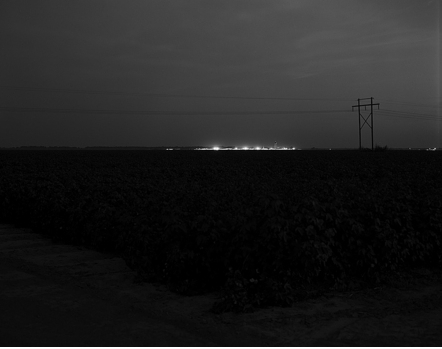
Arkansas Death House, Prison, Grady, AK, 2007. © 2009 Stephen Tourlentes
PB. Are there any notorious prisons that you want to photograph or avoid precisely because of their name?
ST. No I’m equally curious and surprised by each one I visit. There are certain ones that I would like to re-visit to try another angle or see during a different time of year. I usually go to each place with some sort of expectation that is completely wrong and requires me to really be able to shift gears on the fly.
PB. You have described the Prison as an “Important icon” and as a “General failure of our society”. Can you expand on those ideas?
ST. Well the sheer number of prisons built in this country over the last 25 years has put us in a league of our own regarding the number of people incarcerated. We have chosen to lock up people at the expense of providing services to children and schools that might have helped to prevent such a spike in prison population.
The failure is being a reactive rather than a proactive society. I feel that the prison system has become a social engineering plan that in part deals with our lack of interest in developing more humanistic support systems for society.
PB. It seems that America’s prison industrial complex is an elephant in the room. Do you agree with this point of view? Are the American public (and, dare I say it, taxpayers) in a state of denial?
ST. I don’t know if it’s denial or fear. It seems that it is easier to build a prison in most states than it is a new elementary school. Horrific crimes garner headlines and seem to monopolize attention away from other types of social services and infrastructure that might help to reduce the size of the criminal justice system. This appetite for punishment as justice often serves a political purpose rather than finding a preventative or rehabilitative response to societies ills.
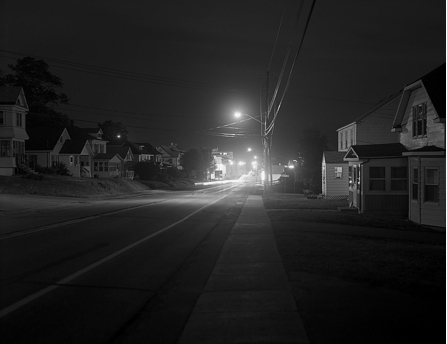
State Prison, Dannemora, NY, 2004. © 2009 Stephen Tourlentes

Prison, Castaic, CA, 2007. © 2009 Stephen Tourlentes

Federal Prison, Atwater, CA, 2007. © 2009 Stephen Tourlentes

Utah State Death House Complex, Draper, UT, 2002. © 2009 Stephen Tourlentes
PB. How do you think artistic ventures such as yours compare with political will and legal policy as means to bring the importance of an issue, such as prison expansion, into the public sphere?
ST. I think artists have always participated in bringing issues to the surface through their work. It’s a way of bearing witness to something that collectively is difficult to follow. Sometimes an artist’s interpretation touches a different nerve and if lucky the work reverberates longer than the typical news cycle.
PB. In your attempt with this work to “connect the outside world with these institutions”, what parameters define that attempt a success?
ST. I’m not sure it ever is… I guess that’s part of what drives me to respond to these places. These prisons are meant to be closed systems; so my visual intrigue comes when the landscape is illuminated back by a system (a prison) that was built by the world outside its boundaries. It’s a bit like sonic feedback… maybe it’s the feedback of exile.
PB. Are you familiar with Sandow Birk’s paintings and series, Prisonation? In terms of obscuring the subject and luring the viewer in, do you think you operate similar devices in different media?
ST. Yes I think they are related. I like his paintings quite a lot. The first time I saw them I imagined that we could have been out there at the same time and crossed paths.
PB. Many of your prints are have the moniker “Death House” in them, Explain this.
ST. I find it difficult to comprehend that in a modern civilized society that state sanctioned executions are still used by the criminal justice system. The Death House series became a subset of the overall project as I learned more about the American prison system. There are 38 states that have capital punishment laws on the books. Usually each of these 38 states has one prison where these sentences are carried out. I became interested in the idea that the law of the land differed depending on a set of geographical boundaries.

Federal Prison, Victorville, CA, 2007. © 2009 Stephen Tourlentes
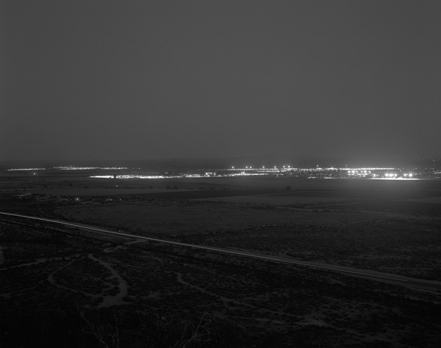
Prison Complex, Florence, AZ, 2004. © 2009 Stephen Tourlentes

Lancaster State Prison, Lancaster, CA, 2007. © 2009 Stephen Tourlentes
PB. Have you identified different reactions from different prison authorities, in different states, to your work?
ST. The guards tend not to appreciate when I am making the images unannounced. Sometimes I’m on prison property but often I’m on adjacent land that makes for interesting interactions with the people that live around these institutions. I’ve had my share of difficult moments and it makes sense why. The warden at Angola prison in Louisiana was by far the most hospitable which surprised me since I arrived unannounced.
PB. What percentage of prisons do you seek permission from before setting up your equipment?
ST. I usually only do it as a last resort. I’ve found that the administrative side of navigating the various prison and state officials was too time consuming and difficult. They like to have lots of information and exact schedules that usually don’t sync with the inherent difficulty of making an interesting photograph. I make my life harder by photographing in the middle of the night. The third shift tends to be a little less PR friendly.
PB. What would you expect the reaction to be to your work in the ‘prison-towns’ of Northern California, West Texan plains or Mississippi delta? Town’s that have come to rely on the prison for their local economy?
ST. You know it’s interesting because a community that is willing to support a prison is not looking for style points, they want jobs. Often I’m struck by how people accept this institution as neighbors.
I stumbled upon a private prison while traveling in Mississippi in 2007. I was in Tutweiler, MS and I asked a local if that was the Parchman prison on the horizon. He said no that it was the “Hawaiian” prison. All the inmates had been contracted out of the Hawaiian prison system into this private prison recently built in Mississippi. The town and region are very poor so the private prison is an economic lifeline for jobs.
The growth of the prison economy reflects the difficult economic policies in this country that have hit small rural communities particularly hard. These same economic conditions contribute to populating these prisons and creating the demand for new prisons. Unfortunately, many of these communities stake their economic survival on these places.

Kentucky State Death House, Prison, Eddyville, KY, 2003. © 2009 Stephen Tourlentes
PB. You said earlier this year (Big, Red & Shiny) that you are nearly finished with Of Lengths and Measures. Is this an aesthetic/artistic or a practical decision?
ST. I’m not sure if I will really ever be done with it. From a practical side I would like to spend some time getting the entire body of work into a book form. I think by saying that it helps me to think that I am getting near the end. I do have other things I’m interested in, but the prison photographs feel like my best way to contribute to the conversation to change the way we do things.
________________________________________
Author’s note: Sincerest thanks to Stephen Tourlentes for his assistance and time with this article.
________________________________________
Stephen Tourlentes received his BFA from Knox College and an MFA (1988) from the Massachusetts College of Art in Boston, where he is currently a professor of photography. His work is included in the collection at Princeton University, and has been exhibited at the Revolution Gallery, Michigan; Cranbook Art Museum, Michigan; and S.F. Camerawork, among others. Tourlentes has received a John Simon Guggenheim Foundation Fellowship, a Polaroid Corporation Grant, and a MacDowell Colony Fellowship.
________________________________________
This interview was designed in order to compliment the information already provided in another excellent online interview with Stephen Tourlentes by Jess T. Dugan at Big, Red & Shiny. (Highly recommended!)

Stones. Mark Kirchner
Mark Kirchner has been returning to Manzanar for over 25 years. Kirchner’s project is Manzanar Pilgrimage which focuses on the annual memorial gathering and documents former internees and their families’ stories. Mark explains in his artist statement:
This project is a work in progress. As a photographer, I felt the need to create a visual record as the Japanese American community struggled to preserve the site, its history and legacy. My primary role is that of a witness. The process of witnessing the pilgrimages over many years has given me the time to attempt a holistic photographic document. Within this body of work I hope to make visible those brief moments when the human spirit is revealed. I have discovered that some of the people I have photographed do not see themselves or their actions as historically significant and rarely worth photographing. I hope some of their modesty has been instilled in me.

Inscription: Watanabe. Sentry Post Building, 1984. Mark Kirchner

Inscription: March 30th 194(2) and Kanji. 2006. Mark Kirchner
It is somewhat fortuitous that Mark asked me not to include images of people and that I didn’t wish to include any pictures of people. Manzanar is a peculiar site and certainly not of a human scale. As the Eastern Sierras drop off sharply, the plateau of high desert to the east is a stark landscape. Beautiful, awesome, sublime – yes; livable – barely by today’s standards.
Some could argue that Manzanar should be allowed to recede into the dust and weeds of the California/Nevada borderlands – that humans should never have been interred and nor should human’s need to return. But we are funny creatures and I, for one, appreciate the impression of meaning upon a site once the site has run through its cycle of original use. The dialogue about former sites of incarceration is where one finds responsibility, complexity and community.

Inscription: Remember. Sentry Post Building, 2007. Mark Kirchner
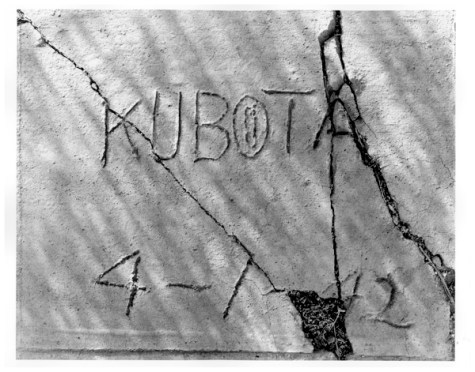
Inscription: Kubota 4-1-42. 1984. Mark Kirchner
Manzanar is a flat site with no place to hide. Everything that is visible is rooted to the ground, and all that is invisible is in the memories and oral histories of the people Mark Kirchner cares so much about. If Kirchner’s concern is preserving the stories of people interred, my concern is his images that reflect that aim. I chose these images because they speak of definites; definite people, dates and action (scribing). They are evidence of existence and time. These images are also all surface which to me summarises the barren desert site.
There is a poetic beauty that one speculates the original scrawler was aware or unaware of – that being, the paradox that the necessary human constructions at Manzanar are those to hold the visible, physical evidence. The concrete is as incongruous to the site at Manzanar as mass human occupation was between 1942 and 1945.

Inscription: Tets Ishikawa, 45, 55, 66, 83. Sentry Post Building, 1984 and 2007. Mark Kirchner
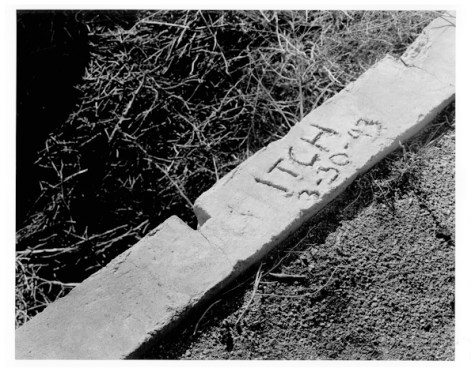
Inscription: Itch 3-30-43. 1983. Mark Kirchner
Kirchner explains further:
Since the annual pilgrimage lasts only a few hours, I knew it would take many years to make the images for the foundation of this work. As the event grew from the intimate Manzanar Pilgrimage and Potluck of the early 1980s to the pilgrimages we experience today, the task of identifying and gathering contact information has grown. After the 2007 pilgrimage I decided to try to contact the people in my photographs. Most of my free time last year was spent in research and correspondence. I have attempted to identify and contact every person photographed on this site. I still have not been 100 percent successful with this effort. I am hopeful that any person that remains unidentified will in time contact me.
If this post can help Mark Kirchner in his noble endeavour I would be thrilled. Tell your neighbours about it!
____________________________________
Mark Kirchner is an expert bookbinder and salmon flies crafter. Here is his Silver Studios website. Read Kirchner’s biography. Found via photoexchange.
Thanks to Mark Kirchner for his permission to reproduce images and the helpful background information on the project.
____________________________________
Comment from Mark Kirchner: I like that you picked up on the nature of the artifacts and their relationship to the earth. At one time there were 800 buildings on the site. Now there are 4 buildings.

Discombobulated
I was delighted to find this collection of “Jail Finds” recently. It is a quiet statement amidst the cacophony of dross we are subject to daily.
The person who documents these notes, scribbles and profundities works for a volunteer library service serving the local Dane County Jail and operated by the University of Wisconsin in Madison.
These are things I find abandoned in books or stuffed on the book cart at the jail where I volunteer. A little context: these come from a county jail, not a state prison – a very important distinction. Most inmates (approx. 75%) are short-term “holds.” They’re there awaiting trial (meaning they couldn’t afford bail); on probation violations; or are federal prisoners being shuffled around the system. About 1/4 are women and 1/3 are minorities. The vast majority stay less than 30 days.

"Subject Mukasey, President Bush and Vice President Dick Cheney to Guantanamo style Waterboarding. Then ask them if it is Torture."

Events and Consequences

Health Testing Request
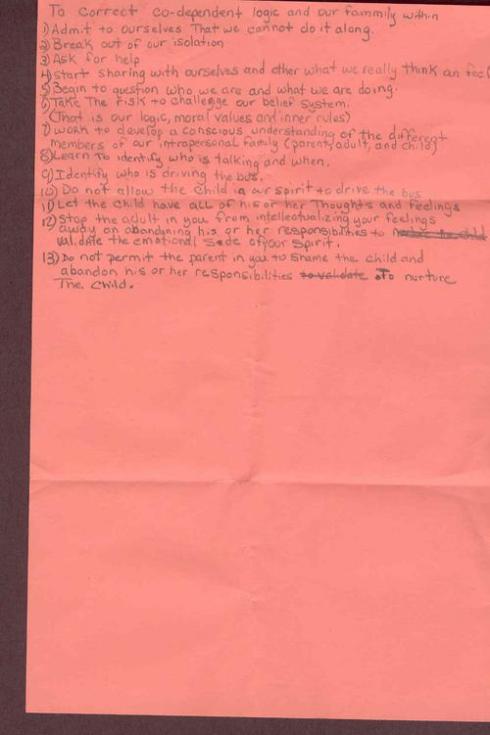
Childhood and Adulthood
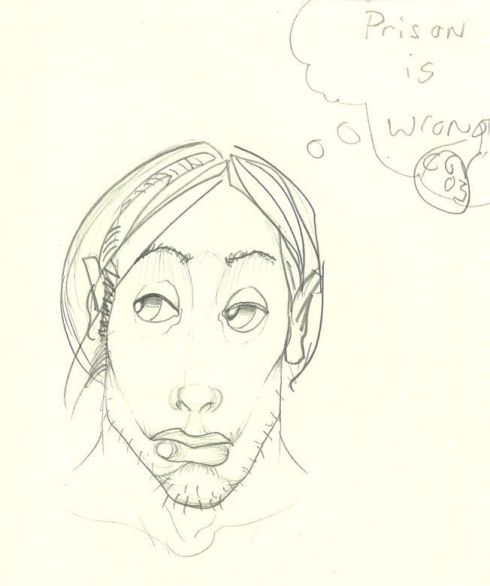
Prison is Wrong
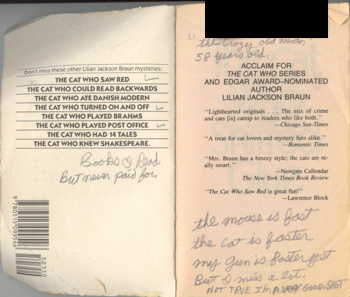
The Mouse is Fast, The Cat is Faster, My Gun is Faster Yet, But I Miss a lot. NOT TRUE, I'M A VERY GOOD SHOT

Vocabulary

Letter of pledges, hopes and favours.
What ties these examples and the other 100 or so in the collection is humanity and surprise. Humanity we should hope of all and surprise we should absolutely insist on from all. Some of these scribbles are penitent in the old fashioned ideal, some are reflections of harsh reality.
I wouldn’t argue, that in my mini-curation, I may be biased. I have picked the most appealing and the most redemptive of scripts, but I feel this only goes some small way to redress the imbalance of mainstream media that a) simultaneously condemns and sensationalises criminals and b) cares little for the transgressor once locked away.

"God give me serenity to accept the things I cannot change and give me valour to change those I can. And wisdom to recognize the difference. May your will be done and not mine."
BURN Magazine, under the fiscal umbrella of the Magnum Cultural Foundation, have announced a $10,000 grant “to support [the] continuation of the photographer’s personal project. This body of work may be of either journalistic mission or purely personal artistic imperatives”
I am encouraging people to take on the difficult task of securing prolonged and necessary time with a prison/jail/detention-centre population in order to faithfully describe the stories and systems of its particular circumstance. On top of that your product must be “work is on the highest level”.
It’s a tall order but if you have carried out portrait or documentary photography in a site of incarceration before (I know many of you), then submit an application to continue that critical and valuable work. It will have to better than my attempt.

San Pedro Prison, La Paz. July 2008.
Hmm. On the same day I encourage photographers to attempt access into sites designed to be impenetrable, the government and police in my home country have introduced “laws that allow for the arrest – and imprisonment – of anyone who takes pictures of officers ‘likely to be useful to a person committing or preparing an act of terrorism’.” (British Journal of Photography via In-Public)
BURN Magazine is a new(ish) venture by David Alan Harvey whose got a Magnum portfolio and his own internets.

 Prison Photography