
You are currently browsing the category archive for the ‘Historical’ category.
It’s no secret I am a fan of Flickr Commons. The UK National Archives just went online.

George Davey was sentenced to one month’s hard labour in Wandsworth Prison in 1872 for stealing two rabbits. He was ten years old. (Source)

© Bob Adelman/Magnum Photos. Washington DC. 1963. At the climax of his "I Have A Dream" speech, Martin Luther KING Jr., the final speaker at the March on Washington, raises his arm on the steps of the Lincoln Memorial, and calls out for deliverance with the electrifying words of an old Negro spiritual hymn, "Free at last! Free at last! Thank God almighty, we are free at last!"
PREAMBLE
When doing research for Wired’s Raw File piece on Dell’s acquisition of 185,000 Magnum press prints, reactions were unanimously positive.
The deal was understood as incentivised in the right ways so that Magnum, Dell’s MSD, the Harry Ransom Center, the individual photographers and – last but not least – the public would all win; the deal meant advanced archiving, preservation, research, lectures, education and access to the materials.
I leant particular weight to the feedback of Eli Reed and Susan Meiselas, two senior Magnum members, both grateful for the collection’s new lease of life.
CONTRASTING POSITIONS
I’d like to quickly bring to your attention two differing opinions I’ve come across this past week.
Firstly, Stephan Minard takes a suspicious view. Minard is the former director for stock-sales and archives of Magnum (Paris, London, New York & Tokyo) between 2008 and 2009. Here is Minard’s article (French) and here is a poor Google translation.
Minard sees the issue of the deal as “bigger than just a deal for money and posterity. It is more the sign of the incapacity of the photographers to protect a common treasure, to build a common project for the agency.”
Minard puts the Dell acquisition in the context of recent acquisitions of Magnum photographers’ works by outside parties (Capa’s “Mexican Suitcase” owned by the ICP, Henri Cartier Bresson’s archive owned by the HCB Foundation in Paris).
I think Minard deals somewhat in hyperbole and paints Dell as an unsuitable custodian. He believes Magnum has sold its ability to own and write its own history, whereas many in the industry feel the retention of all rights by the photographers has ensured exactly the opposite.
Magnum is a business and as such it would be useless hoarding sections of its past collections if in so doing they jeopardised the careers of its current and future members. Magnum is not a museum.
In the other corner, George Zimbel speaks of Michael Dell as an ever-benevolent father figure of documentary photography. Read here.
Zimbel asks a general question as applied to any number of hidden collections and obscured archives, “Where are those prints? I don’t know. No one will have to ask that question about the Magnum archive. Thank you Michael Dell.”
Zimbel knew Cornell Capa in the 1940s. Zimbel did the annual report for Xerox Corp. in 1961. When he couldn’t repeat the contract the following year, Xerox hired all of Magnum to continue the documentary approach.
Zimbel then rattles through a numbers of folk, generations and degrees of seperation to end up at the desk of a family friend Alex Gruzen, Senior Vice President Consumer Products Group at Dell Computers in Austin Texas, “I am sending Alex Gruzen a copy of my catalogue “George S. Zimbel, IVAM 2000″ to give to Michael Dell. He really values documentary photography. It’s like family.“

© Eugenio Espino Barros. 'Orphan's Asylum, Mexico City'
Alejandro Cartagena delights again with his introduction to Eugenio Espino Barros‘ work.
Barros designed his own cameras, which might explain why his subjects look more and more like cardboard cutouts toward the edges of the picture.
His official bio states, “At the age of sixteen he built his first camera, using cardboard and using the lenses from binoculars as his camera lens.”
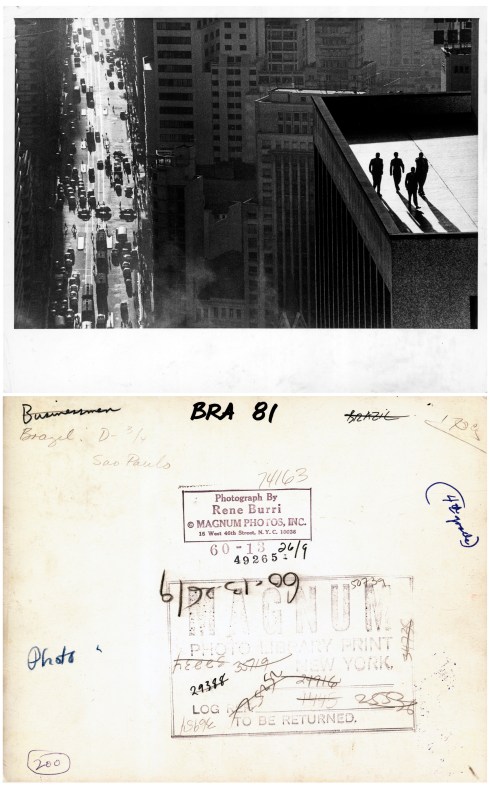
© Rene Burri/Magnum Photos. Brazil. Sao Paulo. 1960 / Back of print.
I spent last week on the phone to Mark Lubell, managing director of Magnum Photos; David Coleman, curator of photography at the Harry Ransom Center; and Eli Reed, photographer, Magnum member and UT professor.
The upshot was The Story Behind the Legendary Magnum Archive Sale, an article over on Wired’s Raw File blog.
There’s a couple of great quotes, my favourite is this from Coleman, “The boxes are marked with three-initial codes. I haven’t quite broken the codes that correspond to all the photographers. Robert Capa is CAR but then also BOB, which is funny. Bob.”
It was a story I really wanted to report on because I do think this is an astounding “incentivized” outcome for all involved. Read the article for details.
I do still wonder what will happen in 2015, though?


I am late on this one, but I thought it so important that it worth a quick post.
Last month, Amy Stein posted Bedlam Exposed. Amy put up some disturbing images by Charlie Lord. He was one of several conscientious objectors who worked at Philadelphia State Hospital, Byberry, PA in lieu of military service.
Listen to Charlie Lord talk about his experience at the Philadelphia State Hospital.
Prison Photography has long determined that there is little difference between prisons and asylums. Asylums have been referred to as sanitariums and as hospitals, but it is necessary to take a quick leap past the label and view the level of care (and security) as well as the agency of those committed.
In photographic evidences we can look to the work of Jenn Ackerman (a prison functioning as a mental health unit) and Eugene Richards (a mental health unit functioning as a prison). These thoughts are just to sow the seeds and the [in]distinctions between prisons and mental health facilities will be something I’ll return to over the coming year.
Ackerman’s Trapped:
http://www.burnmagazine.org/essays/2009/05/jenn-ackerman-trapped-epf-finalist/
http://indepth.jennackerman.com/trapped/feature.html
http://bop.nppa.org/2009/still_photography/winners/?cat=NTP&place=1st
https://prisonphotography.wordpress.com/2009/07/10/jenn-ackerman-trapped-mental-illness-in-americas-prisons/
Richards’ Procession of Them:
http://motherjones.com/environment/2009/03/out-mind-out-sight
http://motherjones.com/photoessays/2009/03/out-mind
http://www.soros.org/initiatives/photography/events/procession_20060201

Last month, I gave a tip of the hat to Melinda Hawtin’s graduate work. Thereafter, Melinda’s graduate advisor Amanda Crawley Jackson dropped me a line to tell me about the exhibition L’IMPOSSIBLE PHOTOGRAPHIE, Prisons Parisiennes (1851-2010) at the Musee Carnavalet in Paris early next year. (Details via Google translate)
I have already enlisted a reporter in the field to visit and review the exhibition for Prison Photography, so there’s something to look forward to in the new year.

Amanda also pointed out the collection of over 2,500 photographs by Henri Manuel archived at the National Museum of Prisons, France.
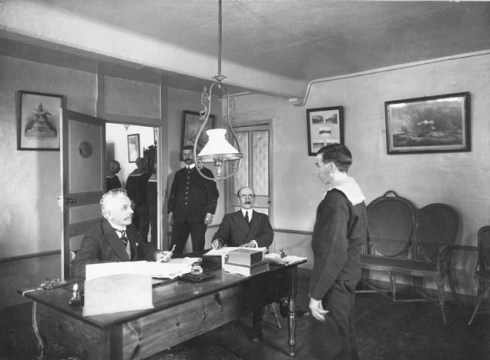
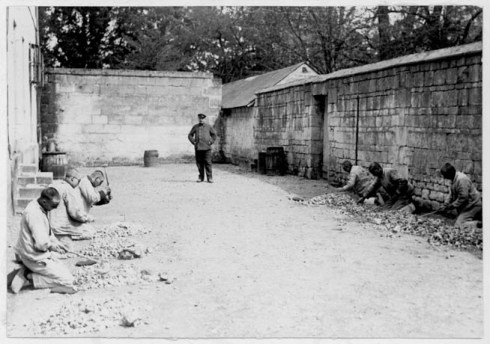
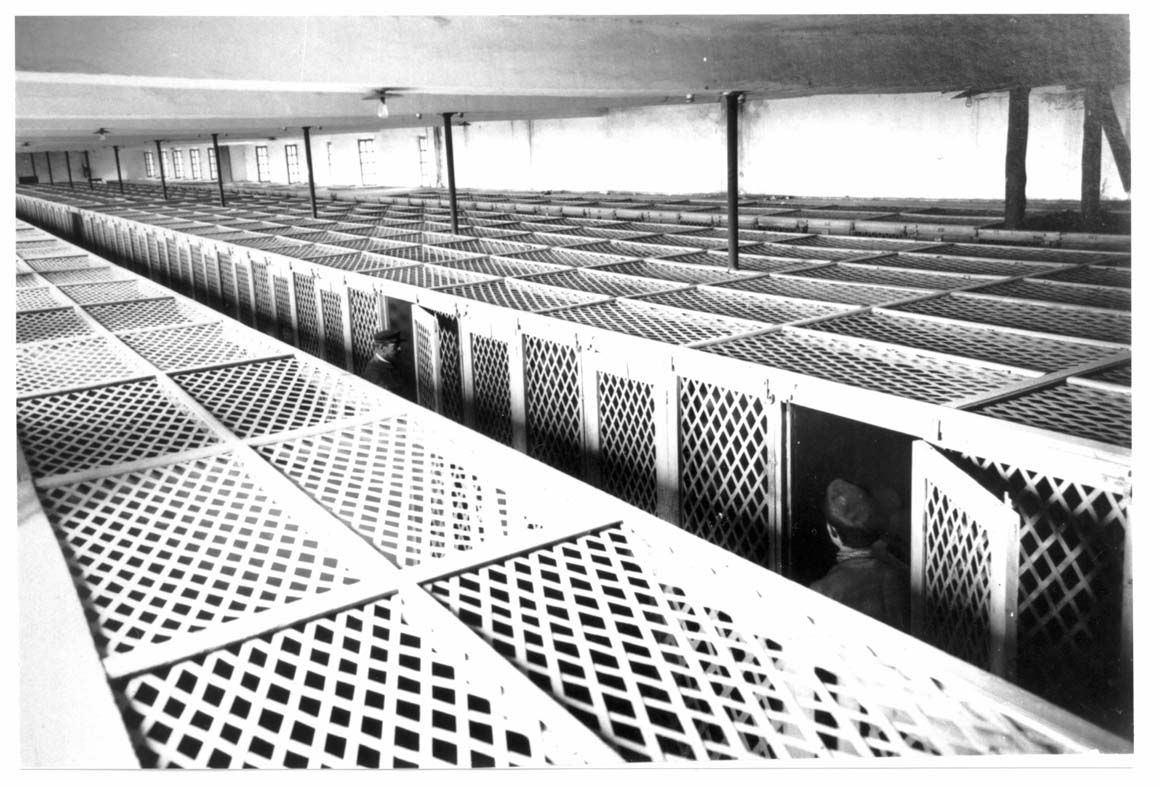
Between 1929 and 1931, the Henri Manuel studio documented prisons and juvenile institutions for the Ministry of Justice.
Manuel’s photographic survey is characterised by its scope, its exhaustiveness and its will to show that prison is not merely a place of detention and punishment but education and work also.
The survey resulted in craftsman-made albums for each prison, and several photographs were published in the press or distributed as postcards.
However, no records exist so exact reasons for the contract such as who ordered the work (and for what purpose) remain unknown. (Source)

Some of Manuel’s photographs blow my mind.



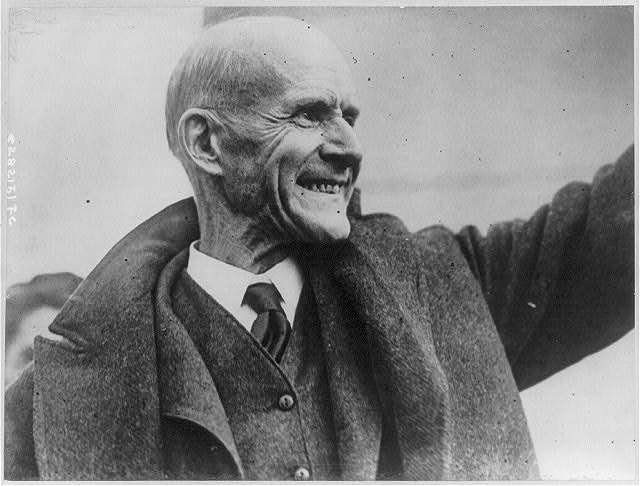
Eugene V. Debs, Five times Socialist candidate for President, as he leaves the Federal Penitentiary at Atlanta, Georgia on Christmas Day, 1921. Library of Congress Prints and Photographs Division, LC-USZ62-75578 (B&W film copy neg). Photoprint copyrighted by Underwood & Underwood, No. S/282,151/FC.
Eugene V. Debs is a hero for the prison reform movement. Which is strange given that prison reform per se wasn’t his main cause. Debs was a labor rights advocate, union organiser and Socialist Party pioneer.
Debs was a harsh critic of American draft policies of the First World War; he was accused of sedition and labeled a traitor by Woodrow Wilson. Debs’ June 1918 anti-war speech saw him arrested under the war-time espionage law. He was sentenced to 10 years. He was effectively a political prisoner.
It is the statement Debs delivered in his court hearing that has inspired generations of prison activists:
Your Honor, years ago I recognized my kinship with all living beings, and I made up my mind that I was not one bit better than the meanest on earth. I said then, and I say now, that while there is a lower class, I am in it, and while there is a criminal element I am of it, and while there is a soul in prison, I am not free.
Given that Marx’s Das Kapital was published in 1867, Debs’ adoption of Socialism is relatively late. Ironically, it was while he was imprisoned in Woostock, Illinois during 1895 that he read Marx’s work and upon release became an avowed Socialist.
Debs ran for the US Presidency five times; first as a member of the Social Democratic Party of the United States (1900) and later as the candidate for the Socialist Party of America (1904, 1908, 1912 & 1920). In both the 1912 and 1920 elections Debs’ received nearly one million votes, 6% and 3.4% of the popular vote, respectively.
The 1920 campaign was run from within prison – after his 1918 speech he was convicted in April of 1919. The photograph above is of Debs’ release on Christmas Day, 1921 when his sentence was commuted to time served.
Debs legacy lives on partly in the form of the Eugene V. Debs Award. Past winner include Studs Terkel, Howard Zinn, Kurt Vonnegut, Molly Ivins, Pete Seeger and Ralph Nader.
Musings on the ‘Third Candidate’
I am always fascinated by the presence of historical figures who have disturbed the prevalent two party system of America. As unsavory as George Wallace was, his impact as a third candidate is worth measuring. Today, Ralph Nader’s name is synonymous with the term ‘third candidate’ and for his involvement in the 2000 general election his is vilified as the reason Al Gore did not become president. I am sick of hearing such a whinging and backward logic. Al Gore did not become president of the United States because he failed to win enough Electoral College votes and we well know the hanging, Floridian chaddy reasons for that.
People’s criticism of Nader says more about their surrender to a seemingly perpetual two party system than it does of his perceived faults.
Nader has made the point that neither the suffragettes or civil rights activists made it to elected office but that didn’t prevent them effecting massive change. If people are criticising any third candidate it is because they are more focused on the intractable two-party system than they are on their own agency and potential to effect change.
Image source.

 Prison Photography