
You are currently browsing the category archive for the ‘Historical’ category.
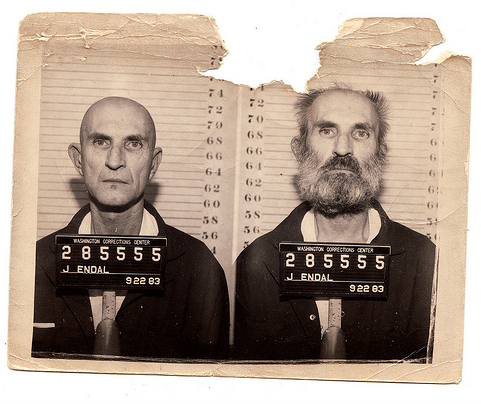
Torn Shorn, Misc. Set. Courtesy of Least Wanted aka Mark Michaelson. http://www.flickr.com/photos/leastwanted/sets/72157605201939008/
Another nod for Blake Andrews. Although not planned, it is welcome, as I think he tries keeps the blogophotosphere fresh, trying new stuff from his hideout in Portland.
Earlier this week I featured Blake’s Brief History of the U.S. Passport Photograph. An artist/collector with hundreds of Passport and ID Photographs, named Least Wanted, followed up with Blake to get the word out on his sprawling collection.
Also earlier this week, I put up a piece about the JUSTICE Art Installation in Bridewell Police Station, London. Coincidentally, one of the artists for the JUSTICE exhibition exhibition was Mark Michaelson, aka Least Wanted. It seems like a small-internet-triangle-of-providence presented itself this morning and it is up to me to draw the hypotenuese …

Head Gear, Misc. Set. Courtesy of Least Wanted aka Mark Michaelson. http://www.flickr.com/photos/leastwanted/sets/72157605201939008/
Least Wanted collects, groups and displays a huge collection of I.D. photos on Flickr. In addition to passport shots, it includes medical photographs, badge I.D. photos and other documentary ephemera. Prison Photography is interested in the majority of the collection: Mugshots.
Least Wanted’s sets are a mad enough curatorial project to keep me going for months. For now, I’ll just echo Blake’s sentiment and point you in the direction of Michaelson’s epic archive.

Austin Old Timer, Misc. Set. Courtesy of Least Wanted aka Mark Michaelson. http://www.flickr.com/photos/leastwanted/sets/72157605201939008/
The three images used in this article were drawn from Least Wanted’s misc. Set
Blake Andrews says, “Together with the mugshot, the passport snapshot was the earliest application of photography as purely personal identifier.” It’s a good read and you should check it out. My favourite observation was the 1920s transition, “Photos were glued instead of stapled.” Also, is that Indiana Jones?…

“One Million Finnish Passports”, 1995. One million replicated Finnish passports, glass, 800 x 800 x 80 cm. Installation view: Museum of Contemporary Art, Helsinki. Artist: Alfredo Jaar, courtesy Galerie Lelong, New York.
I’ve been thinking a lot about mugshots recently and how prison photography is one little orbit of many about the deathstar of dark-photography. Other orbits include Weegee, Larry Sultan & Mike Mandel (defining the cross over between documentary and fine art) forensic photography, police blotter, thanatourism, civil war hangings, Salgado’s “Beautiful Deathscapes”, lynching photography, Danny Lyon (the most appropriated of artists) and fetishism to name a few.
All of these, by method or subject, relate to the state, and thus more orbits of homeland and foreign surveillance, torture slideshows, death suites, electric chairs, driving licenses, mafia movies, Jenny Holzer and genocide.
The most everyday instance of a photographic collaboration with the state is the passport photo. No more than that. Just thoughts.
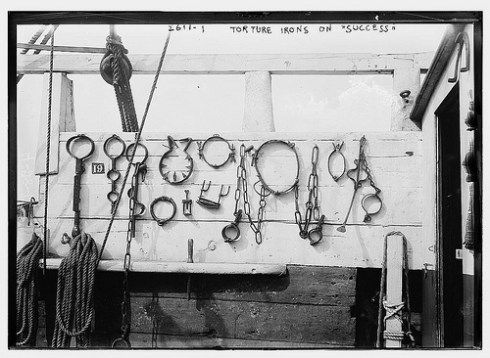
A couple of months ago, I wrote about the prison convict ship Success and its repurposing as a museum ship in the early 19th century. At that time, I featured a couple of images of the ship docked in Seattle and Tacoma. To continue from that visual anchor (pun intended), I’d like to share these few close up images of this unique and long-gone “Museum Ship of Colonial Horrors” (as I like to refer to it).
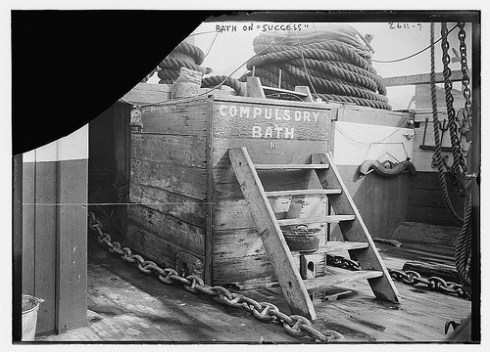
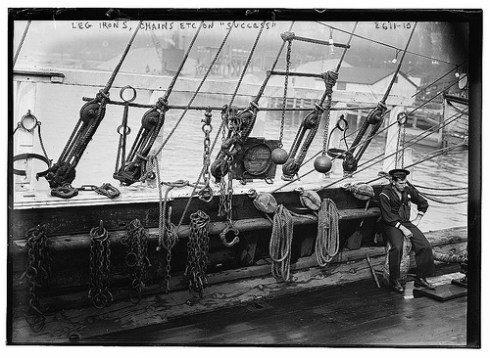 The accoutrements of abuse on display are chilling. The international seafaring exhibit was an old British and latterly Australian ship used for deportation of ‘criminals’ during Victorian times and for non-human commodities thereafter.
I wonder what sort of museological interpretation of Success was given to American audiences? Would this have been kept in a separate narrative to the slavery ships of the Atlantic or would all histories be foisted into one macabre reductive appreciation of the ‘Other’?
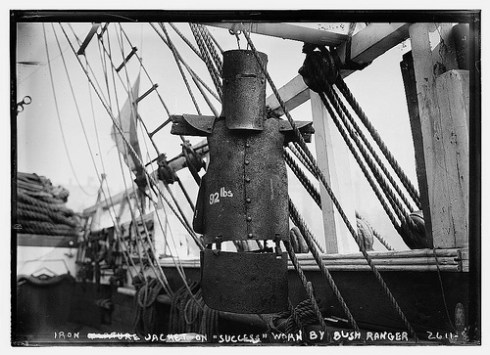
 When I saw the iron jacket I was terrified, but then I read Wystan‘s description of the Wooden Maiden:
If you were very naughty, you might be asked to remove your clothing and climb inside this vertical coffin, where of course it was pitch dark, there was no water, and fresh air was scarce. Then the box (which was clad in sheet iron) would stand in the hot sun until you got nice and warm. But you wouldn’t want to slump or faint, because then your bare flesh might get snagged on the ends of the long nails that had been pounded into it from random directions . . .
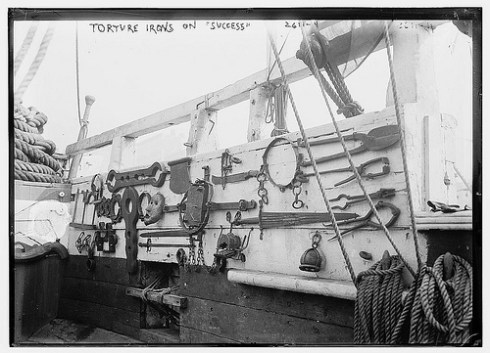
All images from the Library of Congress on Flickr,
and searched out through Flickr Commons.
On Thursday, 28th May, photographs of prison conditions and detainee custody from six facilities other than Abu Ghraib will be released to the public.
Reports over the weekend suggested a figure of 44, but the Guardian has stated over 2,000 photographs are to be made public. Images of Bagram Air base in Afghanistan are included in the cache. Critics will surely scan for similarities in detention/torture methods used in Afghanistan as in Iraq to argue against the ‘few bad apples’ logic that railroaded earlier attempts to bring military and government commanding authorities to full-accountability.

ACLU’s advocacy deserves international acclaim. Not only have they forced the release of photographic evidence they won a ruling to prevent the destruction of audio tapes that record torture scenarios.
This is an interesting counterpoint. I presume we all assume we’ll see the images in the printed press. Would we expect the tapes to play on our televisions and radios? That scenario makes me uncomfortable.
Continuing with issues of format, it will be interesting to see how the media presents the-soon-to-be-released photographic documents in contrast to the recent torture memo’s. WoWoWoW set the bar low with the tabloid inquiry “How Bad Will They Be?” and the Los Angeles Times allays fears with a dead-pan assessment, “examined by Air Force and Army criminal investigators, are apparently not as shocking as those taken at Abu Ghraib.
No doubt these images will be contested and a ‘Meaning-War’ over the images will ensue, but I think people for and against the Bush administration’s interrogation policies are not going to change their position now – whatever the evidence.”
But, I guess it depends who’s looking.

Lefties want more weaponry in the push for prosecution of Bush and his cronies for war crimes. The right is debilitated and otherwise occupied by the economy, stocking guns before the “Obama-ban” and the latest Meghan McCain slur.
Politicians from both parties seem to want this to go away, snarking on about how the release of yet more Un-American activities will only fuel the burning hate toward the US. This position is an insult.
Did Bush care what Iraqi’s would think when he bombed them out of house and home? Did Bush care to think how American’s would react in the face of diminished civil liberties? Yet here, politicians of both parties are scrambling to avoid the negative reactions of entrenched, fundamental opponents INSTEAD of anticipating the beneficial good-will and return to mutual trust provided by honest disclosures of a transparent and constitutional government. Why cover-up a cover-up?
Maybe, the Democrats are shy to see these documents because they may implicate their top brass?

One concern I will air, is that all this could move toward some bizarre show-trial scenario, where lawyers bargain, Bush is spared, the American public settle for a conviction of Cheney, and careers and reputations lie in waste on both sides of the aisle!?!
I certainly didn’t expect the incriminating documents to flood as they have in recent weeks. I have no idea how all this is going to shake down. Obama doesn’t seem to have control of this. That doesn’t bother me. No-one can hold back the truth.
So, as wise at it’d be to remember the date, 28th May, you should bear in mind the photographs of abuse could well leak earlier…
________________________________________________
First Image lifted from Gerry May. http://www.gerrymay.com/?p=1426
Cartoon courtesy of the Nation. http://www.thenation.com/doc/20050307/duzyj
Final Image by Takomabibelot. http://www.flickr.com/photos/takomabibelot/2090273618/
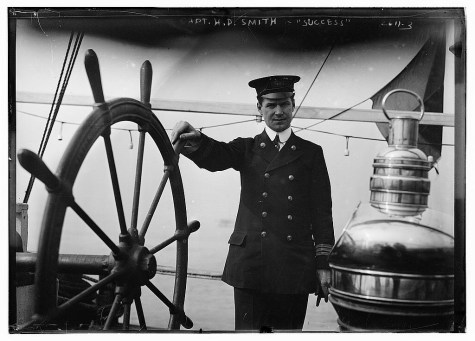
Capt. H.D. Smith of SUCCESS, Date Unknown. Glass negative. George Grantham Bain Collection (Library of Congress). Call Number: LC-B2- 2611-3
A couple of weeks ago I gave a nod to subtopia’s article on Floating Prisons. This is a topic that gets more meaty the more contemporary the examples become. The intrigue levels reach new heights when the 21st century, nautico-military gun-vessels are spear shaped, warp radar detection and travel quicker than your average barracuda. Concomitantly, the further back one ventures, prison ships are mired in the shameful times of slavery and the dirty deeds of colonial conquest.
There is a period between these two paradigms, when American authority locked up American pioneers on prison hulks. When the western expansion became western settlement, predominantly centered about San Francisco, the authority of the time needed a “bulk” solution to the settling and incorrigible population. The quickest solution to the quickest lawlessness on the continent was the prison ship.
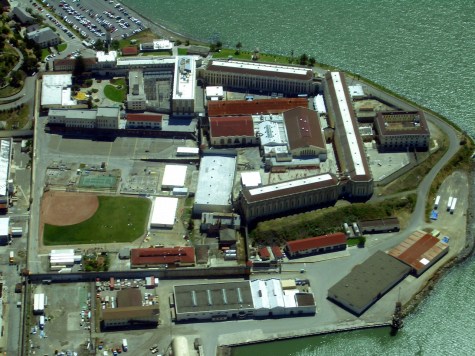
San Quentin Prison. Image: Telstar Logistics (Source)
In 1851, the first prison on the west coast of America was established at Point San Quentin, but when it was established it was not bricks and mortar but beams and gulleys. The Waban, a 268-ton wooden ship, anchored in San Francisco Bay, was outfitted to hold 30 inmates. Subsequently, inmates who were housed on The Waban constructed San Quentin which opened in 1852 with 68 inmates. Unfortunately, I could find no images of The Waban.
I think it is interesting that a “prison-as-terminal” was immediately necessary when humans reached the edge of a continent. San Quentin prison replaced the archipelago of local jails across America as a permanent and expanding facility – the final stopping point for California’s early lawless contingent.
It is poetic that the first penological-structure chosen (based on practical needs) was one that straddled land and water; permanently moored, but temporary in its utility. Carceral use demotes the ship to ‘container’ and The Waban, like its inhabitants, entered its demise.
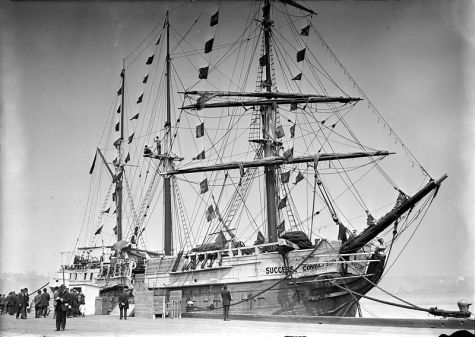
Success convict ship, no date recorded. Image: Library of Congress
Anyway, just to prove its not all bad news for prison ships, above is one of the most famous. Success was reincarnated as a global museum traveling the world purportedly as a museum demonstrating the transportation horrors of the British Empire.
Here’s the skinny, “Constructed in built in Natmoo, Tenasserim, Burma in 1840. sold to London owners and made three voyages with emigrants to Australia during the 1840s. On 31 May 1852 the Success arrived at Melbourne with emigrants, and the crew deserted to the gold-fields, this being the height of the Victorian gold rush. Due to an increase in crime, prisons were overflowing and the Government of Victoria purchased large sailing ships to be employed as prison hulks. These included the Success, Deborah, Sacramento and President.
“When no longer needed as a prison ship as such, the Success was used as a detention vessel for runaway seamen and later as an explosives hulk.
“When the Victorian Government decided to sell the last of its redundant hulks, Success was purchased by a group of entrepreneurs to be refitted as a museum ship to travel the world advertising the perceived horrors of the convict era. Although never a convict ship, the Success was billed as one, her earlier history being amalgamated with those other ships of the same name including HMS Success that had been used in the original European settlement of Western Australia.
“A former prisoner, bushranger Harry Power, was employed as a guide. The initial display in Sydney was not a commercial success, and the vessel was laid up and sank at her moorings in 1892. She was then sold to a second group with more ambitious plans.
“After a thorough refit the Success toured Australian ports and then headed for England, arriving at Dungeness on 12 September 1895 and was exhibited in many ports over several years. In 1912 she crossed the Atlantic and spent more than two decades doing the same thing around the eastern seaboard of the United States of America and later in ports on the Great Lakes.
“The Success fell into disrepair during the late 1930s and was destroyed by fire at Lake Erie Cove, Cleveland, Ohio, while being dismantled for her teak on 4 July 1946. (Source)
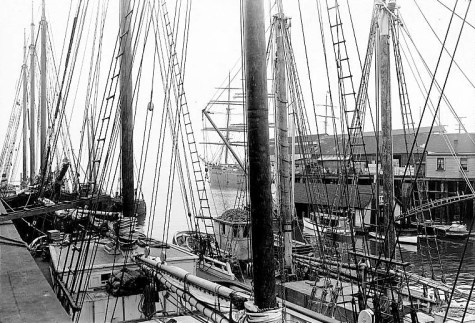
Prison ship SUCCESS, Seattle, 1915. Photographer Unknown. Image: University of Washington Digital Archives
The Success passed through the Panama Canal and spent 1915/1916 on the Pacific Coast. She drew huge crowds in Seattle. I found the image above at the University of Washington Archives, which was my main reason for constructing this post. Success also docked in Tacoma in 1916.
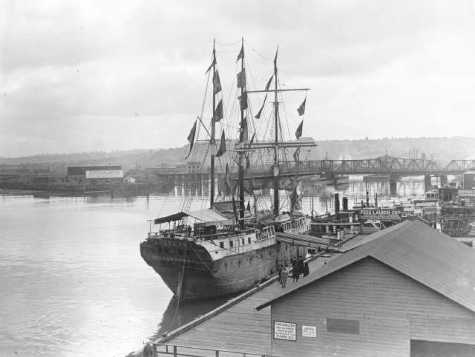
Around 1916, the exhibition prison ship "Success," from Melbourne Australia, was docked at the Tacoma Municipal Dock Landing and open for tours. Marvin D. Boland Collection, Tacoma Public Library. Series: G50.1-103 (Unique: 31555) (Source)
I guess I just like the fact the Success was repurposed so many times and for a long period of time was a museum to the macabre. Some commentators were bothered by Roger Cremers recent World Press Photo win in the “Arts & Entertainment” category for his photographs of Auschwitz tourists. I guess ‘Dark Tourism’, or Thanatourism, has always existed. 21st century generations may not be as perverse as we perceive.
__________________________________________

Woman in cell, playing solitaire. ca. 1950. Nickolas Muray. Transparency, chromogenic development (Kodachrome) process. George Eastman House Collection - Accession # 1983:0567:0151
I was blown away last month when the indicommons feed landed Nickolas Muray’s colour commercial photography on my desktop. Muray’s commercial work is fresh, witty, a sock in the eye and an all round feast of fun. The fact I haven’t any knowledge ofi the advertised products makes my enjoyment all the more visuocentric and naive. And that’s okay … every so often.
Pop music sprouted in the fifties, right about when this image was taken. I have Alma Cogan playing in my mind as I browse Muray’s commercial kodachrome prints. Visually, Woman in Cell, Playing Solitaire is an alterworld mash-up of Jehad Nga and Edward Hopper. Don’t you just dig those colours? None of the psychological edge though; the lady, despite being locked up, hardly looks harassed or without hope. Rather, she looks bored.
To continue the fest of technicolour, let me include the image below. Admittedly, it stretches the theoretical parameters of this blog but I would argue the subject is relevant. Depicted is the harsh subjugation of fowl to sites of incarceration – evidenced by the chicken wire and possibly even the girl’s well-disguised, maniacal grasp of the hat!

American Cyanamid Girl with Straw Hat Full of Chicks, 1947. Nickolas Muray. Color print, Assembly (Carbro) Process. George Eastman House. Accession # 1971:0048:0017.
To end on a serious note, I knew of the exceptional George Eastman House collection, but was frequently frustrated by the archaic platform of its website. Browsing was not fun. To GEH’s credit they recognised this enfeeblement and avidly committed important works to the Flickr Commons project. Kudos to them. We are all the better for it! I am just happy an image came along with vaguely carceral imagery, providing me an excuse to share.
_________________________________________
Nickolas Muray (American, b. Hungary, 1892-1965) immigrated to the United States in 1913, working first as a printer and then opening a photographic portrait studio in Greenwich Village in 1920. He became well known for his celebrity portraits, publishing them regularly in Harper’s Bazaar, Vanity Fair, Vogue, Ladies’ Home Journal, and The New York Times. After 1930, Muray turned away from celebrity and theatrical portraiture, and became a pioneering commercial photographer, famous for establishing many of the conventions of color advertising. He is considered the master of the three-color carbro process. Muray’s portraits of Frida Kahlo are well known and well-loved.

Kevin Van Aelst for The New York Times
I posted about Google’s collaboration with LIFE Magazine a few months ago. I – like many folk – were excited to dig in, ferret about and generally enjoy the visual culture of decades past. It seems the novelty has worn off for some. An excellent diatribe, Photo Negative, in the New York Times last week made the point succinctly.
“When Google first announced on its blog that the Life archive was up, it seemed like another Google good deed: rescuing the name of Life magazine and the glorious 20th-century tradition of still photojournalism. But Google has failed to recognize that it can’t publish content under its imprint without also creating content of some kind: smart, reported captions; new and good-looking slide-show software; interstitial material that connects disparate photos; robust thematic and topical organization. All this stuff is content, and it requires writers, reporters, designers and curators. Instead, the company’s curatorial imperative, as usual, is merely ‘make it available’.”
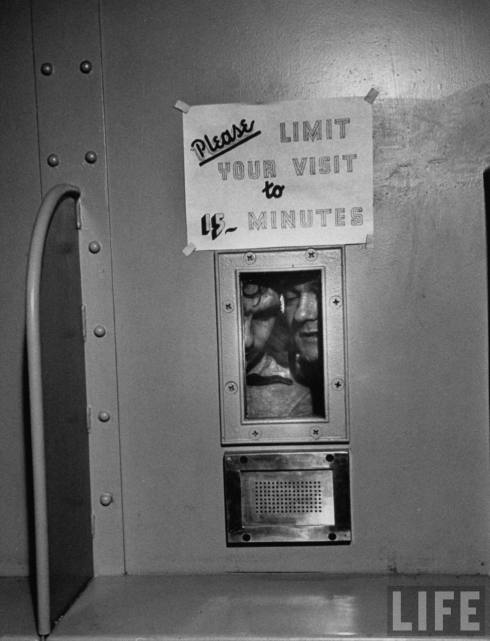
Prisoners watching baptism of repentant killer, in Harris County jail, TX, US. March 1954. Credit: John Dominis. ©2008 Google
With little in the platform or functionality to inspire users, Google could find visitors’ perusal time shrinking. Users might face unavoidable limits to their search time and patience. 15 minutes?

 Prison Photography
Jacob Holdt’s America: Hitch-hiking, Poverty, Racism, Prisons, Death and Love
May 19, 2009 in Activist Art, Documentary, Historical | Tags: America, Anti-Racism, Comment, Death, Drugs Addiction, Inequality, Jacob Holdt, Love, Murder, Philosophy, Poverty, Prison, Prisons, Problems, Social, Violence | by petebrook | Leave a comment
Jacob Holdt presenting at the New York Photo Festival, 2009. Screen shot from WTJ? Video.
In 2008 it was Ballen. In 2009 it was Jacob Holdt; The highlight of the New York Photo Festival.
I have been a fan of Holdt’s work for a couple of years now. Longer than some and not a fraction as long as others. Holdt has lived across the globe as an activist against racism and a harbinger of love for nearly four decades.
In 2008, Jacob Holdt was nominated for the Deutsche Borse Prize eventually losing out to Esko Männikkö. It was a shrewd shortlisting by a notoriously urbane committee at Deutsche. Holdt’s life and productive trajectory is his own, and much like Ballen does not conform to any norms of expected photographic career paths.
Any nomination – any praise – is purely a recognition of Holdt’s philosophy, his “vagabond days”, his trust in fellow humans and his rejection of stereotypes, fear and pride. Holdt does not revere photography as others may, “Photography never interested me. Photography was for me only a tool for social change.”
© Jacob Holdt
I watched Holdt’s presentation without expectation. I was, in truth, very surprised by the number of times he referred to his subjects – his friends – spending time in prison. It seemed only death trumped incarceration in terms of frequency amongst his circle of friends.
Prison Meal on Toilet © Jacob Holdt. Through a “mysterious mistake” I got locked up in this California prison with my camera and had plenty of time to follow the daily life of my co-inmates. Food was served in their cells where the only table was their toilet.
Slide after slide: “I can’t remember the number of times I have helped him get out of prison” and, “He’s in prison, now” or “He’s doing well now. He was in prison, but now he is out, has a family, and is doing well.”
Holdt described his method of finding community. Upon arrival in a new place, he would visit the police station and ask where the highest homicide rate was. He’d go to the answer.
Violence was tied up with poverty, was tied up with drugs, was tied up with deprivation, was tied up with hurt, was tied up with punishment and was tied up with prison – usually long sentencing.
Holdt’s series straddles the massive prison expansion experiment of America that began in the 1980s. Also enveloped are the crack epidemics, the racial fragmentation of urban populations and the relocation of middle classes to the suburbs. Holdt’s photographs are the mirror to racial economic inequalities.
Dad in Prison © Jacob Holdt. Alphonso has often entertained my college students about how he and the other criminals in Baltimore planned to mug me when they first saw me in their ghetto. However, we became good friends, but some time later he got a 6 year prison term. Here are the daughters Alfrida and Joann seen when they told me about it at my return. Today Alphonso has found God with the help of these two daughters who are now both ministers.
Holdt doesn’t play the blame game. Just as institutions and corporations walked all over many African Americans in Philadelphia, Baltimore, New York, and states across the South, so too did people step on each other, “This is a photo of a man the night after he shot his own brother in the head.” The next night, he was out stealing again and soon after was convicted for another crime and served 16 years in prison.
Holdt only makes excuses for the failings of his friends insomuch as their mistakes are more likely – almost inevitable – set in the context of their life experience. He doesn’t jump in, drive-by, photo some ghetto-shots nor cadge some poverty-porn. Holdt involves himself directly and tries to open other avenues.
He and his team has lectured across the globe running anti-racism workshops. Holdt had ex-cons sell his anti-racism book on the streets when they were released from prisons without opportunity. He offered pushers the chance to sell his books instead of dope. Sometimes he saw the money and sometimes not, “But, it was never about the money” Holdt adds.
Prisoner cleaning up on Palm Beach. © Jacob Holdt
One of the most sobering facts of the talk was a double mention of Lowell Correctional Institution in Florida. It was the only facility referred to by name and twice Holdt named friends who’d spent time inside. Lowell is a women’s facility. The female prison population of America has quadrupled in the past 25 years. It is still expanding at a far faster rate than the male prison population. Women’s super-prisons are singularly an American phenomenon. Holdt dropped as an aside, “I have three friends with grandmothers in prisons.”
If he could help, he would. Holdt described a struggling young lady who he desperately wanted to get on staff of American Pictures, but in 1986 she was too strung out on crack. In 1994 he visited her in prison. In 2004 she was released. In 2007 she was still out and Holdt photographed her with her son.
He photographed mothers, lovers, father and sons behind bars. In one case, when the father was convicted the son turned to crime to keep enough money coming in to support the family. He soon joined his dad in prison.
Prison Kiss © Jacob Holdt. I was visiting the friend of this inmate when his wife suddenly came on a visit.
But when it would be expected that Holdt may be too deep inside the experience of the poor Black experience, he took the chance to live amid the poor White experience.
Poor whites at a Klan gathering in Alabama. © Jacob Holdt
In 2002, Holdt had the opportunity to live with the Ku Klux Klan. He became pals with the Grand Dragon and his family.
“I have spent my life photographing hurt people.” The KKK members were no different. The leader had been abused as a child, subject to incest and beatings. Holdt presumed this but it was confirmed around the time the leader was sent to prison for 130 years for murder.
Holdt moved in with Pamela, the leaders wife, to support her in her husbands absence. Also in his absence he brought the unlikeliest of people together.
Pamela with white friend (Jacob Holdt). © Jacob Holdt
Pamela with black friend. © Jacob Holdt
During this time and only through informal discussion did Holdt learn that the man was innocent – he had voluntarily gone to prison to spare his son, the real culprit, from conviction for a hate crime.
Holdt petitioned and won his release. The former Grand Dragon was unemployed upon release and went on to sell Holdt’s anti-racism book on the streets … just as the dope-dealers of Philly had 15 years earlier.
Holdt’s presentation confirmed to me that the prison is inextricably linked with the social history of America. But this should not be surprising in a society so violent. Holdt paints a portrait of America from the 70s through to today in which the poorest people (both Black and White) held the monopoly on violence, disease, depression, addiction and struggle.
When Holdt was in Africa he showed people there his images of African-Americans suffering. Africans thought the Black communities of America would fare better in Africa, “Why don’t they come back here?”
Two unemployed Vietnam veterans at wall on 3rd St. © Jacob Holdt
Given the situations he walked into, some may think Holdt is fortunate to still be alive but having armed himself with love he made his own luck … and friends.
Check out more on Jacob Holdt here and here. Here is an article in support of his hitch-hiking activity.
Holdt’s incredible 20,000 image archive American Pictures.
WTJ? 70 minute video of his NYPF presentation.