
You are currently browsing the category archive for the ‘Historical’ category.
Lots of lists of photobooks cropping up for different reasons.
PHONAR
To close out the remarkable efforts of Jonathan Worth’s experimental open-sourced, web-based, free Photography and Narrative (#PHONAR) course offered through Coventry University, the #PHONAR course closed with a bevvy of recommended readings.
The following photographers, writers, teachers and journalists made picks:
Alec Soth; Andy Adams; Cory Doctorow; Daniel Meadows; David Campbell; Edmund Clark; Fred Ritchin; Geoff Dyer; Gilles Peress; Grant Scott; Harry Hardie; Jeff Brouws; Joel Meyerowitz; John Edwin Mason; Jonathan Shaw; Jonathan Worth; Ken Schles; Larissa Leclair; Ludwig Haskins; Matt Johnston; Michael Hallett; Miki Johnson; Mikko Takkunen; Nathalie Belayche; Peter Dench; Pete Brook; Sean O’Hagan; Simon Roberts; Stephen Mayes; Steve Pyke; Todd Hido
As a contributor, I picked out three titles. Predictably, each dealt with photography in sites of incarceration:

Too Much Time – Jane Evelyn Atwood


Chris Verene‘s Family was a later addition.

It was a privilege to be asked to guest lecture on this pioneering educational model. Thanks to Jonathan, Matt Johnston @mjohnstonmedia (Chief Engineer) and students for their encouragement and engagement.
WAYNE FORD
The #PHONAR list was spurred by Wayne Ford’s Photobooks and Narrative list.
JOHN EDWIN MASON
Following the #PHONAR list, contributor John Edwin Mason extended his selections. Mason’s Photobooks and Narrative: My (Slightly Flawed) Phonar List has an African and African American emphasis.
ALEC SOTH
Tonight, Soth put forward his Top 10+ Photobooks of 2010. As ever, Soth is thorough, thoughtful and generous in response.
JEFF LADD
Jeff at 5B4 has picked out his 15 choices for Best Books of 2010. The comments section is lively and I don’t think being to conceptual (as Jeff is accused of) is a problem, even if it were a fair allegation.
SEAN O’HAGAN
Sean at the Guardian has selected 2010’s best photography books that you should put in someones stocking.
NIALL MCDIARMID
Niall has put together his Photobooks and Magazines of the Year.
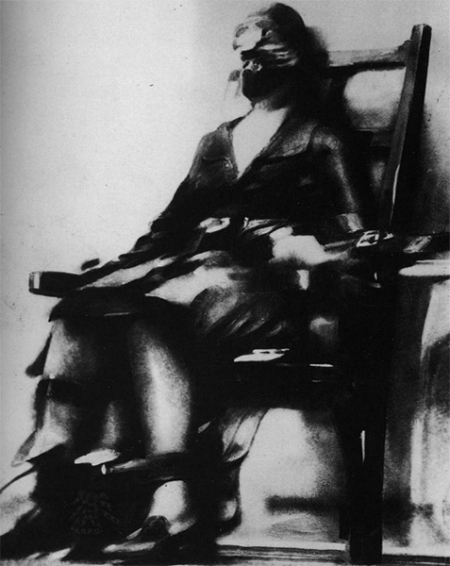
From the consistent, informative and often disturbing Iconic Photos:
“Photographers are not permitted into executions in the United States. For the notorious Ruth Snyder case, the New York Daily News was desperate to get pictures; so they hired a Chicago Tribune photographer Tom Howard – virtually unknown to the prison warders or journalists in the New York area. On that fateful day (12 January 1928), Howard, posing as a writer, arrived early in Sing Sing Prison and took up a vantage position. A miniature camera was strapped to his left ankle, the shutter release button was concealed within his jacket. As Snyder’s body shook from the jolt, Howard hoisted his pant leg and secretly snapped with a one-use camera.”
[My bolding]

‘Seance’. A photograph of a group gathered at a seance, taken by William Hope (1863-1933) in about 1920. The information accompanying the spirit album states that the table is levitating. In reality, the image of a ghostly arm has been superimposed over the table using a double exposure. From the Collection of the National Media Museum, UK.
Great set of Spirit Photographs on the Flickr for the National Media Museum.

‘Man with a female spirit.’ Collection of National Media Museum

Cell with Two Male Convicts
Two months ago, I posted about how the the roundhouse panopticon at Stateville Penitentiary in Joliet, MI had become the subject of art photographers David Leventi, Doug Dubois/Jim Goldberg and Andreas Gursky.
OLD NEWS
These famous names were preceded by anonymous inmate photographers a century previous. Nearly 200 plates from the early 20th century were found by Robert Lawson, a prisoner sentenced to six years in 1969. Lawson was “assigned as an inmate photographer in the Bureau of Identification.”
Lawson: “The B of I maintains mugshots, fingerprints, and criminal records of convicts from the early days of the prison. In a corner of the basement darkroom in a few drawers of an old filing cabinet were several hundred glass-plate negatives which documented Joliet prison around the turn of the century. I spent most of my two years working in these darkrooms, producing a blend of public relations and evidence photographs for the prison administration. The photographs were used in penal publications and were occasionally released to news agencies to illustrate the events and social progress of the prison.”
“The photographs were made by inmate photographers, although their identities still have not been determined. Prison records from 1915 indicate that there were five convicts who listed their previous occupation as photographer. Reports also document that there was a room in the prison designated as the “Photograph Gallery” and that the current warden, Edmund M. Allen, had an annual budget for photographic expenses of almost $1000, approximately three times greater than that of previous administrations.”
“These public relations photographs were taken by an anonymous series of inmate photographers under official direction. It was not necessarily their purpose to create a clear understanding of what prison is and what it does to the minds of those who live there, but it was their purpose to illustrate the progressive changes which were taking place during an era of penal reform which lasted until the beginning of World War I, when public and political attention was diverted to other areas.“
[My bolding]
The collection includes Workplaces, The Grounds, Chaplin, Cells, and Mugshots. A catalogue of the images is available on eBay.
The intriguing story of historical prison photography and later discovery have been reported in publications and featured in James R. Hugunin’s, 1996 survey of prison photography, Discipline and Photograph: The Prison Experience, which is the primary academic work on the history of prison photography in public domain.
Here’s a full list of related links and the list of plates.
Fascinating stuff.

Cell for Female Prisoner

Chaplin with Four Inmate Assistants, ca. 1910
Thanks to Stan for the tip.

Tumbling competition, San Quentin Little Olympics Field Meet, 1930. Courtesy Anne T. Kent California Room Collection, Marin County Free Library
Earlier this morning I pointed out the riches of the Anne T. Kent California Room Collection, in the Marin County Free Library Archives. The San Quentin Little Olympics Field Meet 1930 Album deserves it own post.
Any sack race that has contestants cocooned up to their necks is a serious affair (image 2). Any tumble would hurt.
The tug-of-war (image 3) is fought on a remarkably complex purpose-built platform. It unfortunately looks like a rack.
I have no idea what narrative the parade (image 4) carries, but African American inmates donning hessian sacks painted to mimic “primitive” costume and carrying a whiter-than-whiter mustachioed swan-king is particularly discomforting.
Pole vault without a 60 inch crash-mat beneath the bar?
Lots to be said about cross-dressing and gender-bending in prisons, but not to be superimposed upon these 80 year old photographs. Two fascinating images.
And we just had Halloween. Who knew pie-eating contests (last image) produced zombies?
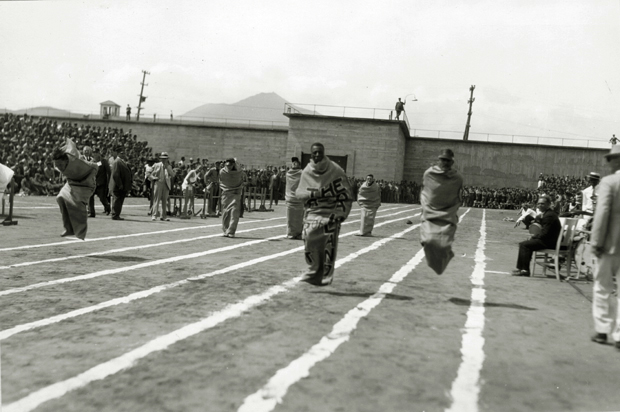
Sack race, San Quentin Little Olympics Field Meet, 1930. Anne T. Kent California Room Collection, Marin County Free Library.

Tug-of-war competition with officials looking on, San Quentin Little Olympics Field Meet, 1930. Courtesy Anne T. Kent California Room Collection, Marin County Free Library

Prisoners in costume parading at the San Quentin Little Olympics Field Meet, 1930. Courtesy Anne T. Kent California Room Collection, Marin County Free Library.
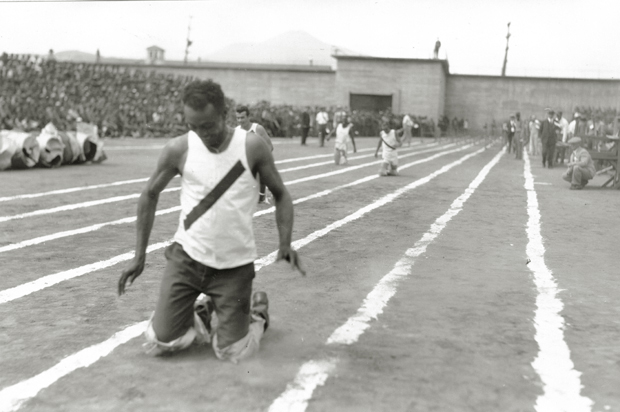
"Fifty-yard crawl" race, San Quentin Little Olympics Field Meet, 1930. Courtesy Anne T. Kent California Room Collection, Marin County Free Library.

High-jump competition, San Quentin Little Olympics Field Meet, 1930. Courtesy Anne T. Kent California Room Collection, Marin County Free Library.

Pole vault competition, San Quentin Little Olympics Field Meet, 1930. Courtesy Anne T. Kent California Room Collection, Marin County Free Library.

Long-jump competition, San Quentin Little Olympics Field Meet, 1930. Courtesy Anne T. Kent California Room Collection, Marin County Free Library.

Clown performance featuring a duck, San Quentin Little Olympics Field Meet, 1930. Courtesy Anne T. Kent California Room Collection, Marin County Free Library.
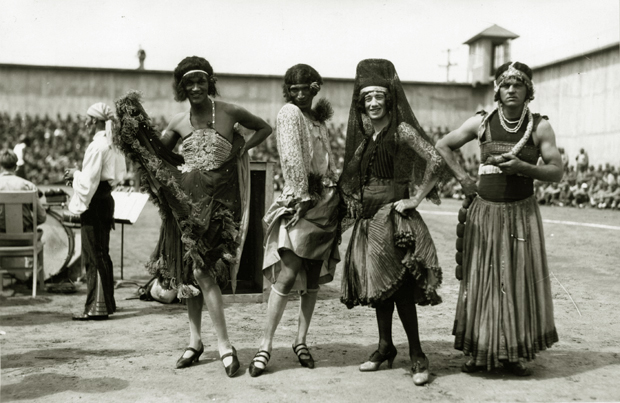
Stage entertainment with four male dancers in female dress, San Quentin Little Olympics Field Meet, 1930. Courtesy Anne T. Kent California Room Collection, Marin County Free Library.

Courtesy Anne T. Kent California Room Collection, Marin County Free Library.

Pie-eating contest showing three participants, San Quentin Little Olympics Field Meet, 1930. Courtesy Anne T. Kent California Room Collection, Marin County Free Library.
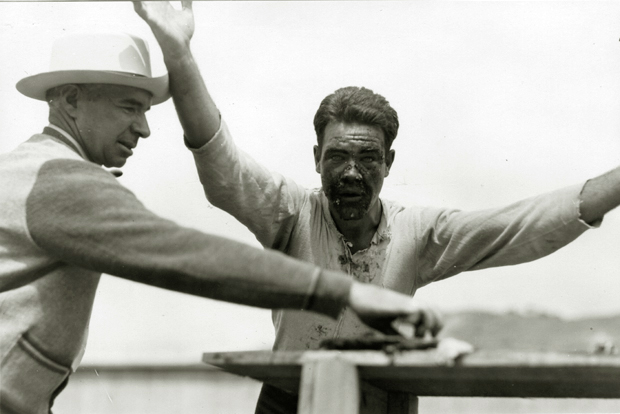
Pie-eating contest (close-up of one participant), San Quentin Little Olympics Field Meet, 1930. Courtesy Anne T. Kent California Room Collection, Marin County Free Library
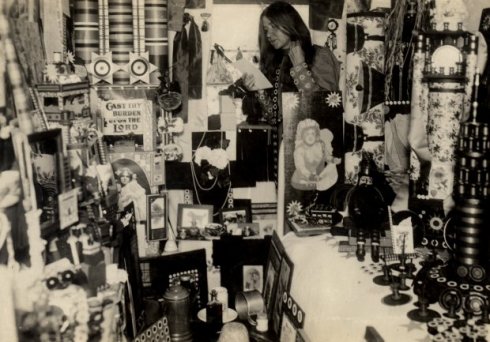
The caption to this photo reads, ‘A woman prisoner at San Quentin in her room. The decorations are all made from fancy paper and spoons.’ Courtesy Anne T. Kent California Room, Marin County Free Library.
This image from the San Quentin Photography Album from the Marin County Free Library really struck me. Dedicated decoration. The San Quentin Photography Album was compiled by Richard M. Smith & Genevieve Smith.
The Anne T. Kent California Reading Room, Marin County Free Library Archives are great. Don’t miss:
Views of the 1906 Earthquake and Fire in San Francisco by W.J. Street.
Golden Gate Bridge Photo Album (Construction images).
Frank Lloyd Wright and the Marin County Civic Center Photo Album, showing the construction of one of FLW’s few West coast buildings. It was later used as the set for Star Trek: Next Generation.
All of these things within just a few miles of one another. Browse the full archive listing.
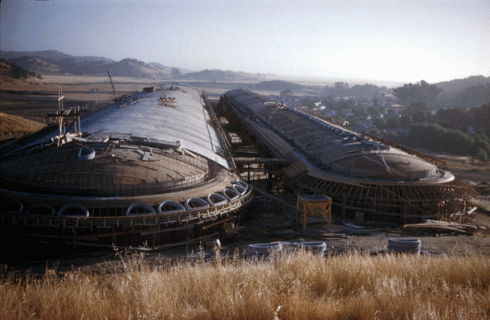
Administration Building Construction. South end of the Administration Building looking North. Photograph by John Trimble. Harold Stockstad Slide Collection. Courtesy Anne T. Kent California Room, Marin County Free Library.

View of the Golden Gate way with the Palace of Fine Arts in the foreground; circa March 9, 1935. Courtesy Anne T. Kent California Room, Marin County Free Library.

Francis Nielson as Isaac in Abraham & Isaac, the first Mountain Play, performed in 1913. Courtesy Anne T. Kent California Room, Marin County Free Library.
American Suburb X republished an Art Voice interview with Bruce Jackson.
Bruce Jackson is one of the greats of prison photography, up there with Danny Lyon, Deborah Luster and Alan Pogue.

Jackson: “The people who are in penitentiaries are no different than the people outside, except that they’ve done a certain thing that got them classified as the kind of person that goes to the penitentiary. But they’re in a penitentiary, and being in a penitentiary does something to people. It puts you in a position. All the things that Foucault writes about—about power and what it does and the way it’s used—are there. Prison is a place where power rules. Prison is about power; if it were not, people would walk out the gate. You see it in the way people walk and in people’s faces and the way they present themselves.”
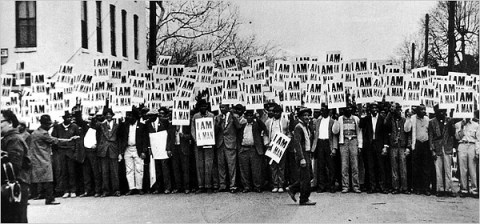
Two stories that broke this week demonstrate the levels to which everything is never as it seems.
The New York Observer describes links between Leslie Deak and funders of the controversial mosque, the CIA and U.S. military establishment have gone unacknowledged.
Meanwhile, The Commercial Appeal in Tennessee reports famed and revered Civil Rights Photographer Ernest Withers doubled as FBI informant to spy on civil rights movement.
Democracy now states, “Withers’s alleged involvement was revealed because the FBI forgot to redact his name in declassified records discussing his collaboration.”
Withers died in 2007.

Thanks to Stan for the tip off.

 Prison Photography