
You are currently browsing the category archive for the ‘Institutional’ category.

Cell with Two Male Convicts
Two months ago, I posted about how the the roundhouse panopticon at Stateville Penitentiary in Joliet, MI had become the subject of art photographers David Leventi, Doug Dubois/Jim Goldberg and Andreas Gursky.
OLD NEWS
These famous names were preceded by anonymous inmate photographers a century previous. Nearly 200 plates from the early 20th century were found by Robert Lawson, a prisoner sentenced to six years in 1969. Lawson was “assigned as an inmate photographer in the Bureau of Identification.”
Lawson: “The B of I maintains mugshots, fingerprints, and criminal records of convicts from the early days of the prison. In a corner of the basement darkroom in a few drawers of an old filing cabinet were several hundred glass-plate negatives which documented Joliet prison around the turn of the century. I spent most of my two years working in these darkrooms, producing a blend of public relations and evidence photographs for the prison administration. The photographs were used in penal publications and were occasionally released to news agencies to illustrate the events and social progress of the prison.”
“The photographs were made by inmate photographers, although their identities still have not been determined. Prison records from 1915 indicate that there were five convicts who listed their previous occupation as photographer. Reports also document that there was a room in the prison designated as the “Photograph Gallery” and that the current warden, Edmund M. Allen, had an annual budget for photographic expenses of almost $1000, approximately three times greater than that of previous administrations.”
“These public relations photographs were taken by an anonymous series of inmate photographers under official direction. It was not necessarily their purpose to create a clear understanding of what prison is and what it does to the minds of those who live there, but it was their purpose to illustrate the progressive changes which were taking place during an era of penal reform which lasted until the beginning of World War I, when public and political attention was diverted to other areas.“
[My bolding]
The collection includes Workplaces, The Grounds, Chaplin, Cells, and Mugshots. A catalogue of the images is available on eBay.
The intriguing story of historical prison photography and later discovery have been reported in publications and featured in James R. Hugunin’s, 1996 survey of prison photography, Discipline and Photograph: The Prison Experience, which is the primary academic work on the history of prison photography in public domain.
Here’s a full list of related links and the list of plates.
Fascinating stuff.

Cell for Female Prisoner

Chaplin with Four Inmate Assistants, ca. 1910
Thanks to Stan for the tip.
This time last year, I talked about the torture of Iraqis by the UK Army. The issue at hand then was specifically the death of Baha Mousa.
As part of court proceedings against the British Army into Mousa’s death, hundreds of films from the British interrogation centre in Basra have been released.
The Guardian has this report. [Warning: Content may be disturbing to some viewers.]
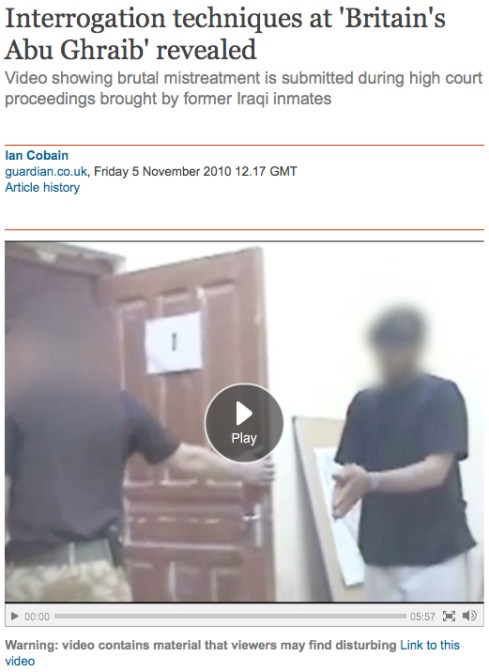
Only last week, I also noted the late to surface reports of US complicity in Iraqi upon Iraqi torture in Samarra.
It seems now we are starting to “see” a more varied picture of violence in Iraq. This is not the images of violence through the lenses of embedded journalists or through the sights of military aircraft, but images/footage of bullying; personalised verbal and physical abuse of men behind closed doors.
Without doubt, the most indelible images of the Iraq war are those from Abu Ghraib; they are the images the world remembers, will always remember.
Likewise, these videos of interrogation and of the uninhibited darker side of standard operations are key to understanding the facts of the Iraq War.
Also read: British troops use torture – even if it is by another name

Left: According to photographer D.K. Langford, this is the Texas vehicle inspection sticker designed from his photograph. Right: This photograph is exhibit A in Langford’s suit vs. the Department of Public Safety and the Texas Department of Criminal Justice. (Source)
At last. I’ve been waiting for one of these legal disputes to have a prison angle! From the My San Antonio News:
“A photographer is suing the state over roughly 4.5 million vehicle inspection stickers that appear to incorporate, without his authorization, an image of a saddle-toting cowboy he created in 1984. Plaintiff David K. Langford wants the court to block the Department of Public Safety from further use or issuance of the stickers, the design of which he says is based on his copyrighted photo, Days End 2.”
“The stickers were produced by state prison inmates under a Texas Department of Criminal Justice (TDCJ) contract with the DPS. […] The suit says Langford’s photo was illegally appropriated by an inmate who scanned it from a copy of Texas Parks and Wildlife Magazine in 1998.” [My bolding.]
Langford, the photographer, seems quite tenacious here. He argues simply that the State of Texas should be more careful about how it sources its images.
I want to avoid the lazy joke about a prisoner “stealing”. It’s just a shame that when prisoners working for the Texas Correctional Industries which is, for some, a form of modern slave labor (I withhold comment), the products of their work are at the centre of a substantial lawsuit.
This story was brought to my attention by Bob, who says, “I guess Texas is always full of unintended ironies.”
The TDCJ refused to comment, and of course there’s no response from the prisoner. I would want to hear from the prison-artist who originally ripped Langford’s image. He ended up producing a nice piece of graphic design!
With 4.5 million stickers in circulation, the prisoner has quite the visible profile. There’s more of a story here. Texas journalists! Get on it.

Tumbling competition, San Quentin Little Olympics Field Meet, 1930. Courtesy Anne T. Kent California Room Collection, Marin County Free Library
Earlier this morning I pointed out the riches of the Anne T. Kent California Room Collection, in the Marin County Free Library Archives. The San Quentin Little Olympics Field Meet 1930 Album deserves it own post.
Any sack race that has contestants cocooned up to their necks is a serious affair (image 2). Any tumble would hurt.
The tug-of-war (image 3) is fought on a remarkably complex purpose-built platform. It unfortunately looks like a rack.
I have no idea what narrative the parade (image 4) carries, but African American inmates donning hessian sacks painted to mimic “primitive” costume and carrying a whiter-than-whiter mustachioed swan-king is particularly discomforting.
Pole vault without a 60 inch crash-mat beneath the bar?
Lots to be said about cross-dressing and gender-bending in prisons, but not to be superimposed upon these 80 year old photographs. Two fascinating images.
And we just had Halloween. Who knew pie-eating contests (last image) produced zombies?
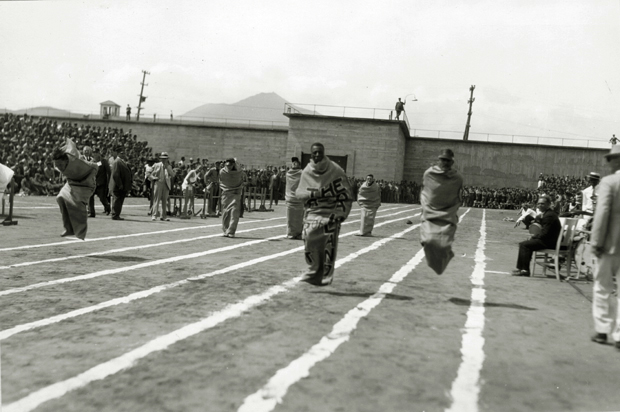
Sack race, San Quentin Little Olympics Field Meet, 1930. Anne T. Kent California Room Collection, Marin County Free Library.

Tug-of-war competition with officials looking on, San Quentin Little Olympics Field Meet, 1930. Courtesy Anne T. Kent California Room Collection, Marin County Free Library

Prisoners in costume parading at the San Quentin Little Olympics Field Meet, 1930. Courtesy Anne T. Kent California Room Collection, Marin County Free Library.
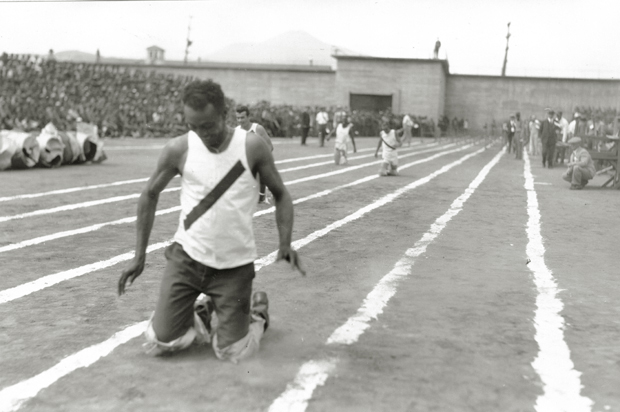
"Fifty-yard crawl" race, San Quentin Little Olympics Field Meet, 1930. Courtesy Anne T. Kent California Room Collection, Marin County Free Library.

High-jump competition, San Quentin Little Olympics Field Meet, 1930. Courtesy Anne T. Kent California Room Collection, Marin County Free Library.

Pole vault competition, San Quentin Little Olympics Field Meet, 1930. Courtesy Anne T. Kent California Room Collection, Marin County Free Library.

Long-jump competition, San Quentin Little Olympics Field Meet, 1930. Courtesy Anne T. Kent California Room Collection, Marin County Free Library.

Clown performance featuring a duck, San Quentin Little Olympics Field Meet, 1930. Courtesy Anne T. Kent California Room Collection, Marin County Free Library.
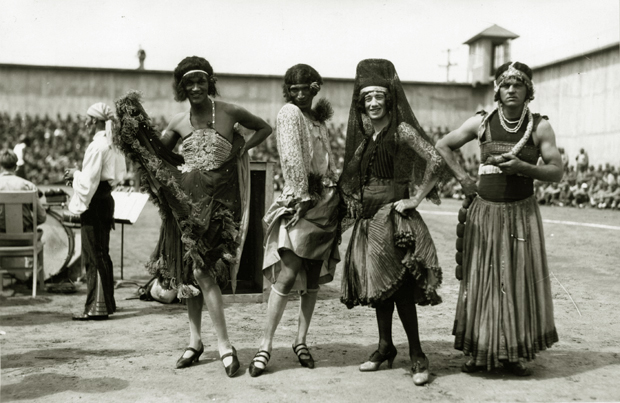
Stage entertainment with four male dancers in female dress, San Quentin Little Olympics Field Meet, 1930. Courtesy Anne T. Kent California Room Collection, Marin County Free Library.

Courtesy Anne T. Kent California Room Collection, Marin County Free Library.

Pie-eating contest showing three participants, San Quentin Little Olympics Field Meet, 1930. Courtesy Anne T. Kent California Room Collection, Marin County Free Library.
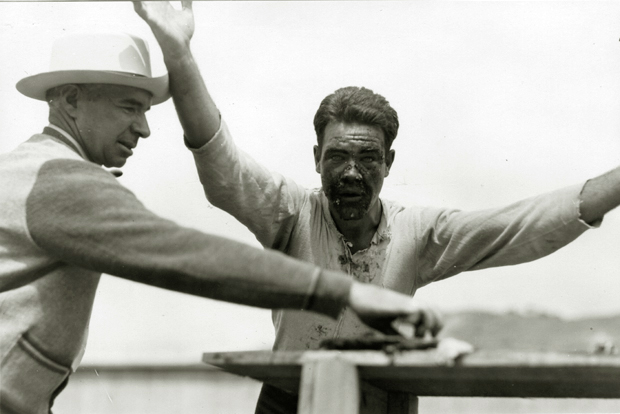
Pie-eating contest (close-up of one participant), San Quentin Little Olympics Field Meet, 1930. Courtesy Anne T. Kent California Room Collection, Marin County Free Library

Golf Five Zero watchtower. Crossmaglen, South Armagh, Northern Ireland, UK. © Jonathan Olley.
Last month, I had a jolly nice chat with a jolly nice chap about what all this means at Prison Photography. Where’s this open journal taking me?
I said if I took this whole thing to the academy, it could be as simple as a historic survey: The Uses of Photography to Represent, Control and Surveil Prison, Prisoners and Publics in the United States (1945 – 2010).
I was encouraged to ditch the historical view and engage the modern. Ask myself, why should anyone care about prisons? Only a small minority care now and that status quo has remained for many reasons tied up in the antagonisms of capitalism. Would a historical survey change minds and attitudes or just lay out on paper the distinctions most people have already made between themselves and those in prison?
Perhaps people would care more if the abuse of human rights that exists within the criminal justice system of America were shown to impinge on everyone, not only on those caught in its cogs?*
What if we consider the methods and philosophies of management used by prisons and identify where they overlap with management of citizens in the “free” society. Think corporate parks, protest policing, anti-photography laws, stop and search, street surveillance, wire taps, CCTV.
My contention has always been that there was no moral division or severance of social contract over and through prison walls. For me it’s never been us & them; it is us & others among us put in a particular institution we call prison.
But, now I am seeing also, there is an ever decreasing division of tactics either side of prison walls. Strategies of management and technologies of discipline perfected in prisons have crept into daily routine.
What has this emphasis on containment and of monitoring – at the expense of education and social justice – done to our society and to our expectations of society?
SURVEILLANCE/CCTV IN PHOTOGRAPHY
And now for the tie in with photography…
Thinking about surveillance, obviously we have the big show at Tate from this Summer, Exposed: Voyeurism, Surveillance & the Camera with its devoted section to CCTV. (Jonathan Olley‘s work from Northern Ireland is the standout.)
But I always think back to Tom Wichelow‘s series Whitehawk CCTV (1999), possibly because he insists it is not a criticism of CCTV just a look at the politicisation of the human subject viewed through its lens.
Most remarkable in the series is the trio of images of the tragic site of a murder. They reveal to us that looking and bearing witness can be an act of respect as much as that of curiosity as much as an act of control. We are all compelled to look, but some observers are recording the feed and have a disciplinary apparatus to back it up.

Untitled (CCTV footage). Young family visits murder site. Brighton 1999. © Tom Wichelow

Untitled. Friends of murdered boy visit the site. Brighton 1999. © Tom Wichelow

Untitled. Resident reveals murder site outside her bungalow window. Brighton 1999. © Tom Wichelow
– – –
*There’s a simple argument that we all suffer because our tax dollars support a broken system that makes us no safer.
Photographer Mohamed Bourouissa asked a friend – known only as JC – detained in a French prison to share the banality of his confinement via cell phones pictures and over 300 SMS messages.
Bourouissa’s exhibition ‘Temps Mort’ (‘Time Out’ or ‘Dead Time’) which closed at the Galerie Kamel Mennour today featured nine images and an 18 minute film montage of the correspondence.
Earlier this year, Algerian-born Bourouissa gained significant attention in the US with his show Périphéries at Yossi Milo Gallery which depicted the lives of youth in the depressed banlieue neighbourhoods on the outskirts of Paris. (Reviews here and here.) ‘Temps Mort’ confirms Bourouissa’s commitment to the underprivileged in French society.

JC and Bourouissa worked together over a period of 6 months. Initially Bourouissa had to instruct JC closely describing the shots he was looking for. Bourouissa broke down the boundary between the imprisoned JC and himself as a free man by filming repeated actions outside the walls on his own camera phone – at one point in the film the JC’s steps on a jail corridor blur into Bourouissa’s steps through snow in the free world. (I concede this blog post cannot come close to describing the mood of the finished video.)
For exhibition, nine pixelated images were blown-up; the degraded resolution mocking the Parisian preoccupations with Impressionism and Pointilism. As Bourouissa’s press release explains, images were hung adjacent to prison newspapers “reconstructing a comprehensive representation of the prison world, and mentally filling in the blanks of the images, the spaces between the bed pan, radio, barred window, lamp, etc.” The viewer sees the abnormality of confined life.
We should bear in mind that in 2008, Bourouissa and JC were working against a national debate in France about the appalling state of their prison system. Again from the Temps Mort press release, “How not to express our outrage at the French prisons? Their infamous exercise cages, their areas of lawlessness, their unhealthy showers and four rolls of toilet paper monthly.”

Gleaning available information from poorly translated sources (1A, 1B, 2A, 2B, 3A, 3B, 4A, 4B), I am still not sure how the images were secured. Reviews suggest that cell phones are banned within French prisons – which I would expect to be the case – so the feat seems even more remarkable. (I have detailed a short-lived case of cell phone photography behind UK bars.)
Whatever, first impressions may offer, Temps Mort is not a lazy presentation of “vernacudigi” photos. In many of his projects Bourouissa wants to “make the illegal legal”. Just as with Peripheries he gives over much of the creative process to his subjects. Many images for Peripheries were staged simulations of actual events experienced previously by the photographer and subjects. After a period, Bourouissa gave JC very little direction and their output synchronised. Alone the photographs would fall short, but Bourouissa always intended to pair them with the film.
Of course we should not miss the obvious here. Low-res imagery is associated with the spontaneous capture of event, with protest, with skirmish, with citizen documentation and more often than not with the testimony of the individual against the (violent) uncertainties of the State in which they exist.
Low-res is about the privilege of witness beyond any inherent privilege of existence. Romantically, low-res photography is thought of as a tool for use against dominate conglomerate forces; practically low-res photography is the evidence of the effects of those forces.
Bourouissa presents the incarcerated masses as the disenfranchised and the dispossessed.
MOHAMED BOUROUISSA
A student at le Fresnoy, Mohamed Bourouissa graduated from the National School of Decorative Arts and also holds a DEA (M.A.) in Plastic Arts from the Sorbonne (2004). He recently benefited from a solo exhibition at the Finnish Museum of Photography in Helsinki and has participated in numerous group exhibitions, most notably at the New Museum in New York. In 2010, the artist will show his work at the Berlin Biennial and at Manifesta. Born in Blida, Algeria, in 1978. Lives and works in Paris. Represented by gallery Les Filles du Calvaire, Paris / Brussels. (Source)

via Vingt

Anonymous Mexican Men photographed in Altar, Mexico, 2006 © Chris Floyd/Getty Images
Photographer, Chris Floyd was shocked to find one of his photographs depicting three Mexicans IN Mexico from a 2006 editorial assignment being used by Republican candidates Sharron Angle (Nevada) and Sen. David Vitters (Louisiana) for “reds under the bed” scare-mongering TV campaign ads.
Floyd doesn’t know how the Angle and Vitters campaigns acquired the image. It’s feasible they did so legally via Getty Images. But if that were the case why would they ignore the lengthy caption detailing the non-illegal status and circumstances of the three men?
Floyd provides the full caption included on the Getty site:
“ALTAR, MEXICO: Mexicans pose for a portrait whilst gathered in the town square of Altar, Mexico. Altar is located 40 miles from the US border and is the last major town that Mexicans reach before the dangerous crossing. Much of its economy is dependant upon these congregated Mexicans who can purchase numerous necessary provisions. The Minutemen, most of whom are white, retired, armed citizens devote much of their time to musters or vigilante border watches in the Arizona desert, preventing Mexican illegal immigrants flooding into the US. These Minutemen, who claim to simply watch and report to the border police, have received criticism for being a cover for white supremacists whilst others hail them as heroes. Either way, they have struck a cord with many Americans who sympathise with their mission to make an impact on the illegal immigrants that are flooding across the Mexican border at a faster rate than ever. It is estimated that around 750,000 illegal immigrants entered America in 2005, amounting to more than 2000 per day, joining the 12 million that already live there. (Photo by Chris Floyd/Getty Images)”
More from WaPo here.
American Suburb X republished an Art Voice interview with Bruce Jackson.
Bruce Jackson is one of the greats of prison photography, up there with Danny Lyon, Deborah Luster and Alan Pogue.

Jackson: “The people who are in penitentiaries are no different than the people outside, except that they’ve done a certain thing that got them classified as the kind of person that goes to the penitentiary. But they’re in a penitentiary, and being in a penitentiary does something to people. It puts you in a position. All the things that Foucault writes about—about power and what it does and the way it’s used—are there. Prison is a place where power rules. Prison is about power; if it were not, people would walk out the gate. You see it in the way people walk and in people’s faces and the way they present themselves.”

 Prison Photography