
You are currently browsing the category archive for the ‘Institutional’ category.
Words
Prisoners All posits that we are all severely impeded, individually and as a community, because of bad politics, poor policy and family devaluation. The posts are really well composed.
The anonymous author – by the pseudonym of Zebulon Brockway – has “worked many years in [California] prisons, and worked many years in journalism” and believes “much written about prisons is misleading at best and wrong at worst. The false impressions and false information are not helpful to public discourse”.
Moving Images
John Malsbary contacted me at the start of the Summer to tell me of his new venture Prison in Cinema.
John’s moving across a country at the moment. His few posts suggest he’ll be worth watching. John brought to my attention the film The Jericho Mile made on location at Folsom State Prison in 1979. Anthony Friedkin photographed Folsom convict portraits twelve years later. Mann’s directing and Friedkin’s shooting share in visual dialogue.

Four Convicts, Folsom Prison, CA. Anthony Friedkin. 1991. Silver Print. 16 x 20 inches.
Reading
Governing through Crime; WA State Library; Grits and Bid’ness in Texas; and Ben Gunn (Serving prisoner) and John Hirst (Released) in the UK.
Followed LEAP’s twittering and other ones …
Stats
The Dallas News reported the ‘Circumstances, Evidence, Problems and Outcome’ of five cases of arson in Texas under re-examination. That includes the Cameron Todd Willingham case. (via The StandDown Project)
‘A Paperclip and a CD’
Matt Kelley at Change.org had a well reasoned rallying call for support of prison book programs. Take Action.
Edmund Clark
A favourite of mine. Since recommended by Nathalie Belayche. Colin Pantall (recently back from a summer blogatical) and LensCulture showing Clark‘s new prison series, ‘If the Light Goes Out: Home from Guantanamo’.
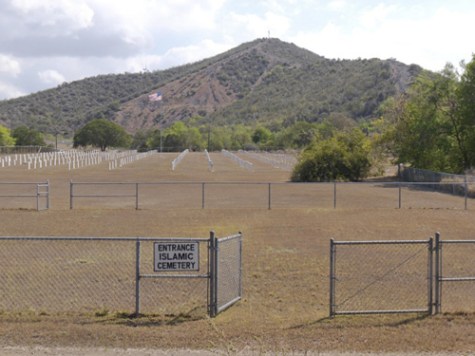
Naval Base Cemetery by Edmund Clark
Naval Base Cemetery (above) is not typical of the project. It is outside. ‘Home from Guantanamo’ uses the same detailed look at everyday institutional and domestic objects in their place. I don’t think it is as successful as ‘Still Life: Killing Time’, as I don’t think this approach lended itself as well to the War About Terrorism as it did to the Geriatric E-Wing of Kingston Prison, Portsmouth. ‘Killing Time’ is best viewed as a slideshow with Erwin James’ commentary.
Reciprocity Success
And finally, thanks to Stan for his coordinations and libations. Stan recommends Courthouse Confessions, as do I.
Jolted by photographs from this ludicrous Alcatraz Hotel in Kaiserslauten, Germany I recalled an article about prisons & jails converted to tourist accommodations. I guess it makes sense to convert solid and culture-worn stone fortresses into chic hotels such as at the Charles Street Jail/Liberty Hotel, Boston (it seems a shame to waste all that cool masonry) but a prison-theme is downright tacky.
I like the no-nonsense approach of Mount Gambier Jail in Australia which “markets its rooms as budget accommodations for cheapskates and backpackers”. Oxford Castle/Malmaison Hotel in the UK retained the open cell tiers of the prison, just adding some mood uplights for the new plastered ceiling.

Here’s an article on “Slumber Slammers” which points to the larger tawdry scene of architecture-as-theatre for those wantaway tourists whose appetite for the early 21st century now fails them.
Not to be outshone, the Japanese go the farthest in recreating the prison-spectacle with handcuffs, dungeon-krunk, lethally injected cocktails and salads that refer to incest?! Don’t quite understand the link for that last one …
I’d like to begin a discussion here about recuperation, but that is presuming there was ever an element of resistance or meaningful political opposition from these various sites. All we can say for certain is the current histories of these spaces are gradually erasing those of the past.
Two things today. First an important debate. Second my own reflections and housekeeping.
debate
Ben Chesterton at DuckRabbit has had ongoing discussions with MSF / Medicin Sans Frontier / Doctors Without Borders for many months (years?) about the use of media and the fine line between MSF’s promotion of aid work and fair representation of the peoples they work with. Duck has opened a worthwhile debate with Pete Masters of MSF on the duckrabbitblog with regard this new MSF advertisement.
Feel free to add your comments over on Duck’s blog. I know Ben will appreciate and we should all benefit, right?
house keeping
In absolutely no way related – AND, I encourage you not to presume the fictional scene in the MSF ad as one set in Africa – I’d like to return to an image I featured on Prison Photography in December.

The image is by Tim McKulka. The caption reads: The container which serves as a detention facility as human rights and protection officers make an inspection of the capacity of police and prison service. UNMOs from Torit team site were engaged in a long range patrol to Chukudum along with various civilian sections of UNMIS in order to assess the security and social conditions of the area.
Last night, I had the great privilege of attending a YPIN World Affairs Council presentation by Tim McKulka and his partner Anyieth D’Awol about Human Rights in Sudan. There were a few thing that I took from the talk:
1. The problems in Darfur are very serious, but Darfur is not the only conflict in Sudan
2. Things are better now than they were one, two or three years ago – if you measure better by fewer deaths.
3. The predominant source of unrest in the Sudan always stems from the growth of the capital, Khartoum, at the expense of the periphery.
4. Since independence from the British in 1955, Southern Sudan has never known stable or benevolent governance (Civil wars raged from 1956 – 1975; and then from 1982 – 2005). The first war was settled with the drawing of a new boundary between North and South and newly provided autonomy. The second war began because rich reserves of oil were found within the territory of South Sudan and consequently Khartoum and the North reneged on the agreement, grasped for the wealth and resorted to aggression.
5. There exists to this day tribal conflicts in the central areas of contested lands, particularly Aybei where much of the oil reserves lie.
Needless to say the talk was humbling – Tim and Anyieth successfully gave a summary of culture and politics across the entire country, covering the last 60odd years. No small achievement!
I wanted to finally pin down some background to the image and so I asked Tim, “What is that container assemblage exactly?” His response,
It was in a place called Chukudum in southern Sudan, East Equatoria State and it shows that there is no other place to put prisoners. There are crimes being committed but there is no justice, no security; no security sector. The police don’t have guns, or cars, or transportation. They don’t have communications. So the container is what people are left to use when they have prisoners. What else can you do with them?
Tim has followed much of the peacekeeping and reconstruction work in Sudan. This has involved shadowing the training of new prison officers and the establishment of new institutions for juvenile justice. I hope to follow up on this with more involved comments from Anyieth as she, as a human rights lawyer, has far more knowledge in the area … and Tim deferred to her experience.
Here’s Tim’s portfolio Faces of Sudan.
Tim McKulka has been working as the senior photographer for the United Nations Mission in Sudan since September 2006. Prior to that, he was based in New York covering national and international news as a freelance photojournalist for Polaris Images. He graduated with a fine arts degree in photography from the School of Visual Arts in New York. His work has been featured in numerous national and international publications including The New York Times, Christian Science Monitor, Italian Vanity Fair, The Washington Post, and Time Magazine.
Anyieth D’Awol LLB, LLM is an independent researcher working in Southern Sudan. She has worked for the United Nations Mission in Sudan (UNMIS) as a Human Rights Officer. She also worked for the Joint Donor Office as a Policy Officer. Anyieth was a Senior Researcher for the Presidential Advisor on Gender and Human Rights with the Government of Southern Sudan, focusing primarily on sexual violence and human rights issues and the military. She is the founder of a civil society organization providing underprivileged women and girls opportunities for sustainable income through arts and crafts while creating opportunities for capacity development in literacy and numeracy, and providing information on HIV, gender and human rights issues.

California Institution for Men, Chino, CA. August 2009 riot aftermath. Credit: CDCR
THE OFFICIAL
The California Department of Corrections & Rehabilitation (CDCr) filled the visual hole left by the absence of press photography. I discovered via the CDCr Twitter stream that it had a Flickr profile and more than 72 hours after the event published these images. I use them throughout this post.
THE UNOFFICIAL
I was also contacted by a friend who also happens to have worked in CDCr facilities, is a PP guest blogger and now qualified fact-checker!
He was able to offer some clarification, correction and background on the physical environment at Chino and the CDCR desegregation policy that news sources and I referred to as a factor in the heightened racial tensions. Read on.
Spatial Orientation
The CDCR picture used in the original post shows only the minimum [security] facility at California Institution for Men (CIM). From the picture’s POV, the entire Reception Center infrastructure is behind you. That’s where the riot happened. Nothing happened anywhere in the area pictured.
The large building in the foreground is the administration building for the entire prison. The large building directly behind it is the prison hospital – yes, this is one of the rare prisons that actually has its own hospital. To the right of the hospital is the main walkway toward the back end of the minimum facility and in that upper left corner is a Substance Abuse Program yard with its own dorms and programming facilities. The large baseball field is considered the main yard.

California Institution for Men, Chino, CA. Credit: CDCR
Implementing CDCR Integration Policy
The integration/desegregation issue has not been raised or put into effect in any prison except two – Mule Creek State Prison (MCSP) in Ione and Sierra Conservation Center (SCC) in Jamestown. These were the so called pilot programs for housing integration.
Like all things in CDCR, the reality is not what you think. These two prisons were chosen because they would seem to cause the least possible problems. MCSP is entirely SNY (Sensitive Needs Yard) with only a few hundred general population inmates in a separate minimum facility, and that’s designed for support of the prison itself. Inmates from that population work in administrative areas as clerks, porters, landscapers, etc. Some are sent out to work in local parks, on roads, etc. And some are bussed each day to the training academy for officers in Galt. Almost all of them are within a year or two of release and aren’t interested in getting into any trouble. Anyway, the three SNY yards house about 3600 inmates (1200 on each yard), and they are all in cells and already fully integrated because they are SNY. (Those not in cells are in badly overcrowded gyms and dayrooms.)
Many on the Mule Creek SNY yards, about 1500, are rated EOP mental health inmates (enhanced outpatient program – the most serious level of mental health programming). Virtually all of those are on psychotropic drugs of one sort or another and are essentially in la la land most of the time. Another several hundred are considered CCCMS (correctional clinical case management system) inmates. Some of those are on drugs, and all are doing some sort of mental health programming (support groups, etc.). There is a mental health staff there of about 150 people. Anyway, inmates in this prison are already quite docile and have been de facto integrated for a long time (since it was made SNY three or four years ago). They have had no discord around the housing integration issue that I’m aware of.
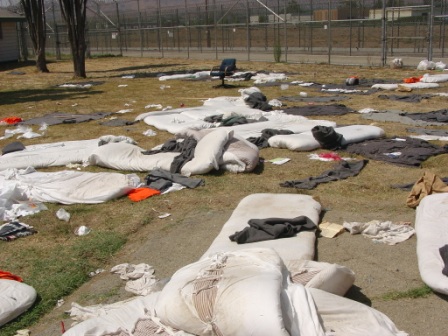
California Institution for Men, Chino, CA. August 2009 riot aftermath. Credit: CDCR
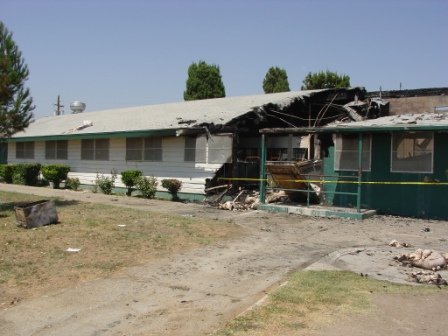
California Institution for Men, Chino, CA. August 2009 riot aftermath. Credit: CDCR
Now, Sierra Conservation Camp (SCC) is a different situation. Half of that prison is a [lower security] 3-level SNY facility, and integration in that half is no issue. [But] the general population side of the prison is a different story.
There is a 1-level yard with about 1200 inmates in dorms. An identical 2-level yard is next to it. The mission of these yards is to train inmates to be firefighters and to staff the small fire camps around the state. It’s hard and dangerous work, but the rewards are substantial. The food in the camps is excellent, and there’s as much of it as you want. The pay is very good (by inmate standards) and some have been able to accumulate a parole nest egg of several thousand dollars. Finally, good time credits mean your in-prison time is as little as 35% of your sentence so you can get out a lot earlier. These inmates are typically not the most violent offenders, although some will have violence in their past. Some are affiliated and active gang members. (On SNY yards there are no active gang members, in theory anyway, because you can’t get to an SNY until you renounce your gang.) The housing integration flies in the face of the gang conventions so it has caused some problems at SCC on those two general population yards.

California Institution for Men, Chino, CA. August 2009 riot aftermath. Credit: CDCR
The CDCR started the integration effort last summer, and it quickly backed off when inmates put up resistance. Summer is not a good time in prison; heat makes violence flare more easily. Also, it’s fire season and the camps must be staffed. So they waited until the fall and tried again. Many dorms had mini-riots as gangs instructed incoming inmates not to comply. There were a couple of yard-level disturbances. The inmates tried refusing to come out of their dorms for a couple of days. They believed the officers would bring food to them as they would in a lockdown situation. When they did not, the stomachs settled it temporarily. Eventually, the administration settled on dealing with the situation by depriving any inmate who refused a bunk assignment of privileges. He would be given a disciplinary writeup and not be allowed phone calls, programming, visits, etc. It is currently this kind of a stalemate.
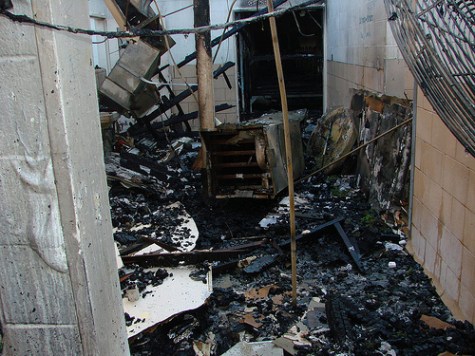
California Institution for Men, Chino, CA. August 2009 riot aftermath. Credit: CDCR
Existing Racial Enmity
One thing that has not been mentioned is the ongoing Black/Hispanic rivalry in the southern half of the state. You may recall in early 2006 there were major riots in the Los Angeles County jails between Blacks and Hispanics. Over 2000 inmates participated, one died and at least 100 were injured. Many men involved in that could be the same people who were at Chino this weekend. Since that part of the Chino prison is a reception center, many inmates were probably local parolees who’d violated. These, and others, would have been through the LA county jail system, probably over the last few years. So this could all be no more than a continuation of the ongoing violence with many of the same people. Who knows!?
I’ve been in those Chino dorms many times and always felt uneasy. Only two officers are assigned, and at any given time one is on the phone or at the door doing an unlock or in the restroom or off on some administrative quest. There is no “gun coverage” as they call it when an armed officer is placed in an elevated position to provide less-than-lethal and lethal force to quell disturbances. As the administrative representative made plain in the interviews, the inmates are really in control. Two officers armed with pepper spray, batons and alarms can be overpowered in seconds. One officer had to be airlifted to medical care from that facility a year or so ago. His partner was doing something and he got hit from behind and they just beat him unconscious. He is extremely lucky he didn’t die; I’m sure the inmates left him for dead. Those dorms are classic World War II era barracks style housing. They would not meet the current standards of prison housing. Actually, they probably would not get any kind of occupancy permit in any municipality in the state.
Conclusion
Finally, a note of purely personal opinion. I believe the CDCR went about integration all wrong. In effect, they asked inmates to integrate. For a year or so prior to the start date, they had meetings with inmates to tell them what it was about and why it was being done. Worst of all, they created a video to sell them on the idea and played it incessantly on the prison TV system. It reminded me of parents who had decided to ask their children to go to school rather than simply telling them to go to school. Inmates are like children, and psychologically, they respond like children. If the administration had simply told them the courts were ordering integration and on a certain date it was happening, I think they would have had less trouble.
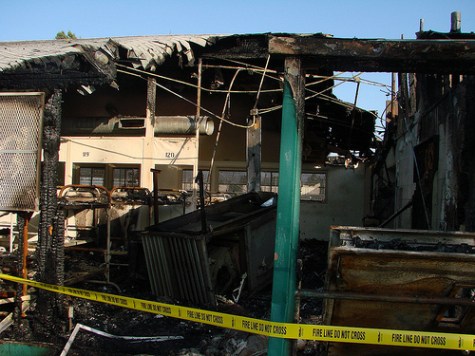
California Institution for Men, Chino, CA. August 2009 riot aftermath. Credit: CDCR
Here’s the official CDCr press release update (11th August)
____________________________________________________
Editor’s note: ‘Sensitive Needs Yards’ (SNY) can be understood, essentially, as protective custody areas. They were conceived seven years ago to accommodate the following populations;
1. Guys who had dropped out of gangs. And you have to go through a six-month to one-year deprogramming that includes telling everything you know about the gang and its activities.
2. High notoriety inmates – ex-cops, celebrities, etc. For example, Tex Watson, the Manson family murderer is at MCSP. Phil Spector is on an SNY at Corcoran.
3. Sex offenders.
4. Mental health inmates.
5. Old and infirm people who are still ambulatory.

The Sybil Brand Institute for women, Los Angeles. Photo Credit: LA County Arts http://www.lacountyarts.org/civicart/01_First_District/1_ela_s_sbi_ppdt_davis.htm
The fixations of Prison Photography on the infrastructural order of sites can as easily be applied outside of carceral space. The Center for Land Use Interpretation has terminus container ports, petrochemicalscapes, first responder training sites, landfill waste streams, pacific coastlines, nuclear proving grounds and even the Trans-Alaska pipeline covered by roving reconnaissance.
There is even a brief field report from the Angola Prison Museum, but I’ll have to come back to that.
I’d like to present the archive for the CLUI’s 2001 exhibit, On Locations: Places as Sets in the Landscape of Los Angeles.
Have you ever questioned the fabric of prison environments in TV or film? There were plenty prison (visiting room) scenes in The Wire, but I was too engrossed in episodes to pay the backdrop any mind. Well, this should get you thinking.
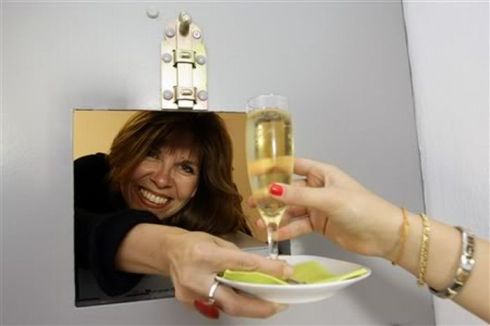
Filming in active prisons is generally not permitted for obvious reasons, and as a result, prison sets are built in soundstages, back lots, and inside other locations. A few prisons in Los Angeles are currently closed, and are regular filming locations. The Sybil Brand Institute, at the County Sheriff’s complex in City Terrace, east of downtown, was the primary Los Angeles County correctional facility for women before it closed in 1997. Though still managed by the sheriff’s department, it is now used exclusively for filming.

Credit: CLUI. Sybil Brand Institute's visiting area has appeared in several films.
Built in 1963, Sybil Brand was a minimum to maximum security facility, with a design capacity of 900, and a peak occupancy of 2,800. It once housed Susan Atkins (whose confessions to a cellmate at the prison led to the arrest of Charles Manson and family), and Susan McDougall of Whitewater scandal fame. When Sybil Brand closed, inmates were transferred to the new Twin Towers complex. The County may renovate the building and open it again as a prison, but in the meantime it offers modern looking prison rooms including cafeterias, hallways, recreation areas, visiting areas, infirmaries, and cells from solitary confinement to dormitories. As it was a women’s prison, the interior walls have a pink color, which is usually painted over for filming.
Productions film here at a rate of two or three per month. The film Blow, about cocaine dealers, recently spent five weeks shooting all over the prison. Other productions include Arrest and Trial, Gangland, X-Files, and America’s Most Wanted.
Though older and more run down, the City of Los Angeles jail in Lincoln Heights is also closed, and is used regularly as a film location, appearing in NYPD Blue, Unsolved Mysteries, and other film and television projects.

Mel Melcon / Los Angeles Times. VISITING ROOM: L.A. County Sheriff's Deputy Jack McClive peers through safety glass, while standing in the visiting room, during a tour of the Sybil Brand Institute Women's Jail in Monterey Park.
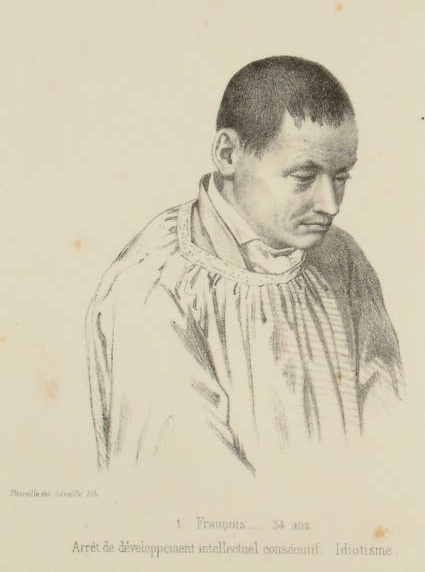
"Francois. 34 ans. Arret de Developpement intellectuel conscentif. Idiotisme." From ‘Traites des Degenerescences', by Morel (1857)

Green Hill, 2000 (C) Steve Davis
A couple of comments that have blown me away in the last 24 hours.
Convergence
From Patrick McInerney;
The similarity between Steve’s photographs and the scientific studies of psychiatric inmates the mid nineteenth century asylums is striking. (For a particularly good example see pictures of psychiatric inmates in Benedict Augustin Morel’s 1857 ‘Traites des Degenerescences: physiques, intellectuelles et morales de l’espèce Humaine’
And its interesting that they have a similar effect today as the early images did in the past, i.e. they encourage us to read the prisoner’s “true” character in their faces, with all the difficulty that incurs. It was obviously not Steve’s intent to mimic 19th c. scientists but maybe its quite understandable he feels that the style has become a bit jaded … it has after all been around for some time!
Steve was jaded not only by the limits of the portrait to communicate but also by the disconnected agendas viewer brought to his works, “People respond to these portraits for their own reasons. A lot of the reasons have nothing to do with prison justice. Some of them like pictures of handsome young boys; they like to see beautiful people, or vulnerable people, whatever. That started to blow my mind after a while.”
It is a serious issue within photography that we are all lazy viewers. The less curious and less open we are, the more likely we are to fall back on pleasing, self-affirming bias.
Memory
Three months ago I posted some images of the Prison Ship/Torture Museum, The Success

Wooden Coffin / Wooden Maiden / Iron Maiden?
Today, I received this;
I believe it was around 1944 that a prison ship, maybe it was The Success came to Cleveland Ohio at Lake Erie. I remember seeing the torture devices and one sticks in my mind to this day. I was told it was called the ‘Iron Maiden’, but your photos call it the ‘Wooden Coffin’.
Although I saw it as a child the memory stays with me to this day.
Age following age has propagated its own fascination with the macabre and majority-assigned human defect. From “scientific” research to childhood memory the will to understand difference has played out (and continues to play out) the shifting – and ultimately false – parameters of normal.

Jenn Ackerman
Larry Chandler, Warden of Kentucky State Reformatory, La Grange, KY
Jenn Ackerman

This year, more than 700,000 people will be released from prisons and jails in the U.S. and more than half of them suffer from some form of mental illness. (Source)
A few months ago I wrote to Jenn Ackerman, praised her Trapped project and of course offered to promote it. I wanted to get at her stories behind the images – namely do an interview. Jenn, however, is as good a promoter as she is a photographer.
The list of questions I wrote out while eating my chili-verde burrito on Wednesday are made largely redundant by her blog post “Trapped: Questions Answered”. Her photography and multimedia is so strong that it also speaks for itself. There is a painful truth in her work; more questions than answers.
I have plenty material to give you a thorough summary of Jenn’s work.


Firstly, allow me to give a run down of the current situation of mental health care provision in America’s prisons and jails.
A 2006 report by the U.S. Department of Justice shows that the number of Americans with mental illnesses incarcerated in the nation’s prisons and jails is disproportionately high. Almost 555,000 people with mental illness are incarcerated while fewer than 55,000 are being treated in designated mental health hospitals. That is inadequate provision.
555,000 represents, at the very least, 16% of inmate populations of state and local jails. I would contend the figure is higher – well above 20% – but this is only my personal belief.
If these numbers are not shocking enough, one must consider the pressures the prison system – in and of itself – exerts on the mental health well-being of those incarcerated by consequence of the increased reliance on solitary confinement to control populations, unqualified staff (especially in private prisons), overcrowding, institutional violence, lack of volunteer programming and engagement (in remote facilities) and the inadequate/unconstitutional general health care provided in states such as Ohio and California. California Department of Corrections has been the subject of a high profile federal lawsuit for the short comings to provide suitable care. (Incidentally, the $1.9b figure quoted in the linked article used to be $6b, until Schwarzenegger rejected it … and there is a serious threat it will be nothing if California cannot sort out its budget disaster).
In prison systems with such endemic problems, it is those who have no way to advocate for themselves who suffer most. Jails have effectively become America’s defacto mental institutions; they house a larger volume of mentally ill people than all other programs combined.
Against this backdrop, Ackerman went to work.

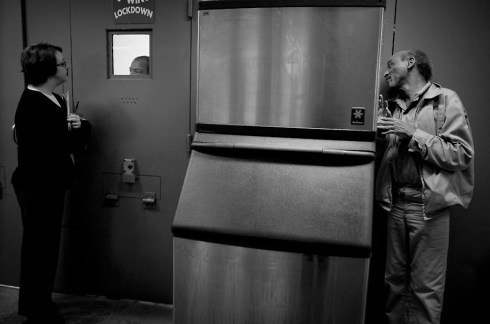
Prison Photography is keen to unveil the means by which photographers, anyone, can gain access to prisons to engage with the “invisibles” of society. In that spirit I quote Jenn;
How did you get access to this story?
I had done a lot of research and had decided on the story I wanted to tell when going to talk to the warden. I always feel that a an in-person visit is more beneficial. — I can better express my passion and excitement for this story. I had called a couple of prisons days before I called the Kentucky State Reformatory and to no surprise they didn’t respond to my messages. But then I came across a wing that was dedicated to mental illness in a prison. Warden Chandler answered on the second ring. This caught me off guard but got it together enough to tell him what I wanted to do. He said I had a lot of work to do before I could start on the project but that he might be interested. I sent a proposal days later and asked to come visit the reformatory to talk to him in person.
How did the warden and officials respond to the project?
I didn’t know how they would respond at first. But I also knew that the warden and everyone involved wanted this story to be told. I was very honest with everyone from the beginning. I told them that I knew that they were doing something to acknowledge mental illness in prisons which hasn’t happened in every state but that I also knew that the program was not perfect. I told them that was going to be my approach. So from the beginning they knew that I was not going to make them look bad but also wasn’t trying to say that they have the final answer to this issue. But I visited the warden the day before I published it on my site to get his reaction. He loved it and thanked me for creating an honest portrayal of the mental illness in prisons. I told him that was the best compliment I could ever get.
There can be no doubt that Jenn was lucky to find Warden Chandler who was so sympathetic to her objective and realised the importance of the project.


Jenn has explained that she spent a total of 10 weeks on the project, including 10 days of still and video shooting. Her time commitment is reflected in the comprehensive coverage. Trapped is a dark bubbling cloud of stories and troubling images that are weft with human emotion, the occasional reprieve but predominantly the collision of lives – lives that orbit tormented psyches that a punitive world of reinforced doors & service hatches cannot soothe.
Jenn’s commitment is epic. Besides the Trapped feature film, Jenn breaks the project into a series of presentations. Firstly, the In Their Corner short about the inmate watch. Secondly, In Their Minds a series of seven film shorts allowing individual inmates camera time to represent themselves. Trapped is segmented into six photography galleries; each one a captivating photo-essay in its own right. I cannot over-emphasise the sensitive depth with which Jenn has documented the incidents on the Correctional Psychiatric Treatment Unit (CPTU) at the Kentucky State Reformatory. Jenn also provides an extended essay about her own response to the CPTU environment.
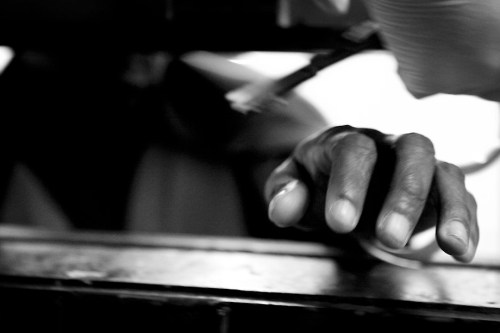

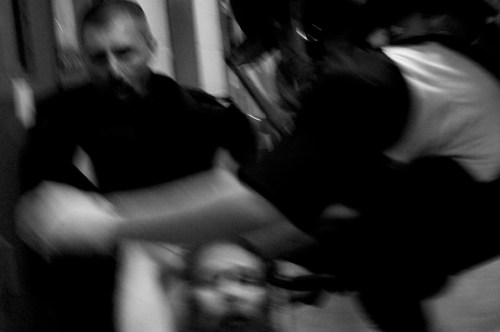
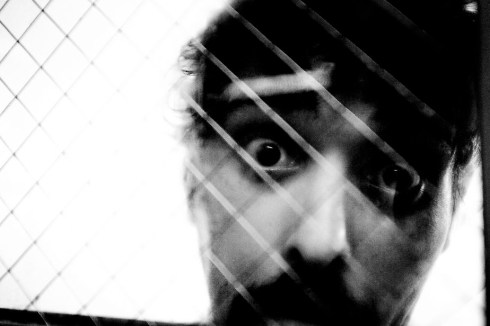
Jenn interviews for 25 minutes at Multimedia shooter. The audio is wobbly and distorted but the information is valuable. Check out from 21 mins. onward to learn of the administration’s response.
Trapped: Mental Illness Inside America’s Prisons has deservedly received acclaim from burn magazine, 100 Eyes, Verve Photo, the White House News Photographers Association (honorable mention), Inge Morath Foundation and CPoY. Jenn recently won an internship at the New York Times.
Jenn credits her students for much of her inspiration. Check out Jenn’s class website for more details.
The illicit manufacture of tools by prisoner piqued Marc Steinmetz‘s curiosity. He called around German prisons to inquire if they were still in possession of particularly ingenious contraband tools and escape devices.
Santa Fu, Celle, Wolfenbuttel and Ludwigsburg prisons all welcomed Steinmetz to view their collections. (The historical objects of Stammheim and Hohenasperg prisons were part of the Ludwigsburg collection.)
Steinmetz’s photographs were used in a German magazine editorial, but I have seen similar series of object types displayed as fine art.
When photographers set up objects (food, seeds, dead birds, insects, fish, etc) it is usually to draw extended attention to common characteristics and impose drama upon ‘the ordinary’. Against a white backdrop and removed form the clutter of daily life, it is intended that these objects can (if only briefly) transcend their functional purpose and be appreciated within the discourses of beauty and/or high art.
Steimetz wanted to highlight the ingenuity and intelligent design of these objects, and I’d like to do the same.
I have included some weapons here and omitted others. I deliberately omitted crude weapons for this post as they are hardly novel … anything with any weight becomes a dangerous weapon, right? On the other hand, I included guns and rifles as I never thought they could be manufactured from scratch. I was particularly impressed by the electrical items.
Below are Prison Photography‘s pick of the bunch with Steinmetz’s own captions. Thereafter is a brief Q & A with Steinmetz.

DOUBLE-BARRELED PISTOL This gun was found along with other homemade firearms in the cell of two Celle prison inmates on November 15, 1984. The weapons had been made in the prison’s metal workshop. They were loaded with pieces of steel and match-heads.

TATTOOING NEEDLE made from a toothbrush handle, a ball pen and an electric motor; confiscated in ‘Santa Fu’ prison in Hamburg, Germany. Tattooing instruments are a popular and common source of income among inmates but are banned as ‘illegal objects’ due to the danger of infection (Aids, Hepatitis, etc.).
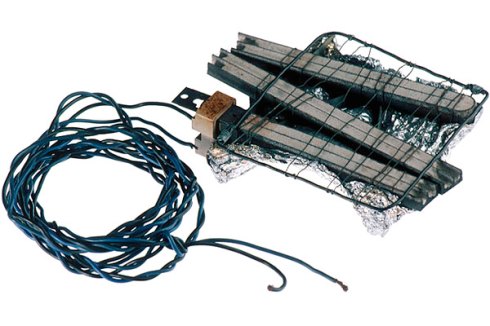
STOVE / GRILL / TOASTER An inmate of Ludwigsburg prison, Germany, botched together this multi-purpose tool from wire, a broken heating rod and some tin foil. It was found in his cell and confiscated sometime in the mid-eighties.

HASH PIPE fashioned from an empty horseradish tube; confiscated in ‘Santa Fu’ prison in Hamburg, Germany. Bongs are the most common of all forbidden items in prisons. The range of materials they are made of mirrors the inmates’ great imagination. And their prior needs.

RADIO TRANSMITTER / BUG made of radio recorder parts by an inmate of Wolfenbüttel prison, Germany (battery is missing). Prisoners occasionally manage to install gizmos like this one in guard-rooms to be prepared for upcoming cell searches. Also suitable as a means of cell-to-cell communication among inmates. A standard radio serves as a receiver.

IMMERSION HEATER made from razor blades; found in a cell in ‘Santa Fu’ jail in Hamburg, Germany. Jailbirds use these tools to distil alcoholic beverages forbidden in prisons. Your typical inmate’s moonshine still includes a plastic can containing fermented fruit mash or juice, an immersion coil of some sort, a rubber hose, and a plastic receptacle for the booze.

RADIO RECEIVER Sometime in the seventies an inmate of Ludwigsburg prison, Germany, built this radio on the sly and hid it inside an encyclopedia. It was probably commissioned by another inmate who had no electronic expertise himself.
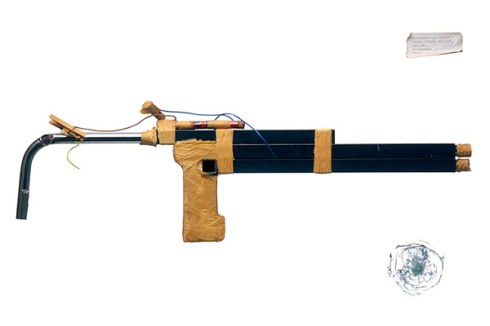
SHOTGUN made from iron bedposts; charge made of pieces of lead from curtain tape and match-heads, to be ignited by AA batteries and a broken light bulb. On May 21, 1984 two inmates of a prison in Celle, Germany, took a jailer as a hostage, showed off their fire power by letting go at a pane of bullet-proof glass, and escaped by car.
________________________________________________________
Q & A
When did you complete this project and why did you take on this subject?
I shot the whole project in April and May 1999. I had read a magazine article about a prisoner in Berlin who had whittled a key to his cell from a toilet seat. Unfortunately, prison officials in Berlin weren’t cooperative, so I wasn’t allowed to take a picture of that key for ‘security reasons’. (Can you believe that?).
But it nevertheless provided the key to the story and got me interested. Süddeutsche Zeitung Magazine editors [provided a catalyst] too – they bought the story.
The objects range in date from the 70s through to the mid 90s and from multiple German prisons. How and where did you source the objects?
Prisons often have a collection of items which were secured from inmates’ cells or after attempts at escape.
I did my research exclusively by phone and located a handful of prisons which seemed worth a visit. I decided then and there which objects to photograph.
Much of your previous photography has been about complex scientific experimentation and grand research. Was this project a departure?
Not at all. I have always been interested in the uncommon or even bizarre.
What about the objects is of interest to you?
Ingenuity of improvisation. Intelligence. Purposefulness.
In my work, not everything depends on meticulous planning, but to a great extent on chance and my ability to improvise. Therefore I can relate to these escape tools. I admire their no-nonsense design, their simplicity. Even if their escape attempts fail, these guys cross boundaries in that they find uses for things other than what they were made for.
What do your photographs of the objects add to the stories objects?
To me, they communicate intelligence and the flexibility of the human mind under adverse conditions. I wanted to share my surprise: ‘What the … ?’
Did this project inform or reflect your understanding of German prisons, prison history and/or current prison politics?
Not really. I wasn’t interested in the political or social aspects of the subject matter. It was an interesting experience, though, to get to peek inside these facilities even though I had no contact with any of the inmates.
To compensate for that and to communicate credibility, I tried to collect as much information about the objects as I could. I felt they should be preserved the same way that archaeological artifacts are.
What are you working on now?
Currently, I am working on an independent project which is called ‘Toter Winkel’. I am still searching for an international title which works both in German and English, even though I focus exclusively on Germany.
I started wondering about what cars have done to our cities. I ended up doing night shots of elevated roads with a 4×5″ field camera. It’s hard to believe what monstrosities have been erected for the sake of misconceived mobility!
But this is more of a long-term fine art project than an editorial piece. Fieldwork is completed, but post-production will take a few more months, I’m afraid.
Thank you, Marc
________________________________________________________
Marc Steinmetz is a photographer specialising in Science and Technology stories. Prison Photography recommends his work on Plasticination, Karakarum – The Archaeology of Genghis Kahn’s Empire and his series on Drinking Water. An extended interview with Marc, is here.

DUMMY PISTOL from blackened cardboard; found on June 23, 1988, in an inmate’s cell in Stammheim prison, Germany, after a fellow prisoner tipped off the jailers. The dummy was hidden in an empty milk pack and was most probably intended to be used for taking hostages in an escape attempt.
________________________________________________________
All images © Marc Steinmetz.
I originally came across Steinmetz’s work at Accidental Mysteries – a blog I highly recommend for its polished curatorial eye of surprising, inventive and humourous human interventions.

 Prison Photography