
You are currently browsing the category archive for the ‘Interview’ category.

In 2007, Jürgen Chill‘s Zellen series won him the European Architectural Photography Prize in the “Favorite Places” category. Awarded every two years since 1995, the international prize is now organized by the nonprofit architekturbild.eV (since 2005). The 2007 jury – chaired by Hans Eberhard Hess, chief editor of Photo International magazine – was impressed by Chill’s strict central overhead perspective and chose four images.
Today, the 2009 prize winners are announced, so it seems like a good time to recall Chill’s intriguing images.
Jürgen Chill’s Zellen photographs are a unique perspective upon prison space. Of all the positions in the cell, this floating light-fixture-eye-view should be the least claustrophobic, and yet, the central (physically impossible) high vantage point is dizzying. How does the camera (let alone cameraman) take up such a position? From here, what is there left to do but fall?
Has Chill has pioneered a new photographic typology? I was fascinated by the order of each work; the order of each cell. I must presume this order is the inmates doing and not the photographers. Chill’s work is labour intensive. The reason he nor the camera falls is because each image is a stitch of over one hundred photographs, captured by a digital SLR mounted on a boom, pressed – facing downward – against the ceiling surface.
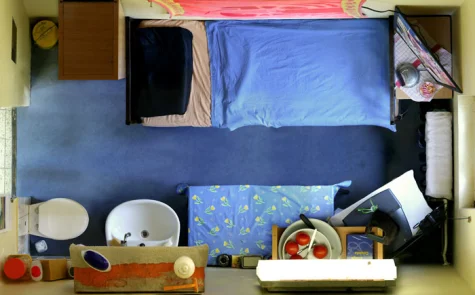
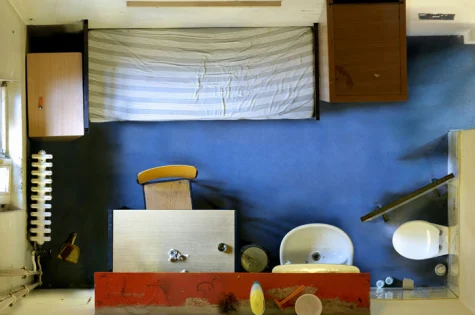

Chill is aware that entering his work in the category ‘Favourite Places’ may seem careless or even cynical, especially as the inmates are not pictured. On the other hand, as he notes on his website, “the barren rooms of the inmates are highly individualized and at least temporary qualify as de facto ‘Favorite Places’.” In 2006 he stated:
A person’s favourite place is a place which can be chosen at will. The person’s freedom is presupposed. Freedom, however, is not granted to all. Those that do not have it must adjust to whatever opportunities exist and strive to create their own place. A cell is perhaps the smallest possible space for habitation that a person can have. Personal and functional items are all accommodated in the tightest space. The spaces are represented as they are found. The Spaces are represented as they are found. The proportions of the photographs mach those of the rooms. All details in the rooms are shown orthogonally from above, nothing has been altered.
________________________________________________________________
I contacted Jürgen via email to ask about the practicalities of making Zellen, and to secure his comments on the series concept.
Jürgen, please introduce your work.
My photographs are most like a map of the prison cells; like a Google Earth view of a landscape. I try to communicate information about the individuals that have to live in perhaps the smallest possible space for habitation that a person can have – without showing this person himself. Personal and functional items are all accommodated in the tightest space.
I’m interested in how a person arranges personal and functional items in their small cell. And what kind of person can it be [based upon the visible evidence]? Is it possible to get a “picture” of a person by having a view of his private space? It’s a view and perspective that you normally would never get of these cells. So it is not really “real”, more a scenery set or something similar.


Where are the cells?
The are all in Germany in big cities in the area of Nordrhein Westfalen.
Are the photographs made in the same institution?
I made 16 photographs in 6 different prisons in the cities of Bochum, Hagen, Duisburg, Gelsenkirchen, Essen and Geldern
Where were the prisoners when you took the photographs?
I had a short conversation with the prisoners in their cells; explained my project, my concept and my motivation. Some of them were really interested in my work and my kind of photography. The prisoners allowed me to spend about 45 minutes alone in their cells, while they are waited outside, in the alleyway, guarded by one or two persons from the prison.
After my work, for their permission to photograph and publish their private things and space, I gave them a small gift; a packet of coffee or cigarettes. Later I sent them all the photograph of their rooms. Some of them asked for it to have as a kind of souvenir for when they are released from prison.
How long did set up take and what equipment did you use?
Just to photograph takes about 30 minutes. With the test shoots and everything it takes about 75 minutes in one cell. The main work, the montage to one photo takes about one week. So it took a long time to make the photo series. You can see how the images were made in the youtube clip of this German television show from October, 2007.
Does the collection and order of all worldly possessions in a single space fascinate you?
It’s the combination of personal and functional items in a small space. First, the cell must contain all the functions of a house in one room: bedroom, toilet, living-room, store-room and sometimes a kitchen. Then the prisoner combines it with his personal possessions and create his private space in about 8 square metres. How does a person arrange such a small space with personal items so that it [also] keeps its basic functions ? And that arrangement exists for years. So my photographs try to draw a picture of an individual person.

Americans, in particular, are starting to realise that they must use/waste less petrol, possessions, energy, space and give up personal largess for the benefit of community. Does the modesty of the prison cell appeal to you? Do future modes of living relate to the cell?
For me, as the artist and maker of these photographs, my intention is not to call out [to people] to give up personal largess for the benefit of community or for other kinds of social and political attitudes or activities. I just want to show the state of things in the visual of photography and try to show these things in an unusual perspective or context. Just to ask questions about it and not to give answers. That’s the viewers job.
Would you put your images into a history of visual culture that represents humans under duress and finding humanity in the smallest places/between the cracks? Or, is the Zellen series a totally modern piece, completely divided from historical context?
About historical context: I think every art work (the good ones) can not be divided from cultural and historical contexts. The Zellen series, and the new photographic series of whorehouse rooms, which I’m now working on, tells us about situations and the state of things now.
But the contemporary associations of now ( the “Zeitgeist” ) result from the past. The series Zellen was shown in a large exposition about prisons, CUSTODY/SPACES OF SURVEILLANCE in the Summer of 2008 in Frankfurt, Germany. The photographs were shown there in the historical context of humanity under surveillance; within imprisonment and [in the context of] prison architectures.

________________________________________________
Thanks to Jürgen for his kind help and time in piecing this article together.
All Images © Jürgen Chill.
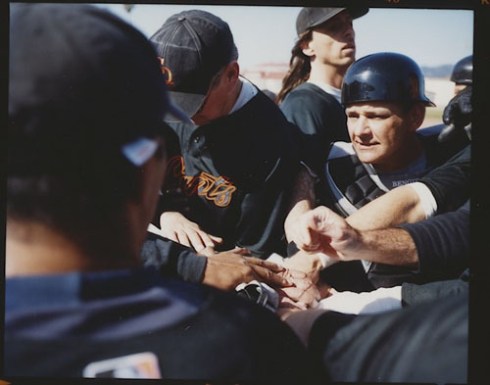
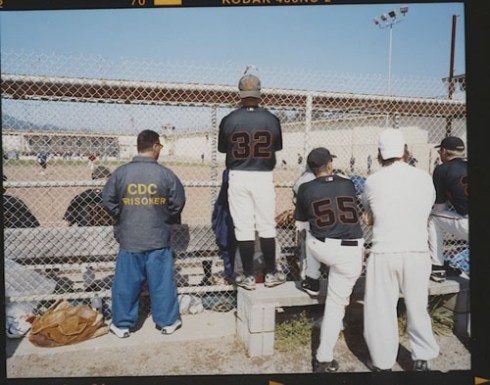
Last week, I threw up a quick post featuring Emiliano Granado’s website images of his photographs of the San Quentin Giants. Here, Granado shares previously unpublished contact sheet images, his experiences and lasting thoughts from working within one of America’s most notorious prisons.


What compelled you to travel across the US to photograph the story at San Quentin?
This was actually a magazine assignment for Mass Appeal Magazine. However, the TOTAL budget was $300, so it really turns out to be a personal project after the film, travel expenses, etc. So, the simple answer to the question is that I’m a photographer. I’m curious by nature. Part of the reason I’m a photographer is to study the world around me. I like to think of myself as a social scientist, except I don’t have any scientific method of measuring things, just a photograph as a document.
With that in mind, it would be crazy of me to NOT go to San Quentin! I’d never been in a correctional institution but I’ve always been fascinated by them. If you look through my Tivo, you’ll see shows like COPS, Locked Up, Gangland, etc. I was also a Psychology major in college and remember being blown away by Zimbardo’s prison experiment and other studies. Basically, it was an opportunity to see in real life a lot of what I’d seen on TV or read in books. And as a bonus, I was allowed to photograph.

What procedures did you need to go through in order to gain access?
I was amazed at the lack of procedure. The writer for the story had been in touch with the San Quentin public relations people, but that was it. There was plenty of other media there that day. It was opening day of the season, so I guess it made for a minor local news story.
I’m pretty sure SQ prides itself in being so open and showcasing what a different approach to “reform” looks like.
It is my opinion that San Quentin is one of the best-equipped prisons in California to deal with a variety of visitors. Did you find this the case?
Definitely. Access was very easy. They barely searched my equipment! Parking was easy. I was really surprised at how easy and smooth the process was. Not to mention there were many other visitors that day (an entire baseball team, more media, local residents playing tennis with inmates, etc).
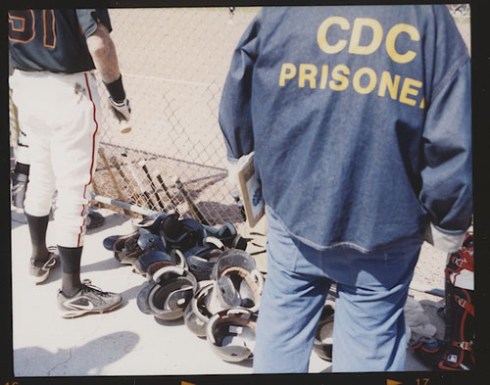

Did your preparation or process differ due to the unique location?
Definitely. I usually work with a photo assistant and that couldn’t be coordinated, so I was by myself. I packed as lightly as I could and prepared myself for a fast, chaotic shoot. Some shoots are slow and methodical, and others are pure chaos. I knew this would be the latter.
One thing I didn’t think about was my outfit. SQ inmates dress in denim, so visitors aren’t allowed to wear denim. Of course, I was wearing jeans. The officers gave me a pair of green pajama pants. I’m glad they are ready for that kind of situation.
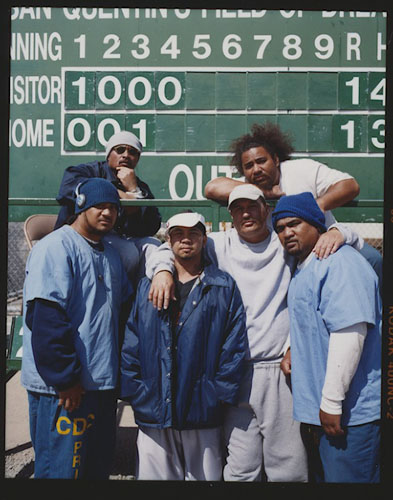
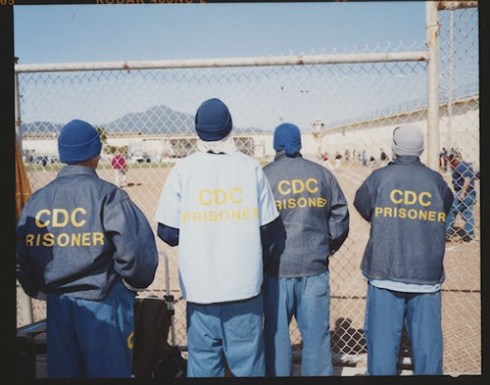
You are not a sports shooter per se. You took portraits of the players and spectators of inmate-spectators. How did you choose when to frame a shot and release the shutter?
Correct. I’m definitely not what most people would consider a sports photographer. I don’t own any of those huge, long lenses. However, I photograph lots of sporting events. I think of them as a microcosm of our society. There are lots of very interesting things happening at events like this. Fanaticism, idolatry, community, etc. Not to mention lots of alcohol and partying – see my Nascar images!
Hitting the shutter isn’t entirely a conscious decision. That decision is informed by years of looking at successful and unsuccessful images. It’s basically a gut instinct. There are times that I search for a particular image in my head, but mostly, it’s about having the camera ready and pointed in the right direction. When something interesting happens you snap.
There are photographers that come to a shoot with the shots in their head already. They produce the images – set people up, set up lighting, etc. Then there are photographers that are working with certain themes or ideas and they come to the location ready to find something that informs those ideas. I’m definitely the latter. There is a looseness and discovery process that I really enjoy when photographing like this. It’s like the scientist crunching numbers and coming to some new discovery.


A lot of photo editors say the story makes the story, not the images. Finding the story is key. Do you think there are many more stories within sites of incarceration waiting to be told?
I’m not sure I agree with that. I always say that a photograph can be made anywhere. Even if there is no story, per se. I definitely agree that a powerful image along with a powerful story is better, but a photograph can be devoid of a story, but be powerful anyway.
Every person, every place, everything has a story. So yes, there are millions of untold stories within sites of incarceration. Hopefully, I’ll be able to tell some of them.
Having had your experience at San Quentin, what other photo essays would you like to see produced that would confirm or extend your impressions of America’s prisons?
Man, there are millions of photos waiting to be made! I’m currently trying to gain access to a local NYC prison to continue my work and discover a bit more about what “Prison” means. Personally, I’d love to see long-term projects about inmates. Something like portraits as new inmates are processed, images while incarcerated, and then see what their life is like after prison. Their families, their victims, etc. And of course, if any photo editor wants to assign something like that, I’d love to shoot it!

Anything you’d like to add to help the reader as they view your San Quentin Baseball photographs?
Yes. When I walked in to the yard, I didn’t know what reaction I would get from the inmates. Everyone was super friendly and willing to be photographed. Everyone wanted to tell me their story. I’m not sure how different their reaction would have been to me if I didn’t have a camera, but I was pleasantly surprised. At first, I felt like an outsider and fearful, but after an hour or so, I felt comfortable and welcome. It was a weird experience to think the guy next to me could be a murderer (and there were, in fact, murderers on the baseball team), and not be afraid. There was this moral relativism thing going on in my head. These people were “bad,” yet they were just normal guys that had made very big mistakes. I left SQ thinking that pretty much any one of us could have ended up like them. Given a different set of circumstances or lack of access to social resources (e.g. education, money, parenting, etc) I could very easily see how my own life could have mirrored their life.
And finally, can you remember the opposition?
I don’t remember who they were playing, but I do remember that their pitcher had played in the Majors and even pitched in a World Series. I believe the article that finally ran in Death + Taxes magazine mentions the opposition.
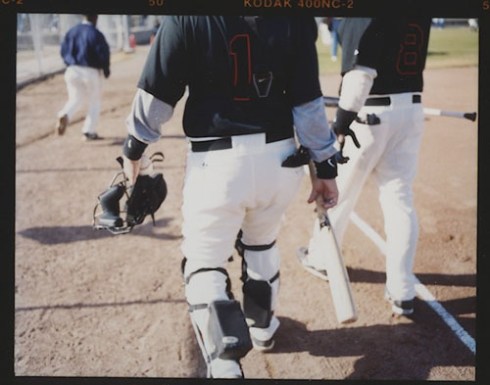
ALL IMAGES © 2009 EMILIANO GRANADO
Authors note: Huge thanks to Emiliano Granado for his thoughtful responses and honest reflections. It was a pleasure working with you E!
Housekeeping. At the end of my previous post on Emiliano’s work, I postured when San Quentin would get more sports teams for the integration of prisoners and civilians. Emiliano has answered that for me in this interview. He observed locals playing tennis and also states San Quentin also has a basketball team.

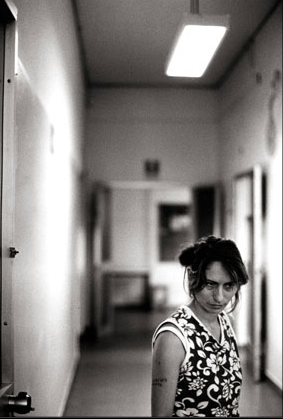
Ettore Scalambra © 2009 Luca Ferrari
Luca Ferrari is a young documentary photographer who graduated recently from The University of Wales, Newport. In 2001, he gained a scholarship in Rome and chose to document the lives of inmates in his native Italy at Rebibbia Prison.
© 2009 Luca Ferrari
I have chosen seven of his most striking works. Ferrari’s portraits are accompanied by words spoken by the prisoners. I have only included a single testimony here and I encourage you all to take the time to visit his site to understand the subjects more. Ferrari offers the caveat, “I apologise if some of the text is long for internet reading, but they are an essential part of my work.” No apology needed. The necessity for the text is obvious; I would argue crucial.
I have included the words of one inmate discussing the experience of another at the end of this post. The words are hard to read. I jostled with the decision to include them or not. In the end, I decided if anything should come from an analysis of Ferrari’s work it should be to convey the real gravity of his subjects’ lives.
I also firmly believe that in the work of any documentary photographer, if the sitters and subjects stories stay in the audience’s mind longer than the photographer’s name then the photographer has succeeded.

Pierluigi Concutelli © 2009 Luca Ferrari

The Mass © 2009 Luca Ferrari
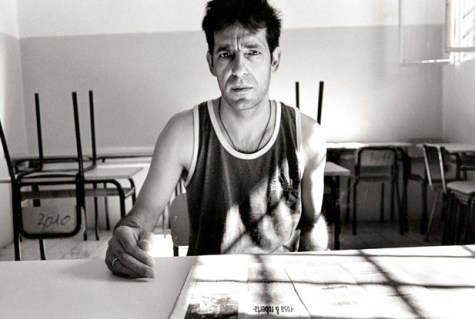
Giovanni Iacone © 2009 Luca Ferrari
______________________________________________
Alessia and Lucia
Ferrari interviewed inmate Alessia on September 10th 2003. She spoke of Lucia’s traumatic experiences and suffered injustice.
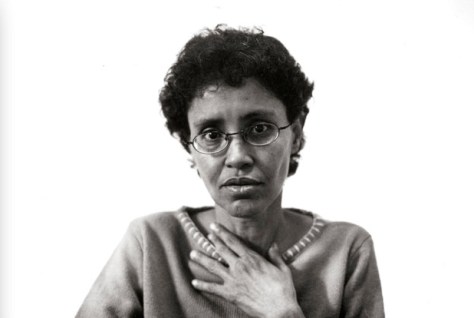
Alessia © 2009 Luca Ferrari
She is 42 years old. She comes from Ethiopia. She lives on the street – in the park at Piazza Indipendenza. She says she will go [be released] on the 22nd. She has a father and mother. They live her in Rome. Her parents have tried to help her but she cannot see a male person because five Italian guys have raped her. She was in the boarding school of Villa Pamphili and during the weekend she would go home. While she was at the bus stop waiting for the bus to go home, a car arrived and kidnapped her. They probably took her to a secluded place. It happened in the cell as well.
In fact, when they lock us up, she opens the water tap and fill sup the buckets, then she empties them on the floor. She then takes the toilet paper and puts it on the television screen. She does this to have the cell unlocked.
She has not been sane since she was raped. They did not only rape her they gave her a good thrashing. One of the guys made her pregnant and nobody knows the whereabouts of the kid. The social services gave him to another family.
Her parents took her to the hospital. She escaped and has never gone back. They attempted many times to help her, but nothing. She has been in a psychiatric hospital, where they bombarded her with electroshock. After this she was worse.

Lucia © 2009 Luca Ferrari
______________________________________________
Brief Q & A
When did you photograph the Rebibbia series and how many times did you visit?
I did the series during August 2001 and the summer of 2003. I can’t count the times, but almost every day for a month in 2001 and daily for one month in 2003.
Describe Rebibbia prison.
Rebibbia is a prison in Rome which holds 352 women and 1927 men. Within the womens’ ward there is also a special section for mothers with children under 5 years old.
What first got you interested in the subject of prisons?
I won a scholarship in Rome in 2001 to produce a exhibition on the theme of “Memory”. From that I showed my pictures to a publisher who was interested in making a book on Rebibbia. In 2003 I continued the work.
Why Rebibbia prison?
At that time I was living in Rome. Moreover, Rebibbia is one of the biggest and most important prisons in Italy.
What arrangements did you need to make to gain access to the prison (phone calls, letters, recommendations)?
I needed a letter of commission from the scholarship/publisher and also the permission of the prison authority.
Describe your interactions with the prison inmates/subjects and also the prison staff.
The permission I had was very restricted. I could not going everywhere, so I decided to add text to my pictures. The texts are not official interviews but chats I recorded in my notebooks. Sometimes the inmates gave me letters from their relatives or text written by themselves.
I tried to be as informal as possible with the texts. The prison institution is already very formal; As Erving Goffman described in Asylums it is a total institution. The status of a prisoner “is backed by the solid buildings of the world, while our sense of personal identity often resides in the cracks.”
I just tried to be a crack.
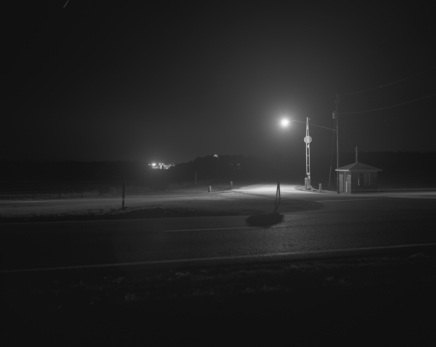
Alabama Death House Prison, Grady, AL, 2004. Silver print photograph. © 2009 Stephen Tourlentes
Stephen Tourlentes photographs prisons only at night for it is then they change the horizon. Social division and ignorance contributed to America’s rapid prison growth. Tourlentes’ lurking architectures are embodiments of our shared fears. In the world Tourlentes proposes, light haunts; it is metaphor for our psycho-social fears and denial. Prisons are our bogeyman.
These prisons encroach upon our otherwise “safe” environments. Buzzing with the constant feedback of our carceral system, these photographs are the glower of a collective and captive menace. Hard to ignore, do we hide from the beacon-like reminders of our social failures, or can we use Tourlentes’ images as guiding light to better conscience?
Designed as closed systems, prisons illuminate the night and the world that built them purposefully outside of its boundaries. “It’s a bit like sonic feedback … maybe it’s the feedback of exile,” says Tourlentes.
Stephen Tourlentes has been photographing prisons since 1996. His many series – and portfolio as a whole – has received plaudits and secured funding from organisations including the John Simon Guggenheim Foundation, the Massachusetts Cultural Council and Artadia.
Stephen was kind enough to take the time to answer Prison Photography‘s questions submitted via email.
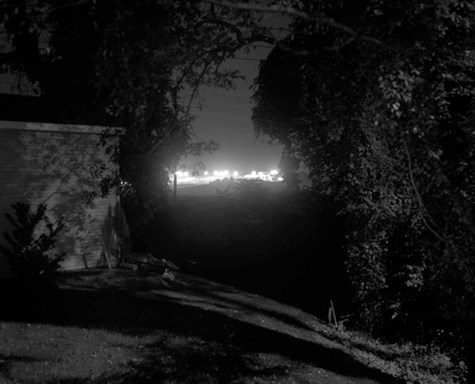
Penn State Death House Prison, Bellefonte, PA, 2003. © 2009 Stephen Tourlentes

Carson City, Nevada, Death House, 2002. Gelatin silver print. © 2009 Stephen Tourlentes

Blythe Prison, California. © 2009 Stephen Tourlentes
Pete Brook. You have traveled to many states? How many prisons have you photographed in total?
Stephen Tourlentes. I’ve photographed in 46 states. Quite the trip considering many of the places I photograph are located on dead-end roads. My best guess is I’ve photographed close to 100 prisons so far.
PB. How do you choose the prisons to photograph?
ST. Well I sort of visually stumbled onto photographing prisons when they built one in the town I grew up in Illinois. It took me awhile to recognize this as a path to explore. I noticed that the new prison visually changed the horizon at night. I began to notice them more and more when I traveled and my curiosity got the best of me.
There is lots of planning that goes into it but I rely on my instinct ultimately. The Internet has been extremely helpful. There are three main paths to follow 1. State departments of corrections 2. The Federal Bureau of Prisons and 3. Private prisons. Usually I look for the density of institutions from these sources and search for the cheapest plane ticket that would land me near them.
Structurally the newer prisons are very similar so it’s the landscape they inhabit that becomes important in differentiating them from each other. Photographing them at night has made illumination important. Usually medium and maximum-security prisons have the most perimeter lighting. An interesting sidebar to that is male institutions often tend to have more lighting than female institutions even if the security level is the same.
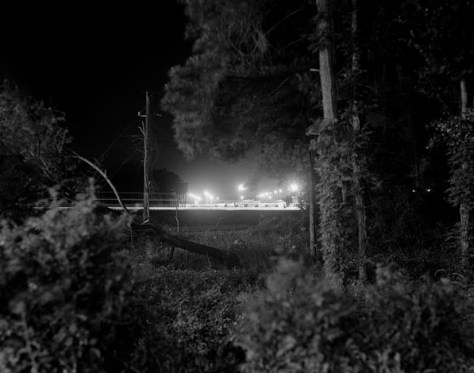
Holliday Unit, Huntsville, Texas, 2001. Gelatin silver print. © 2009 Stephen Tourlentes
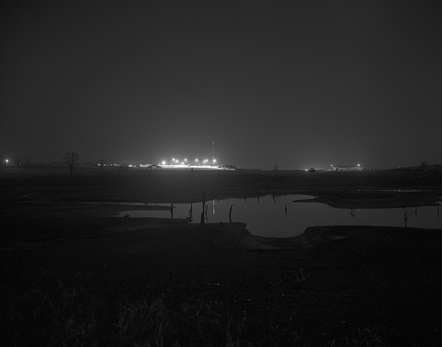
Springtown State Prison, Oklahoma, 2003. Archival pigment print. © 2009 Stephen Tourlentes
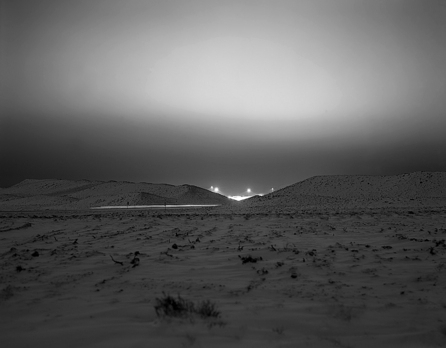
Death House Prison, Rawlins, Wyoming, 2000. Archival pigment print. © 2009 Stephen Tourlentes
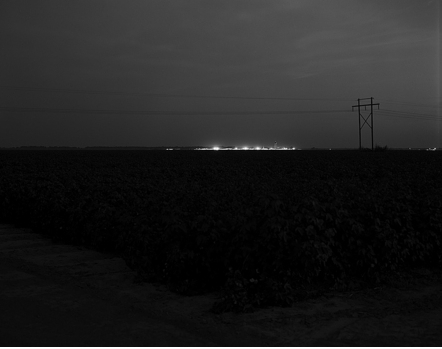
Arkansas Death House, Prison, Grady, AK, 2007. © 2009 Stephen Tourlentes
PB. Are there any notorious prisons that you want to photograph or avoid precisely because of their name?
ST. No I’m equally curious and surprised by each one I visit. There are certain ones that I would like to re-visit to try another angle or see during a different time of year. I usually go to each place with some sort of expectation that is completely wrong and requires me to really be able to shift gears on the fly.
PB. You have described the Prison as an “Important icon” and as a “General failure of our society”. Can you expand on those ideas?
ST. Well the sheer number of prisons built in this country over the last 25 years has put us in a league of our own regarding the number of people incarcerated. We have chosen to lock up people at the expense of providing services to children and schools that might have helped to prevent such a spike in prison population.
The failure is being a reactive rather than a proactive society. I feel that the prison system has become a social engineering plan that in part deals with our lack of interest in developing more humanistic support systems for society.
PB. It seems that America’s prison industrial complex is an elephant in the room. Do you agree with this point of view? Are the American public (and, dare I say it, taxpayers) in a state of denial?
ST. I don’t know if it’s denial or fear. It seems that it is easier to build a prison in most states than it is a new elementary school. Horrific crimes garner headlines and seem to monopolize attention away from other types of social services and infrastructure that might help to reduce the size of the criminal justice system. This appetite for punishment as justice often serves a political purpose rather than finding a preventative or rehabilitative response to societies ills.
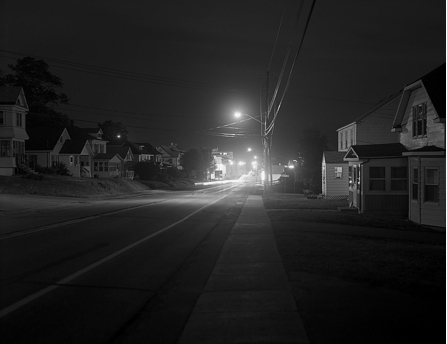
State Prison, Dannemora, NY, 2004. © 2009 Stephen Tourlentes

Prison, Castaic, CA, 2007. © 2009 Stephen Tourlentes

Federal Prison, Atwater, CA, 2007. © 2009 Stephen Tourlentes

Utah State Death House Complex, Draper, UT, 2002. © 2009 Stephen Tourlentes
PB. How do you think artistic ventures such as yours compare with political will and legal policy as means to bring the importance of an issue, such as prison expansion, into the public sphere?
ST. I think artists have always participated in bringing issues to the surface through their work. It’s a way of bearing witness to something that collectively is difficult to follow. Sometimes an artist’s interpretation touches a different nerve and if lucky the work reverberates longer than the typical news cycle.
PB. In your attempt with this work to “connect the outside world with these institutions”, what parameters define that attempt a success?
ST. I’m not sure it ever is… I guess that’s part of what drives me to respond to these places. These prisons are meant to be closed systems; so my visual intrigue comes when the landscape is illuminated back by a system (a prison) that was built by the world outside its boundaries. It’s a bit like sonic feedback… maybe it’s the feedback of exile.
PB. Are you familiar with Sandow Birk’s paintings and series, Prisonation? In terms of obscuring the subject and luring the viewer in, do you think you operate similar devices in different media?
ST. Yes I think they are related. I like his paintings quite a lot. The first time I saw them I imagined that we could have been out there at the same time and crossed paths.
PB. Many of your prints are have the moniker “Death House” in them, Explain this.
ST. I find it difficult to comprehend that in a modern civilized society that state sanctioned executions are still used by the criminal justice system. The Death House series became a subset of the overall project as I learned more about the American prison system. There are 38 states that have capital punishment laws on the books. Usually each of these 38 states has one prison where these sentences are carried out. I became interested in the idea that the law of the land differed depending on a set of geographical boundaries.

Federal Prison, Victorville, CA, 2007. © 2009 Stephen Tourlentes
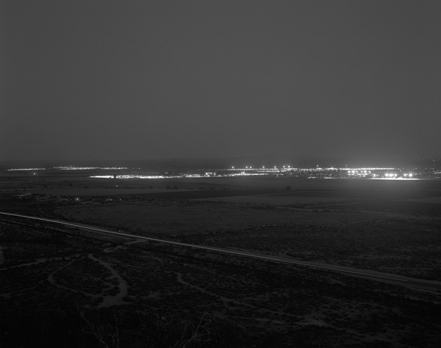
Prison Complex, Florence, AZ, 2004. © 2009 Stephen Tourlentes

Lancaster State Prison, Lancaster, CA, 2007. © 2009 Stephen Tourlentes
PB. Have you identified different reactions from different prison authorities, in different states, to your work?
ST. The guards tend not to appreciate when I am making the images unannounced. Sometimes I’m on prison property but often I’m on adjacent land that makes for interesting interactions with the people that live around these institutions. I’ve had my share of difficult moments and it makes sense why. The warden at Angola prison in Louisiana was by far the most hospitable which surprised me since I arrived unannounced.
PB. What percentage of prisons do you seek permission from before setting up your equipment?
ST. I usually only do it as a last resort. I’ve found that the administrative side of navigating the various prison and state officials was too time consuming and difficult. They like to have lots of information and exact schedules that usually don’t sync with the inherent difficulty of making an interesting photograph. I make my life harder by photographing in the middle of the night. The third shift tends to be a little less PR friendly.
PB. What would you expect the reaction to be to your work in the ‘prison-towns’ of Northern California, West Texan plains or Mississippi delta? Town’s that have come to rely on the prison for their local economy?
ST. You know it’s interesting because a community that is willing to support a prison is not looking for style points, they want jobs. Often I’m struck by how people accept this institution as neighbors.
I stumbled upon a private prison while traveling in Mississippi in 2007. I was in Tutweiler, MS and I asked a local if that was the Parchman prison on the horizon. He said no that it was the “Hawaiian” prison. All the inmates had been contracted out of the Hawaiian prison system into this private prison recently built in Mississippi. The town and region are very poor so the private prison is an economic lifeline for jobs.
The growth of the prison economy reflects the difficult economic policies in this country that have hit small rural communities particularly hard. These same economic conditions contribute to populating these prisons and creating the demand for new prisons. Unfortunately, many of these communities stake their economic survival on these places.

Kentucky State Death House, Prison, Eddyville, KY, 2003. © 2009 Stephen Tourlentes
PB. You said earlier this year (Big, Red & Shiny) that you are nearly finished with Of Lengths and Measures. Is this an aesthetic/artistic or a practical decision?
ST. I’m not sure if I will really ever be done with it. From a practical side I would like to spend some time getting the entire body of work into a book form. I think by saying that it helps me to think that I am getting near the end. I do have other things I’m interested in, but the prison photographs feel like my best way to contribute to the conversation to change the way we do things.
________________________________________
Author’s note: Sincerest thanks to Stephen Tourlentes for his assistance and time with this article.
________________________________________
Stephen Tourlentes received his BFA from Knox College and an MFA (1988) from the Massachusetts College of Art in Boston, where he is currently a professor of photography. His work is included in the collection at Princeton University, and has been exhibited at the Revolution Gallery, Michigan; Cranbook Art Museum, Michigan; and S.F. Camerawork, among others. Tourlentes has received a John Simon Guggenheim Foundation Fellowship, a Polaroid Corporation Grant, and a MacDowell Colony Fellowship.
________________________________________
This interview was designed in order to compliment the information already provided in another excellent online interview with Stephen Tourlentes by Jess T. Dugan at Big, Red & Shiny. (Highly recommended!)

Hailey, 2, reaches out for a quarter in her fathers hand, Shane Macleod, while her mother Danielle Macleod stares out from the table. Each visitor is allowed to bring $20 of quarters for the vending machine and nothing else. Shane, like all of the inmates in the visiting room must ask his wife and daughter to buy certain snacks, as he is not allowed near the vending machines. During the visits, Shane says, “There is just not a lot to talk about after a while, you can only beat a subject to death for so long.” The couple married four years ago outside of prison, and Shane says, “Prison just really messes up your life.”
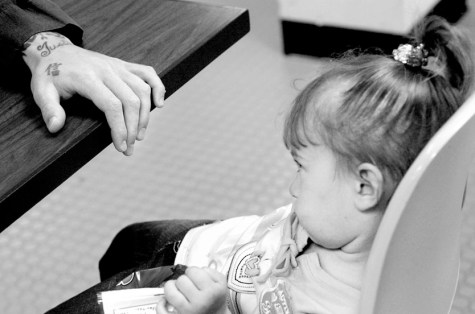
Hailey Macleod, 2, look outs across the table at her father, Shane Macleod, and his outstretched hand. Shane was incarcerated two months prior for bank robbery. Shane says. “It gets really stressful sometimes, to have my wife and daughter away from me.”
Elyse Butler repeat-visited New Hampshire State Prison in 2005. She was working as an intern staff photographer at the Concord Monitor in Concord, New Hampshire. The goal of the assignment was to capture the dynamics of relationships in the prison visiting room. Butler documented the behaviours of those within the room; “how these couples, families, and friends interact with each other when they have only a small amount of monitored time to spend together.” I asked a couple of questions.
How did you get access?
In order to get access into the prison we [Concord Monitor] had to contact the PR department and go through a process of paperwork and I had prison officers watching me at all times when I was in the visiting room.
What reactions did the work receive?
After the piece was done we got a great reaction from inmates and families in the visiting room. They were touched to have their time documented with their loved ones.

Heather Metcalf and Mark Vangordon hold hands at table 19 in the visiting room of New Hampshire State Prison. Vangordon is imprisoned for sexual assault and has been in the for a year. Metcalf says, “Not having him home is the hardest part.” When she is not visiting she waits for his letters to hear how he’s doing. During a visit, they are only allowed to have a 15 second embrace at the beginning and end of each visit and otherwise they are only allowed to hold hands above the table.

Lori Tasney and Chris Lang look into each others eyes as Marilyn and Daniel Haldeman hold each other at the end of a visit. Tasney and Lang have been dating for two years and plan to marry when he gets out. His current parole date is set for 2008. Lang was imprisoned for robbery in January 2005. Tasney visits twice a week, which is the most time any inmate is allowed visitors, but says “I would visit every day if I could.”
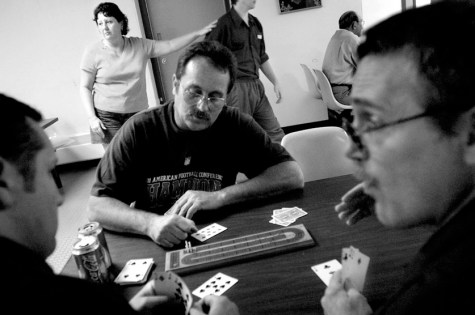
Mark Langlais plays cards with his brother, inmate Alphee Langlais (right) and his son, inmate Eric Langlias (left) while a mother gives her son one last touch at the end of a visit. This is the first time Alphee and Mark have seen each other since 1996. Mark claims, “Alphee’s been in here since his hair lost its color.” The family was estranged a long time ago, but they claim prison has brought them closer together. Eric was admitted for assault and Alphee was admitted on a parole violation following a prior sexual assault crime. Alphee carries around his inmate request slip as if its a trophy and cried when he finally spoke on the phone with his brother Mark. “This visit has been really special to me, ” Alphee claimed. Eric and his father always fought but no that he is on medication and his father is in counseling, Eric says “it is the closest we’ve ever been … I have always loved my father. I have always wanted him around.”
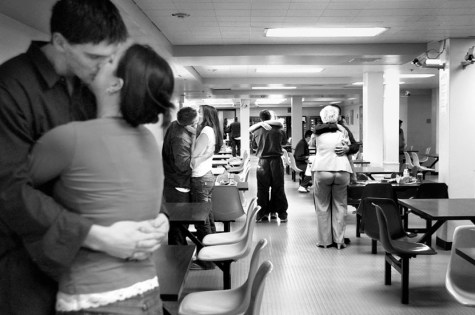
An inmate and his visitor share a last kiss and 15 second embrace, along with three other couples also saying their goodbyes, at the end of a visit. They started dating 5 months ago, only a month before he went to prison, and she says, “If he ends up having a long sentence, we probably won’t stay together.” He was admitted on a parole violation after an original conviction for multiple robberies and larceny. She says, “I come usually once a week. I hate coming here.”
Biography
Elyse Butler is represented by Aevum Photos. She is one of the hardest working and posting photographers in the business. She previously won College Photographer of the Year Award in 2004 for her documents of the porn industry. She has also photographed the debutante activity of La Jolla. I’d like to hear an interview between Butler, Lauren Greenfield and Wendy Marijnissen on the topic of female identity.
Butler did some nice portraiture in South America, but my favourite project of hers is “From Pond to Purse” which follows the trade of alligator products. Be sure to read Butler’s information on the project at her site in the ‘passion’ category.
Lloyd DeGrane‘s work is long-term and it is honest. DeGrane would like to see more transparency surrounding American correctional facilities, “I think people, taxpayers should see what they’re getting for their money”. I came across DeGrane in James R Hugunin’s 1996 curated exhibit Discipline and Photograph.
DeGrane carried out his Prison series between 1990 and 2001, when he photographed within the state maximum security Stateville Correctional Center, Illinois and Cook County Jail in Chicago. The three photos featured here each depict scenes at Stateville.
DeGrane took the time to discuss the role of photography in sites of incarceration, a photographer’s best approach, the names and labels given to him by inmates and images of the spaces between cells.
Did you await each photo opportunity? While working, were you alone or accompanied on the corridor or wing?
“I was usually escorted by a counselor – an unassuming, non-threatening person. Sometimes I’d go into a unit and walk around by myself, being careful not to get out of the view of a correctional officer. Stateville is a maximum security facility so some of the inmates were violent offenders. I talked to the inmates directly, sometimes going into their cells. For the most part the officials let me browse freely and talk to any inmates I wanted. Things, to a point, were pretty transparent. When I came into a unit someone would usually yell out my arrival”.

Isolation Unit, Stateville Correctional Center, 1992. Lloyd Degrane
What is happening in the Isolation Unit photograph?
“This is the isolation unit – I called it ‘the jail within the prison’. Inmates who committed an offense in the prison were taken out of the general population and held there 23 hours a day with one hour for outside exercise. That [the display of legs and arms] was the first reaction to me being on the wing”.
“The inmates, for reasons unknown to me, thought I was a state official of some kind. But, after I got to talking with a few people independently I was able to photograph several inmates with no problems, with the exception of one inmate who would try to throw excrement at the guards”.

Lockdown Protest, Stateville Correctional Center, 1993. Lloyd Degrane
Explain the situation here, with the trash and food on the floor.
“That was taken in 1993. Inmates were ending a five day lock-down and totally disgusted by the lunch served (cold baloney sandwiches every day). So, they threw the servings out of their cells onto the floor. The floor of the wing is commonly known as ‘the flag’.”
“Guards eventually had to clean it up. I noticed when I came back the next week that the roach problem was severe. I had to tuck my pant legs into my socks so the roaches wouldn’t crawl up my legs”.

Protective Custody Unit, Stateville Correctional Center, 1992. Lloyd Degrane
The interaction between the guard and inmate in the protective custody unit is fascinating – it melds contortion, humanity, routine and unlikely types for the prison environment.
“The inmate was in the protective custody unit. That’s a pregnant guard that’s looking at him. He didn’t have a mirror so the only way he could see what was happening outside his cell was to stick his head out of the food tray slot.”
Did the subjects of your images, specifically inmates, see the photographs after they were produced/exhibited?
“I always made a small photo for the inmates. Sometimes they got them and sometimes the warden or captain (for reasons I do not know) didn’t get around to giving them the photo. But, I was able to get a little deeper into the lives of the inmates that received photos.”
How do you work?
“The images are made slowly and carefully. No surprises. Observation and discussion with the inmates and then photos. That was my modus operandi. It’s like going into someone’s home, they know you’re there! So, it’s best to be respectfully curious. Some inmates wanted nothing to do with me (I think they had committed other crimes on the outside and didn’t want to be recognized). Other inmates didn’t mind at all. I talked with people all the time. I think taxpayers should see what they’re getting for their money. Transparency is key. But, many prison officials believe the opposite and in their facility, they rule!
Final thoughts on the prison system?
Prisons – and not correctional facilities (as the State of Illinois has named their institutions) – the concrete human warehouses behind razor wire are just that! Buildings that confine people. It’s an existential experience in a world that is both separate from America but a big part of the American economy. One sees homemade signs along Interstate 55 that read, ‘Don’t shut our prison down’, ‘Save the prison, Save our jobs’ outside Pontiac, Illinois, home to another maximum security facility that may close because of state budget cuts.
Don’t get me wrong though, some people belong in prison. I met many men who raped innocent women, killed children, beat other men to death for a few dollars and some who murdered their cellmates. I was glad that I didn’t meet them in a dark alley in Chicago. But, one thought that always went through my mind was, most of these people will get out some day. Will they change for the better or just be better criminals?
You kept an index of how the prisoners referred to you. It’s length, variety and contradictions reflect well the complexity of social experience within correctional facilities. Can you remind us of the index?
This is my index of how inmates referred to me. Picture Man, White man, The Man White Mother Fuckin’ Press Man, Black Gang Lover, Spic Gang Lover, White Prisoner Lover, Straight Dude Looking for Something – Policeman, The Photo Man, The European, The Springfield Connection, A Fair Man, An O.K. Photographer, An Artist, Homes, Homey, Fuckin’ Photographer, Homo, Fuckin’ Camera Man, The Camera Man, Inmate Lover, The Police, Friend and Cute Mother Fucker (The label given to me by Richard Speck).

 Prison Photography