
You are currently browsing the category archive for the ‘Non-Prison’ category.

Singing the national anthem. © Ben Quinton
Perhaps it is just because I taught in a Kenyan High School in the Rift Valley a decade ago and it remains one of the most formative experiences of my life that I am so taken with Ben Quinton‘s art-docu series, The British Abroad.
By comparison, St Andrews School, which Quinton depicts is better equipped than the schools I visited (the swimming pool being the big giveaway).
The evocation of weather, multiple generations, institutional routine, the mix but not a clash per se of cultures and the vestiges of colonialism all make this an interesting portfolio.
I’d be interested to know if others enjoyed The British Abroad as much as I.
Found in the current issue of Seesaw Magazine.
The Center for Documentary Studies (CDS) at Duke University has awarded the twentieth Dorothea Lange-Paul Taylor Prize to photographer Tiana Markova-Gold and writer Sarah Dohrmann.
With the money ‘Markova-Gold and Dohrmann plan to spend three months in Morocco, “living with and documenting the lives of sex workers whose clients are not sex tourists, but are instead fellow Moroccan men.” They will focus on women in prostitution from different economic levels and backgrounds as they engage with them in their homes and in the hotels, clubs, cafes, and streets where they work. While intimate in their approach, it is their hope that the work will portray Morocco—with its unique position as a bridge between Europe and Africa, its role within the MENA region and Islamic society, and as a developing nation grappling with the economic impacts of globalization—within a larger context of the particular vulnerability of women and girls worldwide.’
No small task. Good luck to them.
OTHER PEOPLE’S DIRTY LAUNDRY

"I think the ten minute foot rub I give is a major key to my success . . . If I were to teach Sex Work 101, this would be Lesson One and I wish I had learned it years earlier in my career." Miami Beach 2007. Photograph by Tiana Markova-Gold from the project Other People's Dirty Laundry (Sex Workers Project / Jenna).
Because the work is yet to be embarked upon, CDS presents images from Markova-Gold’s 2007/08 project Other People’s Dirty Laundry and You Must Not Know ‘Bout Me…
The two projects contrast the addictions & abuses, hygiene & preparations of sex workers servicing clients of vastly different economic means and in very different environments; Miami Beach and Washington D.C. contrast frighteningly with the South Bronx and East Harlem.
HOW CLOSE?
The intimacy the photographer has forged here with the sex workers is remarkable but not unique – Scot Sothern, Mimi Chakarova and Dana Popa have all produced projects recently that suggest a trust with their subjects and provide windows into very troubled worlds, especially in the case of Chakarova and Popa who deal with sex-trafficking in Eastern Europe.
This discussion that must necessarily follow the viewing of these projects is complex and difficult and I don’t pretend to have any answers. I only expect an honest discussion.
Rapid City, South Dakota, 6.16.10.
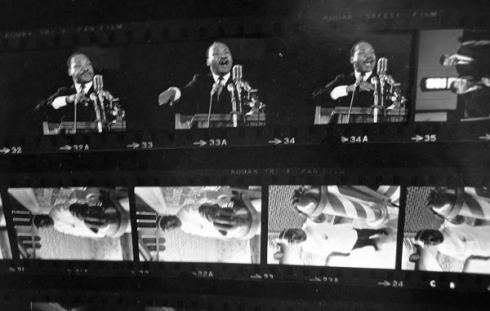
‘Digging into the strata of junk, he found more black-and-white mounted photos, some of them under a broken-down convertible that was one of several cars abandoned in the warehouse. He found the young Jesse Jackson preaching, Dizzy Gillespie playing his trumpet, and four black men—photographers apparently, from the cameras on display—sitting on the concrete front steps of the South Side Community Art Center. […] There was a box filled with negatives in labeled envelopes. There were negatives of Dr. Martin Luther King Jr., negatives of Abbie Hoffman, negatives of Lyndon Johnson. Next to this box was another one that was full of invoices; their letterhead said HOWARD SIMMONS.’ (Story)
(via)
There’s been a few parallels drawn between cameras and guns recently.
Gizmodo reflected upon new laws that would suggest that to wield a camera is to act as a dissident and warrant attention from the police. Carlos Miller continues to collate “interactions” between photographers and law or security enforcement.
Fred Ritchin picked up on this drawing parallel between the Wikileaks video of the Iraq helicopter assault and the photographing of on duty police officers, “the former is certainly prohibited by law, and the latter is now also prohibited by law in some states. Both issues relate to the conduct of military/police forces and the inability of people to publish imagery that may point to excesses.”
Susan Sontag usually crops up when one discusses the violence of photography. Whether or not Sontag was the first to coin this notion I don’t know. I do know her writing about quite complex things can be beautiful, clear and accessible so perhaps she deserves recognition for simplifying and readying the idea that photography can be/is aggressive.
On the other hand, David Goldblatt – as Fred Ritchin argues – was a dispassionate practitioner who shied away from such comparisons.
Goldblatt, “I said that the camera was not a machine-gun and that photographers shouldn’t confuse their response to the politics of the country with their role as photographers.”
Goldblatt was not a dispassionate man, but a photographer who maintained a distance, developed his own language and avoided many of the frightful images that, for example, the Bang Bang Club produced for the world’s media.
Shoot! Rencontres d’Arles
In light of these recent commentaries, this exhibition review in The Guardian (originally in Le Monde) caught my attention:
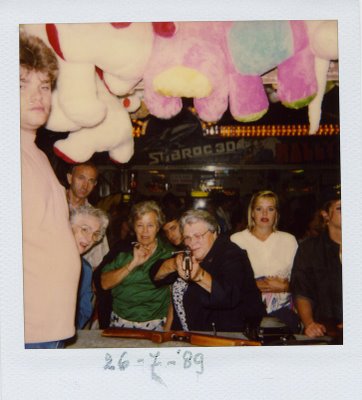
In Shoot! Clément Chéroux, a curator at the Pompidou Centre in Paris, returns to a once popular fairground attraction. When it first appeared in the 1920s, target-shooting enthusiasts could take home as a prize a photo of themselves in action. When the bullet hit the bull’s-eye, a portrait was taken automatically. By the 1970s the attraction had disappeared, but there is no nostalgia here. “I’m not paying tribute to a vanished process,” says Chéroux. “What interests me is its metaphorical side. […] Of the 60 or so exhibitions at this year’s Rencontres d’Arles the most successful and original is certainly the one on the photographic shooting gallery.“
With work from Patrick Zachmann, Christian Marclay, Martin Becka, Rudolf Steiner and Erik Kessels the exhibition is a varied interpretation of camera and gun, or in the majority of these cases, camera and rifle. Looks like a unique and winsome show. More here and here.

Caption: Mahmod Berghote stands with one of Marah Zoo’s world famous painted donkeys. The zoo’s two white donkeys caused an international media frenzy after Mahmod and his brother spent three days painting stripes onto them using black hair dye. Unable to find an animal trader to bring a real zebra through the tunnels from Egypt, the Berghote family decided to make a fake pair using white donkeys. The story was reported all over the world as a feel good news piece and often used as an example of the Palestinian people’s resourcefulness during the siege of Gaza.
Anastasia Taylor-Lind for VII Photo published a remarkable photo essay about the zoos of Gaza.
The idea that imprisoned people can make a business out of smuggling, locking up, and exhibiting animals is deeply ironic. There are about a dozen zoos in Gaza and their story is intertwined with world politics in a way that would be unimaginable anywhere else.
In 2005, Dr. Saud Shawa, a veterinarian, decided to establish Palestine’s National Zoo. For Shawa, this was about education and showing people how to care for animals. Supported by international donors, he built a spacious compound with big cages, a theatre, a library and research centre – Gaza Zoo, the first one ever in the strip.
Gaza zoo opened in January 2006, the same month Hamas, the radical Islamist movement, won elections in Gaza. The border was closed and the initiative was halted before it could get started.
As of today, not a single zoo has been profitable. In fact, there is only one person in the Gaza strip who benefits from the business: Abu Nadal Khalid, an animal trader. He has animals drugged and smuggled through the infamous system of tunnels leading from Egypt into the strip.
Was it an inside act of rebellion?
I have absolutely no grounds on which to make an accusation, which is why I phrase it as a question.
But just looking at the foolish doctoring of images, especially the helicopter cockpit image, I wonder if the culprit intended to be caught? The color of the photoshopped image is just ludicrous, literally unbelievable, unless that is Martin Parr’s Gulf of Mexico!
To me, the reworking seems suspiciously blatant. Who is the “contract photographer” doing these pig-eared photoshoppings? And, is he/she a saboteur?

Original. © BP p.l.c.
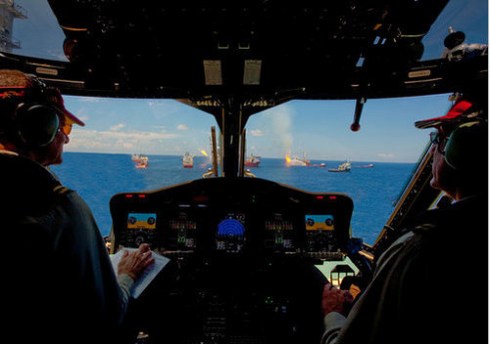
Botched photoshop. © BP p.l.c.
INTERNET MEME
Rather joyously, this image has become a meme. See the comments in the original and excellent Gawker article!
Ed Winkelman has posted another must-read POV, ‘Why Curmudgeons Often Make the Best Collectors‘
Ed responds to this article in The Art Newspaper profiling gambling millionaire David Walsh, whose private collection has just been opened to the public in the purpose built, subterranean Museum of Old and New Art.
Walsh on MONA’s raison d’être:
“Mona is my temple to secularism,” he adds, explaining that he is interested in “talking about what we are”, in other words what makes humans human. “People fucking, people dying, the sorts of things that are the most fun to talk about.”
Walsh on the potential benefits Mona will have to local business:
“We don’t know whether I’m going to make any difference to the economy and I must say I don’t particularly care. If it happens, great. If it doesn’t happen, I don’t give a shit.”
Walsh on curating:
“I believe most curation is bullshit … curators tie together a bunch of stuff they can get their hands on then create the most abstruse and obtuse reality and, in the end, fill an exhibition up with a few things that are slightly connected and the upshot is that about 30% of the art is just there to fill space.”
Walsh on being an artist:
“No one makes art for art’s sake. There are only two reasons to create art: to get laid or defy death.”
Hilarious! Thanks Ed.

 Prison Photography