
You are currently browsing the category archive for the ‘Opinion’ category.
If an individual and the law don’t agree to the point the individual is imprisoned, one hopes lawful imprisonment changes the individual, right? For the better, right?
Unfortunately, American prisons have proved the opposite of rehabilitative or hopeful of positive change. Recidivism rates in America are between 60% and 68% (depending on the source).
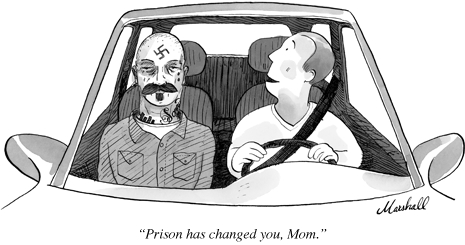
"Prison has changed you, Mom" © 2009 Marshall for the New Yorker
Spurred possibly by the fiscal-driven prisoner releases across the nation, Marshall penciled this pearl.
Some of the best comedy is simultaneously tragedy. The truth is America’s prison archipelago has bruised the lives of the current 2.2 million prison population, the lives of family members AND our lives and communities. Inmates returning to society haven’t been suitably prepared or shown new paths. Change has been for the worse in majority of cases.
I was astonished to read this AlertNet article. It excavates the background to Lovelle Mixon’s massacre in Oakland that killed four people.
I cannot agree with the article’s logic 100%. It would be a sad day if I ever presumed the individual totally powerless and unable to act upon non-violent decisions, but as the author writes:
“Though Mixon’s killing spree is a horrible aberration, his plight as an unemployed ex-felon isn’t. There are tens of thousands like him on America’s streets. In 2007, the National Institute of Justice found that 60 percent of ex-felon offenders remain unemployed a year after their release.”
It is not easy to resist the urge to think of mass-murderous crimes as the singular actions of an individual.
I appreciate Earl Ofari Hutchinson‘s article because it brings together the many invisible and minor trials in life that collectively make daily stress unbearable. I finished the article amazed that there are fewer desperate crimes akin to Mixon’s. An uncomfortable thought.
Again, Hutchinson reminds us that the problems of incarceration, recidivism, education, unemployment and crime are inseparable:
Washington, D.C. is a near textbook example of that. Nearly 3,000 former prisoners are released and return to the district each year. Most fit the standard ex-felon profile. They are poor, with limited education and job skills, and come from broken or dysfunctional homes. Researchers again found that the single biggest factor that pushed them back to the streets, crime, violence and, inevitably, repeat incarceration was their failure to find work.
Q. Why do we warehouse people, break them, and then return them to society in a poorer position to cope?
A. Punitive and immovable laws, collective arrogance & utter denial.
With an estimated 600,000 prisoners either released or due for release in 2009, it’s about time we make a small change in our accomodations – especially given the size of change we expect of former prisoners.
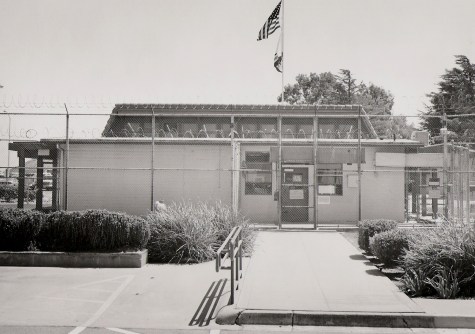
Deuel Vocational Institution, California. © 2009 Robert Walsh
Predictably, my partner is my first critic and supporter. Often distilling my whirling thoughts, she’ll draw some coherence from my arguments. I asked her to look over the photography of Robert Walsh. He had submitted his work via email. She pointed out that three of his images bore striking resemblance to school environments. I can only agree.
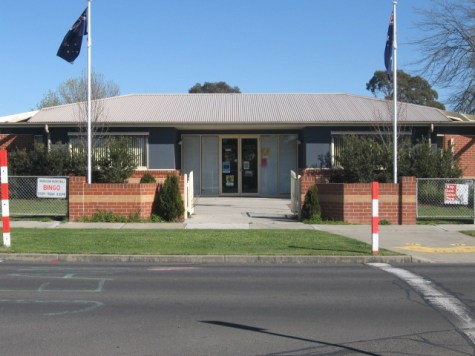
School
Of course, this is not a novel notion and philosophers have, for decades, had a field day dissecting and bisecting institutional architectural forms. I’ll add this quick post to the heap of rhetoric and swagger.
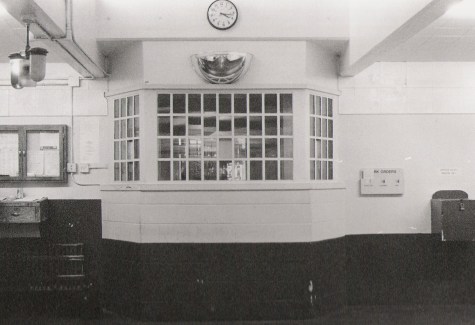
Deuel Vocational Institution, California. © 2009 Robert Walsh

Mill Creek Middle School secretary Jane Crum works beside the new buzz-in system that was installed for safety purposes at the school. Press Photo/Emily Zoladz
Maybe worth returning to would be Richard Ross‘ work. He pin-pointed the many shared criteria in institutional architectures of authority. His prints are pristine and his visual evidence compelling.

Deuel Vocational Institution, California. © 2009 Robert Walsh

School Buses in Yard
Today, March 11th 2009, marks the twentieth anniversary of the first COPS episode. Producer, John Langley, and his cohorts celebrated the when the first show of the twentieth season aired at the back end of last year. Allow me to reflect also.
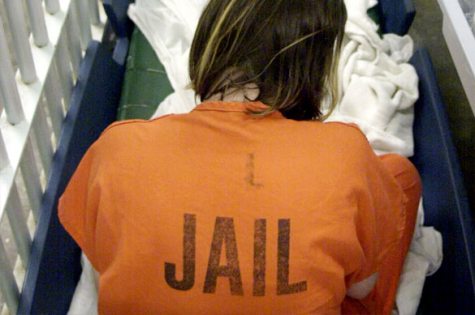
At overcrowded jails, like this one in Marion County, IN, inmates must sleep in portable containers. Credit: Inside American Jail
This is not really a day of celebration. Personally, I loathe the show. It is lazy, cheap and exploitative. In that regard, it paved the way for all the reality TV on the box today. Off my soap box.
It is worth noting that the 1988 television writers strike gave rise to COPS airing on screens. A desperate Fox Channel signed up after Langley had tried and failed pedaling the format for over six years. Lucky for him. But he was no slouch and worked the opportunity when it arose. Langley struggled early in his career. My guess is his PhD in Aesthetics took his thinking outside of the rote and predictable circles of Hollywoodthink. But TVland came round eventually and Langley has since distinguished himself as a true pioneer of America’s most-loved lowbrow art form.

Inmates in this Utah jail aren't digging an escape tunnel. They're learning to garden. Credit: Inside American Jail
Three years ago, Langley Productions introduced a spin off show that went off the streets and into the jails. Inside American Jail has ventured into sites of incarceration across the nation including the circus-like Maricopa County Tent City. The show won high ratings when the Las Vegas County Sheriff detained O.J.Simpson.

A sign at a Maricopa County jail reads "Vacancy." The rates are good but the atmosphere is lacking. Credit: Inside American Jail
In many cases the TV cameras show the true harsh realities of institution after institution with stretched resources warehousing troubled folk with few opportunities for rehabilitation. This doesn’t stop them from hamming up the quirks of jail time as evidenced by the promotional images and campy captions (shown within this article) drawn from the show’s website.
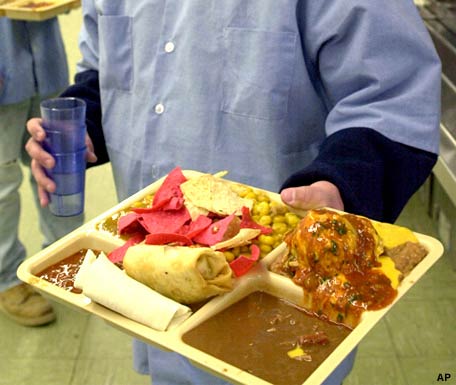
Mmm-mmm-good. An Iowa State Penitentiary inmate shows us what lunch in jail looks like. Credit: Inside American Jail
With most debates, nothing is cut and dried and an insightful article in the New York Times shows a vaguely compassionate point of view from Langley – who, let’s be honest has made his fortune of the back of America’s criminal justice exploits.
Having seen America’s prison population soar to more than 2.2 million, and with widespread prison overcrowding in California, Mr. Langley says he now believes the nation should be reconsidering which crimes should be punishable by imprisonment. “A lot of our attention is dedicated to arresting people who have drug problems,” he said, “when the real solution may be to rehabilitate them.”
And for your viewing pleasure here’s the ridiculous promo for Inside American Jail
This interview allows Langley to describe where Inside American Jail fits into the larger television ecosystem.
While not related to the work of a single photographer or project, the lines of argument proffered by Subtopia are so resonant that Prison Photograph Blog feels the diversion justified. Through summary of the four chosen articles, we can gaze upon the complexity and omnipotence of incarceration in our frantic, contested global society. Subtopia’s images will knock you on your arse!
The analysis of Bryan Finoki at Subtopia consistently join the dots between geopolitics & biopolitics; movement & paralysis; spatial theory and spatial reality. Unsurprisingly, for a writer in the 21st century, his interest in the production of structures & networks, often leads him to theories of militarised space.
I am in awe of Subtopia’s output. From lengthy and comprehensive issue-based summaries; to purposed surveys; from fine image-editing; to diverse links and sources in each post. Finoki serves up rigorous analysis, or entertainment, but usually both.

© 2009 Subtopia/Brian Finoki
Over the past couple of years Finoki has submitted a few pieces on “The Prison”. Subtopia’s preoccupation with power and spatial production means carceral sites/archipelagos are referenced frequently. Finoki has been keen to unravel the mysteries of the Global War on Terror (GWOT), its structures and its legacies – this always means dealing with detention, rendition, and construction (that can be visible, but more often invisible.)
Article One – Fantasy Prison is a meditation on potential prison architectures spurred by the 2007 Creative Prison project a collaboration between architect Will Alsop prisoners at HMP Gartree to redesign corrective and rehabilitative space. Two things struck me about the suggestions made by prisoners. 1) They were most afraid of attack from other inmates, and therefore an option to lock themselves IN was a shared high priority, and 2) They wanted to include a designated photo-room within the visitors center to allow for photography and variant backgrounds. I have posted before about manifestly curious prison-polaroid aesthetic. This article also threw up the crucial social responsibilities of architects & designers in a time of prison expansion, most notably the Prison Design Boycott launched in 2004 by the group Architects/Designers/Planners for Social Responsibility (ADPSR).
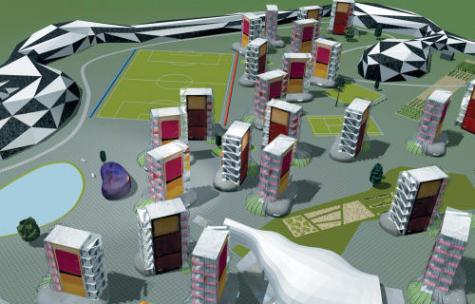
A rendering of Will Alsop’s new corrections landscape, developed in collaboration with prisoners, resembles a cross between Communist-era housing blocs and a series of South Beach condos. Courtesy Alsop Architects
I have been a fan of Alsop’s work since his 2005 hypothetical SuperCity project which would subsume my hometown in the North.
Article Two – Floating Prisons is a historical survey of sea-faring, carceral solutions by warring and colonising nations. Finoki maps the use of prison ships from 18th & 19th century economic necessity to transport human cargo to contemporary manoeuvrings in avoidance of international law. He makes reference to the convenience use of islands as sites of detention, the use of ships as temporary housing in leiu of land locked sites, and the dubious experiments in swapping refugees held in off-shore camps. The summary was to say that new legal definitions and controls are creeping in giving one the sense, “refugees and migrants are just an excess of biomass to be herded around on prison islands or in prison vessels, traded like geo-economic commodities, removed and disposed of like capitalist human waste, reinforcing the state of exception that goes on re-organizing the architectural spheres of global migration.” Phenomenal.

The Vernon C. Bain is a prison barge operated by the City of New York, housing 800 prisoners in a medium and maximum security facility. Built in 1992 at a cost of $ 161 Million means it would have been cheaper to send the inmates to Harvard instead. (Source)
Article Three – “Block D” enters the Pantheon of GWOT Space is a meditation on the totality of restricted space across the globe – in multiple nations – in order to sustain military operations. The point of the survey (which includes previously known sites such as Guantanamo, Baghdad’s ‘Green Zone’, Bagram Theater Internment Facility, US homeland immigrant detention facilities, and Taxi networks for rendition) is to add another site to the list: “Block D” in Pul-e-Charki Prison just east of Kabul, Afghanistan.
With persistent references to journalists’ work for the BBC, New York Times and Washington Post, Finoki summarises, ” ‘Block D’ or ‘Block 4’ as it is also apparently known: a newly built detention facility [is] quickly becoming understood as the Asian corollary of Guantánamo Bay. No matter, it is another utterly disturbing black hole in the universe of legally suspect and secret space.” Finoki doesn’t focus on the conditions of detention but rather America’s self-created legal imbroglio.
Nearly a year after writing, this analysis seems prophetic now, as the American public is slowly coming to realise that Obama’s closure of Gitmo doesn’t necessarily magic away the human rights issues … only shifts them somewhere slightly more obscured. As with Gitmo, one expects Block D to focus the new rounds of jousting between the same ideological stakeholders.
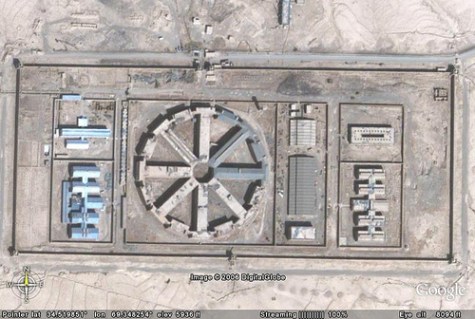
Pul-e-Charkhi prison, Kabul, Afghanistan. Construction began in the 1970s by order of then-president Mohammed Daoud Khan and was completed during the Soviet invasion (1979-89). The prison was notorious for torture and abuses under the control of Afghanistan's communist government following the invasion by the Soviet Union. (Source)
Article Four – The Spatial Instrumentality of Torture is a stomach-pounding dose of reality in the form of an interview with Tom Hilde, Research Professor in the School of Public Policy at the University of Maryland. I will not offer a synopsis, just encourage you to read through it. The interview is illustrated in part by Prison Photography‘s favourite Richard Ross.
Hilde ends with the sobering words, “The secrecy of much of the US torture program, its physical spaces, and its extent has certainly kept public debate rather subdued. But I think the dualistic moral framework has been even more corrosive of a public understanding of torture in general and the consequences of American torture in particular. When a majority of Americans say that torture is acceptable for some purposes, I think they have the fantasy of the ticking timebomb, and likely racism in many cases, in the backs of their minds.”

Camp X-Ray, Guantánamo, Cuba. The facility has not been used since early 2002, and recent heavy rains at Guantánamo Bay have brought about overgrowth. Credit: Kathleen T. Rhem
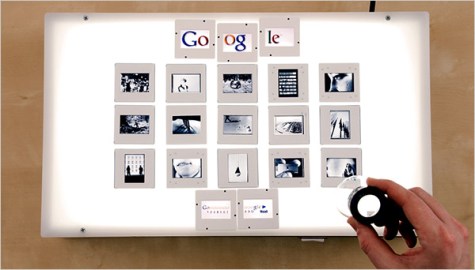
Kevin Van Aelst for The New York Times
I posted about Google’s collaboration with LIFE Magazine a few months ago. I – like many folk – were excited to dig in, ferret about and generally enjoy the visual culture of decades past. It seems the novelty has worn off for some. An excellent diatribe, Photo Negative, in the New York Times last week made the point succinctly.
“When Google first announced on its blog that the Life archive was up, it seemed like another Google good deed: rescuing the name of Life magazine and the glorious 20th-century tradition of still photojournalism. But Google has failed to recognize that it can’t publish content under its imprint without also creating content of some kind: smart, reported captions; new and good-looking slide-show software; interstitial material that connects disparate photos; robust thematic and topical organization. All this stuff is content, and it requires writers, reporters, designers and curators. Instead, the company’s curatorial imperative, as usual, is merely ‘make it available’.”
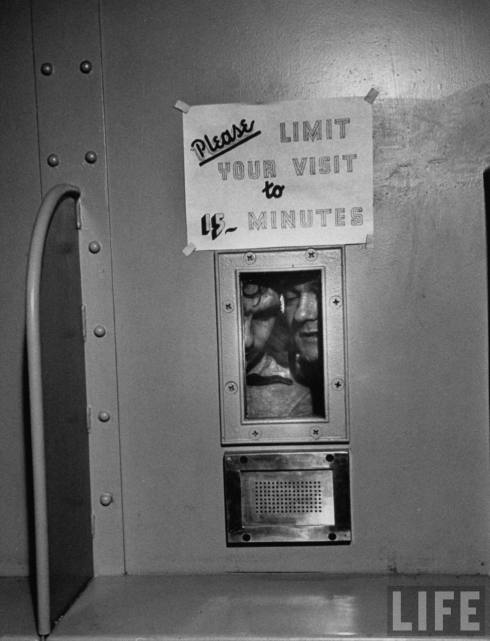
Prisoners watching baptism of repentant killer, in Harris County jail, TX, US. March 1954. Credit: John Dominis. ©2008 Google
With little in the platform or functionality to inspire users, Google could find visitors’ perusal time shrinking. Users might face unavoidable limits to their search time and patience. 15 minutes?
I don’t want to get into the habit of posting on cases of police corruption, police brutality, or correctional officer misconduct.
I don’t want to do this for three reasons:
1. It distracts me, and you the reader, from digesting content directly related to photography and its praxis.
2. Many other regional, national and international newsrooms will cover these stories – as a matter of course – more thoroughly than I.
And 3. Despite their shared “peace officer” status, cops and screws are cut from a different cloth. It would be wrong of me to carelessly blur the activities of one disciplinary group with another. Police and correctional officers share minimal operational relation to one another.
So, I don’t wish to obfuscate the reader/viewer. However, the video below leaves no confusion in anyone’s mind.
The spokesperson in the video relayed the official words of an authority under investigation, but one feels even he could barely stomach the truth here. Where some videos are subject to interpretation – and consequently endless courtroom debate – there can be no doubt here. The officer lost his head and unleashed upon this young girl. He’s a thug, just like a guy fist fighting on the street is a thug.
As some of you may know, I have recently transplanted to Seattle. Occasionally, one witnesses acts of rote police procedure in place of common sense, but by and large, the cops on the streets here (as in my former home of San Francisco) are a friendly bunch on bikes and skates.
I am saddened such a horrendous beating should take place in my new hometown … which is why I have made an exception to my rule here.
Unfortunately, this brutal lashing occurred in the same month that Seattle police chief Gil Kerlikowske was selected by Obama to be America’s next Drug Czar. Seattleites have voiced varied opinions regarding this appointment, but secretly they are all really chuffed. It is a proud moment for Seattle residents, not least, because Kerlikowske – even as a police chief – shares some majority views of the citizenry. Kerlikowske adopted a common sense approach to urban policing by making marijuana infractions the lowest priority of his force in order to redirect resources to more serious matters … matters of violence. The Stranger, Seattle’s favourite free rag offers four wildly different but well-informed opinions on Kerlikowske’s appointment.
_______________________________________
Seattle lost an age-old institution recently. The Seattle Post Intelligencer, like the Rocky Mountain News and San Francisco Chronicle has had its day. I am not sad because I believe newspapers have unending rights or high position in urban comunities because I don’t – I am excited by new media and its different forms of creation and distribution. I am upset because it was the liberal leaning paper in this two paper town. That leaves the Seattle Times, which is very mediocre. If you are intent on getting good journalism in print pick up the San Jose Mercury Times. Crap city, great newspaper!
BURN Magazine, under the fiscal umbrella of the Magnum Cultural Foundation, have announced a $10,000 grant “to support [the] continuation of the photographer’s personal project. This body of work may be of either journalistic mission or purely personal artistic imperatives”
I am encouraging people to take on the difficult task of securing prolonged and necessary time with a prison/jail/detention-centre population in order to faithfully describe the stories and systems of its particular circumstance. On top of that your product must be “work is on the highest level”.
It’s a tall order but if you have carried out portrait or documentary photography in a site of incarceration before (I know many of you), then submit an application to continue that critical and valuable work. It will have to better than my attempt.

San Pedro Prison, La Paz. July 2008.
Hmm. On the same day I encourage photographers to attempt access into sites designed to be impenetrable, the government and police in my home country have introduced “laws that allow for the arrest – and imprisonment – of anyone who takes pictures of officers ‘likely to be useful to a person committing or preparing an act of terrorism’.” (British Journal of Photography via In-Public)
BURN Magazine is a new(ish) venture by David Alan Harvey whose got a Magnum portfolio and his own internets.

Modified captions on Colin Powell’s grainy images.
According to Joseph Pine we all crave – and will buy – authenticity these days.
According to Errol Morris we are more inclined to find authenticity in grainy low resolution images.
ERROL MORRIS: But, as we become more and more sophisticated about images — about how images are processed — haven’t we become more sophisticated about detecting fraud? Photoshop manipulations are relatively easy to detect. They fool the eye, but they don’t necessarily fool the expert.
HANY FARID: The answer is: yes and no. It depends on the image source. So, if we have the raw files[8], if we have the original footage from someone’s digital camera, you can’t fool us anymore. We have enough technology today where, given the camera, the original images that came off the camera, we can tell if you’ve manipulated them. If, however, you are talking about an image that has been cropped and reduced and compressed and posted on the web, then we might be able to do it, but there’s no guarantee. The task is decidedly harder because a lot of information has been thrown away. You’ve compressed the image; you’ve resized it. This is why all the Loch Ness monster and ghost images are always so tiny and grainy, because then you can’t see the signs of tampering. With low-res images it’s much harder to detect a fake. Definitely, when we have a high-res original image, we are much better at it.
[People often trust low-res images because they look more real. But of course they are not more real, just easier to fake. We look at picture of Nessie (the Loch Ness Monster). It’s grainy, fuzzy. It’s hard to make anything out. You never see a 10-megapixel photograph of Big Foot or the Abominable Snowman or the Loch Ness Monster. One explanation is: these monsters don’t exist. But if they did exist — so the thinking goes — they are probably unwilling to sit still for portraiture. The grainy images are proof of how elusive Nessie can be. This belief extends to documentary filmmaking, as well. If it’s badly shot, it’s more authentic. – E.M.]
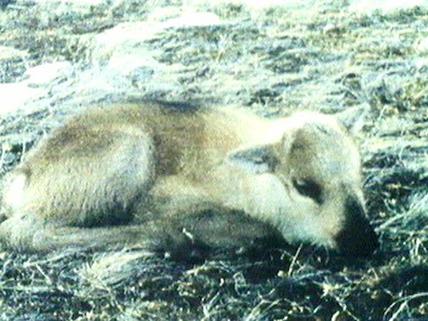
Grainy image of Caribou. From the Film Board of Canada, who gave Boards of Canada a name.
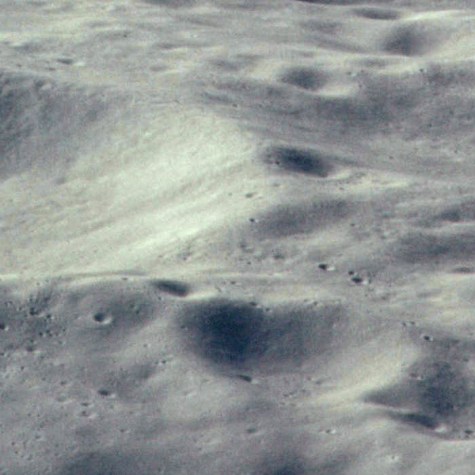
Grainy image of moon surface

Grainy image of Pentagon
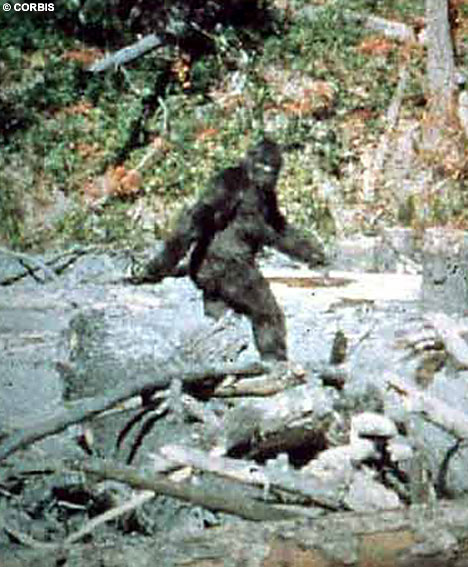
Grainy image of man in a flamboyant hirsute

 Prison Photography