
You are currently browsing the category archive for the ‘Photography: Non-Prison’ category.

In South African slang “pap” means spineless, wet or without character.* Why anyone would want to make a demand for immediate pap (of such a description) is beyond me. And yet, in its chosen company name PapNow! unintentionally hits upon the central tenet of its bilious enterprise – namely a mindless demand for crap.
PapNow! announced itself in June as the place to buy and sell your own celebrity pictures.
The venture takes advantage of the fact everyone has a camera. In my view, PapNow! exploits peoples’ contorted versions of citizenship in a celebrity culture; that they should mimic, stalk and waste time over the looks of others. PapNow! is, one assumes, in it to make money. It is – in the guise of a business model – the reckless, wolfish, jealous little brother of citizen journalism.
Its online presence might just be enough for users to convince themselves PapNow! has value.
There may be other sites like PapNow!; I haven’t bothered the time to do research because I know I’d say the same about each of them. Besides, high value paparazzi shots will always find their monetised routes to the tabloids anyway. My criticism of PapNow! is based purely on how it lowers the bar for entry into the already bottom-feeding paparazzi industry.
The timing is remarkable. Last week, The News of the World scuttled it’s destroyed brand in the wake of the phone hacking scandal that united Britain in disgust. As far as the NOTW is concerned it’s good riddance to bad rubbish, but I worry now that newspapers’ role as arbiters of gossip and candid snaps may be adopted by the docile masses. By process of unconscious assimilation, could the consumers become the producers? Could we end up with a dominant visual culture of only street scuffles, fashion commentary, nipple-slips, antagonism, and up-skirt photography?
Hope not.
By the by, the etymology of the word paparazzi is rather interesting.
* I don’t know if the South African use of the word is innocuous or offensive. If it is rude I don’t want to offend anyone by its use, but the analogy served the argument well.

Ever felt like she looks?
Alberto Lizaralde‘s Frail “is about those everyday moments when everything collapses.”

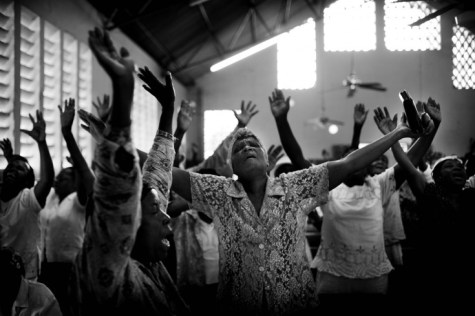
Last week, Danish photojournalist Jan Grarup was awarded the Oskar Barnack Leica Award 2011 for Haiti Aftermath.
COLOUR VS. BLACK AND WHITE
Grarup tells TIME.com: “I want to put some focus on what is going on in other places in the world. […] When you try to photograph things from perspective, you get a little more in-depth of what is happening.”
So, I guess my question is ‘Does colour not exist in the other places of the world?’ Grarup originally shot the images in colour, converting to B&W in post-production. It should be said that not all images in his Barnack entry are part of the original dispatch and so there is a (slight) chance those files were made originally in B&W. [UPDATE 06.22.11, 10:00PST. It could be that as Grarup shot in RGB, and had his screen displaying B&W. It could be that he never intended to use colour. Yet, everything’s colour still, as you look at it through the viewfinder.]
I include shots from his 136-image portfolio, dispatched to his agency NOOR briefly after his stint in Haiti, so you can compare them with the B&W images of his winning portfolio. I’m not here to argue for or against colour and/or B&W – I just want to provide a starting point for conversation.
FABIENNE CHERISMA
As part of my ongoing inquiry into the photojournalism surrounding Fabienne Cherisma’s death, Grarup offered Prison Photography a brief Q&A in March 2010.
Grarup took several photographs of Fabienne Cherisma dead on the collapsed roof-top; it’s an image, I argue, is both multi-authored and synonymous with the Haiti earthquake. Grarup did not include such an image in his Barnack entry, but did include a photograph of Fabienne’s brother and sister over her corpse after she’d been retrieved from the rooftop.
JUROR CONFLICT OF INTEREST?
And to the main issue at hand. Jan Grarup, a member of NOOR Images, was given the award by a five-person jury. One of the jurors was Stanley Greene, a member of NOOR Images.
I should say that, by my reckoning, NOOR is one of the most responsible photo agencies I’ve looked at; it’s stories impress me consistently and they have a couple of my preferred photographers on staff. This is not a distant attack, but a very specific question as to how they could possibly see this one panning out without any questions being asked.
Moreover, the Oskar Barnack Award (OBA) either shouldn’t have allowed Greene on the jury, or if he was so vital to the jury process, they should’ve insisted NOOR photographers needn’t apply. Both NOOR and OBA have exposed themselves unnecessarily to ethical questions.

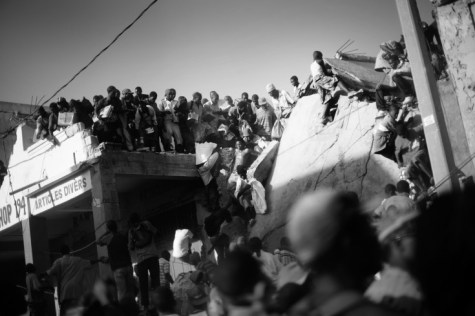

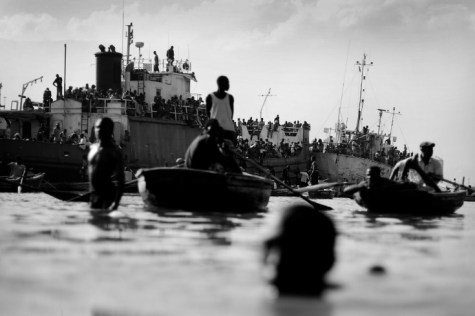
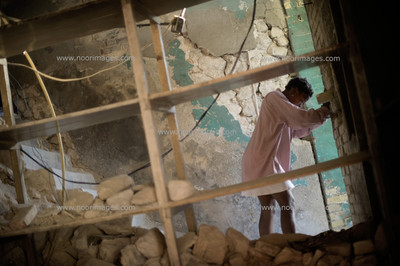

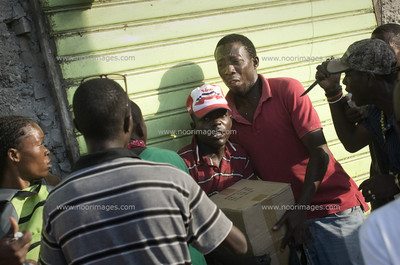
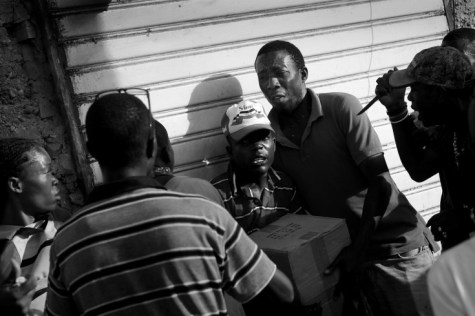
THE PURPOSE OF THIS POST?
1) These images provide anchors to which the endless colour vs. B&W debate can gain some focus.
2) Stanley Greene‘s role as a juror deserves to come under serious scrutiny. As a member of NOOR images, it’s difficult to ignore the conflict of interest.
3) I feel obliged to report on any news, updates and industry awards as they have concerned the photographers involved in my original inquiry.
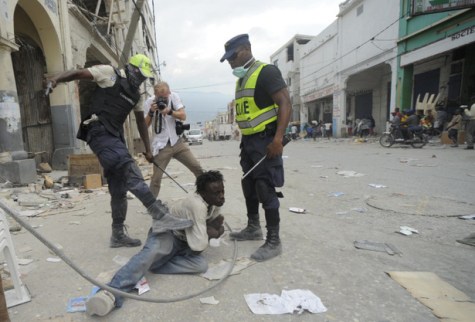
Jan Grarup photographs police beating a looter in downtown Port-au-Prince Tuesday afternoon. © Lucas Oleniuk/Toronto Star.
ALSO IN THE ‘PHOTOGRAPHING FABIENNE’ SERIES
Part One: Fabienne Cherisma (Initial inquiries, Jan Grarup, Olivier Laban Mattei)
Part Two: More on Fabienne Cherisma (Carlos Garcia Rawlins)
Part Three: Furthermore on Fabienne Cherisma (Michael Mullady)
Part Four: Yet more on Fabienne Cherisma (Linsmier, Nathan Weber)
Part Five: Interview with Edward Linsmier
Part Six: Interview with Jan Grarup
Part Seven: Interview with Paul Hansen
Part Eight: Interview with Michael Winiarski
Part Nine: Interview with Nathan Weber
Part Ten: Interview with James Oatway
Part Eleven: Interview with Nick Kozak
Part Twelve: Two Months On (Winiarski/Hansen)
Reporter Rory Carroll Clarifies Some Details
Part Fourteen: Interview with Alon Skuy
Part Fifteen: Conclusions (Matt Levitch, Felix Dlangamandla)
Part Sixteen: Fabienne Cherisma’s Corpse Features at Perpignan (Frederic Sautereau)
Part Seventeen: Brouhaha in Sweden following Award to Paul Hansen for his Image of Fabienne Cherisma (Paul Hansen, Olivier Laban Mattei, James Oatway)
Part Eighteen: A Photo of Fabienne Cherisma by Another Photographer Wins Another Award (Lucas Oleniuk)

© Marjorie Jean-Baptiste/Fotokonbit
After my extended commentaries on photography in Haiti after the January 2010 earthquake, I’d like to bring attention to a non-profit producing and teaching photography workshops and putting cameras in the hands of Haitians.
FotoKonbit is a non-profit organization “created to empower Haitians to tell their own stories through photography. […] Inspired by the Creole word “konbit” which can be defined as the coming together of similar talents in an effort towards a common goal, we use our skills as photographers, educators, and artists to make a positive difference, through photography. By partnering with established Haitian organizations, FotoKonbit is uniquely positioned to inspire hope through creative expression and provide Haitians with the opportunity to document their reality and share it with the largest possible audience.”
The FotoKonbit team is made up of Frederic Dupoux, Ralph Dupoux, Maggie Steber, Marie Arago, Noelle Theard, Tatiana Mora Liautaud and Edwidge Danticat.
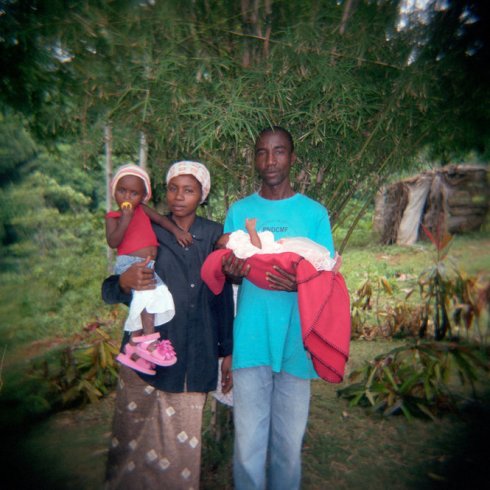
As TIME notes:
One of the most innovative uses for the photographs has been as documentary evidence for aid organizations. During three recent workshops for teenagers and younger adults living in tent communities, participants were asked to photograph aid efforts that they thought were successful, and to demonstrate needs that had not yet been met. Fotokonbit’s partnership with the American Embassy helped to get the work seen by the international aid community in Haiti.
In addition to these laudable humanitarian uses of Haitians photographs, is the simple fact that these images represent something distinctly different to the majority of Western media. How often have we seen naked, entranced worshipers prostrate in the waterfalls of Saut d’Eau? And how often are photographs from Haiti wrought with some outsider hyperbole or gratuitous pain? I don’t want to vilify photographers, especially as many such as Jonas Bendiksen and Louis Quail are committed to nuanced story telling.
Just to say that perhaps the mundane serenity of the landscape photograph below probably would not appear in our mainstream media.
And the market shot is just beautiful.


More images at TIME LightBox.
Well, well, well. All sorts of commentary on the importance of photographs surrounding the assassination of Osama bin Laden and President Obama’s announcement in the East Room with reenactment of his speech for the still cameras.
From the White House Situation Room (now with added memes) and Reuters’ bloody gallery (WARNING: Graphic images of corpses) to whether we deserve or need to see bin Laden’s bullet-riddled head. Then there’s Senator Scott Brown’s faux-pas over a hoax photograph. Not to mention the reported different versions of the actual event.
For all the best articles click on the links over on Raw File Blog’s twitter feed, where I’ve been compiling them all day.
There’s still one photo – to be precise its caption – that is bothering me. And it’s this one:

White House photographer, Pete Souza, captioned the image thus: “President Barack Obama and Vice President Joe Biden, along with members of the national security team, receive an update on the mission against Osama bin Laden in the Situation Room of the White House, May 1, 2011.”
Except everywhere I’ve seen it used, the inference is that the White House team are watching a live feed of the raid on bin Laden’s compound.
They might be, but I want a SOURCE.
It seems to me this image may have been interpreted as one thing at an early stage and because it the narrative tied to the body language is so seductive, no-one has chosen to question it.
I think the reading of the image is massively altered depending on whether you think they’re watching murders in progress or whether they are, for example, waiting nervously for the screen to boot up.
Ryan Singel for Wired.com’s Epicenter blog went as far to say the White House “officials watching what one presumes is the livestream of the Navy Seal raid on Osama’s hideout in Pakistan.”
For all the hullabaloo about this image, no-one is actually sure about what is on THAT screen.
So, does anyone have a solid source saying that they are viewing a live feed of the operation?

“I was have always paid attention to how artists worked in the world, especially with the form known as the Artist Talk where the artist is invited to present his/her works. This form remains intriguing to me. It always seems to involve the following elements: A podium or table; A slide or video projector; Table with glass or bottle of water; A (most of time) inadequate introduction followed by a lecture which is inevitably interrupted by some technical problem that may or may not be resolved; End of lecture; Enthusiastic, polite, or no applause; Someone announces that the artist is willing to answer questions from the audience; Moment of silence; Artists fear and wishes that no questions are forthcoming; Audiences fears and wishes that no questions are forthcoming; Some daring soul inevitably raises his/her hand to ask a good or bad question; artists give good or bad answers; Someone mentions that time has run out; Audience leave while a few people approach the artist to ask him/her more questions; Everyone is escorted out; Artists is invited for a drink or dinner where a polite conversation takes place; Email coordinates are exchanged; Artist is dropped off at a mediocre hotel with an equally mediocre and expensive internet connection.” (Source)
Walid Ra’ad is the recipient of the 2011 Hasselblad Award and founder of the Atlas Group.
I knew something was going on when my blog stats spiked over the weekend. Prison Photography interviews with those who photographed Fabienne Cherisma’s body in Haiti were drawing readers … and they came from Sweden.
PAUL HANSEN’S SPoY WIN
At the Swedish Picture of the Year Awards, photojournalist Paul Hansen was recognised as International News Photographer and won the International News Image for his image of Fabienne (below).
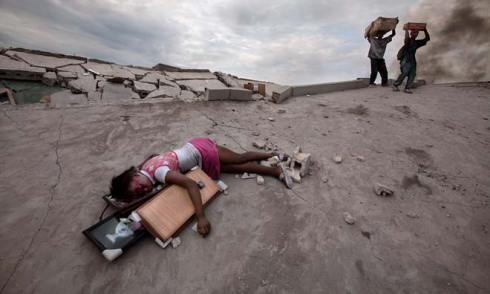
Fifteen year-old Fabienne Cherisma was shot dead by police at approximately 4pm, January 19th, 2010. Photo: Paul Hansen
In March 2010, Hansen answered some of my questions about the circumstances of Fabienne’s death, “For me, Fabienne’s death and her story is a poignant reminder of the need for a society to have basic security – with or without a disaster.”
Paul Hansen was one of eight journalists I quizzed about that fateful day in an inquiry that revealed that 14 photographers were present immediately after Fabienne’s death.
At the time, I noted how the Swedish media and public discussed the ethics of the image and that, by comparison, similar debates were absent elsewhere.
The debate has continued following Hansen’s award, focusing on Nathan Weber’s image (below) that was first published along with my interview with Weber.
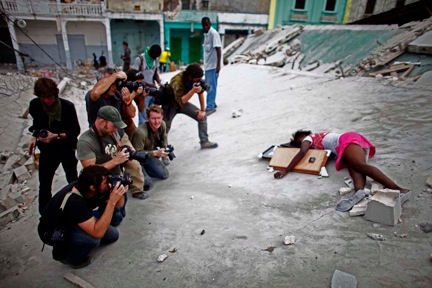
Photo: Nathan Weber
Weber’s image has unsettled many it seems. Judging by garbled Google translations here, here, and here it seems there are a few issues:
– General surprise that Weber’s image – and the revelations it brings – was not widely known before the SPoY award.
– Rhetorical questions about whether – given the scores of photographs made – Hansen’s image was “the best.”
– The expected accusations of exploitation and vulture behaviour by photographers.
– Fruitless thoughts on “truth” within this particular image.
Before they awarded Hansen, I wonder if SPoY were aware that so many photographers were present? Would it have altered the final decision? The image of Fabienne limp on the collapsed roof (whoever made a version) is the summary of innocent death, a society’s desperation and the man-made tragedies that compound natural disasters. It’s is a striking vision.
The circulation of Weber’s image has fueled skepticism toward photojournalism.
The problem with these types of brouhaha is that never are they able to measure if or what effect images – in this case Hansen’s – have. Did Hansen’s image secure a dollar amount of donations for the Haitian relief effort? Did it mobilise professionals and resources that would have otherwise not have moved?
If we are to talk about the “power of photography” then shouldn’t we expect and/or propose criteria for measuring and defining that “power”?
MICHAEL WINIARSKI, REPORTER AND HANSEN’S PARTNER
It should also be noted that Michael Winairski won the the award for News Storyteller from Dagens Nyheter, the national news outlet he and Hansen work for. When I contacted Winiarski last year about coverage of Fabienne’s death, I was particularly impressed with his transparency and commitment to the story. He and Hansen followed up two months after the killing and met with Fabienne’s family.
On receipt of the award, Winiarksi said, “”I’m glad we did not let go of Haiti. I and the photographer Paul Hansen have been back twice. And Paul is down there now with another reporter, Ole Roth Borg.”
ACCOLADES AFTER RECORDING DEATH
Paul Hansen is not the first photographer to be awarded for coverage of Fabienne’s death.
James Oatway won an Award of Excellence at POYi in the Impact 2010 – Multimedia category for Everything is Broken. Fabienne’s corpse open the piece and appears again in images 25 to 33. Olivier Laban-Mattei won the Grand Prix Paris Match 2010 for his coverage of Haiti, including the aftermath of Fabienne’s death. Fredric Sautereau was nominated for Visa d’Or News at Perpignan for his coverage of Haiti, which include seven images about Fabienne’s death.
There may be others.
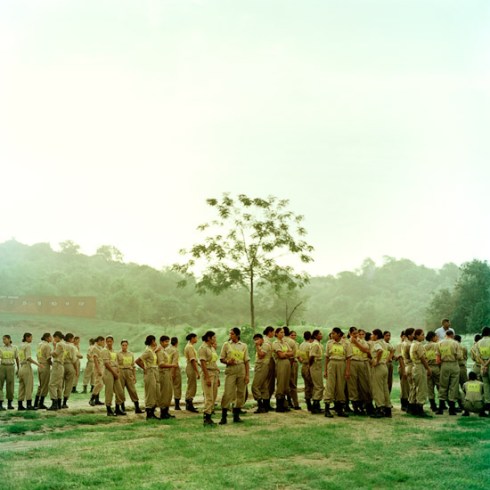
© Poulomi Basu
The border areas between India and Pakistan are dangerous and in many areas lawless.
Indian women have very recently become part of the military response to arms dealing, drug smuggling and people trafficking.
“On September 2009, India’s first ever batch of women soldiers of The Border Security Armed Force were deployed in these infamous borders of Punjab, Jammu & Kashmir as the country’s first line of defence,” says Basu.
Poulomi Basu spent time with the young women (aged 17-25), both Hindus and Muslims, at boot camps, homes and on the front-line documenting their “transformation from women to soldiers.”
Basu believes these women are not only fighting their enemies but also the military tradition and the attitudes of a patriarchal society. Less than 1% of India’s 1.2 million armed forces are women.
To Conquer Her Land is about new forms of stress – related to combatant life – that has never existed for Indian women before in history. Basu says To Conquer Her Land wrestles with “intricate issues of conflict, psychological warfare, class, youth, gender, love, peace, the concept of home, an undefined idea of patriotism, and the strength of the mind.”
The series is a beguiling mix of fine art portraiture, B&W documentary images and PJ style theatre-of-war shots. The mixture can be quite disorienting; blurry B&W akin to Japanese art photography interrupted by delicate double and group portraits in colour. Basu even goes all Robert-Capa on us!
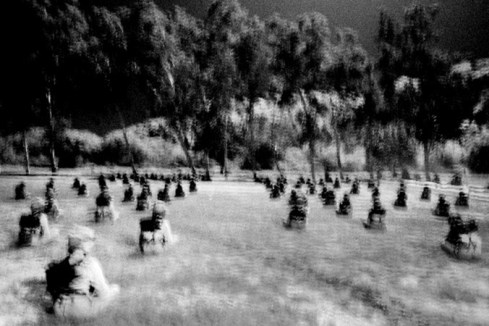
© Poulomi Basu
ALSO WORTH A LOOK
Photographer, Rachel Papo’s Serial #3817131 follows young Israeli girls through the mandatory military service.
Papo and Basu’s work have things in common, although Papo’s work is concerned with her own biography. Papo says, “Serial #3817131 represents my effort to come to terms with the experiences of being a soldier from the perspective of an adult. My service had been a period of utter loneliness, mixed with apathy and pensiveness, and at the time I was too young to understand it all. Through the camera’s lens, I tried to reconstruct facets of my military life, hopeful to reconcile matters that had been left unresolved.”

 Prison Photography