
You are currently browsing the category archive for the ‘Photography: Non-Prison’ category.

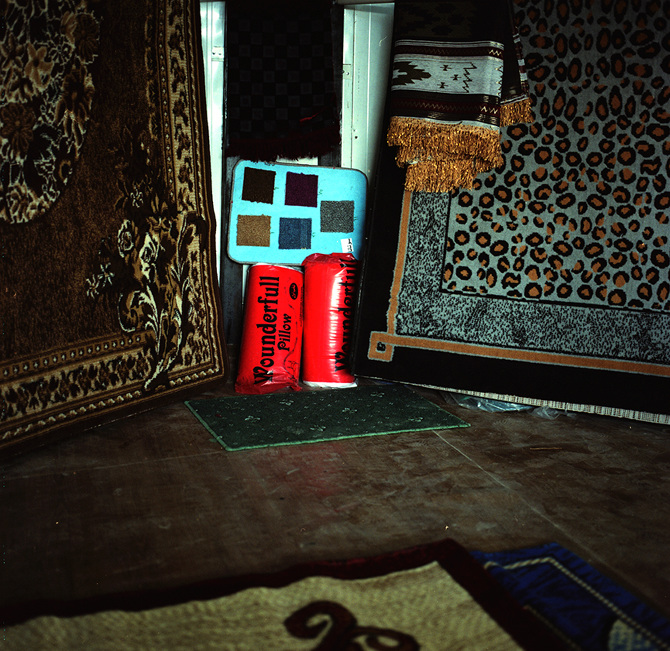
Rashed, 14, leaves the camp to buy furniture from Jordanian merchants and comes back to sell it, much as his family once did back home.
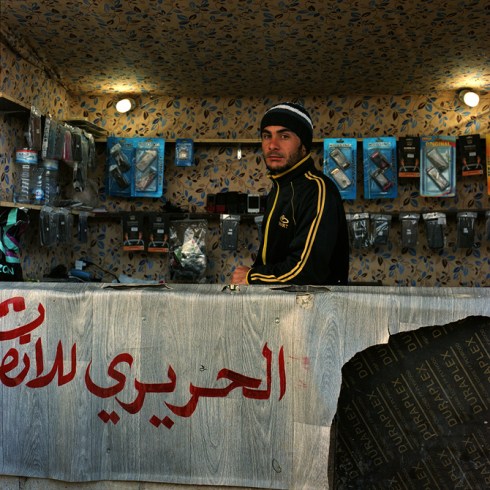
Toufic Beyhum‘s photographs of the Za’atari refugee camp in Jordan provide a look into the makeshift pastimes and work as well as the daily mundane activities of Syrian refugees. His series Champs Elysées focuses on the retail and food stands along the central road in Za’atari nicknamed Champs Elysées by French aid workers.
This body of work is more interesting than many others emerging from the Syrian conflict. There are no bombs here, but there is trauma. That trauma though isn’t immediately apparent. We’ve got to dig deep into Beyhum’s photographs.
Beyhum’s focus on small-scale trade is instantly connective; there’s no society in the world that doesn’t move about the continuous modest commercial negotiations. Beyhum shows us the less fraught but no-less-important side of the Syrian conflict and the refugee resettlement.
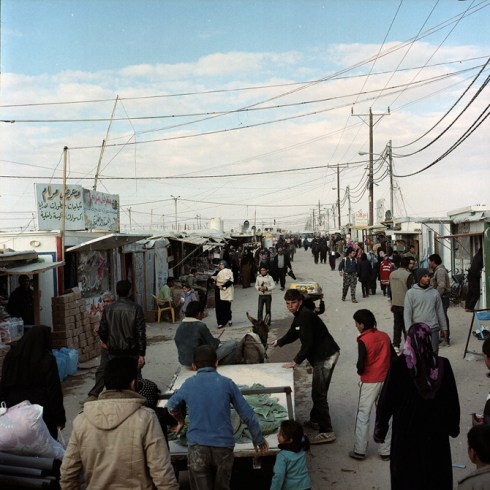
How do cities, wanted or not, develop? How do humans resettle? And what happens if that resettlement is involuntary? Refugee camps are a hive of struggle and psychological trauma, but they are also a hive of survival and continuing on. Of course, the degree to how much refugees want to live on, move on, accommodate and adapt in camps differs hugely. In Western Sahara, for example, refugee camps have housed Sahwaris who fled war over 38 years and the definitions of “home” are under great assault.
One hopes that Za-atari and Syria’s other refugee camps won’t be the “home” for repeated generations. Za’atari is home to an estimated 130,000 Syrians. It is only 3 years old. It is now the 4th largest city in Jordan. It’s an extraordinary place for all the wrong reasons.
The world tends to think of refugee camps as a necessary inconvenience — as better than war, and as the most stable iteration of displacement. Refugees, on the other hand, are daily reminded of lost goods, careers, projects and anchoring points of pride from their former lives (a French psychologist talks about this very well in this VICE feature, Syria: Ground Zero shot by Robert King).
Beyhum’s series, I think, expertly patrols those gaps between subject and audience’s perceptions.
PHOTOGRAPHY’S ROLE
Before digging a little deeper into Beyhum’s work I want make a nod to work made by NOOR photographers at the turn of the year that simultaneously documented the camp and provided opportunities for refugees to make new family portraits. VICE:
Nina Berman, Andrea Bruce, Alixandra Fazzina, and Stanley Greene — supported by the UN Refugee Agency (UNHCR) and Japan Emergency NGOs (JEN) — turned a large tent into a photo booth where refugees could come and have their portraits made. Refugees were asked to bring an object they cherished or, if they didn’t have anything, to bring a person they loved. A boy came wrapped in his blanket. A man brought his shisha pipe. A mother posed with her five children. In all, about 300 portraits were printed on the spot and given to people to keep.
Beyhum‘s series Champs Elysées strikes me as a worthy project for attention. He used film. He self-funded. He partnered with writer Nadim Dimechkie, whose words appear below in italics.
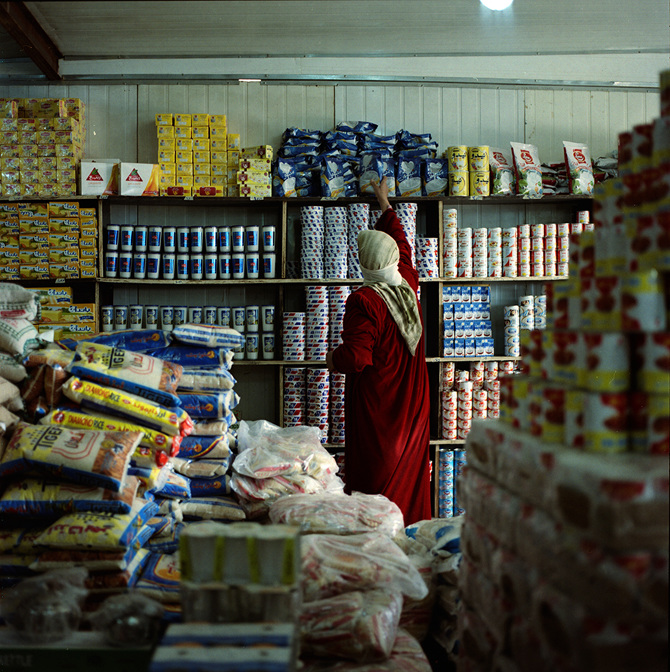
There are common attributes to all refugee camps (devastating stories of different degrees) but Beyhum identified one of the defining characteristics of Za’atari — the extraordinary growth of independent businesses. According to UNHCR’s Andreas Needham, is the growth has been “impressive compared with other refugee camps.”
Eighteen months after the camp’s establishment there were 2,500 shops, and 700 on the Champs-Elysées alone.
So while I’d argue that photography’s role is to give subjects a voice, gift or benefit (e.g. NOOR’s portrait studio) its role is also to usher audiences into the psychological territory of the subjects. The shops and shop-owners in Beyhum’s series are perfect vehicles in explaining to us far-away and comfortable consumers that the Za-atari refugee camp is a place of making do.
Beyhum’s images must remind us however that survival is only partly related to the aid-organisations’ food and shelter that provide physical security. Survival has as much to do with forging ones own spaces, purpose, pride and as a result psychological health.
What a refreshing foil to the photographs of desperate handout and sacks of rice being thrown from atop aid-trucks that we so often see in the media.
Please scroll down to read Dimechkie’s original text that accompanies these images. It provides important context.


‘CHAMPS ELYSEES’ by NADIM DIMECHKIE
The salesman on the Champs-Elysées displays the shiny black shoes in neat, even rows. Each time the wind picks up, each time a truck roars past, they are drowned in billows of fine desert sand. And each time, the salesman dusts the sand off each shoe, wipes it down and places it back in line. Another cloud of sand may come along any moment, but the shoes will stay clean.
130,000 refugees are trying to make a living somewhere they do not wish to live. Most have left their homes, trades, families, and material possessions behind and they want to go back now. But until they do, they must manage with what they have left.
Father-son traditions fostered in the souks of Damascus and Aleppo, and preserved by the protectionism of successive Assad governments, are so ingrained they are almost instinctive. By one reckoning, 80% of the shops hark back to skills honed at home.
Where tradition fails, resourcefulness steps in. There are no cars here, and law and order is the preserve of the UN. So Abdul Mansoor, once a policeman in Syria, now makes phenomenal falafels. Omar was a car mechanic; now he sells second-hand clothes. Mounib established an impressive perfume shop — which he insists is nowhere near as good as the one his family ran in Syria for generations.
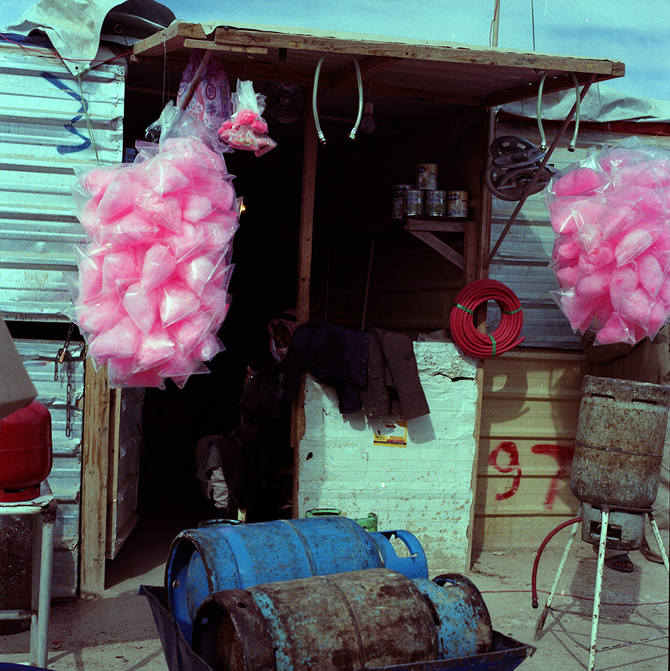
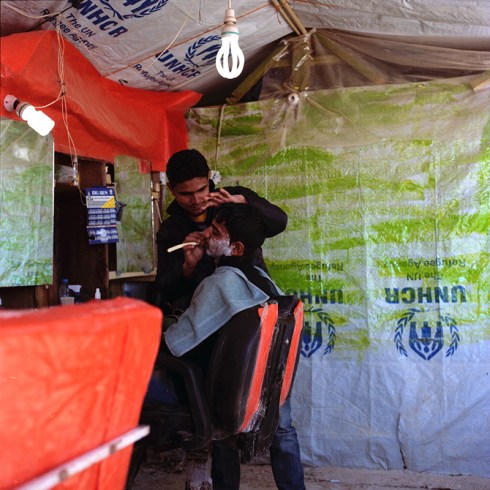
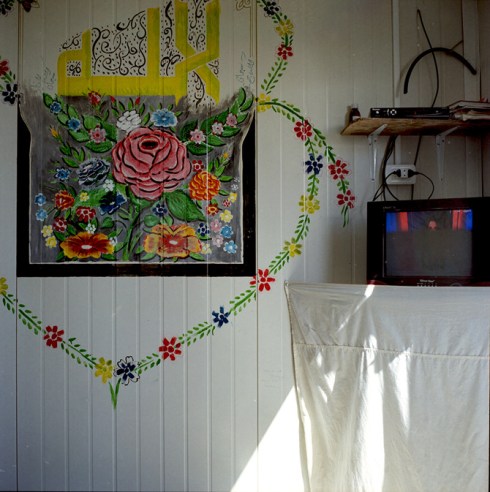
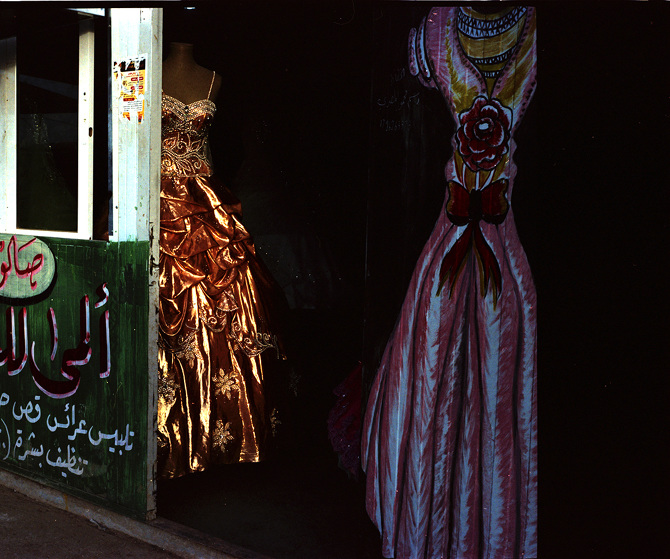
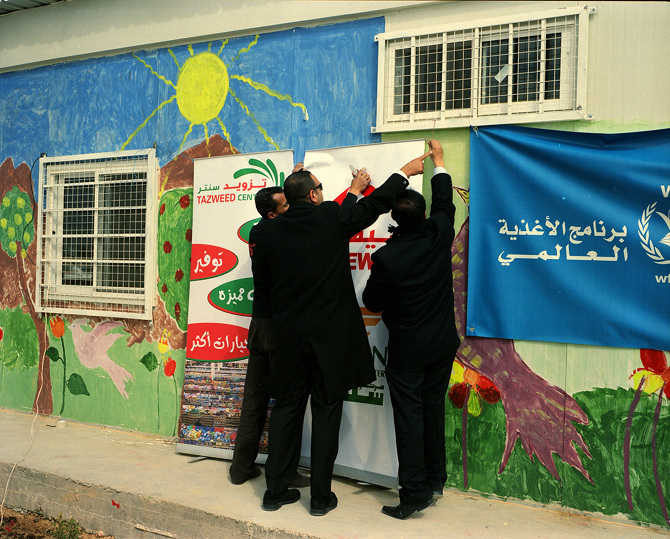

Some jobs have been invented before anyone’s come up with a name for them. What do you call the kids who use wheelbarrows to help people with their shopping for tips, or to resell UNHCR blankets and tents so they can buy what they really need? What do you call the welder-joiners who fuse impossible things from impossible combinations of materials, or the makers of custom-made flat-bed trolleys designed to shift shipping-container homes between buyers and sellers?
Small gardens grow in infertile ground. Bottled water is still sold even though water filtration units have been closed down. Recently, someone stuck a whole police station on wheels and dropped it off somewhere they felt was more appropriate.
The ‘Mayor of Za’atari’, UN Special Field Coordinator Kilian Kleinschmidt, appreciates their entrepreneurial nature. Refugees are building their own amenities, like showers and toilets and kitchens. Even if this is sometimes using illicit materials, Kleinschmidt prefers to see refugees build facilities proactively than wait to receive them. Elements of their success are also down to other factors: there are 193 NGOs here, including UNHCR who provide blankets for warmth, containers for homes and security for business to thrive.
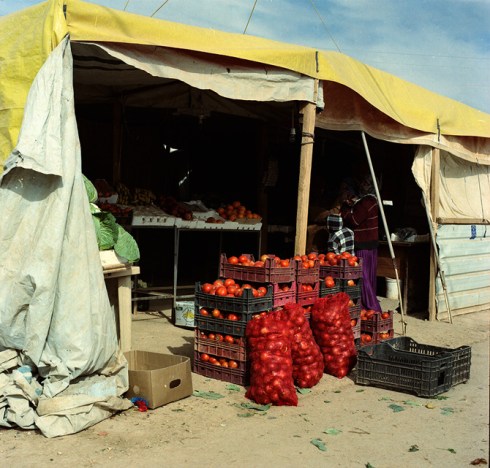


Atallah revived the family bakery from Syria and set up shop in Za’atari.

Some business-owners benefited from existing ties with Jordanian pre-war business partners and set up an enormous supermarket in the centre of Za’atari.
Of course, not all of the attributes brought by the empty-handed are good ones. Fear has also followed them—of government informers, of ISIS informers, of the mafia. Criminality, which characterized the town of Dara’a from which many of the refugees fled, has followed many of them too.
A combination of good governance and the opportunity for dignity has quelled many of these less desirable elements, while providing opportunities for the better instincts to grow. For some, there is even excitement here—in the relative law and order, in the electricity (which some Syrian villagers had never had on tap before), in the entrepreneurial opportunities. But nobody wants to be here.
For all their ability to survive the present moment, no one can build lasting happiness here, for that would mean accepting their fate. Still, there is enough tradition and resourcefulness to make life bearable.
And there is always pride — another resource from within. Pride keeps the streets tidy and the wedding dresses moving. Pride keeps the homes orderly, the teenaged boys groomed and fragrant, the barbershops busy. Pride keeps the shoe salesman in business.
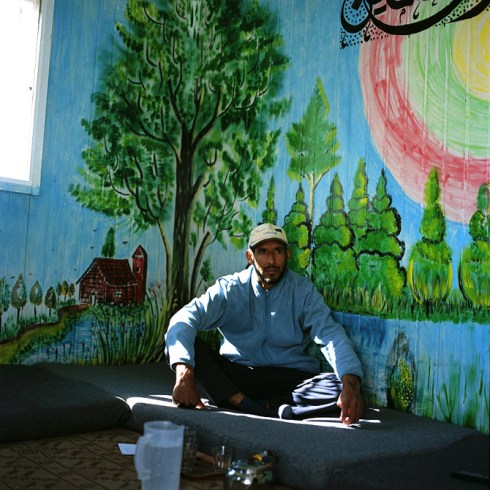

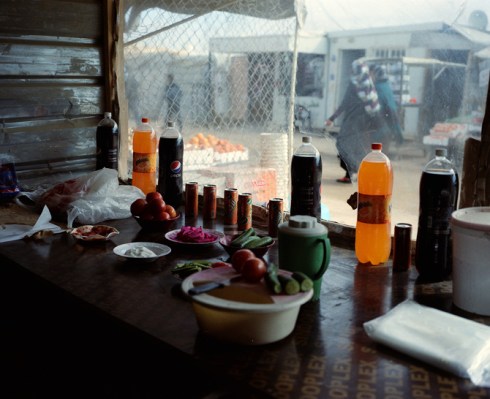
All images: Toufic Beyhum
Introduction: Pete Brook
Text: Nadim Dimechkie

“By definition, a government has no conscience. Sometimes it has a policy, but nothing more.”
— Albert Camus.
Photographer Tomas Van Houtryve puts the above quote top and center of his most recent artist statement. He believes that human activity becomes increasingly absurd and dangerous when it loses empathy.
Researching my latest WIRED piece Here’s What Drone Attacks in America Would Look Like about Van Houtryve’s Blue Sky Days, I was shocked by the number of civilians killed by U.S. drone strikes in Pakistan, Afghanistan, Yemen and Somalia.
“The Obama administration doesn’t release a lot of details, so firm figures are hard to come by. But the Bureau of Investigative Journalism estimates unmanned aerial vehicles have killed between 2,296 and 3,718 people, as many as 957 of them civilians,” I wrote.
President Obama’s Drone War is not widely discussed. Drones operate remotely and forge the very distance that prevents a critical look at their continued use. Drones dismantle empathy.
If a technology with extremely powerful spying and killing capabilities is shielded from public scrutiny there is bound to be abuse,” says Van Houtryve.
WHAT’S IN OUR WORLD?
Art can foster empathy. At least, that’s an aim of political art, no? There are many worthy projects that have co-opted and subverted drone visuals:
Jamie Bridle traces drone shadows in the streets and launched Dronestagram to populate social media with satellite views of drone strike sites; John Vigg surveilled drone research labs and airports; Trevor Paglen photographed drones at distance; Josh Begley’s App MetaData alerts users to drone strikes; and Raphaella Dallaporte took a drone to Afghanistan to do some archaeological surveying.
Most recently, a JR-inspired Inside Out project named Not A Bug Splat is tweaking the consciences of drone “pilots” by laying massive pictures of children in strike zones. However, the novelty (still) of these projects suggests we are not well-versed in drone operations.
WHAT’S IN A WORD?
Furthermore, I worry about how the definition of the word “drone” is shifting. When we hear “drone” do we think about military-grade killer robots or about newer domestic-use quadcopters?
The photo and video world has embraced smaller, non-lethal drones — we oohed and aahed at this aerial surf video and we protested when the police forced down a drone flown over a traffic accident by an off-duty photojournalist.
Soon, a small drone will be a part of every photographers kit.
Also, new legislation is being written to catch up with the technology and the proliferation of public drone ownership and operation. The FAA had self-appointed itself as the authority on drone use and looked disapprovingly at Joe Public sending lil’ aircraft up in the air. So, the FAA started sending out cease and desist letters and $10,000 fine threats.
The recipients — commercial photographers — weren’t threatening homeland security; they were mostly using camera-mounted drones to map agriculture, oil fields and the like. One commercial drone user, Raphael Pirker, challenged his fine in court. He won and nullified the FAA’s authority over him or any other drone operator.
“Pirker’s attorney maintained that the FAA could not simply declare a regulation without having a public notice-and-comment period. His argument went like this: Congress has delegated to its bureaucracy the authority to make rules, but when new regulations have a substantial impact on the general public, the government must have hearings and take comments,” wrote David Kravets for WIRED.
Until those hearings, it is a free-for-all. We must just hope that creepy idiots who want to spy through windows are the exception.
There’s a third player in the mix though. Between the everyday citizen and the military industrial complex are corporations. Who would bet against Amazon actually delivering your slippers by drone? Or Facebook delivering WiFi via drones to the entire globe in the next decade?
Overall, we hope that citizens retain access to the use of drones just as corporations and the state do. We hope citizens’ drone use is protected by laws similar to those allowing street photography on public thoroughfares.
NEW WORDS IN OUR WORLD
‘Drone’ is a new word in photography. ‘Selfie’ is a new word in photography too. In fact, the emergence of the two words was almost parallel.
The earliest usage of the word selfie can be traced to an ABC Online Australian internet forum, on 13 September 2002. Just seven weeks later, on November 3rd 2002, the first ever lethal U.S. drone strike hit Yemen, killing six.
At the turn of the millennium neither the words drone or selfie, as we know understand them, were in our lexicon. I’d argue the definition of both terms is ongoing apace, but for different reasons. Drone visuals and facts are obscured; we must search them out. Selfie visuals, on the other hand, are impossible to avoid.
At some level, the selfie provides the everyday citizen a type of agency and incorporates our foibles, connectedness, and our awkward relationships with social media. Selfies may not be inherently humanizing but they are individually created and do reflect human idiosyncrasy.
By comparison, drone scopes reduce humans to video-mediated targets. Drone visuals eradicate individuality and of course, very literally snuff out human life. The selfie is, spoken of at least, as a completely controllable form, whereas the drone is an apparatus of control. It’s bottom-up liberation vs. top-down oppression.
The drone and the selfie inhabit different ends of an image spectrum. Both in terms of production and consumption, the selfie is all us and the drone is all them. We know us well. We don’t know them at all.
That these are two of the main new words we are processing together as a culture is intriguing to me.
These are just thoughts out loud and may or may not lead to more fleshed out criticism, but the near-simultaneous emergence and widespread use of the words “drone” and “selfie” alongside their contrasting correlation to human consciousness in our remotely-networked globe might provide fodder for further investigation.

Srey Neth and Lia move into the STAR House, a secondary transition home designed to help victims of sex trafficking to learn the skills to reintegrate into society without falling back to sex work. The teenagers are residents of Transitions Global and have experienced horrific physical and mental abuse largely at the hands of their fellow Cambodians. Photo: Tim Matsui, 2012 Women’s Initiative Grant Winner
The Alexia Foundation has opened its call for entries for the 2014 Women’s Initiative Grant.
There’s a lot of grants out there but the Alexia Foundation Women’s Initiative Grant is one of the best. Why? Firstly, it’s a large amount of money: $25,000. That’s the type of money needed to get at an issue in any depth. Secondly, the expectations are high. The winner has six months to produce the work and then is encouraged to plug in the product (and the lessons within) to a host of diverse media outlets. Thirdly, it is about women and their needs. When U.S. females earn 77 cents for every dollar a male earns; when women are trafficked worldwide; when women are bearing the brunt of holding together families and communities in the face of the prison industrial complex; when women face issues such as these and others which are part of routine gender violence, the Alexia Foundation is making it’s contribution to bring these issues to the table.
I am also a big fan of journalist Tim Matsui who was awarded the 2012 Women’s Initiative Grant. His project Leaving the Life is about domestic juvenile sex trafficking. Latest update here. A trailer for a film ‘The Long Night’ which accompanies the project and produced by MediaStorm can be viewed here.
Photojournalists worldwide are encouraged to apply to the Women’s Initiative Grant. Deadline: June 30, 2014.
From the press release:
Unlike the first Women’s Initiative grant, which specifically focused on abuse of women in the United States, this call for entries is intended to permit the photographer to propose a serious documentary photographic or multimedia project encompassing any issue involving women anywhere in the world.
While considering the idea of women’s issues, several themes have been suggested, including femininity and the culture of abuse; women making a difference, leading, changing things for the better; gender inequality; the direct connection to women and education, and the impact on birth rates, health of children and the productivity of the women; gender discrimination, women in leadership, women in the military, mental health issues. They are by no means intended to influence proposals, but they may help photographers start thinking about this topic.
The Alexia Foundation’s main purpose is to encourage and help photojournalists create stories that drive change. While our traditional grant guidelines put no limits on the subject matter for grant proposals, a number of proposals about women’s rights in the last few years have been so powerful that we have been compelled to create a grant specifically on issues relating to women.
Winner announced Sept. 1, 2014.
Winner has six months to complete project, by March 1, 2015.
Contact Eileen Mignoni at grants@alexiafoundation.org with any inquiries.
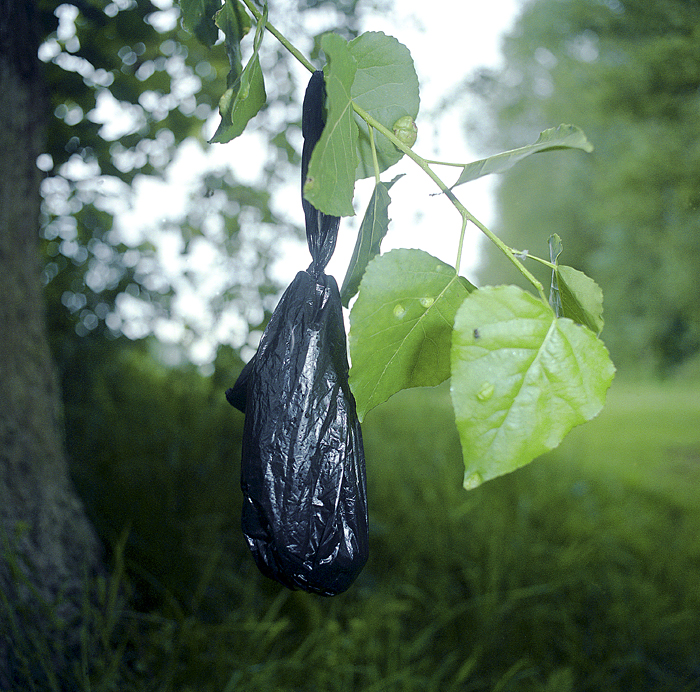
I’ve celebrated John Darwell‘s project Discarded Dog Shit Bags (DDSB) once before. Happy to note that the work is now available as a photo book.
DDSB is just about bonkers enough; it is left-field (in all fields, actually, and steaming) and DDSB proves there is a photo project for absolutely everything.
“I began to notice the appearance of dog shit bags,” explains Darwell, whose 2011 project chronicles the growing epidemic. “At first I spotted them tucked away in dry stone walls or behind said wall. But then they began to appear everywhere, hanging on fences and thrown into bushes. Anywhere they could be found they would be.”

While seemingly silly and scatalogical, the project points to a real issue that many city-dwellers feel is out of control. Americans own 83.3 million pet dogs. In Europe, the figure is 60 million, including 8.5 million in Britain. Those big stats mean it only takes a small proportion of irresponsible owners to make an unsightly mess.
Darwell’s not showing anything that the vast majority of people haven’t seen before — and it’s the familiarity with the images that calls attention to the problem. In the past, Darwell has documented other environmental issues, including various nuclear sites, like Chernobyl, but when he’s not been working on long-term projects he’s been at home in rural Cumbria, England, walking his dogs.
“The local parks became particularly troublesome but even beauty spots were not immune,” says Darwell. “Why go to the trouble of bagging your pooch’s poop to then simply chuck into a bush or hang on a railing?”


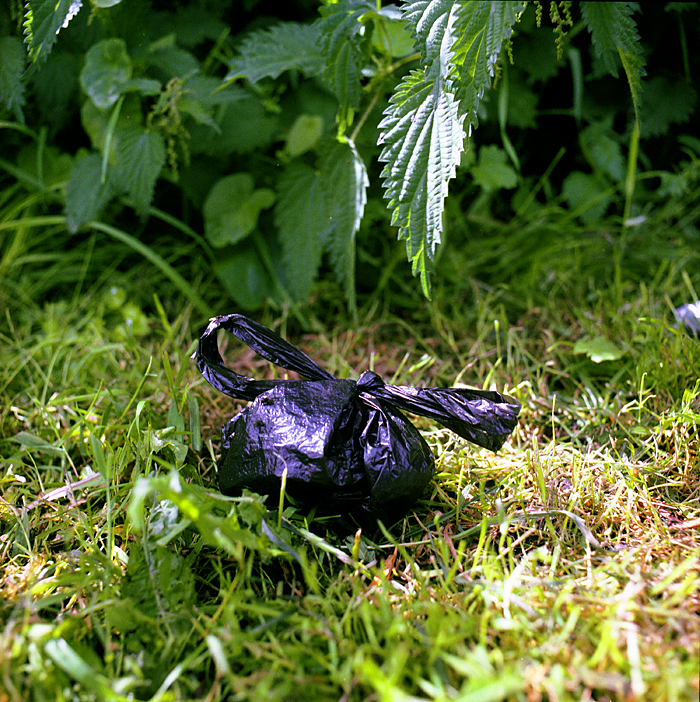
For Darwell, the whole affair has descended into a turdy farce with no behavioral logic.
“I photographed the same dog shit bag twice, a year apart and it still hangs in exactly the same place! There is a move to encourage people to use biodegradable poop bags. So the owner bags the poop then hangs it in the tree, the bag biodegrades and the poop falls to the ground where it was originally. Do you then re-bag the poop? The more you think about it the more insane it becomes.”
Even “dog wardens” in Darwell’s local park haven’t been able to curb the madness.
“They watch dog walkers through binoculars to make sure they bag the poop … but they don’t watch what then happens to the bag.”
Flinging bags of poo tends to be something dog owners try to do unobserved. For all his poop stalking, Darwell has only once witnessed a dog owner chuck a bag away, and it wasn’t the type of person you’d expect. “It was a little old lady,” says Darwell. “She chucked it in the river! I was gobsmacked.”
On that occasion the log floated out of sight and out of mind, but another time Darwell spotted a bobbing bagged doo-doo and chased it down. It was like that plastic bag scene from American Beauty but instead of airborne, Darwell’s polyethylene muse was half-submerged and struggling to keep its turtle head above the surface. “I was amazed it floated,” he says.


UK citizens aren’t the only ones walking alongside their four-legged friends straight into a canine-gut-stew-terror. On an Australian beach, Darwell found himself surrounded with yellow dog poo bags. In Germany, the bags are red, but you see fewer of them, as the Germans provide more bins, says Darwell, who has extended his stool survey internationally.
The British are, on available evidence, a resourceful bunch using any plastic sheaths they have at hand — nappy bags, shopping bags, etc. But for Darwell, all of this is just doubling the problem, not containing it. He wonders if leaving it to biodegrade might be a better solution. “Yes, I know there are, or can be, serious health implications, but then the poo would disappear in a matter of days,” he says.
This universality of bagging and discarding hit home when a magazine editor in Seattle asked Darwell to stop by his office to discuss his pictures. The editor was amazed to find out Darwell was from England — he thought he recognized the bags from his local park.
Home or away, DDSB has clearly struck a chord with folk. Laughably, often it is a conversation starter for Darwell.
“It’s amazing how many people now say, ‘John, I saw a dog shit bag yesterday and immediately thought of you.’”
Darwell has pinched this particular series off but his fecal fascination has not entirely run its course. He may follow through with a different angle.
“I notice a lot of people walking along with the tell-tale bag hanging from their hands vainly looking for a bin to dispose of the offending item,” says Darwell. “I’ve toyed with the idea of developing a new body of work of portraits of people carrying bags.”
The book DDSBs is now available through mynewtpress in signed and numbered limited editions.
John Darwell was part of the group show Confined (2011) at Bluecoats Gallery in Liverpool, the catalogue for which I wrote the foreword.
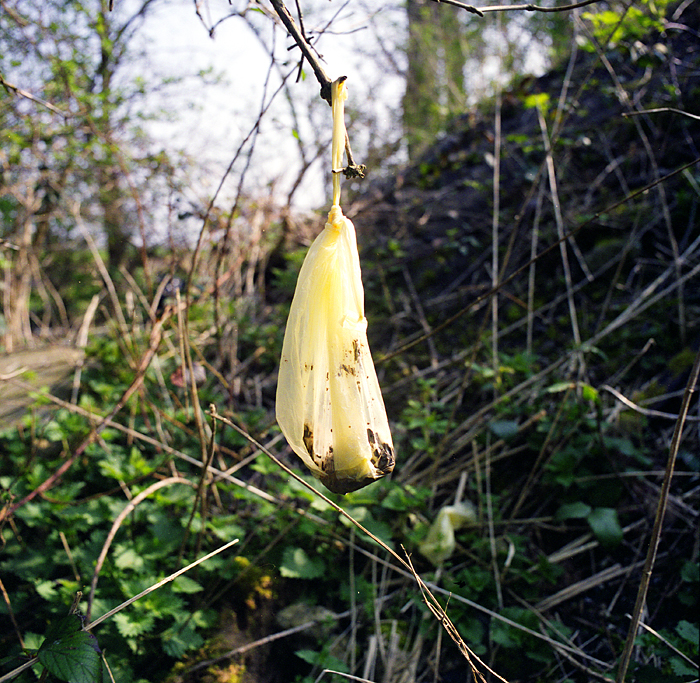
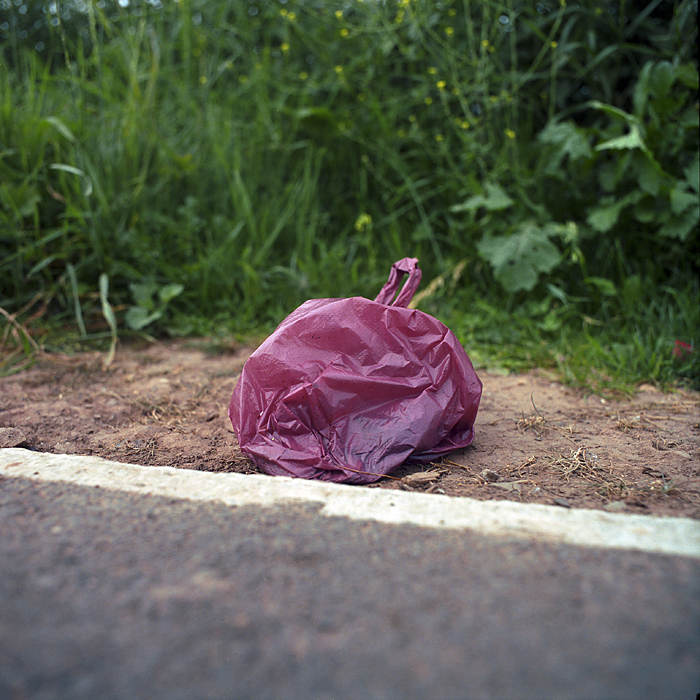
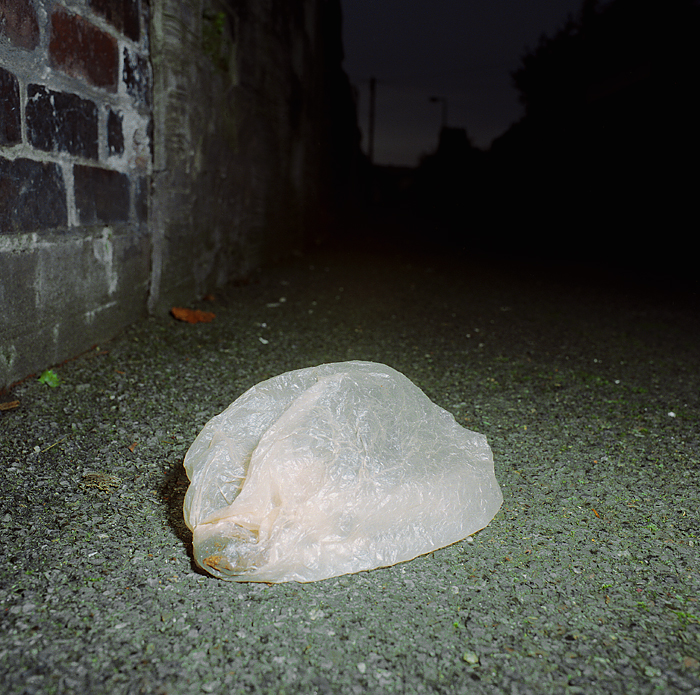
All images: John Darwell
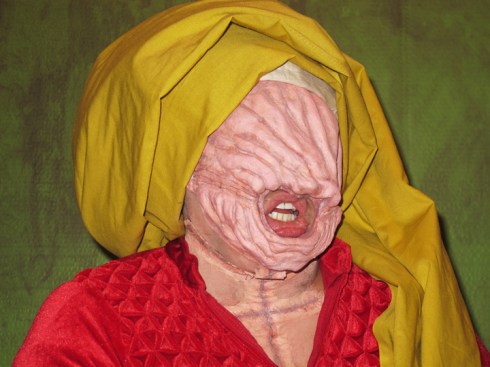
Kansas, MO and Brooklyn, NY based artist Jaimie Warren is the recipient of the 2014 Baum Award for an Emerging American Photographer. This is a curious selection for many reasons — all of them good.
Firstly, I wasn’t aware of Warren’s practice; even though she has a Wikipedia page and a long history with VICE, I had not come across Warren’s work before. I am glad I did.
Secondly, her work is wacky. The meanings of her images are elusive and you’ve got work hard with them. As many photographic artists do, Warren plays with ideas of fantasy, fun, performance and artifice, but she does so in much more aggressive, brazen way. These are not the cool, clinical images of studio assemblages we see from many young (MFA-bearing) image-makers.


I really, really enjoy Warren’s disfigured portraits and tableaus. They’re pop, they’re a bit grotesque, they cinch perfectly into the shock-visuals of audiences habituated to the Tumblr-driven flow of images. Warren’s work is Peewee Herman meets Carnivale meets that bonkers Halloween party you went to in 1997.
Thirdly, it is great to see an award go to a photographer who isn’t just a photographer. For all the intelligent image detournement in her work, Warren is not operating from a fine art ivory tower. Quite the opposite. Central to Warren’s work is constant collaboration with communities. Her main vehicle for making art is the non-profit community arts initiative Whoop Dee Doo.
Whoop Dee Doo works with communities “to create unique and memorable events that challenge the everyday art venue or community event.” Everything from concept to end product is intended to fit the needs of host communities, and all acts are “truly inclusive endeavors that celebrate differences and unabashed self-expression.”
Probably the best and quickest way to get a handle on the art and performances is to view the Whoop Dee Doo Vimeo Channel.
Whoop Dee Doo has worked with youth programs including Caldera Arts (Portland/Sisters, OR), Operation Breakthrough (Kansas City), the Boys & Girls Club (Kansas City), Big Brother/Big Sister (Kansas City), Girls, Inc. (Omaha, NE), Experimental Station’s Blackstone Bicycle youth Program (Chicago, IL), Urgent, Inc. and the Rites of Passage Program (Miami, FL), Muse 360 and 901 arts (Baltimore, MD), as well as college interns at the University of Central Missouri, Pacific Northwest College of Art, the Kansas City Art Institute, the University of Chicago, Maryland Institute College of Art, Rockhurst University, and the Pennsylvania Academy of Fine Arts.
Impressive.

Jaimie Warren, Self-portrait as Bulls fan in La Jeunesse de Bacchus by William-Adolphe Bouguereau/Michael Jordan basketball painting by dosysod of the Independents, 2012.
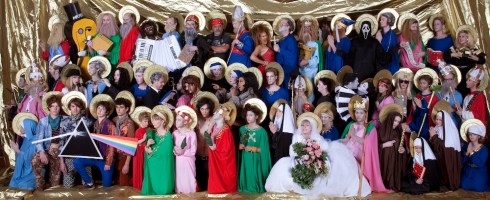
Jaimie Warren, Self-portrait as Nun with some of my Mother’s Favorite Famous People in the Forerunners of Christ with Saints and Martyrs of the Fiesole San Domenico Altarpiece by Fra Angelic, 2014.
From looking over the portfolios, I reckon the folky-rainbow-eclecticism of Warren and her collaborators’ work reflects something close to common feeling. What else could there by except fun, wild variance and complexity when the hands of dozens go into making something?
Breaking down stereotypes and barriers between age, gender, culture and sub-culture is one of Whoop Dee Doo‘s main objectives. The group is open to designing performances and workshops “between unlikely pairings of community members that ultimately blossom into exceptional and meaningful interactions.”
A lot of the time, the use and outcomes of awards can be hard to pin down, but I can’t imagine it’ll be too long before Warren is putting the $10,000 to use making more happenings with communities. Because she always has. Let the merriment continue.


BAUM AWARD
The Baum Award for An Emerging American Photographer is a project established out of the conviction that photography is a powerfully influential medium with the capacity to emotionally connect with audiences in ways that words cannot. This ability to reach people on a visceral level can transform awareness to understanding and lead interest into action – fundamental aspects of a healthy and vital society.
Click here to see previous Baum Award winners.


Photobook “Best-Of” lists sprout like wild-cakes this time of year. Among selections, we are not always guaranteed variety, but we are guaranteed quantity.
Aperture tends to preempt many of the main runners and riders in the autumn with its shortlists for the Aperture/Paris Photo Book Awards (30 books total). Then the deluge beings.
A deluge that which Photolia has made an inventory. It’s a list of Photobook “Best-Of-2013” lists; a list of 80+ lists!
Furthermore, QT Luong at Terra Galleria has taken all the individual titles of those 80+ lists, broke down the votes and constructed a meta-list that cumulates each book’s number of votes. Some titles have votes in double figures, and the “winner” Lieko Shiga’s Rasen Kaigan has 22 votes.
By years end, Best-Of lists had been written and checked twice by Wired, American Photo, Time, Mother Jones, New York Times, Dazed Digital, Lens Culture, Washington Post, Brain Pickings, Tom Claxton, Microcord, Eric Gundersen, Conscientious, Tim Clark, Monsters & Madonnas, Valerian and Discipline and Disorder just to name a few.
The Guardian made two lists — one for best indie books and one for offerings by established photobook publishers. Not to mention Alec Soth and Martin Parr‘s eagerly anticipated annual dispatches. Roger May shifted the formula and picked his favorite book purschases . The Artists Book Cooperative maintained their cheeky approach with the year’s worst photobooks.
So what does all this mean? Head to Blake Andrew’s analysis of the best of the “Best-Of photobook lists. Hilarious.
Well, who am I to reject this ubiquity of Photobook “Best-Of” lists? A few weeks ago, I was asked by Photo Eye to name my highlights for the PhotoEye Best Photobooks 2013 feature. I picked seven titles. Here they are. And, below they are.
Bumbata, Cosmin Bumbuţ (Punctum)
 Beyond the prison subject matter which is, of course, very appealing to me, Cosmin Bumbuţ’s book is the best of design with beautiful binding, a punctured front cover, and thoughtful essay. Those elements compliment pictures that are, frankly, some of the closest, least judgmental I have seen of incarcerated peoples. Bumbuţ spent 3 years visiting a single prison. The portrait he paints is of a closed but relatively stable environment with equal representation. Staff and prisoners feature in similar amounts. The variety and color is something beyond that of most American prison photographers. Here is a documentarian who has worked hard to form an understanding with his subjects.
In December, I spoke at length with Bumbuţ about his project and the book.
Tales From The City Of Gold, Jason Larkin (Kehrer Verlag)
 It is astonishing that with such a distinct and consistent approach to image-making that this is Jason Larkin’s first monograph. His work seems so familiar. Once more, the Englishman Larkin has entered (with his 4×5) a peculiar faraway place with peculiar and depressing social and environmental history. Johannesburg is one of the world’s most successful mining cities but waste dumps litter the landscape. South Africans have built communities in the mines’ hinterlands. The price of gold is spiking and the lives of people who live and work in the region is tied to our global commodities market. Larkin casts a curious but not a judgmental eye over our priorities at the dusty and noisy point at which commerce and daily life intersect.
Photojournalists On War, Mike Kamber (University of Texas Press)
 End of year lists often prioritize photo books with fancy design elements; books that are small run, hand-sewn delicate things. But what about those books about photography that are a bit bigger? What about books put out by a large press, such as UT Press, say? And what about books with more text than image? Photojournalists On War is a brick of a book. Mike Kamber interviewed 89 photographers who covered the War on Iraq. If we are to understand the nature of that flawed conflict then we should pay attention to the journalists whose activities were meant to makes sense of it at the time; make sense of it for us. But, what sense do they make of it now? By virtue of the breadth of opinion and depth of questions, Photojournalists On War is THE reference book for any discussion of the War on Iraq and photography. In much the same way as Photographs Not Taken in 2012 delivered us personal reflections and new entry points to photographic thinking, so Photojournalists On War in 2013 surprises and delights with the first-hand and imperfect narratives. Truth is not usually found in a photograph, but perhaps it can be found in a photographer’s words?
Swell, Mateusz Sarello (Instytut Kultury Wizualnej)
 Sea foam smells, threatening birds, big clouds. Swell is a rough experience. As was Mateusz Sarello’s break-up. This book is in two halves. Each half is a visit to the Baltic Sea — the first with his girlfriend, and the second without as part of some therapeutic turn. So different are the images and mood of the images it’s effectively two books in one. Both books’ exposed spines reflect the vulnerability Sarello has embraced in creating a book about his crushed love-life. 88 pages of fragile hand-made loveliness. Handle with care. Given the proliferation of east-of-Western-Europe sea photography projects (think Petrut Calinescu, Rafal Milach, Mila Teshaeiva, Mikhail Mordasov and even Rob Hornstra), it’s tricky to do something novel in this sub-sub-genre, but Sarello pulls it off with focus on the hyperpersonal. And he’s not afraid to use Instax Fujifilm either. I was skeptical at first, but later blown over by the earnestness of the well-edited and understated grouping of images.
Rasen Kaigan, Lieko Shiga (AKAAKA)
 Between 2006 and 2012, Lieko Shiga lived and worked in the region of northeast Japan worst hit by the 2011 Tsunami. Shiga is part photographer and part conceptual artist, so it makes sense that these images (many of which abandon formal photographic considerations) look nothing like the photojournalism we saw in the aftermath of the Tsunami. Darkness, hard-flash, plants, flowers, sweaters, sand and minerals. It’s all very earthy … and strange. But then again, that region is a geography and a collective psychology transformed. Despite Shiga’s camera experiments, we are still presented images of Japanese communities on the mend, making do, building up, tilling the land and doing the simple things that they must. Big disasters are met with small victories. Shiga’s volatile approach is a reminder that the uncomplicated things she photographs only exist because of massive tectonic force.
What might be otherwise read as an assault on the senses is a celebration of the senses — a celebration of life and of living.
Control Order House, Edmund Clark (HERE Press)
 The images are boring; but the concept is exhilarating — which is exactly the point. Edmund Clark photographed the interior of a “home” inhabited by a UK terror suspect under house arrest. A dull suburban 3-bed semi in no-name Britain. Clark worked within pre-agreed, tightly controlled parameters set out by the UK Home Office. Clark and HERE Press include scans of his contracts and official correspondence. The act and the access is more important than the images; the images are only evidence that Clark made a sortie into this never photographed territory before. (In April, I wrote about Control Order House for Wired.)
So many projects these days comment on control from the outside, but here we see images from from within, and according to, control.
Two Rivers, Carolyn Drake (Self-published)
 Carolyn Drake’s photography has long impressed me, so I’m not surprised her first book is a triumph. Dutch book-designer Sybren Kuiper brought considerable style to Two Rivers. Apparently, it was Kuiper who proposed starting the book’s sequence at where the two rivers appear to end versus Drake’s original idea to begin where the rivers originate high in the mountains. Drake has visited the vast expanse of central Asia that lies between the Amu Darya and Syr Darya rivers 15 or more times in recent years. Judging by the images, it remains a region that beguiles Drake. Two Rivers abandons traditional documentary sequencing and reveals the creators own feelings, uncertainties, awe and brief encounters. One slimmer book is words and notes for the chapters in the other larger book containing pictures of fuzzy narrative, refused objectivity and love. The wrap of images around the Japanese style bound pages is stunning.
Carlos Javier Ortiz has been documenting the effects of gun violence on young people in Chicago for over seven years on a project called Too Young To Die. He is currently crowdfunding support to bookend, literally, the work.
We All We Got will be a photography book that brings seven years of Ortiz’ images together with interviews from parents and students from across Chicago and texts by Alex Kotlowitz (producer of the The Interrupters), Luke Anderson (teacher, North Lawndale College Prep) and Miles Harvey (assistant professor, DePaul University) among others.
Ortiz isn’t a flashy guy; he just gets the job done. He’s not only photographed for an extended period in the community but he’s also got involved directly with local organisations. It’s something he’s done for a long time. He’s thinking about solutions to gun violence among youth, which is one of the toughest issues in America.
The project deserves support. I think it’ll get the funds. I hope it does. Spread the word through Facebook, Twitter, Instah.

We All We Got has already had deserved coverage on NPR; New York Times Lens; CBS Evening News; Chicago Ideas Week; Museum of Contemporary Photography; Leica Blog; Pulitzer Center On Crisis Reporting; CNN blog; and CBC radio

Sisters Faisa Farole, 33, left, and Jamila Farole, 28, are among women trying to preserve female-only swim times at the Tukwila Pool. Photo: Erika Schultz / Seattle Times
I’m a week late on sharing this. But it is important. Fox News made unauthorised use of Erika Schultz‘s Seattle Times double portrait. Fox News did so to push a disgusting Islamophobic story about “the rise” of Sharia Law in America. Schultz made her image in the suburbs of Seattle. Fox were commenting on events in Minnesota.
On the Seattle Times website, Schultz made this classy response:
Using my photo to illustrate a story on a swimming program in Minnesota, under the title “Sharia Law: Swim Class for Somali Muslim Girls,” is unfair to the young women in the photo and misleads viewers.
For years, photographers on our staff have worked to develop contacts, trust and story ideas within this region’s many communities—including the East African community. Photographs can be extremely sensitive, but I’ve seen access increase over the years due to positive response to our stories and photo projects.
An incident like this has the power to intrude into those relationships and our future coverage. People may not want to work with media outlets for fear of being portrayed inaccurately.
This out-of-context and misleading use of this image reaffirms the importance of ethical, contextual journalism.
I appreciate the Farole sisters for the courage to stand up for their beliefs, and their willingness to share their story with the larger community to which they belong.
Erika is one of the most responsible journalists I know (we’ve worked together here, here, here and here). Erika works, with sensitivity, on her relationships with subjects over long periods. Fox News is an arrogant and racist idiot-giant that crushes anything that is nuanced or beautiful.
This is a sad turn of events for any photojournalist and for his or her subjects, but it’s particularly frustrating for a professional as diligent as Erika.

 Prison Photography