
You are currently browsing the category archive for the ‘Photojournalism’ category.

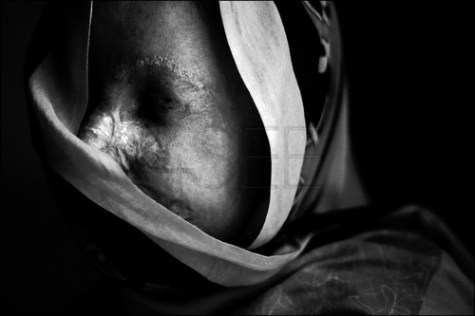
Qamar Jan,18, an Afghan refugee from Peshawar poses at the Ali Medical clinic in Islamabad, June 14, 2007. © Paula Bronstein
In my last post, I suggested the repetition of subject matter in photography is inevitable.
Equally, I’d like to stress that our constant exposure to (predominantly web-based) imagery may likely result in more frequent associations and recall (partial, total, overlapping) between photographers and their works.
Here, I’d like to argue that the gravity of some photography – or rather the gravity of the story it bears witness to – means that ultimately the name of the photographer is inconsequential.
MOTIF, MEME, PERSISTENT THEME
In my last post, I also challenged the notion of plagiarism and inserted the notion of ‘meme’. I was hasty. I used the term ‘meme‘ because meme evolution within host populations can occur without any awareness of said host population; I wanted to infer that repetition, mimicry, copying, mirroring mustn’t always be accorded a conscious origin. Conscious origin is precedent, is ownership, is lawsuit. And I want to live in a world where not everything is subject to ownership and contest.
That said, I want to back-track on the term ‘meme’. Meme is more appropriate for discussing larger shifts, whereas I am really discussing trends. Instead of ‘meme’ I’d prefer to use the term ‘persistent theme’.
FINE ART vs PHOTOJOURNALISM
In Burdeny’s work, the use of a persistent theme (including the minutiae of another artists’ motifs, style) just looks bad. Simply, Burdeny is a prat, but if you want to get uppity you’d argue he has debased artistic notions of respect, brevity and creative integrity.
In the light of Burdeny’s antics (1, 2, 3, 4, 5 & 6), any number criticisms are understandable BUT would anyone level criticisms at photographers in journalism repeating the work of others if it that work pertained to a story that perhaps has not been told enough?

Memona Karachi. 20 years old. Over 30 operations. Attacked by a boy on her way to school. © Izabella Demavlys
ACID ATTACKS: A CRUDE CRIME OF MODERN TIMES
Shouldn’t ‘persistent themes’ in the photography of journalism be judged on different criteria?
Joerg’s post on Izabella Demavlys today recalled the work of Paula Bronstein, Q. Sakamaki, Diego Ibarra, Katherine Kiviat and Emilio Morenatti. (Stan was impassioned by Morenatti’s work recently)
An acid attack is a heinous crime, but made all the worse by lack of awareness, empathy or rehabilitative service. Of course, photography plays second-fiddle to medical intervention in the aftermath of acid attacks, but that is not to say it can’t play its part.
Or are these portraits exploitative? Personally, I don’t think they are. The recurring ‘exploitation’ argument doesn’t develop a discussion – it merely demands you accept or decline the notion of ever-unequal power relations between the operator and subject of a camera. It becomes a discussion about photography and not about the reason the photographer and subject shared a space in the first place.
Personally, again, I don’t think we understand enough about the motives or consequences of these types of brutal attack, and I think portraiture and caption have their role in informing interested parties.
Fortunately, the reports alongside these images describe accessible medical treatment for victims (one woman has had 30 surgeries). More than physical healing though, many of the women have a resolve and psychological determination beyond words. (Read Nick Kristof’s NYT article).

A victim of acid attack stays in the hospital of the Acid Survivors' Foundation. In 2002 Bangladesh introduced very tough laws to try to stop acid throwing, including the death penalty in the most serious cases. However, acid attack is still common in the country -- more than 260 cases in 2005, since "The law is just like a dead law," according to Salma Ali of the Bangladesh National Women Lawyers' Association. Dhaka, Bangladesh, July 12 2006. © Q. Sakamaki
© Diego Ibarra. Portrait of a woman attacked by acid. The consequences of the attacks are for life. Islamabad. Pakistan, May 2009
Saira Liaquat
Both Kiviat and Morenatti photographed Saira Liaquat in the space of a year (the captions for her age must be inaccurate) but opprobrium will never be dealt Kiviat or Morenatti for their repetition.
Saira bears witness to her injustice and both photojournalists help her advocate.
Saira’s name and her story matter, the photographers names really don’t.

Saira Liaquat, 22 yrs, burn victim and survivor, holding an old photograph of herself before she was burned with acid by her husband. Photographed at Saira's parents' home in Lahore, Pakistan on February 7, 2009. Saira is presently working as beautician at the Depilex beauty salon in Lahore, Pakistan. There are presently over 300 cases of burn victims registered in Pakistan. Most victims are between the ages of 14 - 25 years old. Motives vary, but are most frequently obsession, jealousy, suspected infidelity, husband wanting to re-marry, sexual non-cooperation. The face and genitalia are the areas most generally targeted, those guaranteeing complete disfiguration. © Katherine Kiviat/Redux

Louie Palu, a photographer I much admire because of his past photographic exploits has just secured the Alexia Foundation Grant for Professionals. The $15,000 award will allow Palu to continue his project Kandahar.
NPPA quotes Palu:
I don’t think we will, not in today’s media climate that has swung full circle back to great emphasis on the politics of the nine year old conflict.
See Palu’s full proposal and portfolio at the Alexia Foundation website, and view his video work at the Atlantic.
– – –
Juliette Lynch won the Alexia Foundation Grant for Students.
And despite all her amazing work, I just had to post this image (not from her portfolio) of her celebrating the win! I think it deserves an award itself.

Photo by Andrew Maclean. Bruce Strong and Juliette Lynch rejoice as Lynch is named winner of the 2010 Alexia Student Competition. SOURCE
Well done Juliette.
– – –
The Alexia Foundation for World Peace was established by the family of Alexia Tsairis, an honors photojournalism student at the S.I. Newhouse School of Public Communications at Syracuse University who was a victim of the terrorist bombing of Pan Am flight #103 over Lockerbie, Scotland, on December 21, 1988. She was returning home for the Christmas holidays after spending a semester at the Syracuse University London Centre.
DISASTER PHOTOGRAPHY
I ran across the University College Dublin’s Photography & International Conflict project this week. It operates out of UCD’s Institute for American Studies … and it’s awesome.
Or as awesome as something about war can be … or at least the best academic offering on photos and carnage since Photography and Atrocity served up at Leeds University a couple of years ago.
If you fancy going all rogue-scholar then this is the site for you: Imaging, Africa, ethics, Northern Ireland, the political economies of photography, America, Vietnam, the former Yugoslavia and well known academes of the media/photo/critic world.

Anyhoo, this is all by the by, because amongst this thinkers-paradise are some straight video interviews with leading photography editors.
SATURATION POINT
Roger Tooth, Head of Photography for the Guardian UK says (at about 18 minutes and 30 seconds):
I would have thought we are at saturation point for photojournalists, but then you have the colleges churning out thousands of graduates each year, so its all a bit worrying really. I haven’t got a clue what these people are going to do? I would have thought we’ve got enough people to go around at the moment. What I suspect they’ll do in the future, I suspect they’ll do video because that’s going to be the currency.
Well, how’s about that?! Seriously, great site and plenty of food for thought.
Found via the reliably excellent CONTACT blog, which keeps me real with all things Britski.
UPDATE
As if on cue, A Photo Editor has this interview with Vincent Laforet about his switch over to moving images.

© Bob Adelman/Magnum Photos. Washington DC. 1963. At the climax of his "I Have A Dream" speech, Martin Luther KING Jr., the final speaker at the March on Washington, raises his arm on the steps of the Lincoln Memorial, and calls out for deliverance with the electrifying words of an old Negro spiritual hymn, "Free at last! Free at last! Thank God almighty, we are free at last!"
PREAMBLE
When doing research for Wired’s Raw File piece on Dell’s acquisition of 185,000 Magnum press prints, reactions were unanimously positive.
The deal was understood as incentivised in the right ways so that Magnum, Dell’s MSD, the Harry Ransom Center, the individual photographers and – last but not least – the public would all win; the deal meant advanced archiving, preservation, research, lectures, education and access to the materials.
I leant particular weight to the feedback of Eli Reed and Susan Meiselas, two senior Magnum members, both grateful for the collection’s new lease of life.
CONTRASTING POSITIONS
I’d like to quickly bring to your attention two differing opinions I’ve come across this past week.
Firstly, Stephan Minard takes a suspicious view. Minard is the former director for stock-sales and archives of Magnum (Paris, London, New York & Tokyo) between 2008 and 2009. Here is Minard’s article (French) and here is a poor Google translation.
Minard sees the issue of the deal as “bigger than just a deal for money and posterity. It is more the sign of the incapacity of the photographers to protect a common treasure, to build a common project for the agency.”
Minard puts the Dell acquisition in the context of recent acquisitions of Magnum photographers’ works by outside parties (Capa’s “Mexican Suitcase” owned by the ICP, Henri Cartier Bresson’s archive owned by the HCB Foundation in Paris).
I think Minard deals somewhat in hyperbole and paints Dell as an unsuitable custodian. He believes Magnum has sold its ability to own and write its own history, whereas many in the industry feel the retention of all rights by the photographers has ensured exactly the opposite.
Magnum is a business and as such it would be useless hoarding sections of its past collections if in so doing they jeopardised the careers of its current and future members. Magnum is not a museum.
In the other corner, George Zimbel speaks of Michael Dell as an ever-benevolent father figure of documentary photography. Read here.
Zimbel asks a general question as applied to any number of hidden collections and obscured archives, “Where are those prints? I don’t know. No one will have to ask that question about the Magnum archive. Thank you Michael Dell.”
Zimbel knew Cornell Capa in the 1940s. Zimbel did the annual report for Xerox Corp. in 1961. When he couldn’t repeat the contract the following year, Xerox hired all of Magnum to continue the documentary approach.
Zimbel then rattles through a numbers of folk, generations and degrees of seperation to end up at the desk of a family friend Alex Gruzen, Senior Vice President Consumer Products Group at Dell Computers in Austin Texas, “I am sending Alex Gruzen a copy of my catalogue “George S. Zimbel, IVAM 2000″ to give to Michael Dell. He really values documentary photography. It’s like family.“
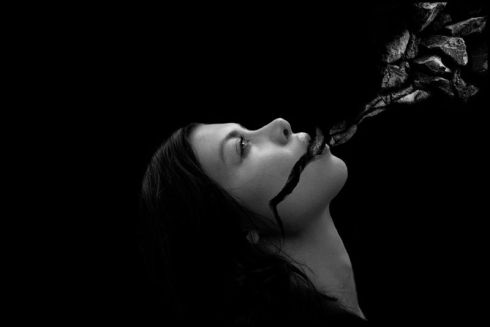
© Zoriah Miller. Model Laura Peterson's negative sandwiched with an image of devastation in Lebanon after the 34-Day Summer War.
CHANGING DIRECTION
Zoriah Miller has put aside his photojournalist work to pursue photocollage full time.
Zoriah’s statement declared photojournalism “rigid and stagnant … obsessed with rules, hiding behind “ethics” in order to produce nothing but formulaic, generic press photography.”
“What if you could create works of art that would not only stun people visually, but also educate people about a subject that they may otherwise ignore or find too depressing to pay attention to?” asks Zoriah.
Zoriah explains that he has been “shooting models and celebrities to work on creating composite images of beauty, sex and fame mixed with conflict, crisis and disasters.”
Zoriah and all models and celebrities involved in the project donated their time and the proceeds from the project will benefit refugees of conflict.
HOW TO POSITION THE WORK?
Judging by the example offered above the composite results will be incongruous mixtures of elements. Seemingly, Zoriah has traded his prior claims toward humanitarianism for the language of Dada.
Zoriah’s position is conflicted. The way in which he suggests putting images together is antagonistic, which is fine if you’re willing to argue away meaning as many agitators do, but Zoriah is trying to bring about attention to the issues surrounding the images of death which he then obscures with images of sex appeal. Do you see his problem?
Anyone want to have a stab at throwing these two images together on photoshop?*
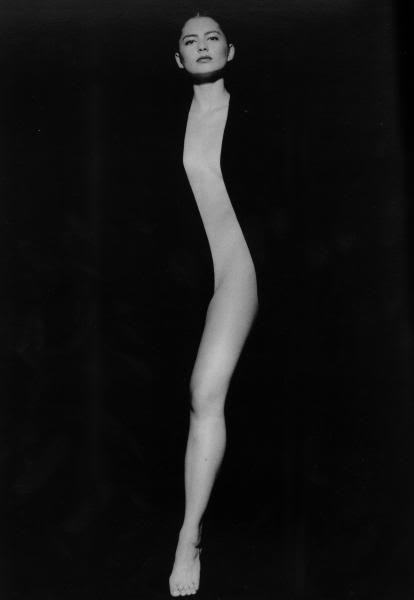
© Tono Stano, 'Sense'

© Yannis Behrakis/Reuters. A Palestinian worker repairs a bullet-ridden wall damaged during the three-week offensive Israel launched last December, at a factory in the northern Gaza Strip November 2, 2009.
If one experiments often enough fusing images together visually intriguing results will ensue. However, visual interest is cheap these days so it alone is not enough to prove an image ethical (I use that word knowingly) and/or effective.
I can see what Zoriah plans. It just doesn’t make a lot of sense.
QUICK THOUGHTS
1. Following the Haitian workshops debacle and in the face of unforgiving and acerbic name-calling, I think Zoriah argued his early corner quite well. To unleash this bizarre move is either total stupidity or unrelenting self-confidence. Either way, I would have liked to have heard and seen more works and reaction from Haiti and from his students before this.
2. Whether or not photojournalism is in a pickle – as Zoriah insists – the questionable cocktail of “sex and fame mixed with conflict, crisis and disasters” is, in my opinion, not the answer.
3. Likely, Zoriah’s future claims of being a journalist will be met only with derision.
4. Zoriah’s efforts at a thanaphilic fashion photography are not without precedent. Zoolander’s poor-taste DERELICTE fashion collection, a homeless aesthetic wrapped in the glitz and lights of the catwalk was great satire. So good it inspired Vivienne Westwood and the late Alexander McQueen. Etnies also had a good go at bad taste with its Hobo Ad campaign. I suppose Vice readers have been getting off on photographs of blood stained victims for years now?…
5. The greatest problem with this issue is that is inflates the importance of photography as an agent of change. No matter how much we recognise a need to raise attention about global issues, photography is not the sole answer, nor is photojournalism. The mode of photography Zoriah suggests is an unholy marriage. Who is the audience for this hybrid approach? What does he expect audience reactions to be? It would seem to me that consumers of images are turned on and off by visual cues. It is very easy to hook them with slick tried-and-tested commercial cliches. It is one thing grabbing a viewers attention for a second or two, it is another mutating that into a long and complex engagement with the real issues.
6. As offensive as this manouver may be to some folk, it isn’t the first time (and won’t be the last) a photographer oversteps logic and accepted practice with great hopes to change the cultural landscape.
7. I suspect there’s a reason why the worlds of fashion and photojournalism are distinctly separate. I can also think of many other more subtle ways in which art and marketing has been used as part of photojournalist careerism.
8. Given the consumer climate in America it is not unlikely that Zoriah will succeed in raising substantial funds. Ultimately, it will become an issue of the project’s branding and delivery.
9. If all else fails, it’s a good start for an Onion feature, right?
What do you make of all this? The “Leave a comment” button is at the top of the post.
*NB. Zoriah is using Negative Sandwiching
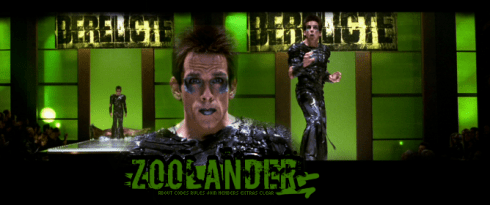
Derek Zoolander launches the DERELICTE collection. Image source: http://www.uninvitedgrace.com/zoolander/
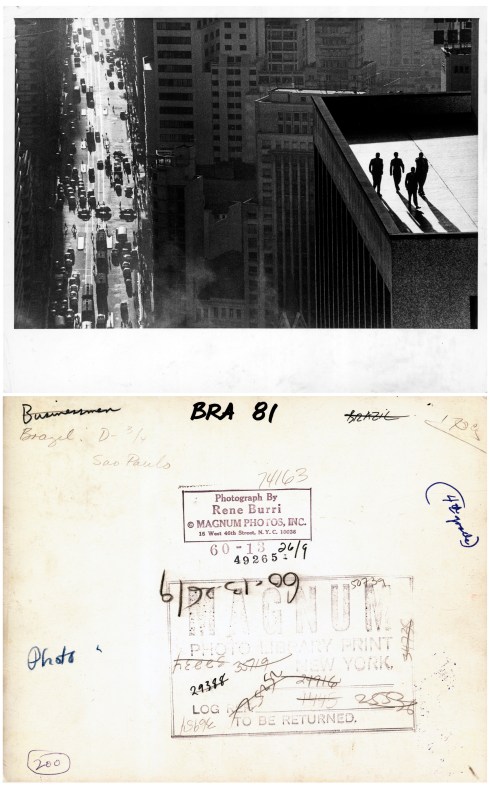
© Rene Burri/Magnum Photos. Brazil. Sao Paulo. 1960 / Back of print.
I spent last week on the phone to Mark Lubell, managing director of Magnum Photos; David Coleman, curator of photography at the Harry Ransom Center; and Eli Reed, photographer, Magnum member and UT professor.
The upshot was The Story Behind the Legendary Magnum Archive Sale, an article over on Wired’s Raw File blog.
There’s a couple of great quotes, my favourite is this from Coleman, “The boxes are marked with three-initial codes. I haven’t quite broken the codes that correspond to all the photographers. Robert Capa is CAR but then also BOB, which is funny. Bob.”
It was a story I really wanted to report on because I do think this is an astounding “incentivized” outcome for all involved. Read the article for details.
I do still wonder what will happen in 2015, though?
PART THREE IN A SERIES OF POSTS DISCUSSING PHOTOGRAPHERS’ ACTIONS AND RESPONSES TO THE KILLING OF FABIENNE CHERISMA IN PORT-AU-PRINCE, HAITI ON THE 19TH JANUARY 2010.
Michael Mullady just gave an interview to CALIBER SF, the second half of which reflects upon his recent experience in Haiti.
The image atop the interview is of Fabienne Cherisma, the 15 year old girl shot dead by police in Port-au-Prince. I have talked about the circumstances and the photographing of her death here and here before.
In addition to Garcia-Rawlins, Grarup and Laban-Mattei, I did not know that Mullady had also followed her corpse down the street.
Warning: The image is graphic. It is so close in. I should’ve offered the same caveat in my earlier posts. The more I deconstruct the images of – and pass on information surrounding Fabienne’s death – the more I feel like an intruder into a scene that should never have been.
WORDS
Read Mullady’s interview
Mullady talks generally about his career and then moves on to talk frankly about why he went to Haiti (last minute), how he wasn’t prepared for it, and how he now has a commitment to telling the stories of Haitians in the “immediate future”. He offers observations on the social/security fabric of Port-au-Prince.
On Fabienne:
“One day while covering the situation, a young girl was shot just a few feet from where I was standing. People had jumped onto a collapsed building and were running over roofs to get inside stores were merchandise was buried. It was a split decision, but I decided to follow the people to get more intimate images. Putting myself into that situation was possibly something I should have thought more about. In the moment, getting the photograph was all I was thinking about, not my life. That bullet could have been in my head. It was that serious. The cops were not looking at who was in the crowd, they were just shooting. To think I could have lost my life in an instant is terrifying. That day I realized the dangers of working in hostile situations as a journalist and that any day could be your last. When I saw that girl laying on the ground and the agony on her families face, I thought about my own family and the agony I put them through every time I leave the country to work. I never want my parents to have to go through losing there only son. That situation impacted me very deeply and I have yet to speak to anyone in detail about it, you guys are the first. I will share one of my images from that day with you guys.”
On Jim Nachtwey?!:
“I always admired James Nachtwey. Believe it or not, I actually got to meet him in Haiti. It was surreal to look over one-day and see him working next to me. Wow. I couldn’t believe it was really him. Everything I had dreamed about and strived towards became real in that moment. He was no longer a golden god in my eyes but a colleague, working to illustrate the same situation I was.”
On the day-to-day situation:
“The way I see things in Haiti is very different then I imagine you guys to see it through the news. Aid is here, but there are so many people in need and not everyone is receiving proper attention. Things have definitely positively progressed, but it’s going to take more time to help everyone in need.”
“Haiti is plagued by corruption. I have witnessed it first-hand, police stealing aid supplies and keeping them for themselves or selling them to wealthy people. This type of thing is a reality in Haiti. I’ve seen it on many occasions.”
“Before the earthquake, Haiti was in a bad situation so after this I fear for their future. Many Haitians whom I’ve spoken with express they want to become and American colony, such as Puerto Rico. Being an American, it’s been difficult to answer those questions for people and even more difficult knowing that if I told them what I really thought, it would not be what they wanted to hear.”
CLOSING THOUGHTS
Mullady’s candour is to be acknowledged. He could do to turn-down the Nachtwey-worship, though.
After reading the article and seeing the picture, however, I cannot shake his earlier quote:
“Many people believe photojournalists to not be artists and consider other genres of photography to be “art.” What I strive to do is bleed these lines. First and foremost, I would consider myself an artist, a visual artist whose subject matter is humanity. I live for light, obsess over sophisticated compositions and spend as much time as needed to make the exact frame I’m envisioning. A large distinction is that I intend to make images for the world to see, via publications, not images just to hang on a wall.”
Is to “bleed the lines” an incontestable perspective on one’s photojournalism? What happens when one is framing a composition of a murdered teenager? Has this perspective been more common than we’d like to acknowledge in recent images of Haiti?
– – –
ALSO IN THE ‘PHOTOGRAPHING FABIENNE’ SERIES
Part One: Fabienne Cherisma (Initial inquiries, Jan Grarup, Olivier Laban Mattei)
Part Two: More on Fabienne Cherisma (Carlos Garcia Rawlins)
Part Four: Yet more on Fabienne Cherisma (Linsmier, Nathan Weber)
Part Five: Interview with Edward Linsmier
Part Six: Interview with Jan Grarup
Part Seven: Interview with Paul Hansen
Part Eight: Interview with Michael Winiarski
Part Nine: Interview with Nathan Weber
Part Ten: Interview with James Oatway
Part Eleven: Interview with Nick Kozak
Part Twelve: Two Months On (Winiarski/Hansen)
Reporter Rory Carroll Clarifies Some Details
Part Fourteen: Interview with Alon Skuy
Part Fifteen: Conclusions
PART TWO IN A SERIES OF POSTS DISCUSSING PHOTOGRAPHERS’ ACTIONS AND RESPONSES TO THE KILLING OF FABIENNE CHERISMA IN PORT-AU-PRINCE, HAITI ON THE 19TH JANUARY 2010.
Following up on last months post about Fabienne Cherisma’s murder, it is apt to note Natasha Elkington’s Reuters Photographers blog post.
Amidst a very serious opinion piece about the hardships of childhood in Haiti and Kenya, Elkington includes a comment from the photographer of the renowned image of Fabienne Cherisma.
I spoke to the Reuters photographer in Haiti, Carlos Garcia Rawlins, who took the pictures of Fabianne to find out who shot her and why. He had no answers. By the time he got there she was already dead. She could have been shot by the police or armed security guards hired to protect property, he said. Witnesses said they didn’t know if she was targeted or hit by a stray bullet when police fired into the air to disperse a hungry mob.
What Rawlins did say is that people around her continued looting and would only stop for a moment to look at her body. “I couldn’t believe the indifference of the people around her,” he said.
Which is a different response to that of Jan Grarup.
– – –
ALSO IN THE ‘PHOTOGRAPHING FABIENNE’ SERIES
Part One: Fabienne Cherisma (Initial inquiries, Jan Grarup, Olivier Laban Mattei)
Part Three: Furthermore on Fabienne Cherisma (Michael Mullady)
Part Four: Yet more on Fabienne Cherisma (Linsmier, Nathan Weber)
Part Five: Interview with Edward Linsmier
Part Six: Interview with Jan Grarup
Part Seven: Interview with Paul Hansen
Part Eight: Interview with Michael Winiarski
Part Nine: Interview with Nathan Weber
Part Ten: Interview with James Oatway
Part Eleven: Interview with Nick Kozak
Part Twelve: Two Months On (Winiarski/Hansen)
Reporter Rory Carroll Clarifies Some Details
Part Fourteen: Interview with Alon Skuy
Part Fifteen: Conclusions

 Prison Photography