
You are currently browsing the category archive for the ‘Photojournalism’ category.

Greg Kahn documented Douglas Bolden, 52, following his release. Bolden lives in Fort Myers Florida, cares for four children and at the time of the photo-essay was struggling to find work.
I have featured stories on the difficulties and shock of reentry into society before – in one case with an elderly man following a 50 year sentence and in the other a wrongfully-convicted, consequently exonerated man.
I’ve gotten to know Adam Westbrook‘s work through mutual online friends. I signed up for his Twitter feed about the same time I did for the RSS feed on John Hirst’s Jailhouselawyer’s Blog.
John Hirst served 35 years for murder and now writes and advocates for prisoners rights. This year he has contributed at the Guardian.
It’s good to see these two folk collaborate.


Some of you might know that I volunteer for Books to Prisoners. Our book donations fall into a few categories: the majority go on the stacks for future dispatch to prisoners; other books not suitable/requested in prisons go to the bargain bins (25c-$1) at Left Bank Books; and good quality titles we sell online (I think?) for the $5 or $10 we anticipate. This third scenario crops up infrequently.
All monies raised from book-sales goes toward postage … and it is postage that accounts for most of BTP expenditure.
Last night, I was sorting some old donations – the usual suspects were there (Alice Walker, Louis L’Amour, John Le Carre, James Patterson) as were the much-needed non-fiction (Spanish dictionaries, parenting books, American history titles, etc.)
I did not expect to come across an original edition fine art photography book. I put Images a la Sauvette, Photographies par Henri Cartier Bresson aside while I sorted the thrillers from the biographies from the media studies text books.
At the end of the night I picked Images a la Sauvette up again. It was obviously too large and too heavy to go on the stacks. During my induction, I remember high end monographs were mentioned specifically as candidates for sale rather than dispatch. I new this was a special book, but I didn’t realise it was Cartier-Bresson’s foundational work, fully illustrating his ‘Decisive Moment’ philosophy.
The book is beautiful. Published by Editions Verve, Paris in 1952. The cover was designed by Matisse purposefully for the book. There are 126 pages of full-sized (37 x 27.5 cm) black-and-white gravure reproductions. The cover is strong, the spine a little discoloured. The pages are in fine fettle. The pages are bound to one another tightly but as a group have come away from the spine. Still, gorgeous.
I instantly thought it might be worth more than your average book – I hoped maybe $100, perhaps even $200. That amount would pay for a fair whack of postage, right? A few hundred books, right?
After getting home, I checked out the specifics. The proceeds from the sale of this book are to pay for postage on thousands rather than hundreds of books. Depending on which source you credit, make allowances for the condition of this copy and factor in the state of the book market, it could be worth anything between $1,000 and $3,200.
Antiqbook pegs it at $1,053; AbeBooks start it at $1,260 running it up to $7,700 (for what I guess is a pristine copy); Franklin Books values it at just shy of three grand and Bauman Books pushes it a little further to $3,200. In 2007, PhotoEye auctioned a copy for $2,250.
Books to Prisoners has never sold a book of such high value before so we’re a little stumped. I guess we’ll get a local dealer to stick a valuation on it and then carefully search out buyers. We’ll likely use AbeBooks. I’ll let you know in due course. If you have any advice or interest, please drop me a line.
In the mean time, salivate over these images:


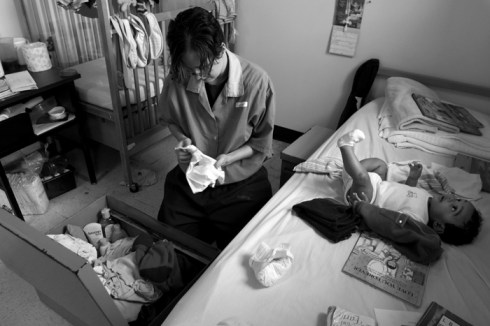
Jessica changes Kyree inside the 12-by-6-foot cell they share at the Ohio Reformatory for Women. The inmate mothers have special privileges the other inmates don’t have like leaving their cell at night to warm a bottle and a special outdoor play area.
I while back I posted a nod to Angela Shoemaker and her work at the Prison Nursery at Ohio Reformatory for Women, Marysville, OH.
Since then, Angela has been busy with her multimedia work on families and the recession, updating her website theme & images and securing a Fulbright Grant to photograph Muslim youth in the Netherlands.
Check out Angela’s series about mothers and babies in prison. She has provided us with good background information to the program.
The stand out stat for me was that only 16 of the 138 women who have passed through this program have re-offended which is good for them and very good for us as a society.
Angela also teamed with Dustin Franz on the multimedia piece Hope is on the Horizon.

A Developing Story is a new joint venture by Johnny Bennett, Phil Maguire and Benjamin Chesterton of duckrabbit.
In an email a few months ago, Ben said to me his interest lies in “getting under the skin of NGOs” and have them realise that they can deliver their stories and campaigns in far more effective ways. A Developing Story wants the stories told in Government & NGO international development campaigns to outlast the short term objectives of said campaigns.
A Developing Story proposes that the media of these campaigns is deposited in a common silo, accessible by all (usually under a Creative Commons license) so stories – once created – can tell themselves infinitum.
Given the primacy of Creative Commons and open-source content, Matt and Scott at DVAfoto needed clarification on A Developing Story‘s impact on the photographer (which was provided). I have fewer worries as I feel this venture is aimed at transforming media sharing practices among government funded and NGO initiatives rather than another pressure on the distribution and remuneration of individuals’ works.
I would anticipate that the payments made to photographers and journalists by media campaign management will continue and that photographers will take on assignments in the knowledge that their work can be used repeatedly for non-profit purposes.
That said, A Developing Story is very open to individual contributions. This is the most relaxed approach to collaboration I’ve witnessed!
So, as Ben asked, “Can You Help?”

Past and present ruminations about what is and isn’t a photograph have been a source of frustration for me. For one, people can draw whatever lines they wish to determine the point at which manipulation tricks out a photograph and thus qualifies it as photo-illustration. And for another, as Errol Morris keeps banging on about, ALL photography is lies (and manipulation).
These debates are not about truth. Interventions – power relations, habit, photographic custom, complicity among subjects, props, political agendas (and framing), cropping, tweaking of exposure levels before and after development, digital alterations – mean that photography can never be, will never be truthful.
People forget that often it is the ingenious tricks that have spurred the largest wonder among viewing public – think Oscar Rejlander’s Two Ways of Life, Spirit Photography and – in a different sense – Ansel Adams’ Zone System.
It is therefore, with some relief that an artist like Azzarella comes along using photo-manipulation as the tactic and purpose for his work.
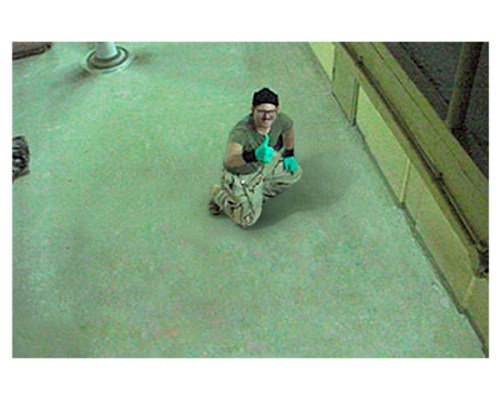

Last week, I questioned Anton Kratochvil’s Homage to Abu Ghraib, mainly because I think it makes little contribution to the discourse on the political aesthetics of Abu Ghraib. The blurry references to torture in Kratochvil’s images are in response only to a personal, conscious and willing point of view. I understand that Kratochvil’s work was an exercise in self-therapy but that shouldn’t stop me comparing it to Azzarella’s broader concerns about more general and unconscious reactions to well-circulated images.
If I w re to wr t th s sent nce wi h lette s m ss ng, you can still read it. The human brain is a wonderful instrument drawing on past experience to quickly filter out the non-possibilities. Just as the brain instantaneously deciphers gaps in text so it does with gaps in images.
With every passing hour the Spectacle suffuses itself further. It isn’t so much us reading images but images reading us. Our involuntary responses to images are predictable, predicted, precoded. The redacted action of violence in Azzarella’s pictures plays second fiddle to the original image, for it is the original image we drooled over and devoured.
The hooded detainee, dead student, wailing child or falling soldier needn’t even be present; our internal, emotional feedback spun by these images will forever be the same. We fill in the gaps and short circuit to prescribed disgust, sadness and politics, thus confirming our prevailing bias.
Azzarella’s works expose the fraud in us all … and our cheapened, robotic response to image.

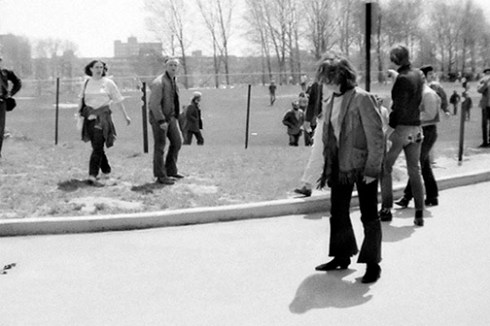
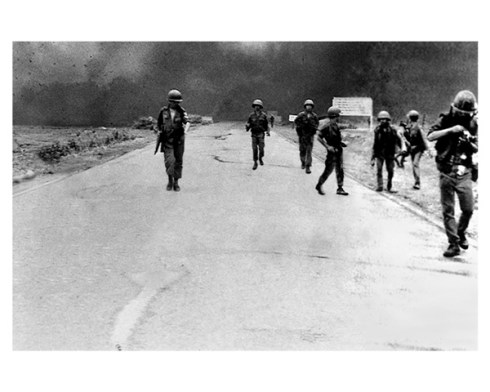
ALL IMAGES © JOSH AZZARELLA. FROM TOP TO BOTTOM: UNTITLED #13 (AHSF); UNTITLED (SSG FREDERICK); UNTITLED #24 (GREEN GLOVES); UNTITLED #35 (CAFETERIA); UNTITLED #39 (265); UNTITLED #20 TRANG BANG; UNTITLED #43 (PAR115311).

Too Much Chocolate
When Jake Stangel put out a call to interview Damon Winter for Too Much Chocolate I didn’t hesitate. How often do you get to bend the ear of a Pulitzer Prize winning photographer?
Jake assured me that Damon was – is – “a super-nice guy” as well. I might argue that Damon is too nice; he carried, without complaint, a sinus-busting cold to deliver the interview.
Damon and I spoke about his assignments in Dallas, L.A. and New York, the Obama campaign coverage, making portraits, Dan Winters, Irving Penn and Bruce Gilden. Read the full interview here.
_____________________________________________________________
Angola Rodeo
Not without my own agenda, I also asked Damon about his experience down at the Angola Prison Rodeo:
PP: Why were you there?
DW: I had gone out for two trips. It was when I worked at the Dallas Morning News. The way I pitched it was that the prison was expanding the program to launch a spring rodeo. I wanted any excuse I could get to go down there and photograph. It sounded absolutely incredible.
DW: And the paper ended up not being that interested. They may have run a small little blurb about it, but I did it for my own interest. It was fascinating – a completely wild situation. Most of these guys came from the cities. Some had never even seen a cow let alone roped a horse.

PP: Describe the atmosphere.
DW: The closest thing to modern day gladiators – something you’d see in a Roman Coliseum. The crowd is chanting for blood, they want to see a violent spectacle where prison inmates are the subjects. It’s the same reason people go to see a horror movie or stare at a wreck on the highway. It is a very strange situation but they want to see blood.
PP: Do you think it helpful to the local community?
DW: There is no interaction between public and inmates. The public is there to observe and the inmates are there to entertain. The benefit the inmates gain is at a level very specific to their situation. They risk injury being in the ring with massive bulls, and their prize is something I think anyone in the free world would laugh at, you know? Maybe a couple hundred bucks. But it is substantial in their environment.
It speaks to the bleak situation that those guys are in that this would be enticing – to risk bodily harm for a couple of hundred dollars.
I don’t know how constructive it is for relations between prison and non-prison populations.
PP: Which is unusual because in any other state across the country, there is no interaction between the public and the incarcerated population.
DW: What’s your feeling?
PP: I think it builds a division at a local level, but it also feeds a national view that excludes the realities of prisons. The inmates are put out there to be observed, photographed and consumed. Such a presentation is not unpalatable to the American public. To the contrary, the public feels as though it gains from it. I think here unexamined (and abusive) interactions can be confused with relationships.
I think the wasteful and very boring reality of prisons in America is not going to make it into newspapers or media, but the rodeo does. It skews perception. I think the rodeo is problematic.
DW: I felt the event was dehumanizing. It was done in a manner so that the inmates are reduced to the level of the beasts they are competing against. It seems the field has been leveled between animals and inmates and the feeling that you get from that is that they themselves are like animals. They are not seen terribly differently from the way that the animals are seen.
PP: I am not sure that that sort of spectacle would take place outside of Louisiana, certainly outside the South. Granted, Angola’s warden Burl Cain jumps at the chance to get the cameras in at any opportunity.
DW: Yes, I saw The Farm, a documentary filmed at Angola.
PP: I think Cain’s administration paired with the history of the event creates a spectacle at the rodeo that goes unexamined.
PP: Cameras are common at Angola; documentary shorts on the football team and photo essays on the hospice. It is a complex that has 92% of its population.
DW: You should look at Mona Reeder’s work. She works at the Dallas Morning News. I think it was called The Bottom Line and she turned the stats into photo essays and one of the stats was the number of prisoners in juvenile facilities. She got some pretty good access. She received a R.F. Kennedy Award.
PP: I certainly will. Thanks Damon.
DW: Thank you.
_____________________________________________________________
Below are three of Damon’s photographs from Afghanistan which stopped me in my tracks. Unfortunately, I discovered them after the interview so didn’t get Damon’s take on them.

The images of the boys really affected me. We see so many images of bearded men, U.S. Marines in the dirt, explosions, women in burqas, etc, but it is the children of Afghanistan who will carry the violent legacy for the longest. What pictures reflect that fact?
It is an impossible task of any image to near ‘truth’ or reality, but these two pictures get very close to the sad reality of conflict and the impressionability of youth.


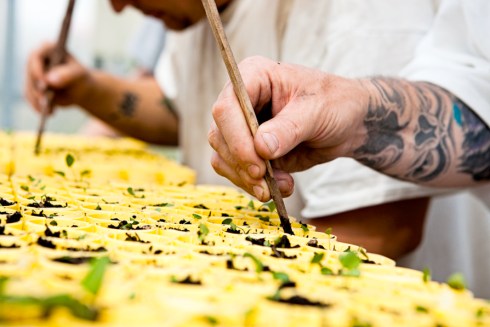
Benjamin Drummond and Sara Joy Steele have been in the news recently for their Facing Climate Change initiative. They were featured by PDN as photographers who cared and secured a $10,000 Grant4Change.
I was super happy then, to see them diversify and change focus from massive global issues to the environmental issues of our region here in Washington State.
They teamed up with Dr. Nalini Nadkarni, Evergreen State College and The Sustainable Prisons Project (which I have talked about before) to produce a 7-minute multimedia piece with a gorgeous mix of inmate, staff, student and academic volunteer voices. They also deliver the goods for the stills gallery.
__________________________________________________________
The Sustainable Prison Project has proved that environmental justice, social justice and fiscal conservatism can be delivered all in the same package. I teach in a prison and the resolve to try new programs and learn new skills is not something left wanting.
Drummond and Joy Steele’s documents make it clear more than ever that prisons often are not – and really never should be – the intimidating “neverwheres” that media (often TV and film) depict them as.

 Prison Photography