
You are currently browsing the category archive for the ‘Photojournalism’ category.

© Andrew Jackson. Black Child, Gulugetu, Cape Town, 2006
I have no answers. I have just asked for them. We will get answers but they may be outnumbered by more questions.
I have no answers. And yet, two things struck me this week. They both go to the heart of the necessary cynicism AND optimism toward the photojournalist’s craft. These two contributions are contrary in tone and yet I can agree with them both.
I have no answers.
ANDREW JACKSON
Firstly, from Andrew Jackson and his ‘WrittenByLight‘ blog.
A 4OD episode of the Art Show entitled If asked a number of contemporary poets to produce modern (re)workings of Kipling’s famous poem If. Jackson was compelled to create his own and “perhaps speak of [his] own misgivings of documentary photography”.
FINBARR O’REILLY
In answering such doubts, Finbarr O’Reilly on the Reuters blog gives an honest and balanced appraisal of the global coverage (and his part in it) of conflict in the Democratic Republic of Congo.
Even as Democratic Republic of Congo’s war-related death toll rose above a staggering five million, making it the most lethal conflict since World War Two, the war in Central Africa remained largely unnoticed and under-reported.
and
The media could enjoy coffee and croissants for breakfast, drive up to the front-line fighting or the squalid camps home to hundreds of thousands of displaced Congolese, then return to file stories and pictures in time for dinner and a night at the bar.
and
There were so many photographers in Congo last year that there’s a running joke at photojournalism festivals and competitions this year about viewers and judges having to sit through “yet another picture story from Congo.”
and
But at least Congo, that beautiful, terrible place, became a highly visible story. It’s easy to be cynical about the idea of a devastating conflict suddenly becoming a trendy cause, but the important thing is that people are finally paying attention to one of the world’s worst catastrophes. U.S. President Barack Obama referred to Congo’s troubles in speeches, Secretary of State Hilary Clinton visited Goma in August and said she was moved by the plight of Congo’s women, many of whom are victims of extreme sexual violence and mass rape.
The temperance of O’Reilly’s opinion – in spite of his closeness to the events – is impressive.
Maybe the foil against the consumption of images of distant plight is to insist that the photographer’s voice and experience is always carried with them. Better still, the voice of those depicted is carried with the images. That way there can be no doubt of the actual conditions in which the images were created.
Finbarr O’Reilly has spent many years on stories in DRC, including eight specific photo series relating to aspects of Congolese experience.

© Finbarr O'Reilly / Reuters. From the series 'Congo Hair'
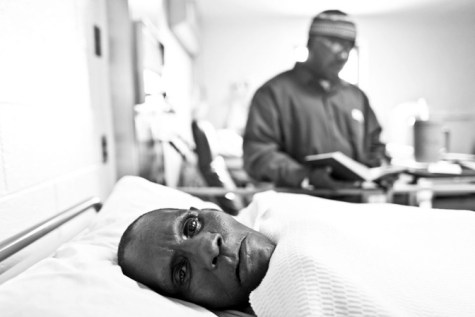
© Fred Conrad/New York Times
3,000 inmates die of natural causes in US prisons each year. If they are fortunate, they will do so in a prison hospice. The New York Times’ John Leland reports on this growing sector of corrections provision. Fred R. Conrad provides the photography.
The story focuses on the relationships between the dying men and the inmate volunteers who tend to their needs in the final days, weeks, months.
Coxsackie Correctional Facility, NY, featured in the NYT audio slideshow is one of 75 prisons across the nation that has developed hospice programs for geriatric and dying inmates.
___________________________________________________________
Related: Lori Waselchuk has won the admiration of the photographic community for her series Grace Before Dying which surveys the prison hospice at Angola, Louisiana. More on Waselchuk to come.
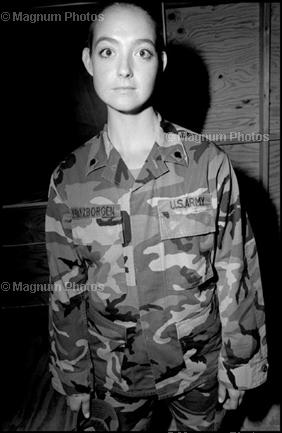

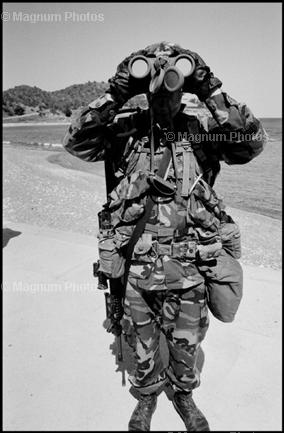

Go to Magnum and search “Gilden Guantanamo”. I’m not sure Gilden’s technique could really flourish at the illegal prison but he had a good go.
(From top left, clockwise) 1. Major-General Geoffrey Miller, Commander of Joint Task Force at Guantanamo Bay, is in charge of the 680 suspected enemy combatants in the camp. 2. Specialist Lily Allison Fitzborgen, a reservist who wants to become a police officer, is one of the guards who watches over the detainees. 3. Surveillance at Camp America. 4. Sergeant guard at a hospital for “enemy combatant” detainees. His name is blacked out so the detainees can’t see it. (Below) Before a prayer breakfast at Camp America.
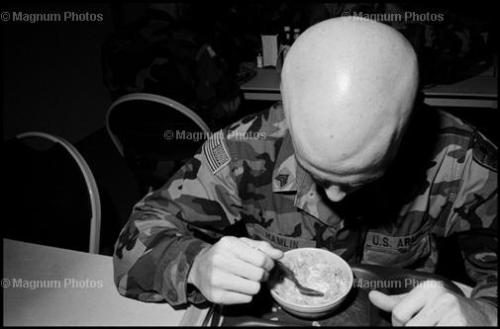
All photos © Bruce Gilden/Magnum
“The statistics are embarrassing to the state [of Texas]”
Mona Reeder, Poynter Online, May. 20, 2008

41% of children in the juvenile justice system have serious mental health problems. Joseph, 17, got a little bit of sunshine in the yard outside the security unit at Marlin. The facility, which once housed adult prisoners in the Texas Department of Criminal Justice.
Damon Winter recommended the work of Mona Reeder, a former colleague of his at The Dallas Morning News.
Reeder won the ‘Investigative Issue Picture Story’ at the 2008 Best of Photojournalism Awards for The Bottom Line. Through pictures, Reeder explored Texas’ poor rankings in a number of categories including health care, executions, mental health statistics, juvenile incarceration, voter apathy, poverty and environmental protection.
This is not solely a photography project about prisons, and thereby lies its strength. Reeder successfully links the stories of numerous state institutions that are left wanting when put under close examination. It is truly a Texan story for Texan constituents. Reeder explains, “As I was wrapping up a project about homelessness in Dallas, a social worker who had helped me with contacts on the streets handed me a set of statistics issued by the state comptroller’s office ranking Texas with the other states in the U.S.”
Photojournalism was an effective medium for this breadth of information, “This project represented a well-researched, in-depth piece about serious issues affecting the entire state of Texas, and it was presented in an innovative manner that even the busiest person could get through and absorb in a relatively short amount of time” states Reeder.
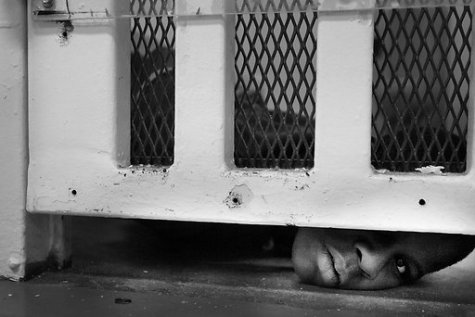
60% of children under the Texas juvenile prison system come from low-income homes. Texas spends more than twice as much per prisoner as per pupil. Laying on the floor, thirteen-year-old Drake Swist peers out from underneath the bars on his cell door in the security unit of the Marlin facility. Kids get their first glimpse of life in the Texas Youth Commission through the Orientation and Assessment facility in Marlin, Texas.
Mona Reeder has worked on numerous criminal justice issues in Texas, including death row stories and sex-offender rehabilitation.
As well as the BOP (2008), Reeder won a Robert F. Kennedy Award for The Bottom Line. She was interviewed by the Poynter Institute about the project and her approaches to photojournalism.
The Dallas Morning News gave The Bottom Line the full multimedia treatment with an impressive online package featuring eight slideshows of the stories of individuals wrapped up in the statistics. IT’S A MUST SEE.

Texas: First in capital punishment, second in the size of the income gap between rich and poor, and second for the number of people incarcerated. Behind every set of numbers is the possibility that yet another child will live a lesser existence. Does Texas not know what to do, or does it just not care? Texas has the most teen births and the most repeat teen births in the nation, earning a ranking of 50th in the U.S. Barely one day old, Jasmine Williams sleeps on her mother’s lap as they wait for the baby’s paternal grandmother to come and take custody of her. Her mother, Kimberly Williams, 15, is in TYC custody and correctional officers shackled her feet shortly after giving birth to her baby. Both of Jasmine’s parents were 15 when she was born.
“Curiosity was the initial spur. Surprise, shock and bewilderment soon took over. Rage propelled me along to the end.”
Jane Evelyn Atwood on photographing in women’s prisons.
This is the third and final installment in my series Women Behind Bars. The second part looked ta the writing of Vikki Law and the first looked at the journalism of Silja Talvi. It was Silja who recommended Jane Evelyn Atwood’s work.
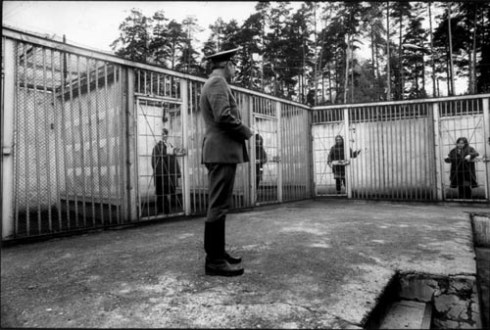
When discussing the work of a prison photographer, it is preferable to do so within the specifics of the region or nation they document. Prison Photography‘s key inquiry is how the photographer came to be in the restricted environment of a prison and these details differs from place to place. Such inquiry is complicated by Jane Evelyn Atwood‘s work because she visited over 40 prisons in twelve countries over a period of one decade. In some cases I know the location of a particular image and in others I don’t. I suggest you compensate for this by buying the book Too Much Time for yourself.
Above is a women’s penal colony in Perm, Russia. It holds over 1,000 women – the majority of who work forced hard labour. Here we see women who are in solitary confinement experiencing their yard privileges – half an hour in outside cages. Most women in the prison are there for assault, theft or lack of papers.
Below is a scene from a Czechoslovakian prison. The scars are not the result of genuine suicide attempts but of regular self-mutilation – a problem more common among female prison populations than male populations.

Another reason to pick up Atwood’s book would be that there isn’t much stuff out there on the web – and that which is is low resolution or small-size. You can see a small selection from Atwood’s Prison series at her website; small images at PoYI; and a really good selection of tear-sheets at Contact Press Images.
By far the best stuff on the web concerning Too Much Time is an Amnesty International site devoted to the project. It includes a powerful preface in which Atwood lays out her raison d’etre. Next Atwood provides a “world view” comparing the prison systems of France, Russia and the US (each a five minute audio). Then comes three specific photo-essays with audio (Motherhood, Vanessa’s Baby, The Shock Unit). Finally, Atwood provides six stories behind six photographs. The stories are many and the facts more astounding than the emotions.
While Atwood’s pictures present the many individual circumstances of the prisoners, Atwood has identified a common denominator; “Of the eighteen women I met in [my] first prison, all but one seemed to be incarcerated because of a man. They were doing time for something he had done, or for something they would never have done on their own.”
Atwood qualifies this, “One woman told me her husband forced to set the alarm to have sex with him three times a night. She endured it for years and finally killed the man that kept her hostage. Another woman’s husband was shot by her daughter after he had stabbed her in the arm as a “souvenir”, poured hot coffee on his wife’s head for not mixing his sugar, and urinated all over the living room after one of the children refused to come out the bathroom. The woman was serving time for “refusing to come to her husband’s aid.”

What is most impressive about Atwood’s work is that it predates photojournalism’s wider interest in prisons by a couple of decades. She had at first tried to gain entry into a French prison in the early eighties. Her failure is unsurprising given Jean Gaumy of Magnum was the very first photojournalist inside a French prison in 1976.
It is a scandal that the discussion over shackling women during labor and gynecological examination continues today. Atwood captured the brutality of it decades ago.

Atwood’s work veers consciously between two reality of the women’s situation – the environment and the body.
Many of her photos share a compositional austerity. The hard angles of institutions run according to ‘masculine mathematics’ (dictating sentencing and experience) are repeated. Atwood punctuates this stern reality with flourishes of femininity … and touch.

Some may think Atwood has over-reached herself with a global inquiry and I’d be sympathetic to the point if anyone else had come close to her commitment. Even considering each prison system in isolation, Atwood’s work can hold its own. Her work in Perm, Russia is particularly powerful as it orbits closely around the issue of uniform, identity and the complications it brought to bear directly on her documentary.
At the Amnesty site, Atwood brings up many interesting points of comparison. She identifies the US system as the most sterile with a legal mandate to treat female prisoners in the same manner as male prisoners. But she also says that if there is grievance or complaint to be settled, US prisoners have recourse to do so. Such allowances are not made in France.
On the other hand, children are excluded from all but a couple of US prisons. The security threat is cited as the reason: a child inside a prison is a constant vulnerable life and constant hostage target. The claim seems a little bogus when penal systems of other countries are brought into consideration.

Atwood was interviewed by Salon about the project. She has also worked on landmine victims and talked to Paris Voice about that. Here, she talks about Canon about her work in Haiti.

Jane Evelyn Atwood
Biography: Jane Evelyn Atwood was born in New York. She has lived in Paris since 1971. In 1976, with her first camera, Atwood began taking pictures of a group of street prostitutes in Paris. It was partly on the strength of these photographs that Atwood received the first W. Eugene Smith Award, in 1980, for another story she had just started work on: blind children. Prior to this, she had never published a photo.
In the ensuing years, Atwood has pursued a number of carefully chosen projects – among them an 18-month reportage of a Foreign Legion regiment, following the soldiers to Beirut and Chad; a four-and-a-half-month story on the first person with AIDS in France to allow himself to be photographed for publication (Atwood stayed with him until his death); and a four-year study of landmine victims that took her to Cambodia, Angola, Kosovo, Mozambique and Afghanistan.
Atwood is the author of six books. In addition, her work has been including the ‘A Day In The Life’ series. She has been exhibited worldwide in solo and group exhibitions. She has worked for LIFE Magazine, The New York Times Magazine, Stern, Géo, Paris Match, The Independent, The Telegraph, Libération, VSD, Marie-Claire and Elle. Atwood has worked on assignment for government ministries and international humanitarian organizations, including Doctors Without Borders, Handicap International and Action Against Hunger.
She has been awarded the Paris Match Grand Prix du Photojournalisme (1990), Hasselblad Foundation Grant (1994), Ernst Haas Award (1994), Leica’s Oskar Barnack Award (1997) and an Alfred Eisenstaedt Award (1998). In 2005, Atwood received the Charles Flint Kellogg Award in Arts and Letters from Bard College, joining a company of previous laureates including Edward Saïd, Isaac Bashevis Singer and E.L. Doctorow.

AP Photographer, Brennan Linsley has visited Guantanamo twelve times in the past four years. Why? “My goal is to come back from each trip with a couple of shots that will allow me to paint more of a picture of this place'” says Linsley.
A journalist’s visit to Guantanamo is a frustrating experience – newsmen have a constant escort on a preplanned itinerary and must read and follow the fifteen pages of ground rules provided by the US military.
To offset these limitations Linsley chose repeated visits as a a tactic. In an attempt to humanise the detainees, he has weaved a photo-essay in-spite of Guantanamo’s milieu which is counter to all notions of free speech, experience and objective fact-gathering.
The British Journal of Photography has a brief but interesting interview with Linsley about his project.
This sequence of interactions between a Chinese detainee and photographers (described by Linsley) exemplifies the minutiae with which the US military must control the flow of information out of Guantanamo.
Just to get the juices flowing, Linsley closes the interview with this position, “The Golden Age of photography has been over for a long time. It died somewhere between the Vietnam War and the Gulf War.”
Discuss.
_______________________________________________________________
BJP’s interview coincides with Linsley’s work showing at the 2009 Visa pour l’Image at Perpignan.
For more images and links on Guantanamo see Prison Photography‘s Directory of Visual Sources.

Cameron Todd Willingham in his cell on death row, in 1994. He insisted upon his innocence in the deaths of his children and refused an offer to plead guilty in return for a life sentence. © Ken Light.
Read the The New Yorker‘s article Trial by Fire about Cameron Todd Willingham, which asks, “Did Texas Execute an Innocent Man?”
Ken Light photographed Willingham fifteen years ago in his death row cell.
Willingham was accused of setting his house alight while his three children slept inside, tried for arson and murder, found guilty and sentenced to death. He always professed his innocence. Willingham was executed on February 17th, 2004. Before and since his execution, evidence supporting his conviction has been brought into question. Eye-witness testimonies conflicted and the fire forensics for the case are considered unreliable.
Recently, I spoke with Ken Light about his Texas Death Row.
The New Yorker only had one photographer to turn to for an image of the incarcerated Willingham. Without Texas Death Row (1994), we would have precious little photographic record of the lives and experiences of Texas’ institutions for the condemned.
“There is beauty and there is truth and most truth in this present world is ugly.”
Momena Jalil
“In the central jail of the capital Dhaka, it is unbearable to live there. It is impossible to document it, cameras are not allowed inside.”
Momena Jalil

The prisoners sit on the floor of the common cell; this special newly opened women prison has much space. But in the central jail in the capital Dhaka this same amount of space is packed with women and their children.
I received an email yesterday from Diederik Meijer, editor of The Black Snapper, an online magazine that presents each day the work of a new photographer. The works are selected by guest curators and grouped under a weekly (geographical) theme.
I was happy Meijer contacted me.
This week, The Black Snapper is focusing on photographers from Bangladesh. Following Andrew Biraj, they’ve featured Momena Jalil a photographer whose work I’ve pointed out before. Prison Photography and The Black Snapper share admiration for the Bangladesh photographic community and its numerous talents putting work out internationally.
Momena Jalil’s project is obscured however; her photographs are only half the story of sorry conditions in Bangladesh’s prisons.
These are the images she was allowed to take … and this is a newly operating jail. She was not granted access to the older sites of incarceration. The scenario is quite bizarre. Jalil speculates that, in 2007, this prison was hastily finished so as to house two prominent female political leaders. Not all the buildings, such as the male or juvenile blocks, in the compound were completed or in use at the time of Jalil’s visit. The prison was opened amidst a choreographed national media campaign.
Jalil refers to the women in their prison provided white shari with blue stripes as “angels without wings”. Jalil suggests that the crimes accused and evidence gathered are neither properly articulated or adequately qualified. Who are we to judge these women when the system that cages them exposes itself to grave question?
Take the time to read Jalil‘s involved and emotive response to the womens prison and be sure to follow the high standard of work presented by The Black Snapper.
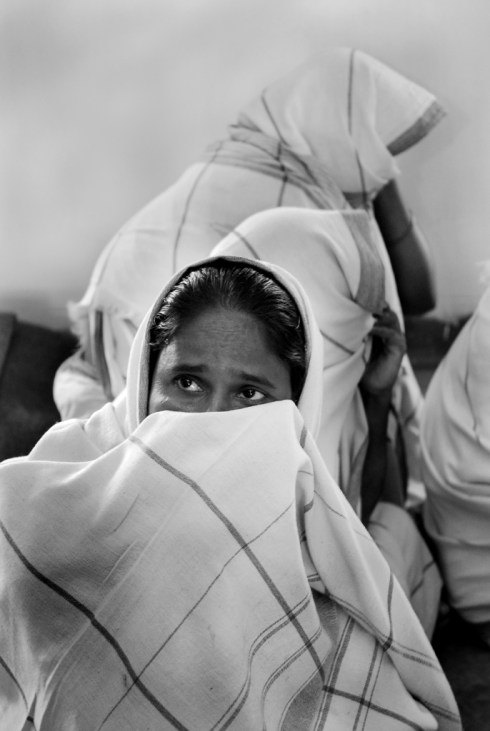
The eyes of Salma tell more than we can read or understand, perhaps there is complaint, plea, anguish, misplaced trust or betrayal? It is fact a she hides her lips but she kept her eyes open. It is sad we are illiterate to the language of eyes.
Photo & Captions: Momena Jalil

 Prison Photography